PCI Express 8.0: Powering AI, Cloud, and HPC with Transformative Interconnect Technology


Introduction
We are living through a data revolution that’s fundamentally changing how we design and build technology. From the neural networks that power tomorrow’s autonomous vehicles to the massive computational clusters that train the next generation AI models, one truth has become crystal clear: the bottleneck is not just about processing power anymore—it’s how fast we can move data between components.
Consider this: a single modern GPU can process terabytes of information per second, but if the interconnect can’t keep pace, that computational muscle goes waste. Meanwhile, automotive engineers are grappling with sensor arrays that generate more raw data than many enterprise servers, all the while demanding real-time processing for safety-critical decisions. In data centres, the race to deploy larger AI models has created an insatiable appetite for bandwidth that current infrastructure is struggling to satisfy.
This is where PCI Express 8.0 enters the picture—not just as another incremental upgrade, but as a fundamental leap forward in interconnect technology. By doubling data rates to an unprecedented 256 GT/s per lane, PCIe Gen8 promises to unlock new possibilities across industries, from enabling more sophisticated AI training workflows to supporting the complex, multi-sensor ecosystems that will define next-generation vehicles.
But speed alone is not enough. As we’ll explore, PCIe 8.0 represents a carefully engineered balance of raw performance, backward compatibility, and the signal integrity challenges that come with pushing data rates to unprecedented levels. This is where Siemens plays a crucial role in the ecosystem. Through our advanced PCIe verification IP solutions and comprehensive testing frameworks, Siemens is helping semiconductor companies and system designers ensure their PCIe 8.0 implementations meet the stringent reliability and performance requirements that the next-generation applications demand. Our verification technologies are instrumental in bridging the gap between theoretical specifications and real-world deployment and ensure that the promise of 1 TB/s bandwidth translates into reliable, production-ready systems.
Let’s dive into what makes this technology so transformative—and why robust verification, powered by solutions from Siemens, is essential for realizing the full potential of PCIe 8.0.
What is PCIe? Why PCIe Gen8 Represents a Critical Inflection Point?
If you have ever wondered what keeps the inside of a modern computer talking to itself and its peripherals at blistering speeds, the answer is almost certainly PCIe — Peripheral Component Interconnect Express.
It is the high-speed serial communication standard that connects your CPU to the rest of the world: GPUs, SSDs, network cards, FPGAs, and a growing constellation of specialized accelerators. First introduced in 2003 as a successor to the aging PCI and AGP buses, PCIe was designed from the ground-up to be fast, scalable, and future-ready. And over the past two decades, it has delivered on that promise — repeatedly.
Each generation doesn’t just bring faster speeds — it unlocks entirely new categories of applications that were previously bottlenecked by bandwidth. And with PCIe 8.0, we are standing at one of the most consequential inflection points in computing history.
- AI & Machine Learning: Modern AI workloads face a critical challenge that goes beyond raw computational power: the ability to efficiently move massive datasets between processing units, memory hierarchies, and storage systems. PCIe 8.0’s bandwidth capabilities enable more straightforward scaling approaches that allow, AI researchers to focus on model architecture rather than working around I/O constraints.
- Cloud & Data Centres: Computational storage devices and storage-class memory technologies require interconnects that can support both high-bandwidth data movement and low-latency command processing—capabilities that PCIe 8.0 is specifically designed to address.
- High-Performance Computing (HPC): Scientific computing applications—from climate modelling to pharmaceutical research—increasingly rely on heterogeneous computing architectures that combine CPUs, GPUs, and specialized accelerators. These systems require seamless data movement between diverse processing elements to maintain computational efficiency. PCIe 8.0 enables new HPC architectures where accelerators can be more tightly coupled, reducing the data movement overhead that currently limits many scientific applications.
- Future-Ready: Perhaps most importantly, PCIe 8.0 provides the infrastructure foundation for technologies that are still emerging. Quantum-classical hybrid computing systems, neuromorphic processors, and advanced sensor fusion platforms will all require interconnect capabilities that exceed current standards.
Advanced PCIe 8.0 Feature Support and Comprehensive Debug Capabilities
Siemens QuestaTM One Avery Verification IP is leading the industry with the verification solution for almost all protocols and their associated Compliance Testsuite (CTS) and checklists, that collectively are FIRST, FAST, EXPERT, and TRUSTED, as mentioned below:
- FIRST — solutions for leading edge
- FAST — native SV/UVM code, fast debug and support turnaround
- EXPERT — direct access to our Protocol Experts
- TRUSTED — finding bugs that other VIPs do not find
PCIe 8.0 draft 0.5 features that Avery PCIE VIP supports
- PIPE and Serial interface support
- All equalization Modes supported till 256 GT/s data rate (Gen8)
- Full Equalization
- Equalization Bypass
- No Equalization
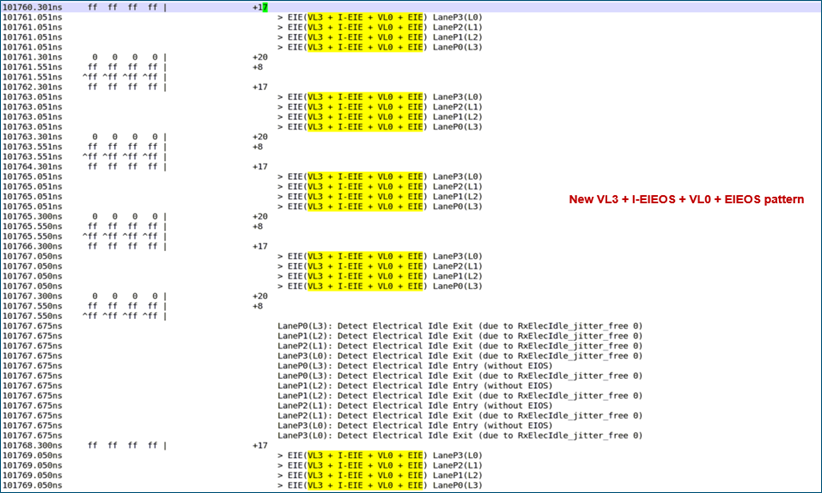
- EIEOSQ: VL3 + I-EIEOS +VL0+ EIEOS
- Dynamic link partition: 2×8 links at 256 GT/s
- Precoding support
- Loopback and Polling compliance Support
- Support of Optical retimer and 4 FRA retimers
- Security Stack: SPDM, IDE-KM, IDE, and TDISP
Key Benefits of Choosing Avery PCIe VIP
The Avery PCIe VIP provides the following key benefits:
- Class-based BFM and easy to integrate
- Random configuration capabilities
- Compliance Test Suites that include randomized tests
- 7000+ checklists items with 1400+ Compliance Tests
- Proven track record of finding Design IP bugs
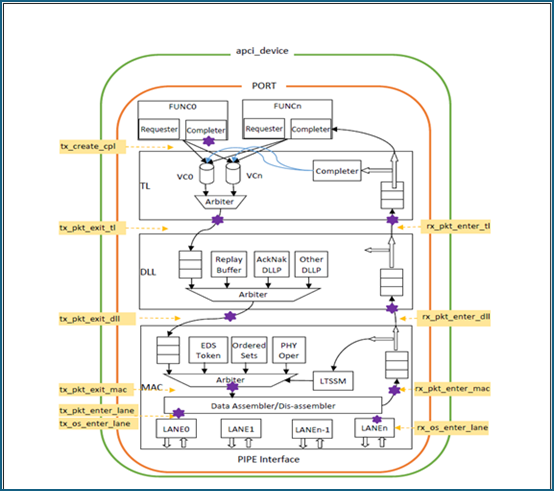
- Full stack Callbacks at TL, DL, PL layer, adding error injection capabilities
- Multiple trackers for each layer TL, DL and PL
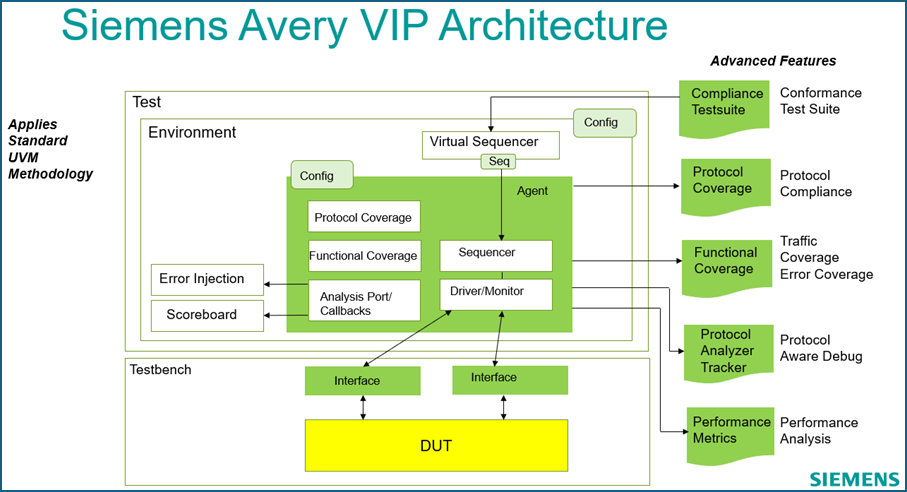
The following figure illustrates the Siemens Avery VIP architecture.
The following figure illustrates the callbacks.
The following figure shows the Gen8 EIEOSQ pattern.
Conclusion
As PCIe 8.0 sets new standards for interconnect performance, Siemens Questa One Avery Verification IP delivers a comprehensive toolset needed for comprehensive verification. Our advanced VIP solution combines full PCIe 8.0 feature support with intelligent debug capabilities that enables efficient verification of even the most complex designs. The powerful analysis and troubleshooting tools of Avery PCIe VIP help engineers quickly identify and resolve issues, ensuring robust system performance.
Trust Siemens QuestaTM One Avery VIP to provide the verification excellence required for your PCIe 8.0 designs.