Peekaboo! Uncover hidden structural dynamics using FBS Decoupling in Simcenter Testlab 2606
Have you ever seen a magician make an object disappear? It’s probably the oldest trick in the book, but as an NVH engineer I’ve often wished I could pull off the same illusion.
In structural dynamics testing for example, measuring Frequency Response Functions (FRFs) on a component that is mounted on a test rig returns the structural dynamics of the component plus the rig. What NVH engineers actually want is to make that test rig disappear, as if they were measuring the structural dynamics of the isolated component instead. For example, such FRF models can be coupled using Frequency-based Substructuring (FBS) to predict the NVH performance of virtual prototypes.
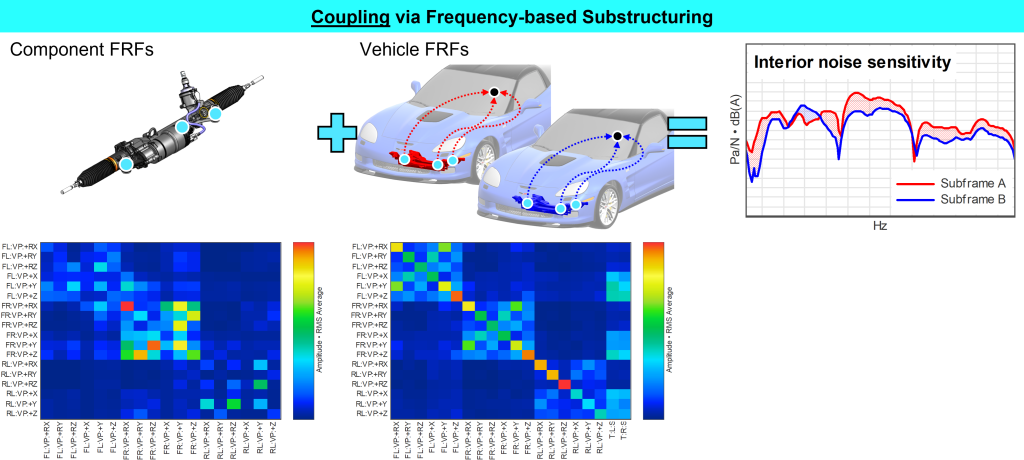
The challenge is that directly measuring realistic FRF models of isolated components is often difficult or even impossible in practice. Many components require specific boundary conditions that significantly change the component’s structural dynamics in operation. For example, compliant mounts may experience stiffening effects due to static preload from the vehicle’s weight and dynamic forces while driving. The only way to include the influence of such operational boundary conditions is to apply them with external hardware such as test rigs, fixtures or even entire vehicles during the FRF measurements. However, this also means that the measured FRFs will be polluted by the presence of the external hardware itself.
Is there a way to get the best of both worlds? In other words, is there a way to measure component FRFs as if the external hardware isn’t there, while keeping the influence of the operational boundary conditions? Why yes, there is!
With Simcenter Testlab release 2606, we are putting the power of the disappearing act into the hands of NVH engineers. Our latest release adds support for FBS Decoupling, an FRF-based technique to mathematically decouple a known structure from an assembly. FBS Decoupling enables the extraction of accurate and realistic component FRF models in relevant operational boundary conditions from test rig or vehicle FRF measurements. Best of all: this new functionality is fully available through our flexible token-based licensing concept!
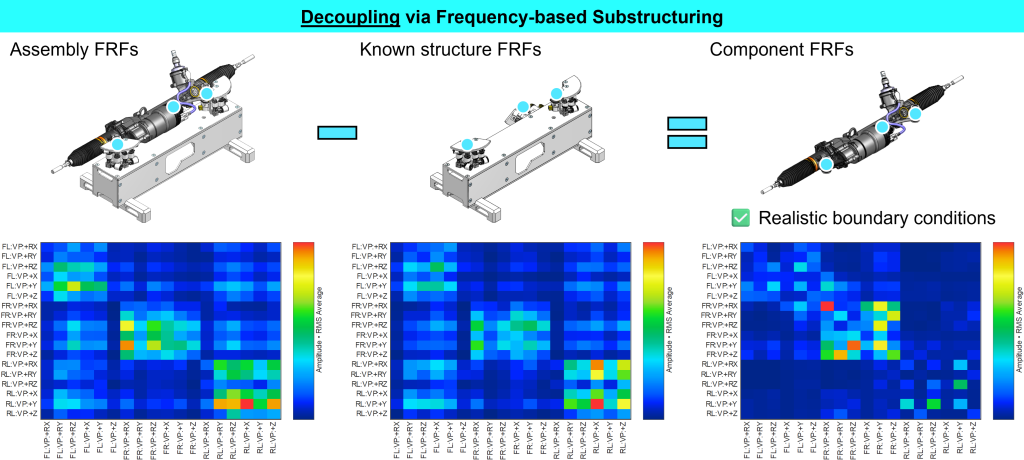
Are you curious how to apply FBS Decoupling for your use case? Read on for a step-by-step overview of the FBS Decoupling workflow and several application examples.
FBS Decoupling in Simcenter Testlab
The first step in FBS Decoupling is to measure two sets of FRFs: one for the assembly (AB) and one for the known structure (B), as shown in the figure below. The assembly FRFs are measured with the component (A) installed on the known structure while applying realistic operational boundary conditions. The component is then removed to measure the known structure FRFs. At minimum, the FRFs in both configurations should be acquired at the connection interface Degrees of Freedom (DOFs) of the component and known structure (c). Additional observation DOFs can optionally be added on the known structure (b) to improve the numerical conditioning of the calculations and on the component (a) to extend the resulting FRF model.

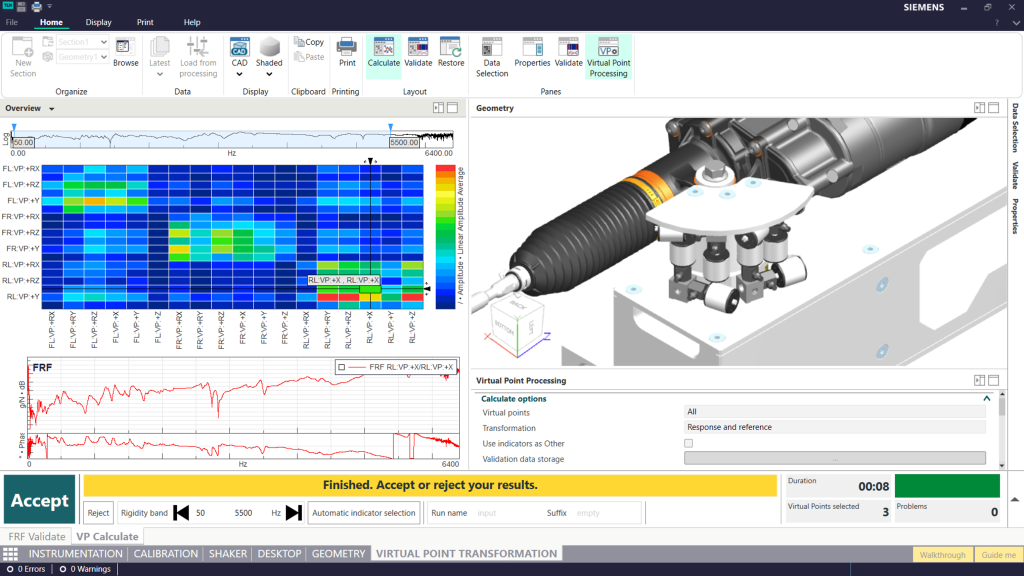
Simcenter Testlab provides modern workflows for both impact testing and shaker testing to acquire this FRF data accurately and efficiently. In addition, our workflows are seamlessly integrated with Virtual Point Transformation (VPT) to enable versatile interface characterization in up to 6 DOFs even in inaccessible locations.
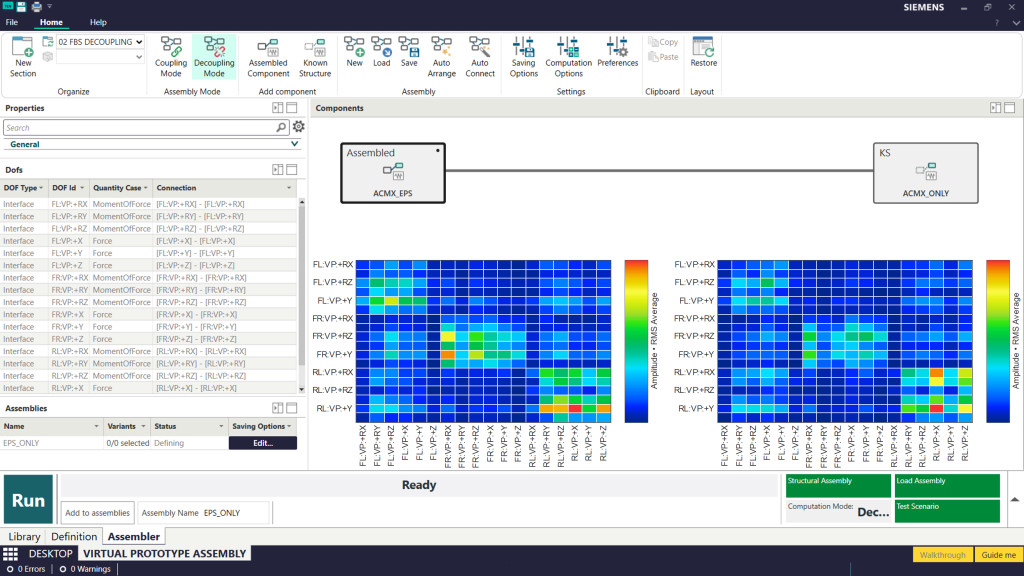
FBS Decoupling is then applied using Simcenter Testlab Virtual Prototype Assembly (VPA). The measured FRFs of each assembly and known structure are first published to a component library in a standardized format. The FBS Decoupling calculation can then be performed automatically by loading and connecting compatible assemblies and known structures from the component library. This workflow makes it easy to apply FBS Decoupling repeatedly and consistently, for example when reusing the same known structure for multiple component variants. Optionally, additional regularization strategies can be applied during the calculation to improve the numerical stability when the assembly FRFs are not very sensitive to the presence of the component compared to the known structure FRFs.
Application examples
Siemens has shown that FBS Decoupling is particularly useful for predicting structure-borne road noise using virtual prototypes12. Accurate and realistic component FRF models can be obtained in operational boundary conditions which are unsafe or even impossible to reproduce in isolation.
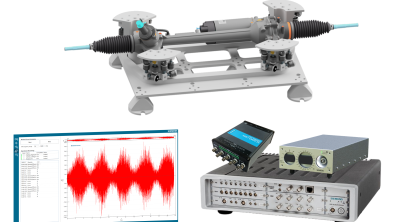
For example, FBS Decoupling has been applied to obtain suspension system FRFs from test rig measurements. The test rig was required for applying static preload (¼ vehicle weight) and slip motion in the dampers at low frequencies.

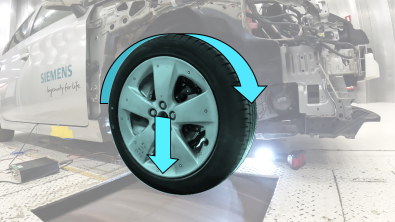
In the same context, FBS Decoupling has also been applied to obtain tire-wheel FRFs from vehicle measurements on a chassis dyno. The vehicle was required for applying static preload (¼ vehicle weight) and the chassis dyno for introducing rotating tire dynamics at variable speeds.

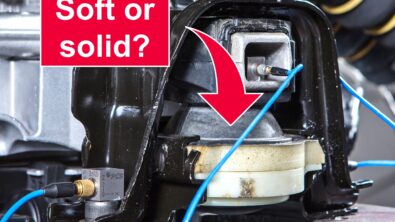
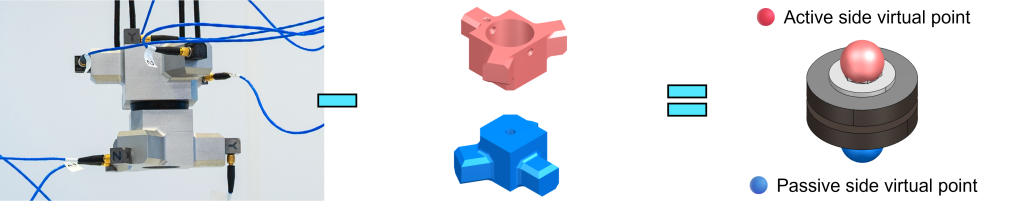
Another common use case for FBS Decoupling is the removal of excitation adapters which are often used to measure connection interfaces in up to 6 DOFs with VPT. This approach can for example be applied to obtain full 12×12 FRF models of compliant mounts using 6 DOF virtual point connection interfaces at the active and passive sides.
Conclusions
FBS Decoupling is an incredibly powerful tool for extracting accurate and realistic component FRF models in relevant operational boundary conditions for use in virtual prototyping. With Simcenter Testlab release 2606, we are offering a seamless and modern workflow to acquire and process the necessary FRF data using standard functionality that is fully available through our flexible token-based licensing concept.
Has this article left you curious about virtual prototyping techniques? Check out our solution guides for a comprehensive overview of Siemens’ solution offering for structural dynamics testing and Transfer Path Analysis. Or, watch our our free on-demand webinars on Component-based Transfer Path Analysis and Virtual Prototype Assembly to learn more.
- D. Minervini, S. Park, T. Dirickx, T. Geluk, “FBS Decoupling at Suspension Level for Road Noise Applications”, SAE Technical Paper 2022-01-0978, Siemens, Hyundai, 2022. ↩︎
- D. Minervini, A. Stella, “Experimental Frequency-Based Decoupling for Tire Characterization”, in Proceedings of the 30th International Conference on Noise and Vibration Engineering (ISMA), Siemens, 2022. ↩︎