What’s new in Simcenter 3D 2606
Simcenter 3D 2606 is Out Now!
This summer’s release sees Simcenter 3D continue its alignment with other Simcenter products, including those that were part of the recent Altair acquisition, while delivering practical advances across the simulation workflow. Highlights include faster ray acoustics and additive manufacturing simulations, more realistic pass-by noise and electric motor NVH prediction, stronger motion and drivetrain modeling, improved Simcenter Nastran convergence and postprocessing, and more connected workflows for electromagnetics, co-simulation and aerospace structural analysis.

Model the complexity
Engineering teams are being asked to predict the behavior of increasingly complex products earlier in development, often before physical prototypes exist. The latest Simcenter 3D updates help teams model that complexity with greater realism, whether they are investigating acoustic performance, drivetrain behavior, multibody motion, additive manufacturing distortion or electric motor NVH
Acoustics: Pass by noise with Simcenter Testlab LMS
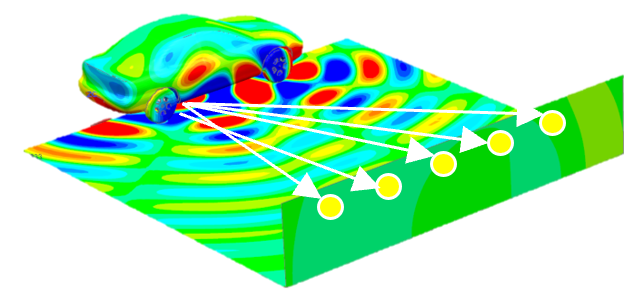
For pass-by noise simulation, Simcenter 3D now supports broadband transient sources, making it possible to capture the true behavior of components such as tires during the event. Engineers can directly import Simcenter Testlab LMS files, including volume displacement, velocity and acceleration data, so source definitions can be simulation- or test-based, broadband or tonal, stationary or transient. This enables pass-by noise predictions that better reflect what happens on the road and supports more confident design decisions before physical prototypes are available.
Motion and Drivetrain: Predict real-world behavior and potential failures
Simcenter 3D also strengthens motion and drivetrain modeling. The new Graphical Topology Map transforms complex 3D multibody models into intuitive 2D schematic views, helping engineers understand model relationships, see how motion elements connect and edit mechanisms directly from the schematic. For drivetrain simulation, a dedicated contact element for spline couplers accounts for runout, load dependency, clearances, and shaft misalignment. By calculating nonlinear stiffness from actual geometry and material properties, the element helps teams predict real-world drivetrain behavior and identify potential failures earlier.
E-Motor Vibration Synthesis vertical: Predict what really happens and evaluate electric motor integration KPIs
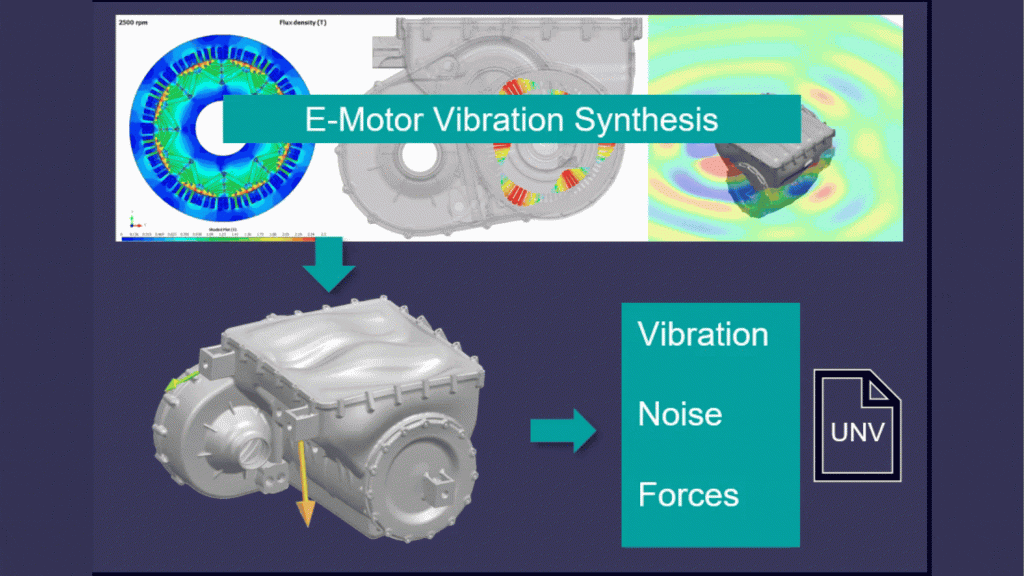
Electric motor NVH prediction also becomes more representative of real operating conditions. Simcenter 3D E-Motor Vibration Synthesis vertical now incorporates transient current load scenarios based on Simcenter Amesim results, capturing the NVH impact of power electronics interactions and excitation conditions across more realistic operating scenarios in Simcenter Amesim full vehicle models. A new Noise Map visualization synthesizes NVH response across the full motor operating range in a single plot, while blocked-force post-processing and export provides valuable information about the loads that the motor will introduce in the structure in which it will be installed. This insight helps engineers more easily predict and optimize what occupants and bystanders hear and feel rather than assessing motor noise in isolation.

Go faster
Speed matters when engineering teams need to evaluate more design alternatives, perform more robust studies and shorten the path from analysis to decision. Several updates in Simcenter 3D and Simcenter Nastran are designed to reduce solve times, simplify workflows and make results easier to process.
Engineering Desktop: Attribute driven FEM body automation
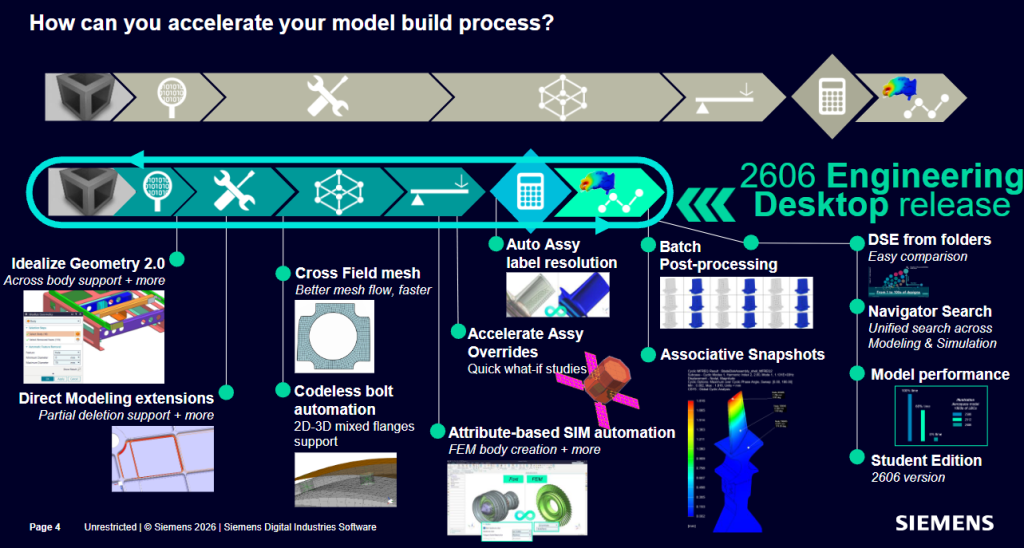
Engineering Desktop introduces two workflow accelerators for model build. Idealize Geometry has been reinvented for faster, smarter geometry abstraction. This now includes across-body support, range and expression-driven exploration for what-if studies, a refreshed modern UI, and better diagnostics that capture failed entities in an Object Group.
Additionally, an attribute-driven FEM approach replaces today’s click-heavy body selection. Now, bodies are automatically inherited into the FEM based on their CAD attributes, giving intelligent, swift, and repeatable model builds. Together they extend attribute-based automation across the simulation process and shift the workflow from a manual, label-oriented one toward one that is persistent and attribute-oriented.
Acoustics: Reduce your MATV needs
Ray acoustics simulations are now up to 50% faster for models with high numbers of sources and microphones or those requiring higher-order diffractions. This performance improvement allows teams to evaluate more design variants in the same timeframe, accelerating acoustic optimization without compromising model fidelity. Acoustic workflows are also streamlined through support for force input directly in the Modal Acoustic Transfer Vector solution, eliminating the need to combine a modal-based response solution with a separate MATV solution.
Additive Manufacturing: Less resource requirements and faster solves
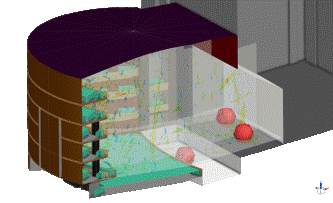
For additive manufacturing, the new octree mesher in Simcenter 3D Additive Manufacturing creates significantly smaller models than traditional voxel meshes, especially for parts with large cross-sectional areas. Smaller models mean faster solve times, enabling engineers to simulate larger and more complex additive manufacturing geometries without exceeding computational resources or waiting days for results.
Rotor Dynamics: Focus on what matters most
Simcenter Nastran introduces several improvements that reduce analysis and postprocessing effort. Rotor dynamics workflows now output complex modes at critical speeds only, paired with Campbell diagrams, reducing result file sizes while focusing attention on the data that matters most. Energy distribution calculations, including strain, kinetic and dissipation energy, can now be performed on element groups within superelements, providing key insights without recovering results on the full original structure.
Nastran SOL401: Get AI ready
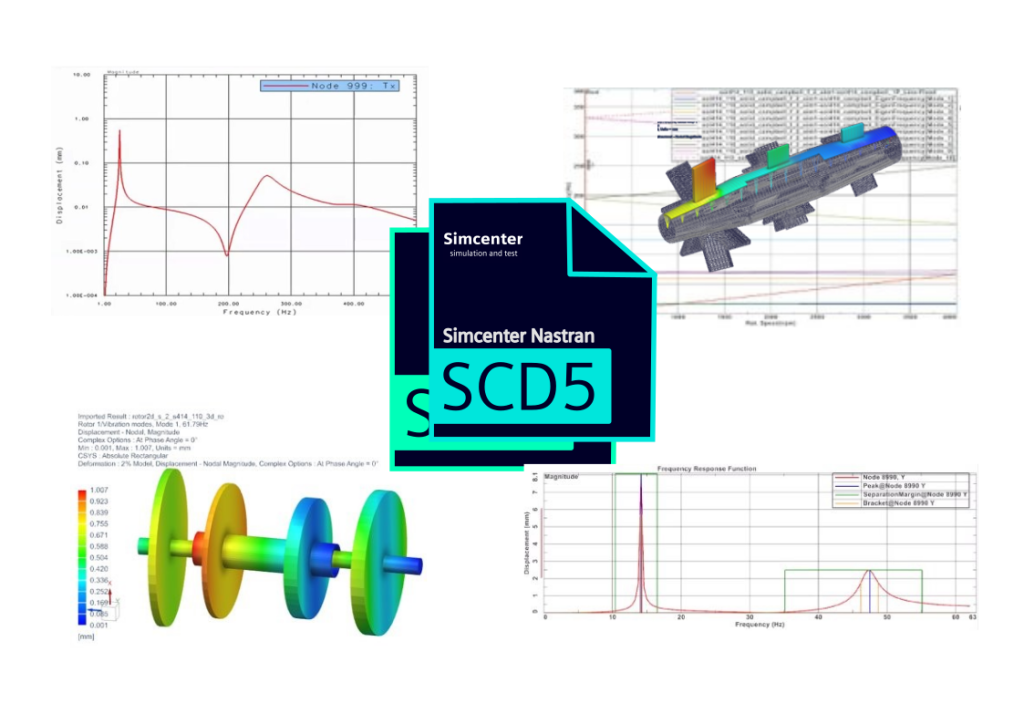
Robust convergence in Simcenter Nastran SOL401 is improved through a refactored contact implementation, reducing the manual tuning required to complete solutions. This is especially valuable for automated workflows such as AI training runs and MDO-based robust design studies, where consistent solver behavior is essential. SOL401 also now supports the SCD5 result format, providing lighter files that are easier to manipulate and consistent with other Simcenter solutions.

Stay integrated
Modern simulation depends on connected workflows. As designs evolve, teams need analysis models that remain associated with geometry, solvers that exchange information reliably and results that can move smoothly between specialist tools. The latest updates help engineers maintain continuity across design changes, simulation domains and partner ecosystems.
Low-Freq EMAG: Improve efficiency and reduce manual effort
New persistent patterning in Simcenter 3D preserves associativity when geometry evolves, keeping simulation setup intact as electric machine designs iterate. This streamlines design iterations by minimizing manual model updates. Multiple eccentricity scenarios can also be evaluated using a single simulation model, simplifying rotating machine analysis. For transformer simulation, streamlined frequency-domain studies and integrated electro-thermal workflows further improve simulation efficiency while reducing manual setup effort across the analysis process.
Thermal Multiphysics: co-simulation multi-surface mapping
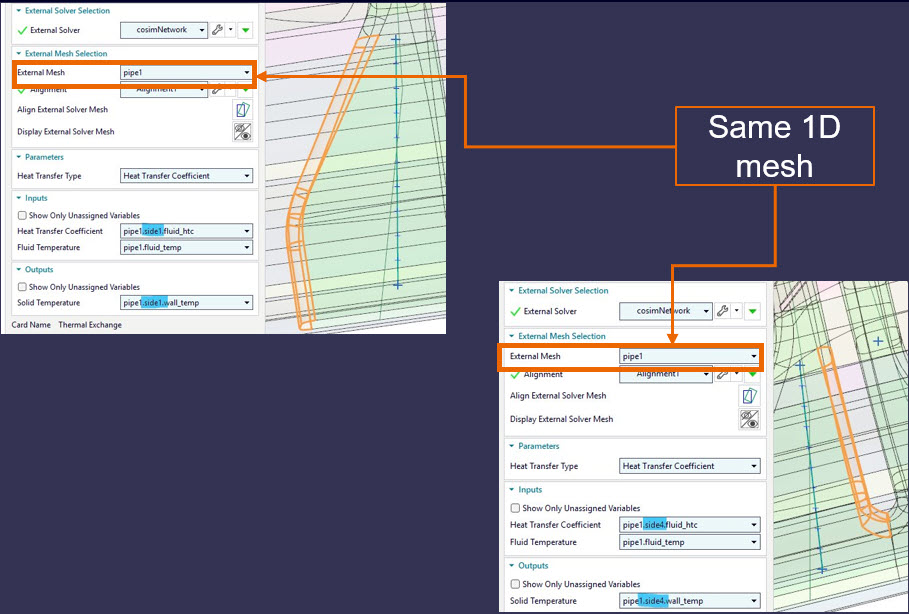
Co-simulation workflows also become more accurate and connected. Iterative coupling for FMU-based co-simulation allows solvers to re-iterate each time step, resolving nonlinearities and eliminating lag between physics operating at different time scales. New multi-surface mapping enables detailed thermal characterization along pipe lengths, with different heat transfer coefficients and wall temperatures on different sides, helping teams capture the true multi-physics behavior of complex aerospace thermal systems.
Simcenter Nastran: data that’s ready for launch
Simcenter Nastran improves integration with established aerospace workflows. Monitor points are now supported in modal dynamic response solutions, providing force balance data at specified locations for VMT diagrams and shear flow analysis. Improved coupled loads analysis workflows generate the data formats mandated by launch vehicle providers directly, reducing the need for custom scripts and lowering the risk associated with proprietary format conversion tools.
Simcenter Nastran: Direct model migration from MSC Nastran
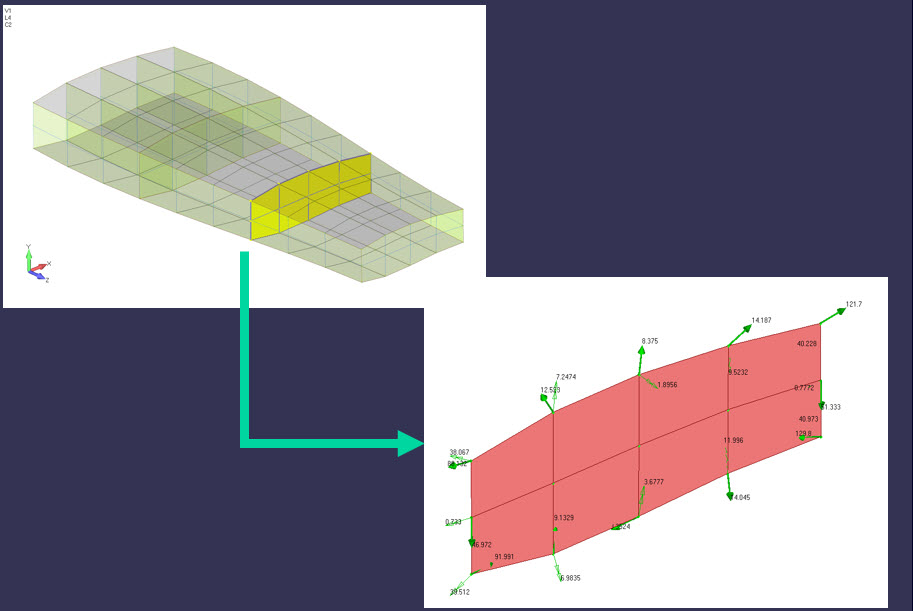
For airframe structural modeling, Simcenter Nastran now supports beam offsets in SOL106 and shell offsets in linear solutions, including buckling analysis. These capabilities help engineers migrating from MSC Nastran transfer proven modeling approaches directly, protecting existing model investments while enabling access to Simcenter Nastran capabilities.

Explore the possibilities
The broader value of these updates is not only that individual simulations become faster or more accurate. They also expand what engineers can investigate, where simulation can be deployed and how much insight can be extracted from limited physical data.
Smart Virtual Sensing: Complete load and response insights
Smart Virtual Sensing in Simcenter 3D now extends to unconstrained structures with rigid body motion, opening applications such as in-flight electronic equipment load prediction and structural health monitoring. Efficient parameter tuning accelerates solution setup while improving accuracy, and new xDT licensing for Siemens Industrial Edge enables deployment to production environments. This allows teams to transform sparse sensor measurements into more complete load and response insights across a broader range of real-world scenarios.
Together, these capabilities help engineering teams move beyond isolated analysis tasks. They make it easier to model complex physics, accelerate design exploration, keep simulation connected to evolving product definitions and extend insight from simulation into testing and operational environments. For organizations facing shorter timelines, higher product complexity and growing pressure to get decisions right earlier, the latest Simcenter 3D and Simcenter Nastran updates provide a stronger foundation for confident engineering exploration.

More information
Simcenter X
What if you could solve all your mechanical, fluid, and thermal problems with a single license?
One license to rule them all, one license to process them, one license to solve them, and with a single user to combine them. – not Tolkien
With Simcenter X you can! Released towards the end of last year, with Simcenter X you can download most of your favourite simulation tools and work on your machine as normal. But now, with the new named user license you can use a single license to work in all the products. No licenses sitting ideal while you work in a different software, and no longer do you have to choose between software becuase you get them all. If that was enough to excite you it also comes with Teamcenter and an embedded AI assitant.
Simcenter 3D Student Edition
Get direct access to professional CAE tools and build industry-revelent simulation skills directly applicable to your future. Give your career a kickstart by downloading and learning Simcenter 3D today.

Downloads
Many of our software packages have a trial available; see the links below to find the one for you.
Are you already a customer and want to ensure you are benefiting from all the latest features? following the link below to the latest Version
Keep up to date
Be sure you have all the latest news by following ‘Simcenter 3D: The Latest’, our monthly blog with all the latest news on Simcenter 3D and related products. This will soon change to the cover a wider set of simcenter products, but will remain a key resource for Simcenter 3D users.


