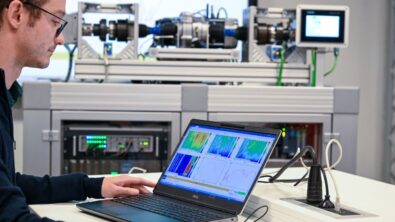
A 4-step approach to transform multiphysics e-drivetrain measurements into meaningful initial engineering insights

In our previous article, we explained how to acquire high-quality multiphysics measurement data using a simple demo setup: an electric machine connected to an air valve. The article covered electrical sensor integration, accelerometer and microphone instrumentation, and several shaft-speed tracking sensors using Simcenter SCADAS and Simcenter Testlab.
E-drivetrain testing programs generate massive volumes of multiphysics data — yet many engineering teams still struggle to turn that data into consistent, trusted decisions.
It is not uncommon to see: conflicting KPIs between teams analyzing the same dataset, days lost reprocessing signals due to inconsistent methods, delayed root cause identification despite high-quality measurements.
The problem is not data acquisition. It is the lack of a structured approach to validate, standardize, and correlate that data across domains.
Engineering confidence does not come from measuring more signals.
It comes from transforming raw data into validated, correlated, and repeatable insights.
This article outlines a proven 4-step approach using Simcenter Testlab to move from raw multiphysics measurements to actionable engineering decisions.
Unlike fragmented toolchains where acquisition, processing, and reporting are disconnected, Simcenter Testlab provides a unified environment where multiphysics data remains synchronized and traceable throughout the entire workflow — from measurement to decision.
Step 1 — Validate your measurements before you analyze
Every electric drivetrain generates high-bandwidth, multiphysics data streams: electrical signals (phase currents and voltages), mechanical quantities (torque and rotational speed), vibrations (torsional, airborne, structure-borne), and encoder-derived mechanical angles.
The real challenge isn’t acquiring this data — it’s ensuring it’s physically consistent. Are electrical and mechanical domains as expected? Does inverter switching behavior align with torque ripple and vibration response? Is the electrical angle correctly tracking the mechanical shaft?
With Simcenter Testlab, engineers can validate these relationships immediately after acquisition. Time-domain signals from analog and digital channels can be inspected in context, synchronization between inverter signals and mechanical response can be verified, and electrical-to-mechanical angle tracking can be confirmed. Offsets, scaling errors, pulse miscounts, and inverter ripple become visible before any deeper analysis begins.
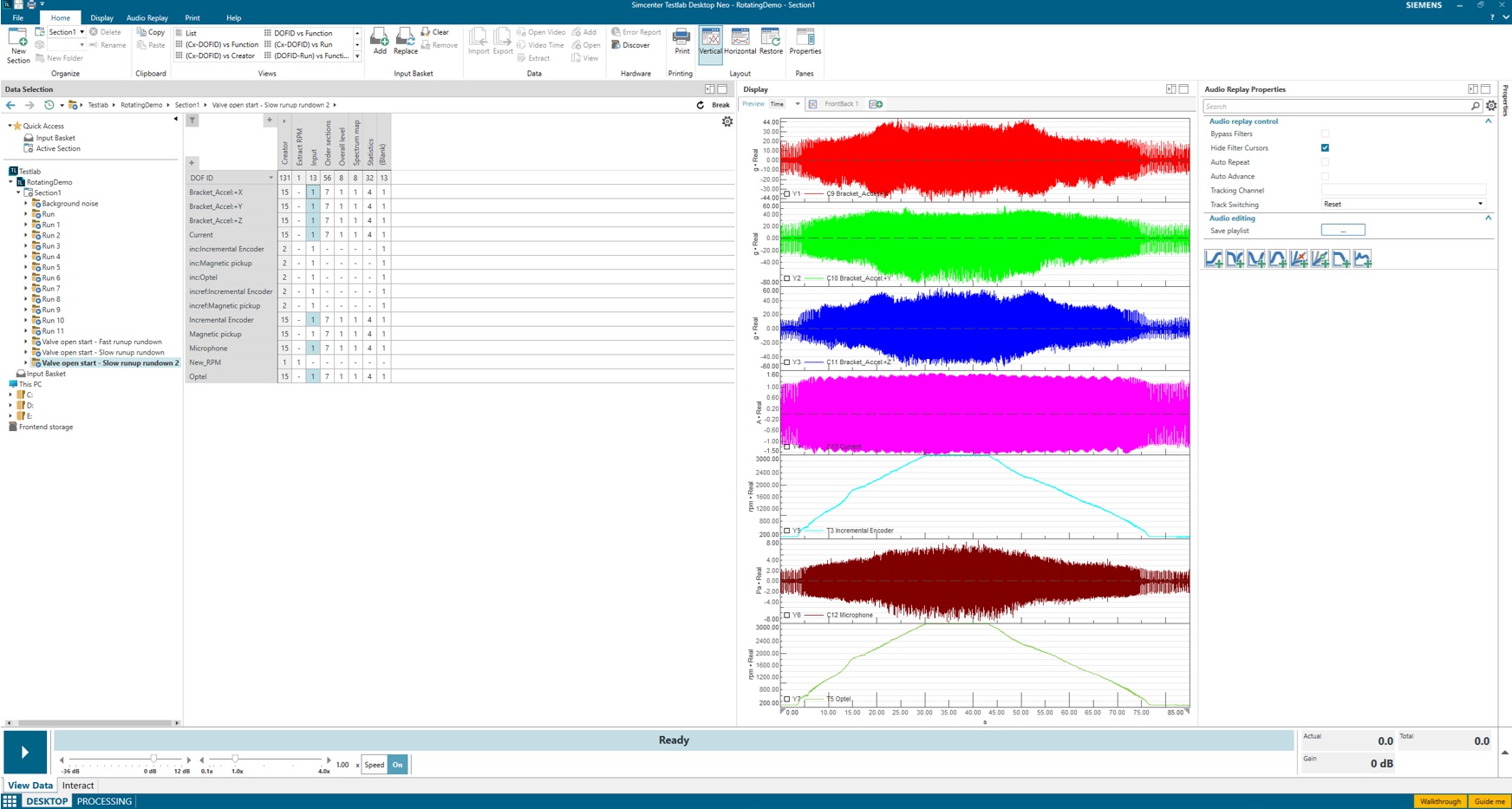
A practical consistency check
In a test case, coherence between electrical and mechanical domains was confirmed with a simple physical cross-check. From the measured phase current waveform, an electrical frequency of 50 Hz was observed under constant-speed operation. For the two-pole machine in this setup, the theoretical synchronous speed is 3000 RPM. The measured mechanical speed was 2971 RPM, giving a slip of ~0.9% — fully consistent with normal induction machine behavior under light load.
This check confirms that: the pole-pair configuration is correct, the speed sensing is in line with the control parameters, and electrical and mechanical signals are as expected.
It also validates the integrity of the entire acquisition chain — from current measurement to encoder tracking. If this basic consistency check fails, any downstream analysis — from order tracking to NVH diagnostics — becomes unreliable.
Insight doesn’t begin with complex analytics — it starts with validation. Validation isn’t just a step; it’s the gatekeeper of engineering credibility.
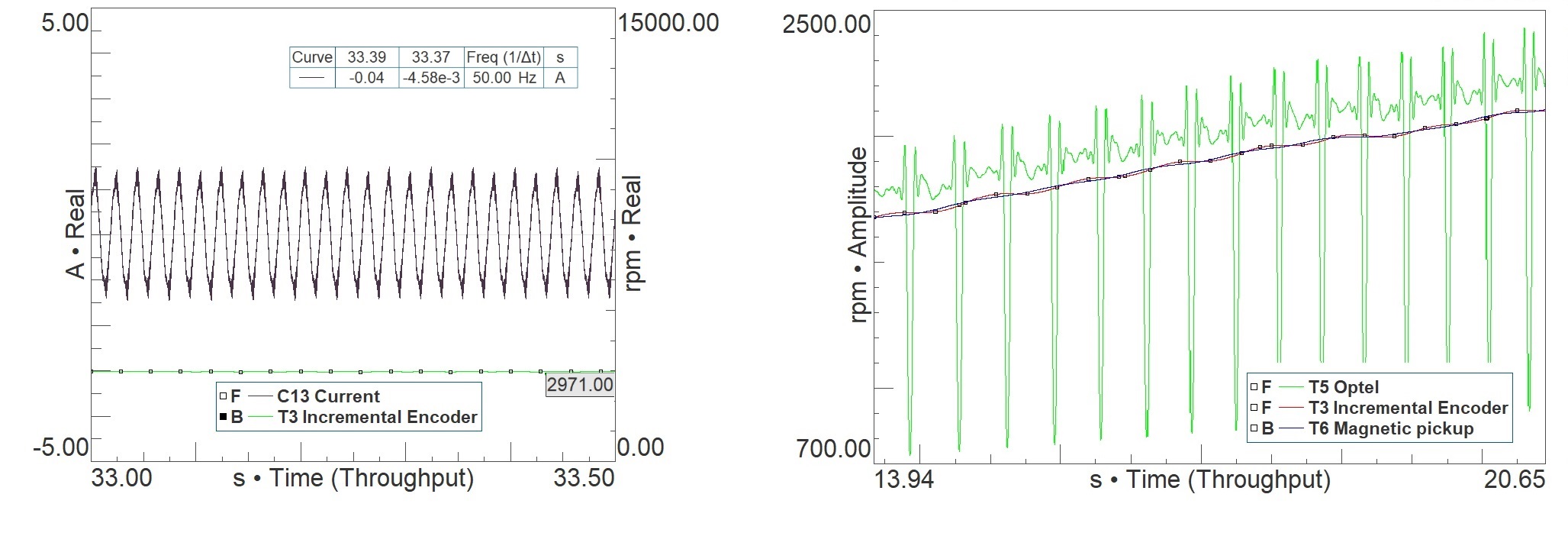
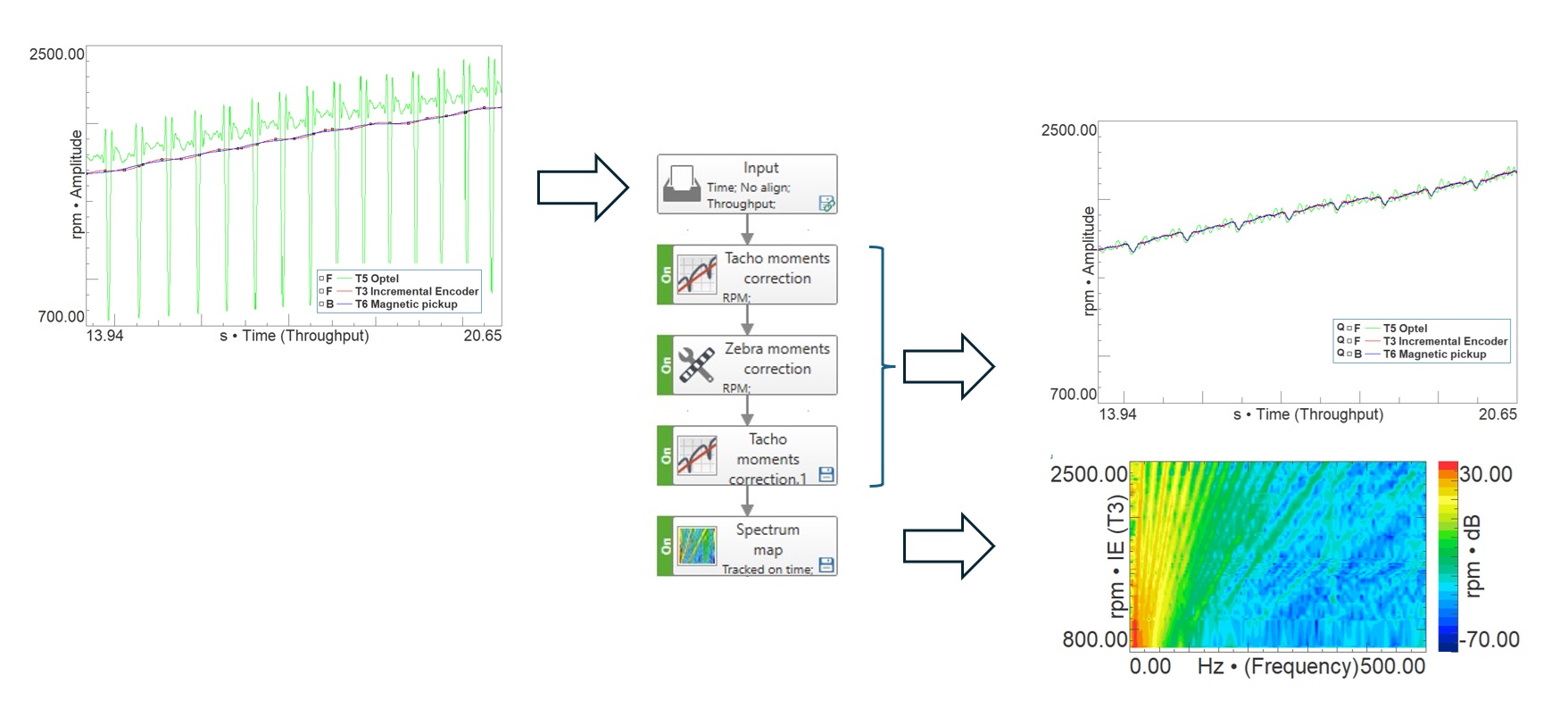
For some signals, like the Optel speed sensor, additional processing may be needed to correct offsets or zebra tape butt joints. Incremental encoders and magnetic pickups may require tacho moment adjustments. In the next step, we’ll show exactly how to apply these corrections.
Finally, Simcenter Testlab allows you to replay recorded signals and apply filtering without performing a new measurement, making it easy to extract further insights and understand your data before building full analysis workflows.
Step 2 — Eliminate variability with automated workflows
Once data integrity is confirmed, a new challenge emerges: ensuring that every engineer applies the same methodology — across teams, projects, and locations.
In practice, manual analysis introduces variability: different filtering strategies, inconsistent order definitions and varying speed extraction methods.
This leads directly to non-comparable KPIs and conflicting conclusions.
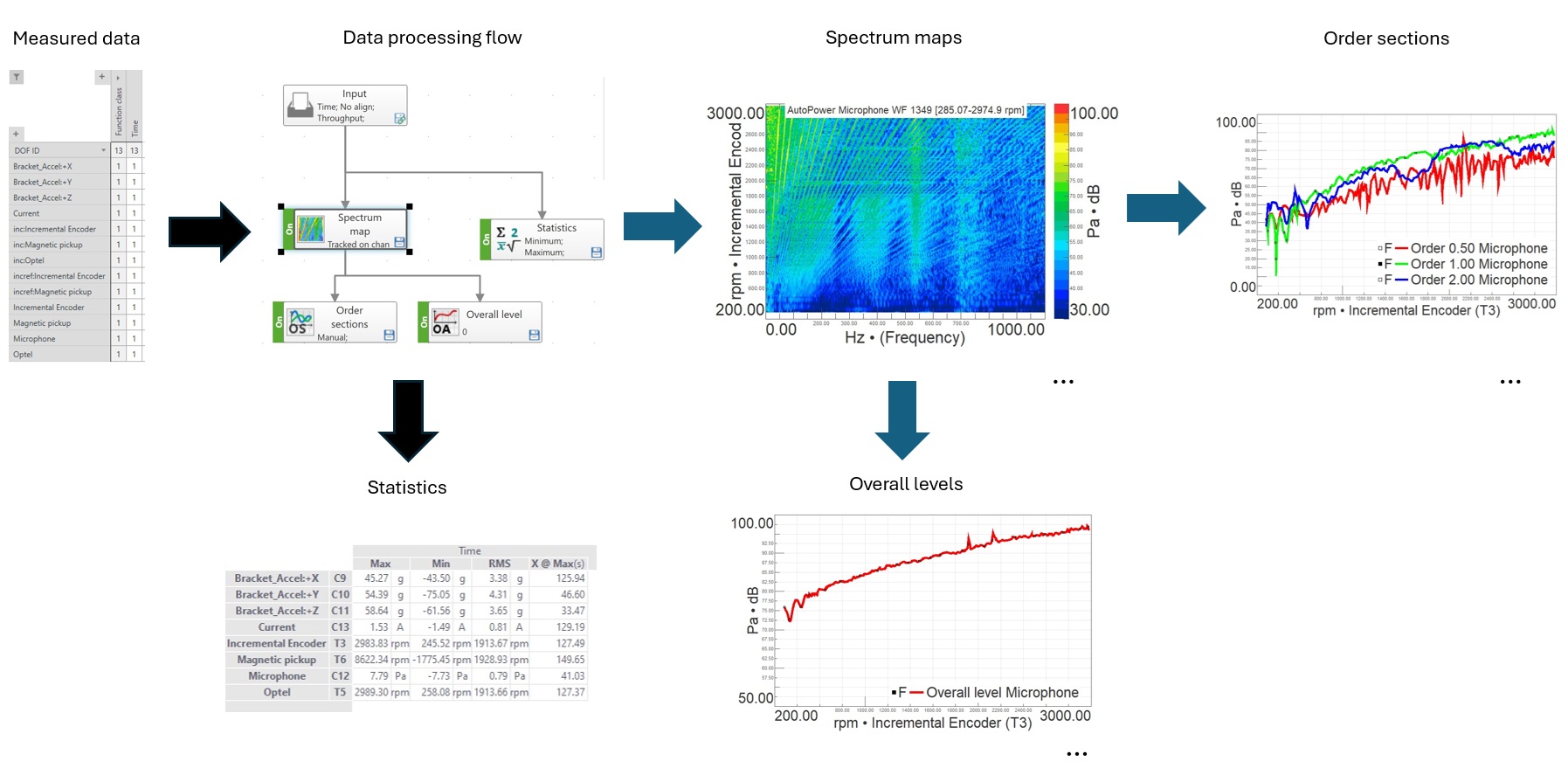
With Simcenter Testlab Process Designer, analysis intelligence is embedded into standardized, automated workflows. Raw signals are transformed into traceable performance indicators through predefined processing chains.
This goes beyond efficiency: engineering methods scale across global teams, results become independent of individual expertise and KPIs remain consistent and auditable across programs.
Instead of relying on expert knowledge applied manually, methodology is embedded directly into the process.
This is a fundamental shift — from analysis as an activity to a controlled, repeatable system.
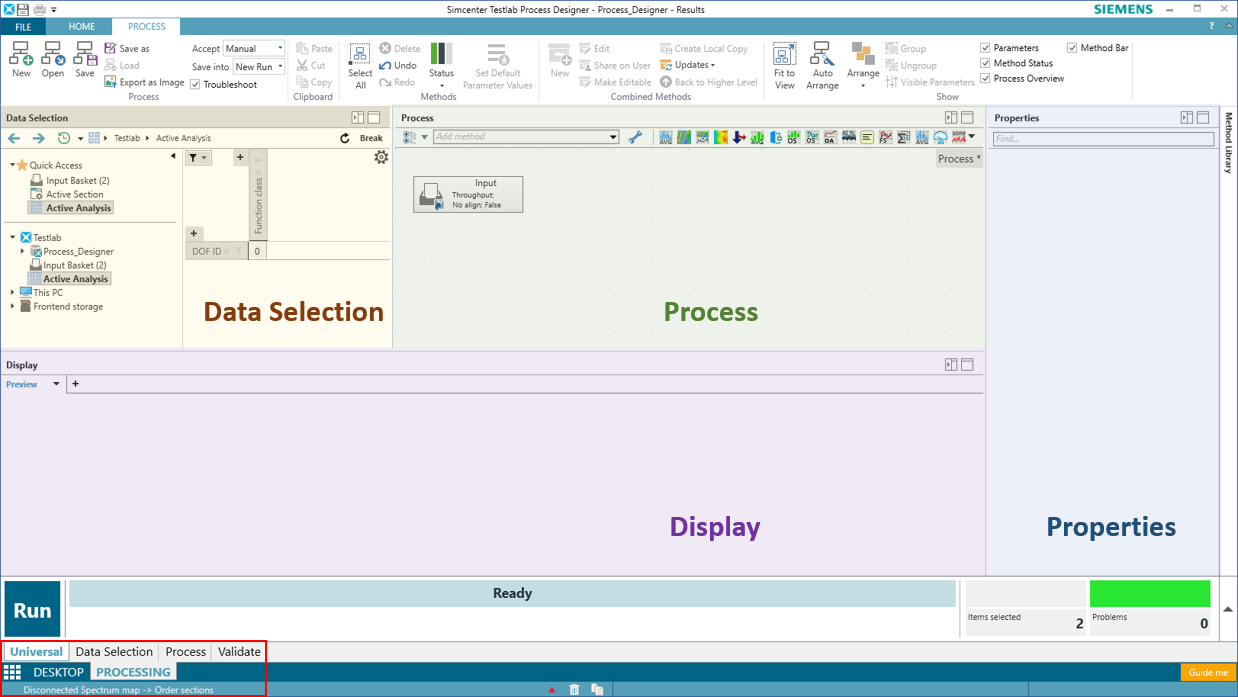
Simcenter Testlab Process Designer
In practice, these workflows can automatically estimate synchronous speed from stator current frequency and compare it with encoder-based mechanical speed to compute slip. This enables direct validation between electromagnetic behavior and mechanical response.
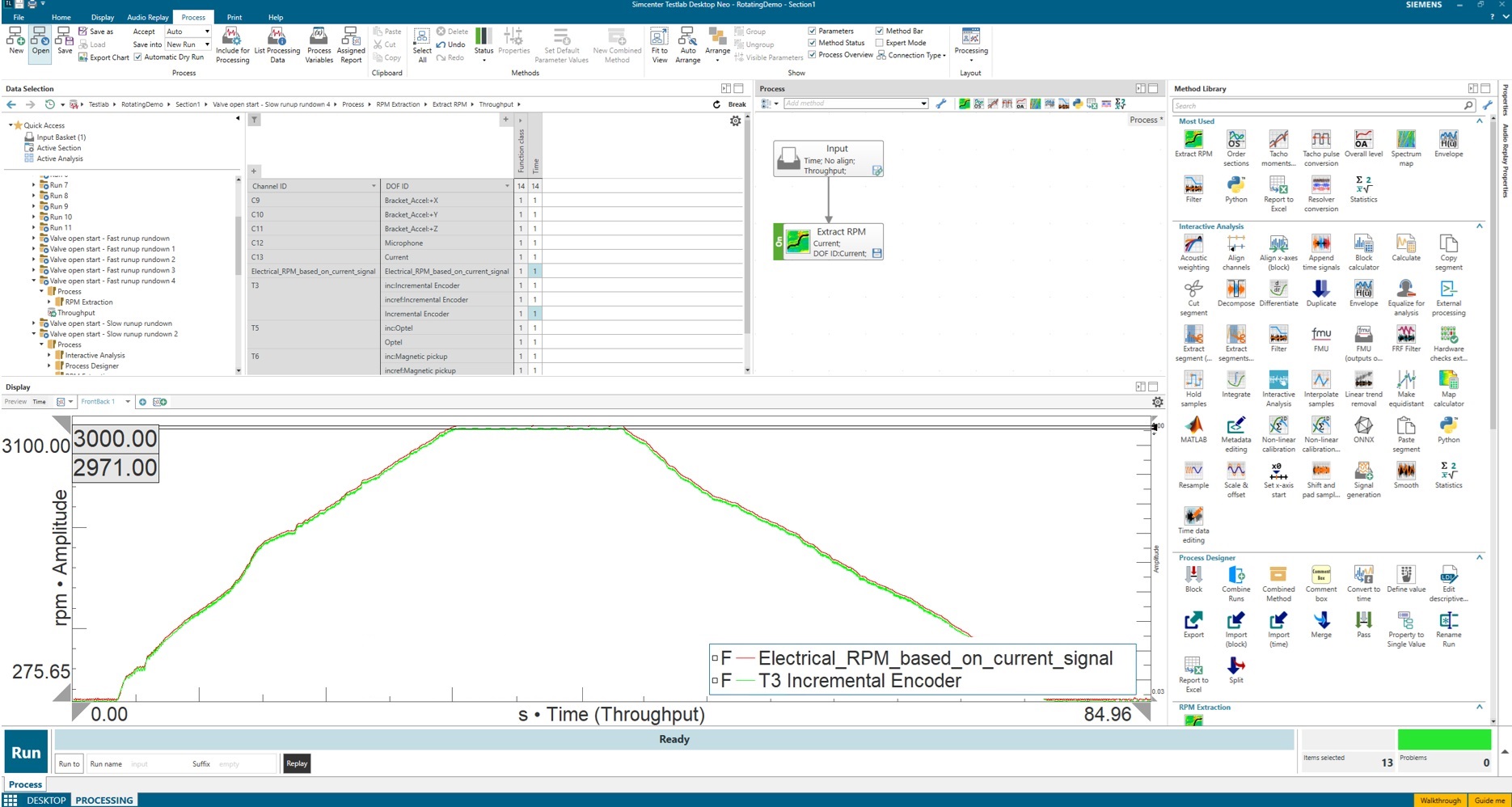
Multiple speed sources — encoders, magnetic pickups, and optical sensors — can be processed consistently, despite differences in signal quality. Torsional vibrations and related orders become directly comparable across sensor types.
Standardized processing chains ensure consistent signal conditioning, encoder correction, spectral analysis, and KPI extraction (RMS, peak, crest factor, torque ripple). Because these operations are predefined and parameterized, interpretation drift between users is eliminated.
The impact is immediate: analysis time is reduced, methodology becomes consistent across teams, and traceability improves.
Engineering rigor is no longer dependent on individual experience — it is built into the workflow itself.
Because workflows remain transparent, auditable, and reusable, organizations can standardize analysis at scale while maintaining full control over their methodology.
Step 3 — Correlate multiphysics phenomena to identify root causes
Once workflows are built and standardized, diagnostics become both powerful and trustworthy. With data integrity ensured and methodology controlled, engineers can move beyond validation toward true causal analysis.
Simcenter Testlab enables advanced multiphysics investigations within a unified environment where electrical, mechanical, and acoustic domains are processed coherently. Electromagnetic order tracking reveals pole-pair harmonics, slotting effects, and inverter switching components directly within the rotational spectrum.
In practice, this analysis is straightforward to implement: spectrum maps can be generated with minimal setup, and visualization can be instantly switched from time to RPM to expose order content.

Torque ripple can then be correlated with torsional vibration to uncover rotational irregularities propagating into structural and acoustic responses. At the same time, electrical signal processing preserves inverter switching behavior, enabling detailed analysis of PWM-driven excitations and off-zero orders in the audible range.
Because all domains are analyzed within the same environment, engineers can directly correlate airborne noise, structure-borne vibration, and electromagnetic excitation mechanisms — without exporting data or reformatting datasets. The workflow remains continuous, preserving synchronization and physical context.
The result is a shift from observing symptoms to identifying root causes.
High-bandwidth multiphysics data stops being complex — and becomes actionable engineering intelligence.
This translates directly into faster development cycles: root causes are identified earlier, reducing the need for repeated test campaigns and accelerating drivetrain optimization.

Step 4 — Communicate with authority and consistency
Insight only creates value when it drives decisions.
In many organizations, reporting is where inconsistency re-enters the process — through manual formatting, disconnected datasets, and non-standardized KPIs.
Simcenter Testlab eliminates this risk by embedding reporting directly into the analysis workflow. Results remain linked to the validated data, ensuring full traceability from raw signal to final KPI.
This enables: consistent communication across engineering teams and management, rapid comparison between test campaigns and configurations, auditability of results for validation and compliance processes.
Because reporting is automated and standardized, decision-making becomes faster, more aligned, and more reliable.
This is not about generating reports — it is about enabling confident engineering decisions at scale.
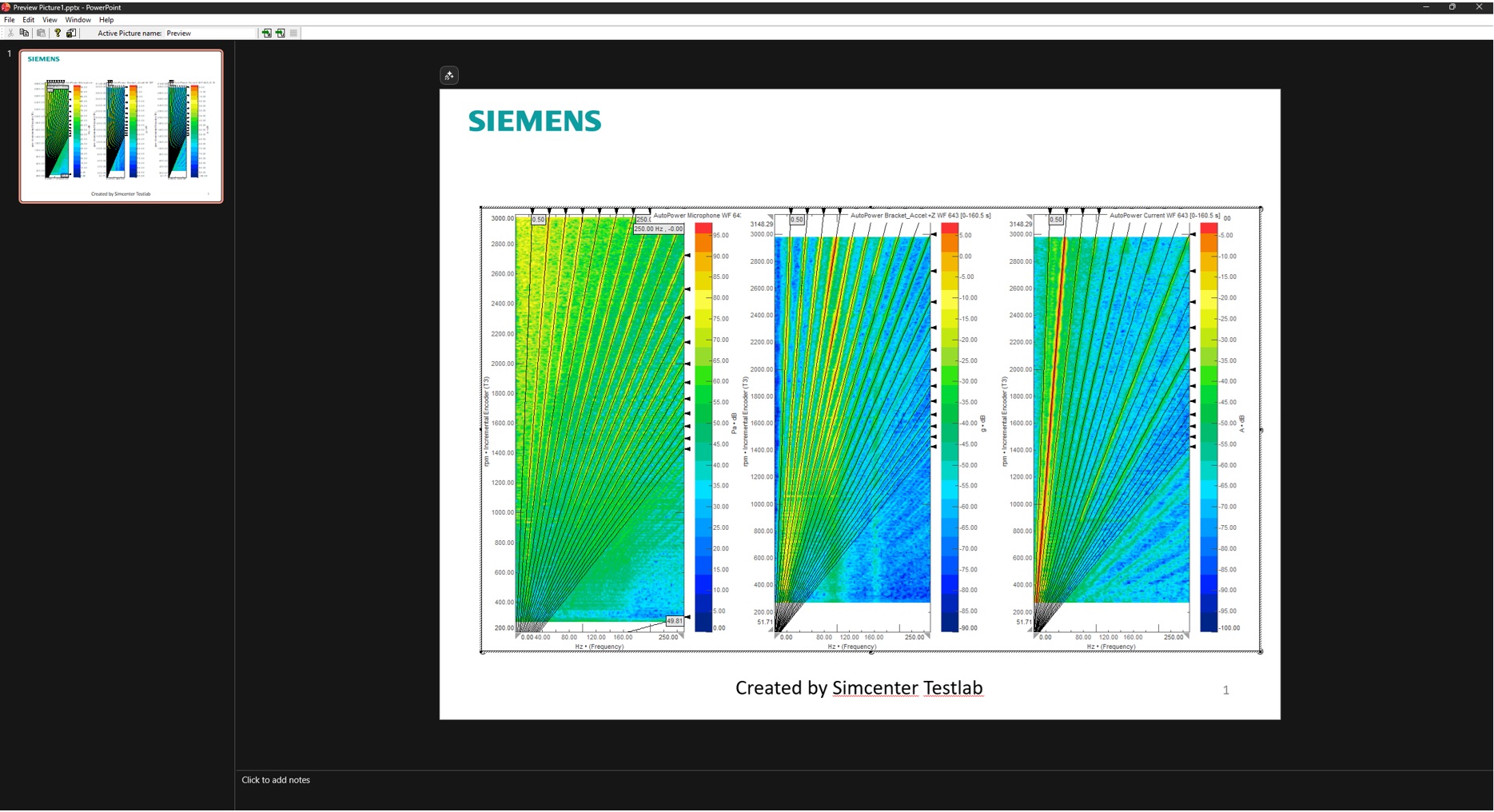
For advanced reporting capabilities, explore Simcenter Testlab Neo: Reporting.
A structured path to engineering confidence
In modern electric drivetrain programs, competitive advantage is no longer defined by how much data is recorded.
It is defined by how quickly and reliably that data can be converted into engineering decisions.
A structured approach — combining validation, standardization, multiphysics correlation, and decision-ready reporting — transforms testing from a data collection activity into a decision acceleration engine.
Simcenter Testlab enables exactly that transformation by connecting measurement, analysis, and reporting into a single, coherent workflow.
Ready to elevate your E-drivetrain testing workflow?
- Explore the key steps of real multiphysics workflows in Simcenter Testlab
- Learn how to correctly connect electrical sensors with Simcenter SCADAS
- Connect with the Simcenter physical testing community to accelerate your expertise.
👉 Request a live demo or workflow walkthrough tailored to your application
Turn your electric drivetrain testing workflow from raw signals into actionable insight — with confidence.