UCIe.mem: One protocol, multiple verification paths


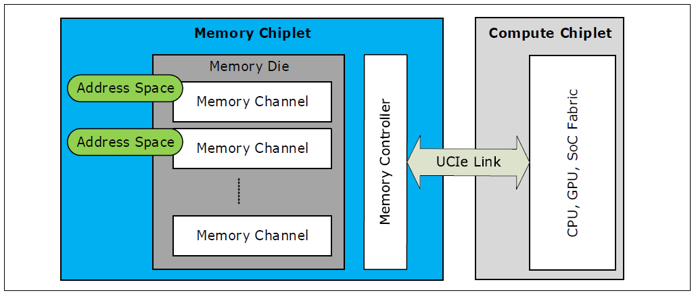
As chiplet-based architectures become increasingly diverse, connecting compute and memory efficiently is more important than ever. Modern systems bring together compute chiplets and a range of memory technologies, including HBM, DDR, and LPDDR. UCIe.mem helps bridge these disparate worlds by providing a standardized, memory-technology-agnostic protocol for exchanging memory requests and responses across chiplets.
But standardizing the protocol is only part of the equation. The real challenge lies in verifying connectivity across different design implementations. From early-stage designs with limited interfaces to fully integrated systems, DUTs vary in their interfaces, development maturity, and integration requirements. This calls for a verification approach that can adapt to each stage of the design journey.
The challenge: one protocol, different design implementations
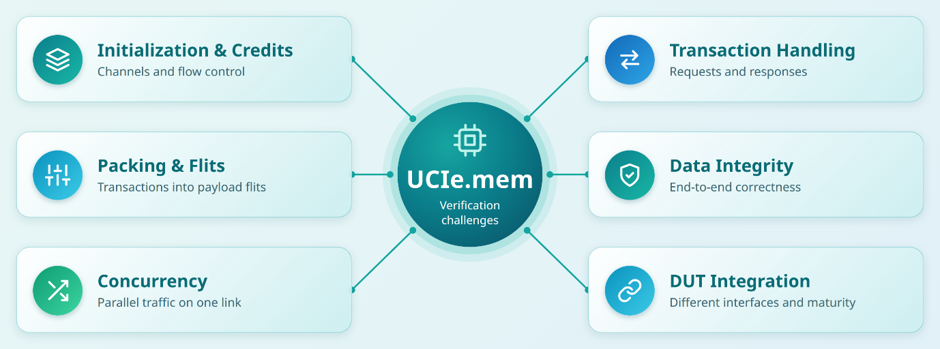
UCIe.mem verification goes beyond checking basic memory request and response exchanges. It requires validating protocol initialization, credit management, transaction handling, packing, and data integrity. Concurrent traffic, channel configurations, and correct request-response association add further complexity.
The challenge becomes more pronounced when considering different DUT integration models. Early-stage designs may expose conventional memory interfaces, such as AXI, without implementing UCIe.mem. More mature designs may implement the protocol and expose flit-aware die-to-die interface (FDI) for direct protocol-level validation. At the system level, verification must also account for realistic interactions between compute and memory subsystems. This calls for a flexible verification environment that can adapt to these different scenarios without requiring a separate set up for each one.
A flexible approach with Questa One Avery UCIe VIP
Questa™ One Avery UCIe VIP supports UCIe.mem verification across different DUT interfaces and system configurations, allowing teams to begin validation early and extend it as their designs evolve.
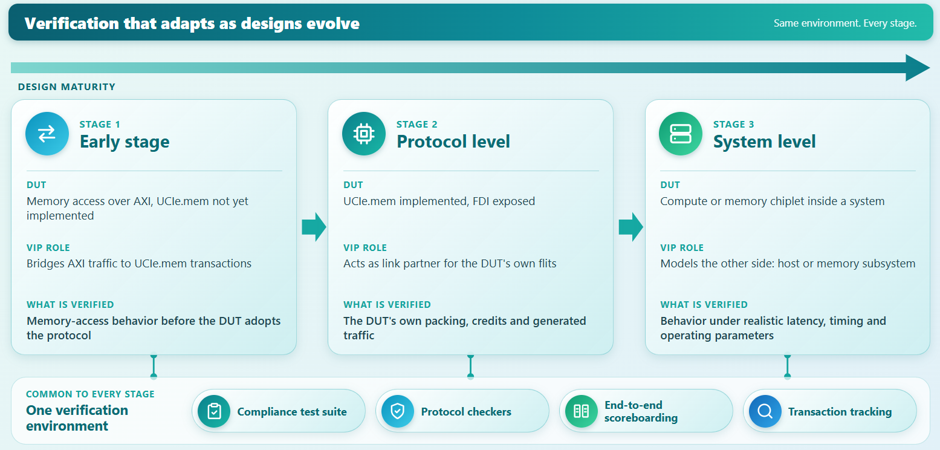
For early-stage designs, the VIP can bridge conventional memory interfaces, such as AXI to UCIe.mem transactions. This enables memory-access functionality to be validated even before the DUT incorporates the UCIe.mem protocol. For DUTs that implement UCIe.mem and expose FDI, the VIP acts as the link partner, enabling direct validation of the DUT’s protocol implementation.
This flexibility also extends to system-level verification. The compute or memory side of a chiplet-based system can be modeled using complementary VIPs. A CXL.mem host VIP can represent the compute-side host when the DUT is the memory chiplet. Alternatively, a memory subsystem VIP, comprising a memory controller and memory model, can represent the memory side when the DUT is the compute chiplet. Configurable latency, timing, and memory operating parameters help model realistic system conditions.
Beyond protocol compliance
In addition to supporting varied integration models, the VIP provides a dedicated UCIe.mem compliance test suite, comprehensive protocol checking, and end-to-end data validation. Transaction tracking provides visibility into memory transactions and supports efficient debug, helping identify protocol and data-related issues.
Together, these capabilities provide verification coverage from protocol-level validation to realistic system interactions, helping teams build confidence in the correctness of memory communication across chiplets.
Verification that evolves with the design
UCIe.mem enables a more modular approach to connecting compute and memory resources. Verification needs to offer the same flexibility, accommodating different interfaces and levels of design maturity.
With Questa One Avery UCIe VIP, teams can start with early-stage memory-access validation, progress to direct UCIe.mem protocol testing, and extend verification to system-level scenarios—all within a common verification environment.
To explore the verification architecture, supported integration topologies, and capabilities in more detail, read the whitepaper:
Verifying UCIe.mem: A Scalable Framework for Chiplet-Based Compute and Memory Systems