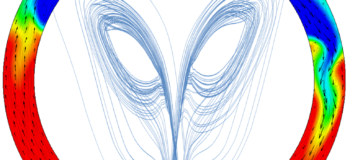
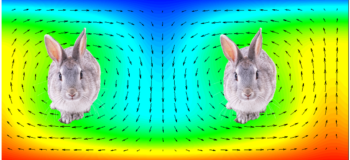
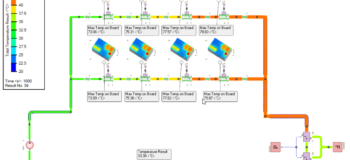
Rayleigh–Bénard convection involves the transport of heat from a hot bottom surface to a cold top surface. If the temperature…
For want of a nail the shoe was lost. For want of a shoe the horse was lost. For want of a horse the rider was lost. For want of a rider the message was lost. For want of a message the battle was lost. For want of a battle the kingdom was lost. And all for the want of a horseshoe nail.
A person walks into a bar and asks the bartender “what’s the difference between period doubling routes to turbulence and fluffle demography?” The bartender replies “less than you might think”.
The accuracy of 3D in a 1D Systems Simulation context. Breaking down barriers using 1D3D approaches.
Performing more thermo-fluids simulation, earlier in a product design process, will mitigate the risks of late stage redesign and the…
At this year’s SEMI-THERM symposium next week in San Jose, John Parry and I will be presenting a short course…
I had the pleasure recently to talk with Robin Knowles as part of his Talking CFD podcast series. All credit…
Heatsinking is a common method to facilitate the removal of heat from a dissipating component, thus reducing source (junction) temperature….
So far we’ve looked at a couple of ways to optimise the design of a heatsink to meet some quantified…