Designing orbital data centers with confidence using Simcenter Amesim and 3D Thermal
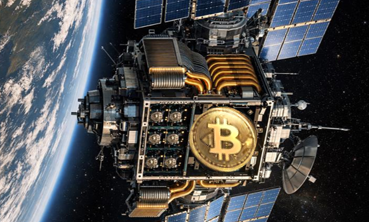
From space-based bitcoin mining to the future of orbital compute
The idea of deploying data centers in space may sound futuristic, but the engineering challenges behind orbital computing are very real today.
Whether the mission is bitcoin mining, AI inference, Earth observation analytics, or edge computing in orbit, every orbital data center faces the same fundamental challenge.
We’ll cover in this blog the different steps to succeed, combining the appropriate tools from the Siemens Simcenter portfolio.
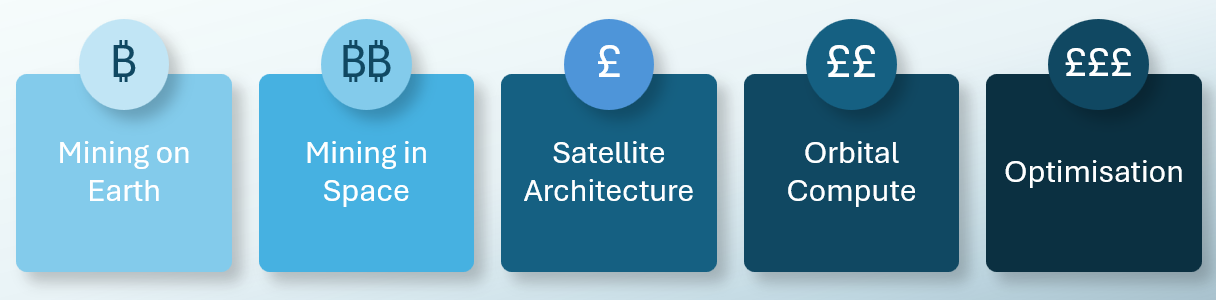
It’s about an innovative model-based systems engineering (MBSE) framework to evaluate power generation requirements, heat rejection strategies and key design trades impacting scalability and cost.
To gain insight into the role of integrated thermal and power system design while exploring the future possibilities of space-based computing infrastructure.
📌 You’ll learn about:
🔵 Initial system sizing and preliminary thermal architecture
🔵 Integrated thermal, power, and system-level modeling
🔵 Co-simulation and optimization’s role in identifying feasible operating points and architectural limits
Successfully combining different Simcenter tools by Siemens:
▪️ Simcenter Amesim (AME) | 🎨⏱️ | Physical digital twin
▪️ Simcenter 3D Thermal (SC3D) | 🛰️🌡️ | Space systems thermal model
▪️ Simcenter HEEDS (MDO) | 🎯📐 | Optimization and Design exploration
▪️ Simcenter PhysicsAI | 🧠🔮 | Physics-informed surrogate model

Now let’s start discovering this engineering with 1D System / 3D Thermal simulation and PIDO (Process Integration and Design Optimization) for satellite architecture, thermal loads, optimization, up to ROM (Reduced Order Models) to get runs executed even faster in few seconds.
All this great work was completed by engineers at Maya HTT.
How do you manage large amounts of power within thermal limits?
Actually the challenge is not only about managing large amounts of power while keeping critical hardware within thermal limits, but also considering all the steps upfront like the power generation, its distribution and finally its storage.
Answering these questions requires more than component-level analysis. It demands a system-level understanding of how every subsystem interacts throughout the mission.
This is where Simcenter Amesim delivers a unique advantage. By enabling engineers to model the complete spacecraft architecture and its interactions, organizations can explore concepts, evaluate performance, and optimize designs long before hardware is built
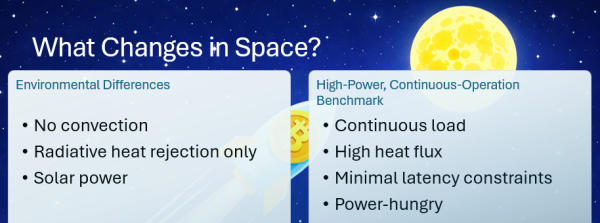
Heat transfer is different in space, there’s no air so no convection. It’s primarily radiation and conduction with solar power generation. Since bitcoin mining is an extreme, but clearly defined, power-intensive workload it can expose the architectural limits of a satellite, given its continuous load and high heat flux. Bitcoin mining has relatively low bandwidth requirements. The miner primarily performs computation locally, although reliable connectivity is still required to receive new block templates and submit results.
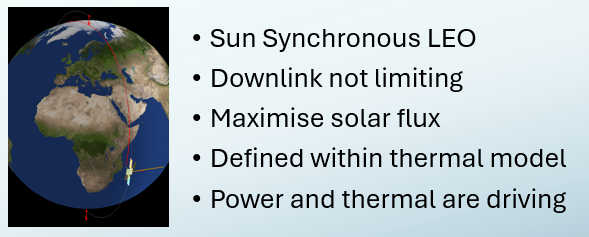
The satellite architecture and orbit are driven from a requirements-based design. It’s a “LEO” (Low Earth Orbit) satellite. While power and thermal are going to be driving this design.
Why orbital data centers are a system challenge
Let’s see how this requirement impacts the design of orbital data centers, and practically how system simulation with digital twins can help. High-performance computing platforms in orbit are fundamentally different from terrestrial data centers.
On Earth, thermal management typically relies on air or liquid cooling. The challenge consists in capturing the power demands for the miners and the fans that keep the miners cool while accounting for operating conditions. While the goal is to predict heat dissipation and figure out power draw for cooling and compare the cost for cooling to the value of bitcoin being mined. Simcenter Amesim can definitively help support the digital twin of the mining factory with its high-power density, continuous operation and thermal constraints
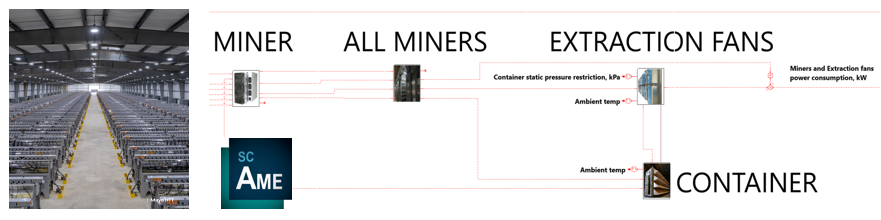
In space, there is no external convective cooling, so ultimately heat must be rejected to space by radiation. At the same time, the spacecraft depends entirely on power generated by solar arrays and stored within batteries. As computing demand increases, engineers must simultaneously answer several questions:
- How large should the solar arrays be?
- Will the battery capacity support continuous operation?
- Can excess heat be rejected efficiently?
- How will orbital conditions affect performance?
- What happens when power and thermal constraints interact?
These are not isolated design questions. They are system questions. And system questions require system simulation.
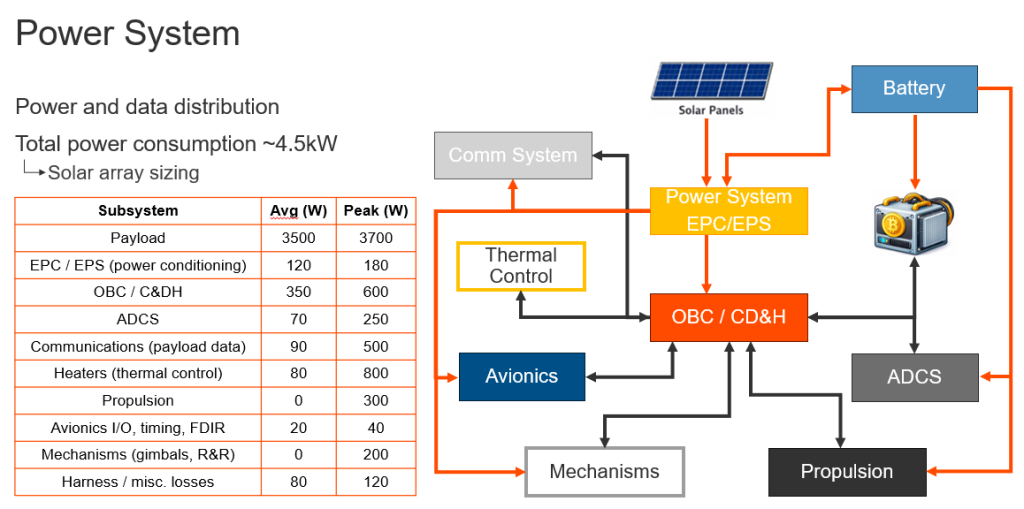
The power budget accounts for typical subsystems. Here is the diagram representing power and data distribution, from a conceptual design perspective. We can consider:
- The main payload – Bitcoin miner
- The total power consumption driving the solar array sizing.
These subsystems are what we will mainly capture within the 1D power system model and 3D thermal model for the:
- EPS – Electrical Power System
- EPC – Electronic Power Conditioner
- OBC – On Board Computer
- C&DH – Command & Data Handling
- ADCS – Attitude Determination and Control System
- FDIR – Fault Detection, Isolation, and Recovery
- R&R – Restraint and Release (latches)
Simcenter Amesim: the digital backbone of orbital compute design
Traditional engineering processes often divide thermal, electrical, and operational analyses into separate activities. Simcenter Amesim brings these domains together through a single system simulation environment. Using a 1D system architecture model, engineers can evaluate:
- Solar power generation
- Battery behavior and state of charge
- Compute payload energy consumption
- Power distribution networks
- Thermal dissipation
- Operational control strategies
- Long-duration mission performance
All within one integrated model. The result is faster engineering decisions and earlier visibility into performance risks. Instead of waiting for detailed designs, teams can rapidly assess whether a proposed orbital data center architecture is technically viable and understand which parameters drive mission success.
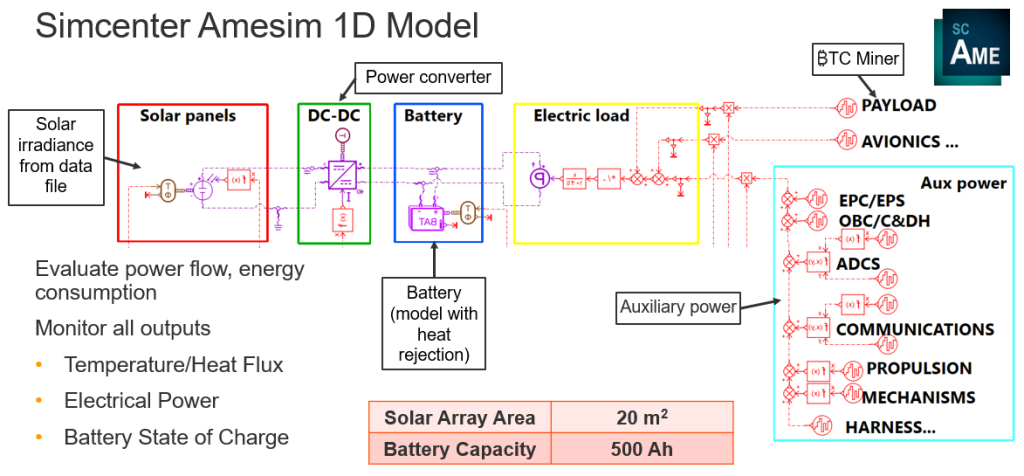
This is the standalone version of the digital twin – not connected to the thermal model directly. It’s used to check that there’s enough power with the given orbit and design we’ve chosen. It represents the power requirements depending on the electrical loads, heat generated, and how we manage that heat dissipation from the critical components. It includes the control logic to turn the payload off if it’s running too hot. Finally everything runs in 10 seconds while simulating hours of satellite operation over one orbital period.
One of the greatest strengths of Simcenter Amesim is its ability to simulate complex systems over long mission durations with exceptional efficiency. Engineers can analyze hours of orbital operation in seconds. This allows teams to evaluate multiple concepts quickly and identify promising configurations early in the development process with faster concept validation and reduced development risk.
Connect power and thermal performance with Simcenter 3D Thermal
For orbital computing platforms, let’s say AI factories, power and thermal management are inseparable. Higher computing capacity increases power demand. More power generates more heat. More heat requires larger thermal rejection systems. Those thermal solutions impact spacecraft mass, architecture, and performance.
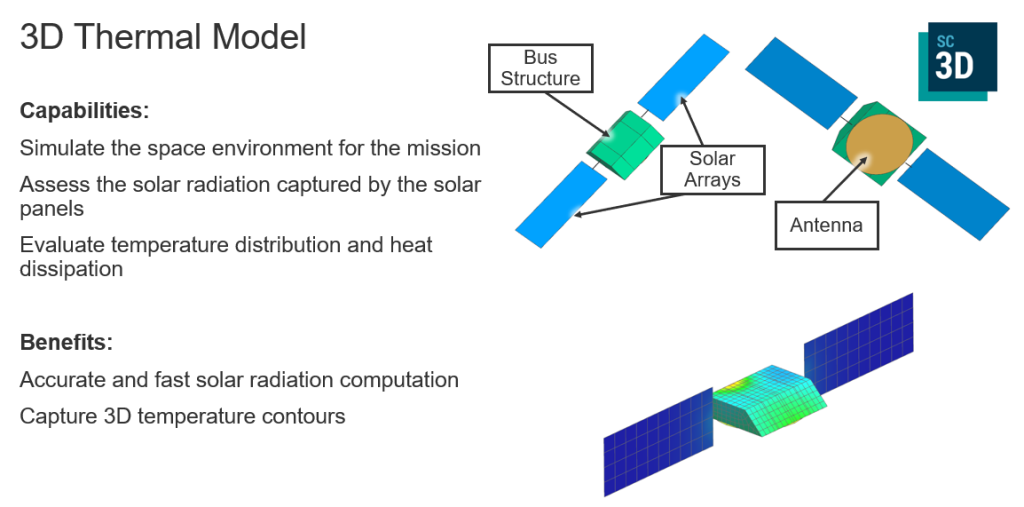
The thermal model captures direct solar heating, Earth albedo, planetary infrared radiation and radiative heat rejection to space. “Space Systems Thermal” which is one of the solvers available in Simcenter 3D offers accurate solar and radiation computations which run on a GPU and process view factor and ray tracing calculations even faster. Engineers can examine the satellite model comprised of various sub-assemblies, working directly with the CAD. The model includes solar panels in blue and an antenna in orange with several components found inside the green bus. The spacecraft attitude maintains the required antenna pointing toward Earth, while the articulated solar arrays track the Sun.
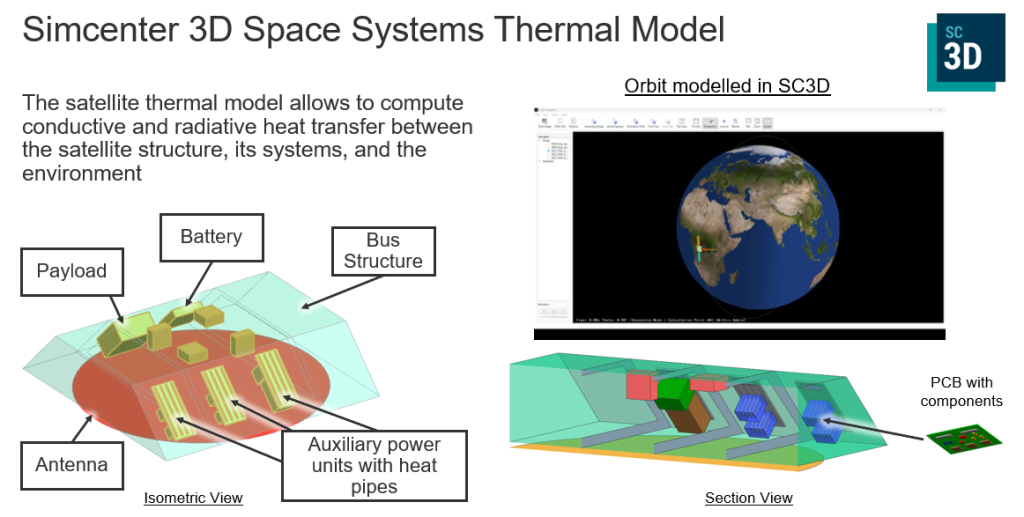
In addition to the radiation, we’re capturing the internal conduction paths. Passive thermal control is assumed. There are several components inside the bus structure. Heat pipes are modelled within some auxiliary power units. Heat pipes use a working fluid and phase change to transport heat and reduce hot spots. We can even be more detailed and capture the PCB level (Printed Circuit Board) thermal loads and components inside of those units. Simcenter 3D Space Systems Thermal (SST) allows engineers to model the orbital thermal environment and visualize the spacecraft throughout its orbit. Let’s now see how we can benefit from the different approaches introduced here previously.
Co-simulation with Simcenter Amesim and Simcenter 3D Thermal Multiphysics
By combining Simcenter Amesim with Simcenter 3D Space Systems Thermal, engineers can establish a co-simulation workflow that continuously exchanges information between both environments. The workflow links the orbital heat fluxes, the spacecraft temperatures, the power dissipations, the battery thermal behavior and the solar array performances.
This creates a closed-loop digital representation of the spacecraft, ensuring that power and thermal decisions are always evaluated together.
The benefit is simple: Better engineering decisions based on real system behavior rather than isolated analyses.
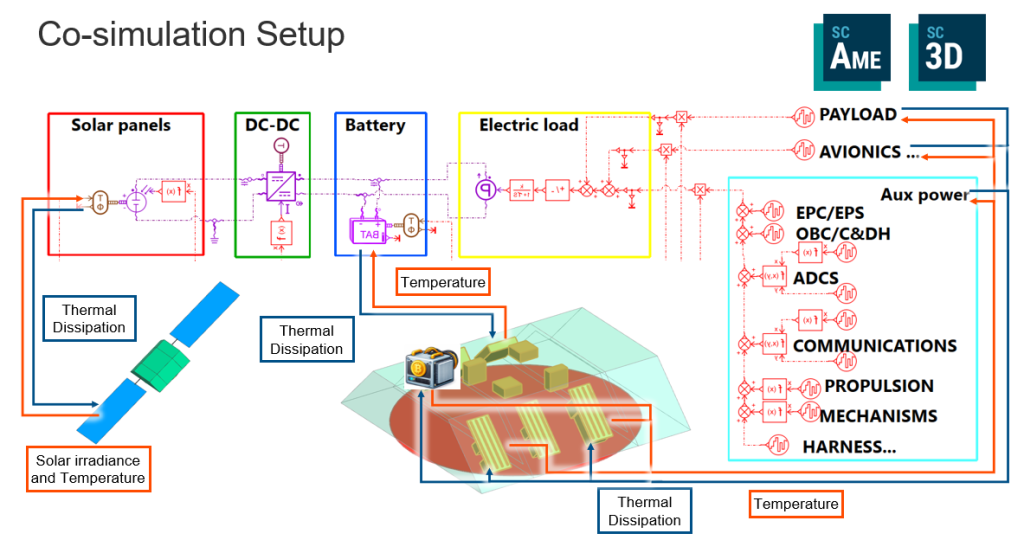
The power system model in Simcenter Amesim receives the solar fluxes and temperatures from the thermal model in Simcenter 3D Thermal. While the thermal model will get the solar panels’ thermal dissipation, as they generate both heat and electricity. Heat dissipation can change with temperature, so it’s important to have this connection well represented.
The battery similarly dissipates heat which is sent to the thermal model while the temperatures are reported back to Simcenter Amesim. Similarly, parameters are passed back and forth for the electrical loads.
We setup a co-simulation interface block in Simcenter Amesim to exchange the appropriate inputs/outputs.
Once all interfaces are set up, we specify the co-simulation in the solution parameters and run the model. This launches both the Simcenter Amesim and Simcenter 3D Thermal models simultaneously. The solution monitor displays the progress for both models, showing radiation calculations, temperature computations, and data exchanges.
The 3D viewer allows us to see the satellite’s temperatures as the co-simulation progresses. Let’s take a look at these nice results! Then let’s pop back to Simcenter Amesim and check the battery state-of-charge (SoC). We now have a complete view of what happens on both sides with the system integration view in Simcenter Amesim and the detailed temperature gradients and heat fluxes in Simcenter 3D Thermal, both software being executed concurrently.
Beyond bitcoin mining – Enabling the orbital compute economy
Let’s step back now and zoom out to reconsider the broader picture and the real benefits using such a combined 1D/3D approach in simulation. The question is, “Is bitcoin mining really the best use of our satellite architecture?”. While bitcoin mining provides an excellent benchmark due to its continuous and power-intensive workload, the real opportunity lies beyond cryptocurrency. The same architecture can support:
- Space-based AI processing
- Earth observation data analytics
- Defense and intelligence applications
- Hosted customer workloads
- High-value orbital compute services
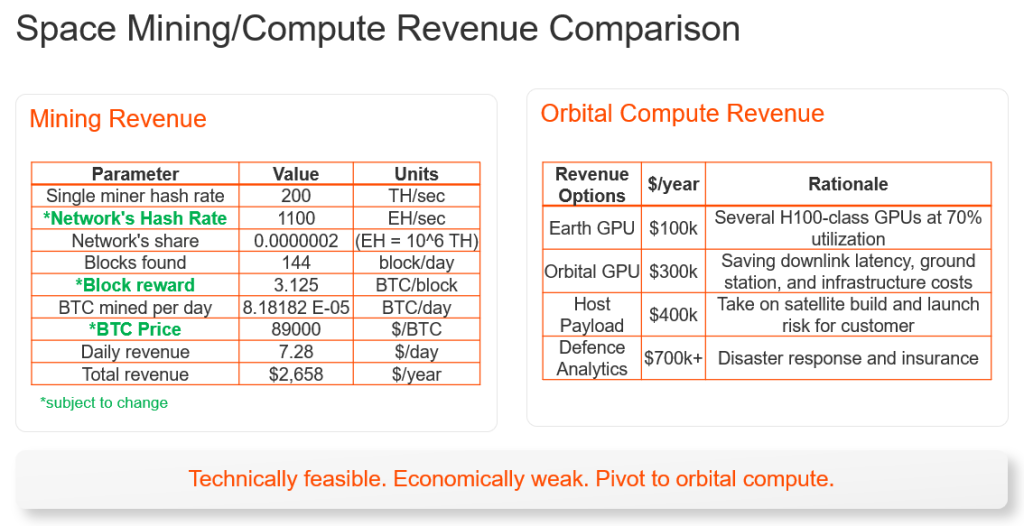
As orbital computing business models evolve, engineering teams will need flexibility to evaluate different payloads, power demands, and operational concepts quickly.
This 1D/3D framework provides a reusable systems architecture with thermal loads that can evolve alongside these new mission concepts. Let’s now explore additional scenarios in more details to get an optimized design variant matching the new requirements.
Explore more designs. Find better solutions with Simcenter HEEDS.
Designing an orbital data center involves countless trade-offs.
- Should solar arrays be larger?
- Does the battery need additional capacity?
- How much radiator area is required?
- Is the compute payload oversized or undersized?
Finding the answers manually can be time-consuming and expensive. By integrating Simcenter HEEDS, organizations can automate design exploration and optimization studies. Simcenter HEEDS intelligently evaluates alternative configurations. The result is:
- Faster design space exploration
- Reduced engineering effort
- More innovative concepts
- Higher-performing system architectures

If your company wants more profits, engineers can look to use a larger compute node. They’ll need more power, so a larger solar array, so a need for more radiative surfaces. The question is simple. Could you make a bunch of models by hand and solve each one? Or should you automate the process to explore your design space automatically, with repeated design evaluations once the workflow has been configured?
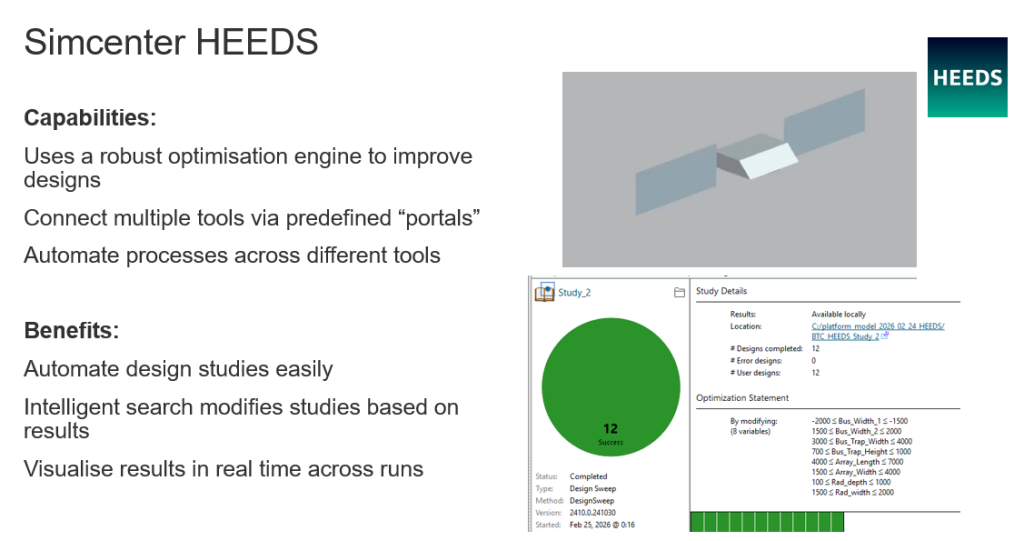
Simcenter HEEDS facilitates automated design studies, helping you intelligently search for optimal solutions based on the results. We used HEEDS to create design configurations and to solve the runs to get the best results. You can see
examples of the different configurations we looked at.
Let’s now move to the last step of this engineering workflow where we’ll generate a geometric deep-learning surrogate model from the Simcenter 3D Thermal results. Now it’s time for Simcenter PhysicsAI to operate.
Reduced Order Models (ROM) for faster execution with Simcenter PhysicsAI
We’ll need an abundance of results for different configurations. So it makes sense to generate a dataset of high-fidelity thermal simulations across multiple design configurations and use those results to train a PhysicsAI surrogate model. to get the 3D thermal results much quicker.
First step is to train a physics-informed surrogate model that uses machine learning to approximate the high-fidelity simulation results just found before.
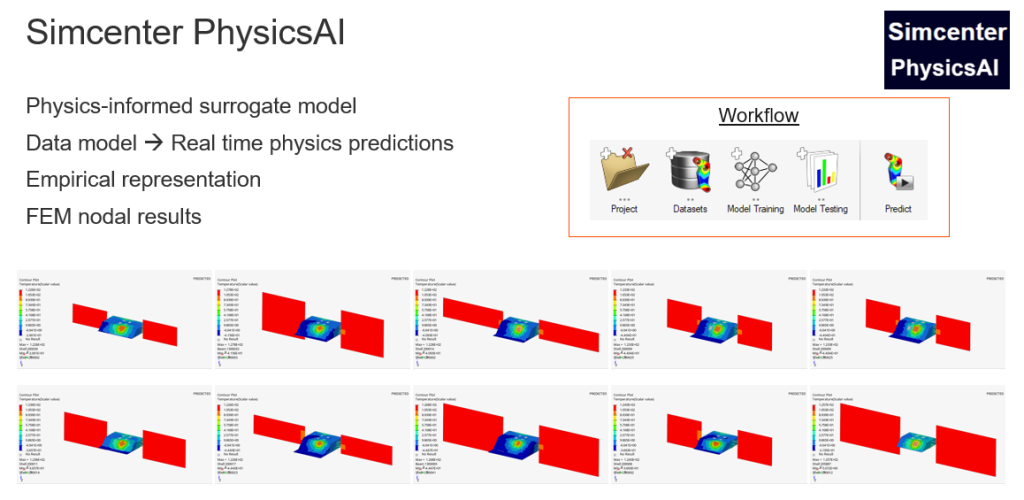
This allows for quick predictions using the data model to evaluate future design options. The workflow goes through dataset used for training and testing. Then we can rapidly predict the response of new designs that fall within an appropriate range of the training dataset.
The Physics AI workflow is done inside Simcenter Hypermesh. By training a surrogate model on detailed thermal simulations, we reduced evaluation time from minutes to seconds. So we can load a new design and get directly the predicted 3D thermal results, it’s a matter of few seconds to analyze these alternative designs.
Turning orbital data center concepts into reality
For organizations pursuing next-generation space infrastructure, 1D System / 3D Thermal analysis delivers benefits far beyond technical analysis. It provides a clear understanding of how an orbital data center will behave before committing to detailed design, manufacturing, or launch activities.
We’ve been able to build a quick running Systems-based representation of our satellite architecture covering power and thermal requirements. So that we can see how it performs in orbit. We were able to detect some issues with the battery state-of-charge (“SoC”) that implied exploring alternative configurations And since we wanted to speed up exploring future designs we then built a machine learning representation to do a quick design evaluation. All these are key achievements.
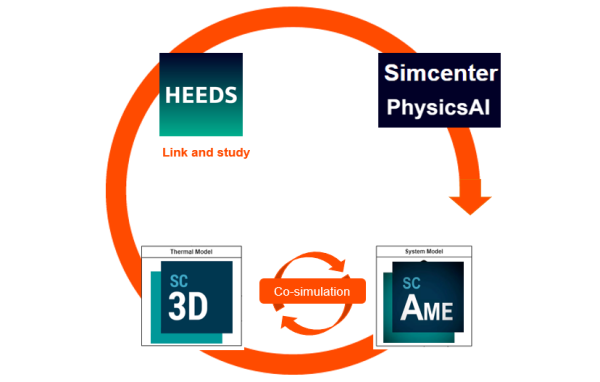
The future of orbital computing will depend on the ability to balance power generation, thermal management, energy storage, and compute performance as a single integrated system. Simcenter Amesim with Simcenter 3D Thermal make this possible.
By providing a system-level digital twin of the spacecraft architecture, engineering teams can move from concept to confidence faster than ever before.
For organizations exploring orbital data centers, the question is no longer whether the technology is possible. The question is how quickly you can design, evaluate, and optimize the right architecture.
Learn more about Simcenter Amesim
Simcenter Amesim is the leading integrated, scalable system simulation platform, allowing system simulation engineers to virtually assess and optimize the performance of mechatronic systems.
Learn more about Simcenter 3D
Simcenter 3D helps you model and evaluate complex product performance by integrating multiple physics domains together from a single simulation modeling environment.