System Simulation for AI factories: A digital twin approach to cooling, power and microgrid for modern data centers
In today’s rapidly evolving digital landscape, data centers are the backbone of our information economy. AI is redefining what datacenters need to achieve and how fast they must evolve. Higher thermal loads, rising power densities, and growing sustainability pressures mean that traditional design methods just aren’t enough anymore. That’s why System Simulation is becoming a competitive advantage.

With Simcenter Systems solutions, engineers can model and optimize an entire Data Center ecosystem, from chip‑level cooling to facility‑wide energy flows, thanks to the predictive results obtained virtually before the real systems exist. Let’s see how to use your digital twins for complete scenarios executed in few seconds/minutes of CPU-time.
System Simulation comes with very fast runs. Which is perfect, knowing such tremendous execution is mandatory when you need to explore so many different scales and interactions, to deliver the outcomes quickly and to get a successful deployment onsite from day 1.
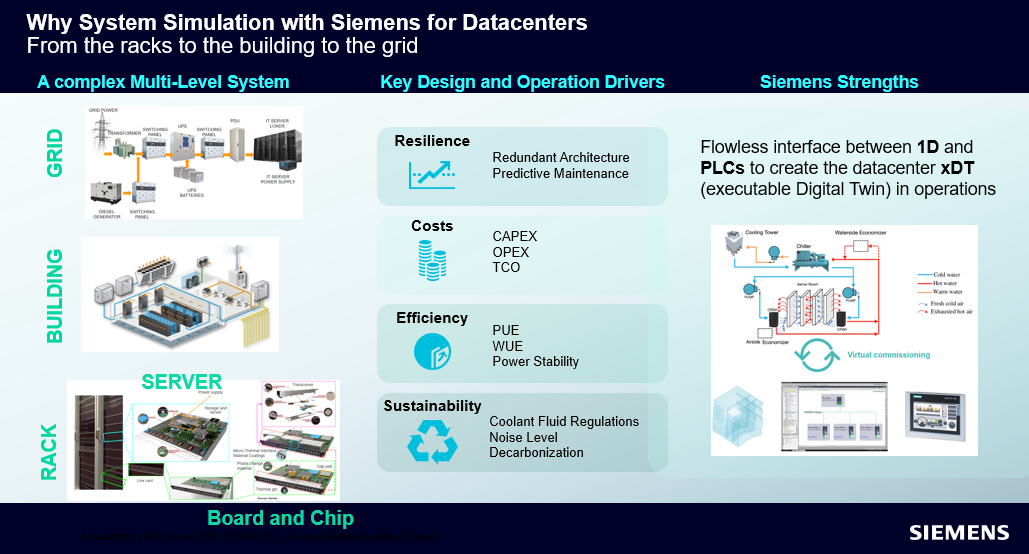
This is impressive, let’s go deeper in the use cases to highlight the benefits of using System Simulation for your AI factories.
A dedicated offer, ready-to-use to tackle new challenges
This is exactly where Simcenter Simulation can help. With advanced digital twins to simulate complex scenarios, quickly executed in few seconds or minutes of fast cpu-time. Typically to address:
📈 Extreme power densities :
Manage HPC racks exceeding 100 kW with advanced power solutions to get most tokens-per-watt.
🌡️ Intense thermal loads :
Replace air cooling with liquid cooling to ensure thermal stability and efficiency.
📐 Urgent, scalable deployment :
Decrease time-to-compute with modular, standardized designs across diverse global sites.
🧩 Operational complexity :
Integrate and manage intricate systems for massive AI workloads while balancing talent shortage.
⚡ Grid constraints :
Adopt flexible energy strategies to accelerate grid interconnection and secure required power capacity.
♻️ Sustainability & decarbonization :
Optimize energy and water use, integrate renewables, and enable AI workloads at massive scale, carbon-aware.
In a world where AI pushes infrastructure to its limits, integrated System Simulation isn’t just helpful, it’s essential.
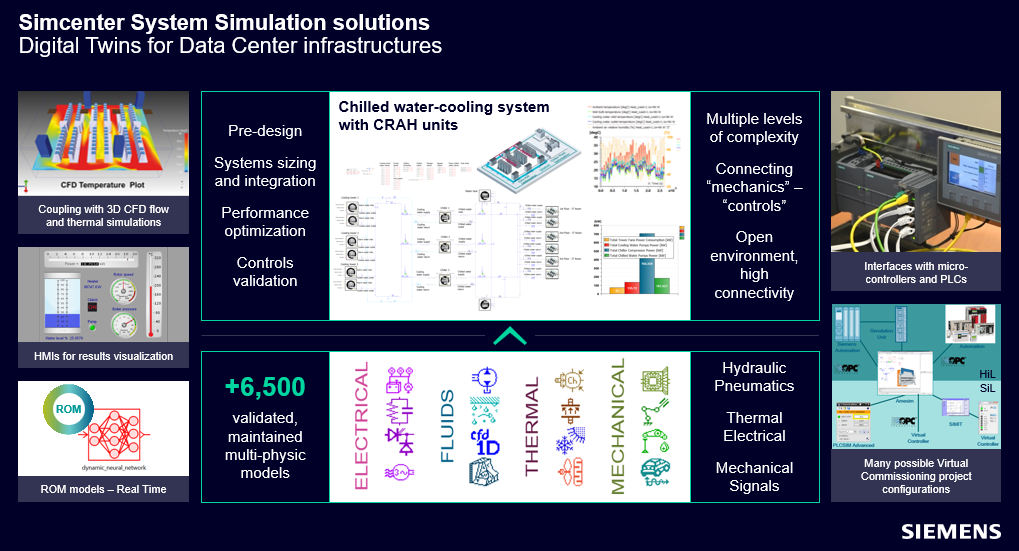
- Indeed you have multi-physic libraries in an integrated environment to represent different physical domains that you find in liquid-cooling such as fluids, thermal, electrics, mechanics. And all these domains interact together in the same system simulation model
- Multiple levels of model fidelity exist … From 1D to 3D models, from functional to detailed geometry-based models, from quasi-static to dynamic models adapted to the specific simulations that you need
- System simulation also supports the control development by coupling easily the high-fidelity physical models with control logics. It includes the connection with PLC Automation for the regulation of fans, pumps and compressors speeds, and several on-off valves within the data center cooling infrastructure
- For in-operation monitoring, smart virtual sensors, anomalies detections and in service performance optimization, artificial Neural Networks or AI with Reinforcement Learning can be easily generated from your high-fidelity simulation models
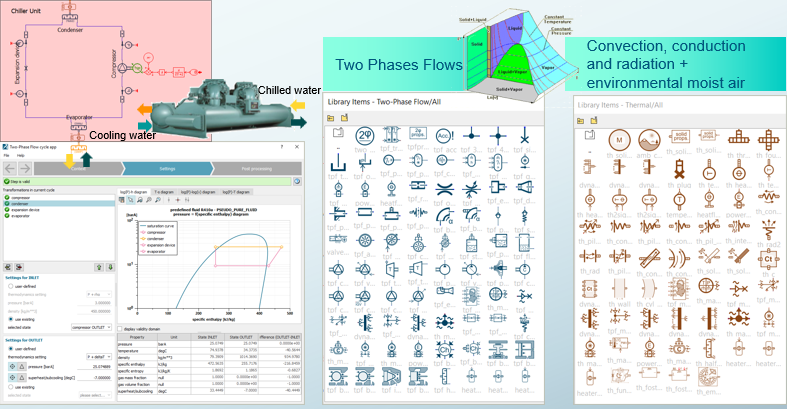
For example here, you can see below the content of some physical libraries of components for refrigerant loops, chiller cooling or heat-pumps with their thermodynamic plots. So you can get the optimal sizing and dynamic behaviors during transient operations in few clicks.
Data Centers that embrace multi‑physics modeling will lead on efficiency, sustainability, and uptime. Curious how simulation could transform your next Data Center project? Let’s have a close look with detailed examples.
Why System Simulation matters for AI data centers
Artificial Intelligence (AI), high‑performance computing (HPC), and GPU‑accelerated workloads are reshaping modern data centers. These facilities must deliver unprecedented compute density while maintaining extreme reliability, energy efficiency, and sustainability targets. Power consumption, heat dissipation, water usage, and resilience are now tightly coupled challenges.
Traditional design approaches based on static sizing rules or isolated discipline studies are no longer sufficient. While these methods are valuable, they often fall short when it comes to understanding dynamic, multi-domain interactions across electrical, thermal, cooling, and control systems, especially over long operational time horizons.
System simulation provides a virtual environment to explore design trade‑offs, evaluate operational strategies, and de‑risk decisions before implementation. Simcenter Amesim, as a multi‑physics and multi‑domain system simulation platform, enables engineers to analyze AI data centers holistically, from chip‑level thermal behavior to facility‑level cooling and power infrastructure.
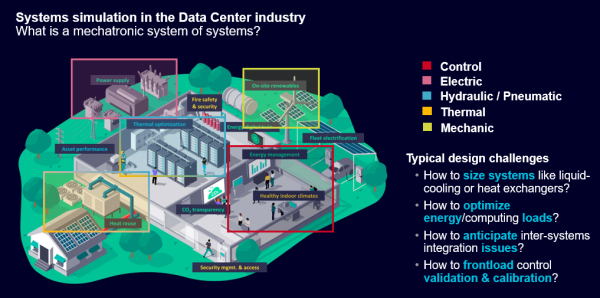
This is where system-level simulation becomes a powerful enabler. Tools such as Simcenter Amesim allow engineers to model and analyze the entire data center as a coupled system, capturing transient behavior, control strategies, and operational scenarios that are difficult or impossible to evaluate using static or isolated approaches.
System simulation focuses on modeling functional behavior and energy flows across a complete system, rather than resolving detailed geometry. In a data center, this includes key challenges:
- Cooling production and distribution
- Thermal response of white space and equipment
- Electrical power generation, conversion, and distribution
- IT load behavior and workload variability
- Control systems and operational logic
System simulation allows these constraints to be evaluated together, capturing interactions that are difficult or impossible to observe with siloed tools.
With Simcenter Amesim, engineers create a virtual digital twin that connects electronics, fluids, thermal, energy, and controls into one coherent system. This transforms data center development from trial‑and‑error into informed design decision‑making.
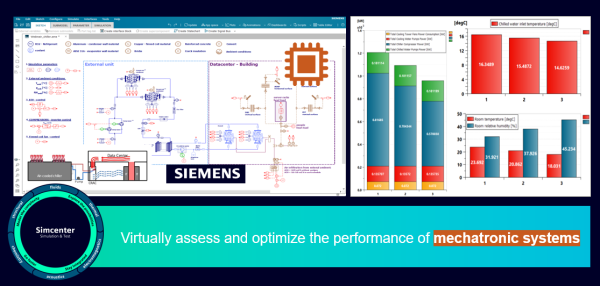
Designing integrated systems with intelligence
Meeting these challenges requires more than incremental optimization. It requires a system-level approach, powered by physics‑based system simulation and digital twins. With Simcenter Amesim, data center stakeholders can design, validate, and operate their infrastructure with confidence, across the full lifecycle.
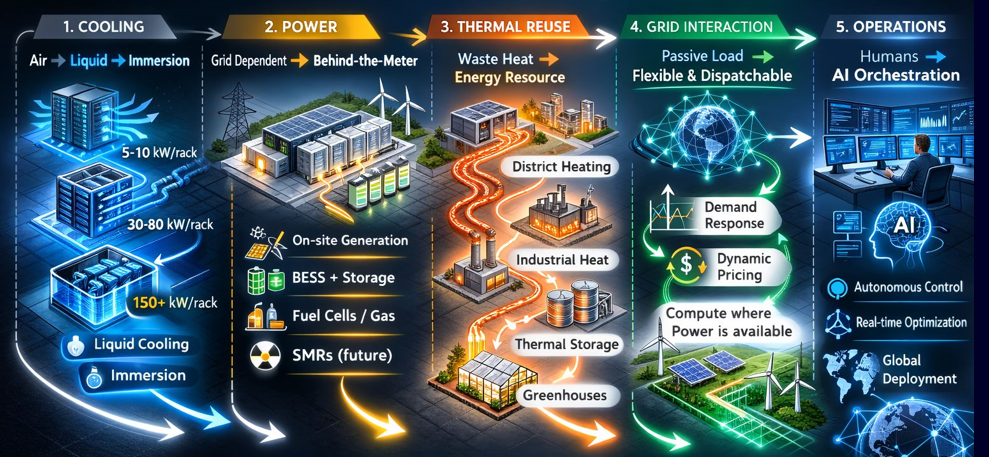
These requirements cascade all over the 5 segments of the Data Center activities:
1. Cooling : Air -> Liquid -> Immersion
2. Power : Grid dependent -> Behind the meter
3. Thermal reuse : Waste heat -> Energy resource
4. Grid interaction : Passive load -> Flexible & dispatchable
5. Operations : Humans -> AI orchestration
Modern data centers are no longer collections of independent subsystems. They are tightly coupled systems where IT workloads, power infrastructure, cooling technologies, controls, and energy markets continuously interact.
System simulation makes these interactions visible. With Simcenter Amesim, engineers can model the complete data center as an integrated system, capturing how changes in compute demand propagate through power consumption, heat generation, cooling response, and control logic. This holistic view enables better decisions, earlier in the lifecycle.
Multi‑scale cooling System Simulation, from chip to facility
Cooling remains one of the dominant energy consumers in AI data centers. Simcenter Amesim supports multi‑scale thermal modeling, enabling engineers to connect detailed component‑level behavior with rack‑, row‑, and plant‑level cooling systems.
At the component and server level, engineers can represent:
- Direct‑to‑chip liquid cooling loops
- Cold plates and heat exchangers
- Flow distribution and temperature gradients
- Transient hot spots driven by workload variation

At the rack and row level, simulation enables optimization of:
- Coolant Distribution Units (CDUs)
- In‑row chillers, Rear‑door heat exchangers (RDHX)
- Manifolds, hoses, and quick‑disconnects
- Redundancy and failure scenarios
At the facility level, Simcenter Amesim models complete HVAC and heat rejection systems, including chillers, cooling towers, dry coolers, economizers, and thermal energy storage. By combining these levels into a single system model, engineers can evaluate how local thermal decisions affect global efficiency, reliability, and operating cost.
Power distribution, energy storage, and microgrids
AI workloads introduce sharp power transients that propagate through the electrical infrastructure. Power quality, redundancy, and efficiency must be ensured from grid connection down to the server power supply.
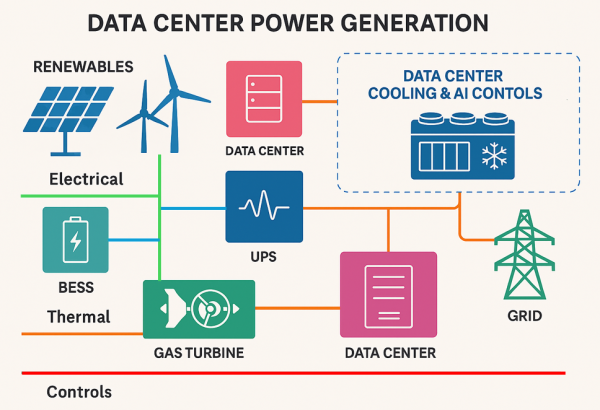
Beyond conventional grid‑connected designs, many AI data centers are adopting microgrids to improve resilience and sustainability. System models can integrate:
- Renewable sources such as solar or wind
- Battery energy storage systems (BESS)
- Backup generators or alternative fuels
- Intelligent control strategies for power dispatch
This system‑level approach enables what‑if analyses for outages, peak shaving, and future capacity expansion long before physical assets are installed.
With Simcenter Amesim, engineers can simulate:
- AC and DC power distribution architectures
- Transformers, rectifiers, and power electronics
- Uninterruptible Power Supply (UPS) systems and battery energy storage (BESS)
- Load‑dependent efficiency and losses
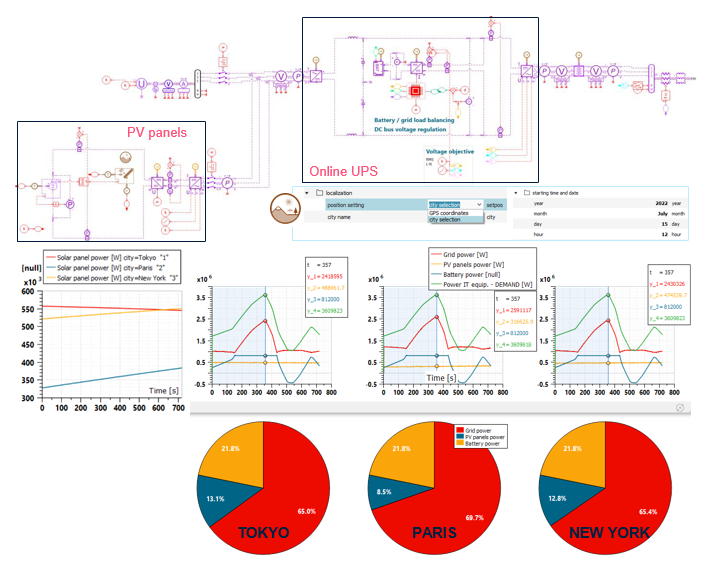
For example, you can evaluate the benefits of renewables based on your data center location (Tokyo, Paris, New-York) and weather conditions, also considering the possible variants for the configurations. To finally optimize the power delivery with photovoltaic panels integration within the microgrid.
Gas turbines, hydrogen, and future‑ready architectures
As data center operators pursue aggressive decarbonization goals, gas turbines, hydrogen and other alternative energy pathways are gaining attention. These concepts introduce new thermal, electrical, and control interactions that must be carefully validated.
Simcenter Amesim supports physics‑based simulation of:
- Gas turbines for continuous or backup operation
- Electrolysis systems converting renewable power into hydrogen
- Hydrogen storage and balance‑of‑plant components
- Fuel cells for on‑site power generation
- Thermal integration with cooling and heat recovery systems
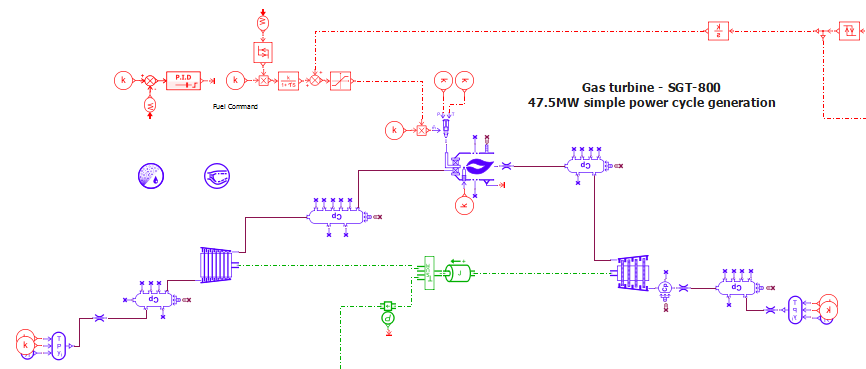
Engineers can simulate multi-domain power systems with:
- Prime movers and power electronics
- Fuel systems, thermal losses, and emissions
- Dynamic transitions between grid-connected and islanded modes
This system-level approach enables:
- Validation of black-start and load-shedding strategies
- Comparison of fuel-based vs hybrid renewable microgrids
- Optimization of generator dispatch under variable IT demand
By representing these technologies within the same system model as the IT and cooling loads, engineers can quantify efficiency, response time, operational constraints, and long‑term performance impacts. Thanks to System Simulation, they can capture electrical, mechanical, and thermal dynamics together, to move from backup-centric designs to active energy management strategies.
Digital twins for design and operation, from virtual prototype to live operations
A system model becomes even more powerful when extended into a digital twin. In this context, a digital twin is not just a static representation but a continuously evolving model connected to operational data.

With Simcenter Amesim, digital twins can:
- Reflect real operating conditions and workload profiles
- Predict temperatures, flows, and power consumption in real time
- Support anomaly detection and root‑cause analysis
- Evaluate control strategy changes before deployment
Such capabilities enable a closed‑loop workflow where design assumptions are validated during operation, and operational data continuously improves future designs.
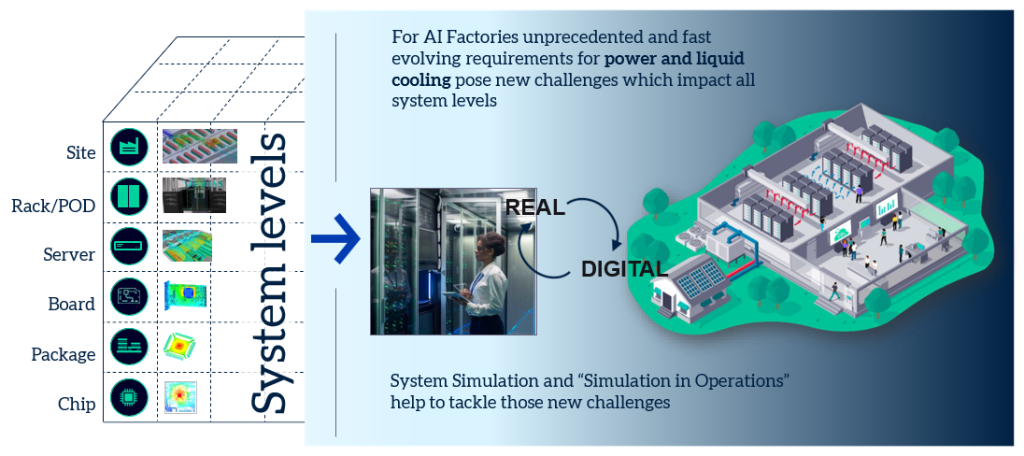
Then you can combine with AI in operations to find out the best control strategies. Typically with some self-adapting algorithms for the DCIM (Data Center Infrastructure Management) or BMS (Building Management System). You can get cooling degradation alerts, or optimize some PUE (Power Usage Effectiveness) improvements in real-time with AI-driven load shifting strategies.
Enabling confident decisions for AI infrastructure
Here are some key takeaways to remind when looking at System Simulation for AI Factories or Data Centers.
For organizations investing in data centers, Simcenter Amesim provides a foundation to build smarter, lighter, more capable AI Factories, faster than competitors.
AI data centers sit at the intersection of extreme performance, sustainability, and reliability requirements. The complexity of these systems demands engineering tools that can capture interactions across thermal, fluid, electrical, and control domains.

Simcenter Amesim enables a system‑level simulation approach that supports the full data center lifecycle, from early architecture studies and component sizing to operational optimization and digital twins.
By virtualizing the data center before and during operation, engineers and operators can make informed decisions, reduce risk, and build infrastructure ready for the next generation of AI computing.
Learn more about Siemens Simcenter Amesim
Simcenter Amesim is the leading integrated, scalable system simulation platform, allowing system simulation engineers to virtually assess and optimize the performance of mechatronic systems.
👁️ Read the white paper here : “Improving Data Center Cooling”
💽 Watch this webinar : “Data center sustainability – Enhancing energy efficiency”