What’s new in Simcenter PhysicsAI 2026.1?
Generative AI for design, broader simulation coverage, dramatic performance gains, and deeper Simcenter ecosystem integration – the Simcenter PhysicsAI 2026.1 release advances AI-powered simulation on every front.
Simcenter PhysicsAI 2026.1 is now available, delivering capabilities that empower engineers to unlock the full value of their CAE data with greater speed, accuracy, and intelligence. Built on the foundation of geometric deep learning , Simcenter PhysicsAI trains AI surrogate models on your historical simulation data and delivers data-driven insights up to 1000x faster than traditional solver simulations. In 2026.1, that foundation grows stronger across every dimension: generative AI for early-stage design exploration, extended SPH particle support for demanding impact and large-deformation scenarios, sharper stress and strain hotspot prediction, automated frequency extraction for NVH workflows, up to 5× faster training with up to 50% reduction in peak memory usage, and a deeper native connection to the broader Simcenter ecosystem.
These enhancements in Simcenter PhysicsAI are designed to deliver:
Faster Engines
Simcenter PhysicsAI Generate: From performance requirements to design concept in seconds
Perhaps the most exciting development in the 2026.1 release is the introduction of Simcenter PhysicsAI Generate – a capability that brings generative AI directly into the engineering design process. The challenge it addresses is one that virtually every product development team recognizes: new design requirements arrive with tight timelines, yet every design variant traditionally requires a full physics solver run before any concept can be confirmed. Exploring a broad design space spanning geometry, dimensions, material parameters, and performance targets simultaneously is simply not feasible at the pace modern projects demand.
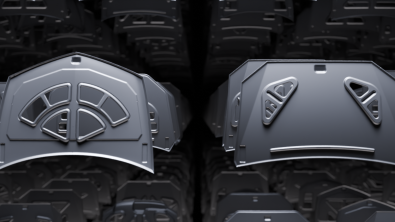
Simcenter PhysicsAI Generate changes that dynamic fundamentally. Powered by diffusion-based generative AI models – it trains on historical designs to learn the deep correlations between geometry, design parameters, and engineering KPIs. Once trained, it produces novel, physics-aware 3D design concepts directly from performance and dimensional requirements, in seconds. Critically, unlike traditional generative tools that apply physics constraints as a post-processing step, Simcenter PhysicsAI Generate produces concepts that are inherently physics-consistent from the outset.
Weeks of iterative design exploration can be compressed into a single workflow, with generated concepts that reliably reflect prescribed performance targets from the very first run. For a deeper look at the technology and vision behind this capability, Generate physics-aware 3D engineering design concepts with Simcenter PhysicsAI is an essential reading.
Training performance improvements – Up to 5× faster, 50% reduction in peak memory usage
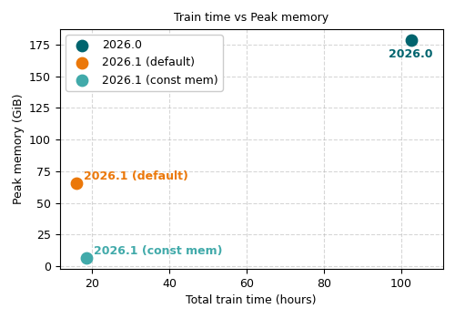
Simcenter PhysicsAI 2026.1 is significantly faster and more efficient at using RAM during training. Memory utilization has been fundamentally improved, delivering up to 5× faster training speeds and up to 50% reduced peak memory usage as compared to 2026.0. In one of the benchmarks, peak memory dropped from 175 GiB to 75 GiB, while total training time was cut roughly in half – meaning teams can train larger, more complex models on the same hardware, faster than ever before.
Teams using the Simcenter PhysicsAI add-on in Simcenter STAR-CCM+ also benefit from newly available multi-GPU support, enabling even faster model training by distributing the workload across multiple GPUs. For more details, see the Simcenter STAR-CCM+ 2606 release blog.
For enterprise teams running large-scale CFD or crash models, this translates directly into faster design iteration cycles, reduced infrastructure costs, and the ability to tackle problems that previously strained available resources.
Smarter Execution
Spatial conditioning: Teaching the generator where things matter
Building on Simcenter PhysicsAI Generate, 2026.1 also introduces spatial conditioning – the ability to condition generative models on point clouds. Rather than constraining the generator only with scalar design parameters, engineers can now define spatially-distributed constraints as 3D point arrays: attachment point locations, load application zones, manufacturing fixture positions, or any other spatially-meaningful design context. These point clouds are specified in companion JSON files during training, and at generation time, users select node sets for each conditioned point cloud directly in the generation dialog.
The result is a generative model with genuine spatial awareness – one that produces concepts respecting real-world geometric constraints, not just abstract performance targets.
SPH particle support: AI-accelerated workflows for your most demanding simulations
One of the most significant capability expansions in 2026.1 is the addition of Smoothed Particle Hydrodynamics (SPH) particle support. SPH simulations are the method of choice for some of the most demanding physics scenarios in engineering – large-deformation impact events, bird strike analysis, and fluid-structure interaction, to name a few.
Until now, SPH particles & point mass elements were not recognized by Simcenter PhysicsAI – limiting its use in explicit simulations. That changes in 2026.1. SPH particles and point mass elements are now fully visible to Simcenter PhysicsAI, enabling it to learn from and predict critical structural integrity indicators – including the number of failed layers, stress, and strain – directly from SPH simulation data. For automotive OEMs, aerospace manufacturers, and defense engineers whose most challenging analyses live in the SPH domain, this is a meaningful step toward AI-accelerated workflows for their hardest problems.
Eigen frequency prediction for modal analysis and NVH workflows
Modal analysis sits at the heart of NVH and structural dynamics workflows. Understanding how a structure vibrates, where its resonant frequencies lie, and how those modes change across design variants is fundamental to delivering products that are quiet, durable, and dynamically well-behaved. In previous versions of Simcenter PhysicsAI, only mode shapes were predicted, requiring engineers to work around a fundamental missing piece in their AI-assisted simulation pipeline.
In 2026.1, that gap is closed. Eigen mode frequency values are now automatically extracted and predicted for modal analysis, with Eigen Model Step Labels automatically associated to each predicted mode shape without any manual intervention. The result is a faster, more accurate normal modes analysis workflow – one where engineers spend less time configuring and more time acting on the insights their models deliver.
Native integration with Simcenter Inspire manufacturing solutions
The value of AI-driven simulation is maximized when it is embedded directly in the tools engineers use every day, not bolted on as an afterthought. In 2026.1, Simcenter PhysicsAI deepens its integration with the Simcenter Inspire manufacturing solutions ecosystem, enabling seamless data exchange and workflow continuity between casting, molding, forming, extrusion process simulation and AI-powered prediction. For manufacturing-driven industries – automotive, aerospace, heavy equipment – this native connection is a meaningful step toward truly end-to-end workflows, where AI accelerates every stage of the product lifecycle from process design to in-service performance prediction.
Constant memory mode: Scaling AI training beyond RAM limits
For teams working with extremely large datasets where available RAM is the hard constraint, 2026.1 introduces Constant Memory Mode. When enabled, Simcenter PhysicsAI stores graph data on disk and loads it into RAM only as needed during training – effectively decoupling dataset size from available system memory. To mitigate the I/O overhead inherent in disk-based loading, an asynchronous loading variant is also available, leveraging multiple CPU threads to prefetch data in parallel and recover much of the speed penalty. For organizations with large historical simulation libraries that would otherwise exceed available RAM, this mode removes what has been a genuine barrier to scaling AI-powered workflows.
Smarter dataset curation: Better data pipelines
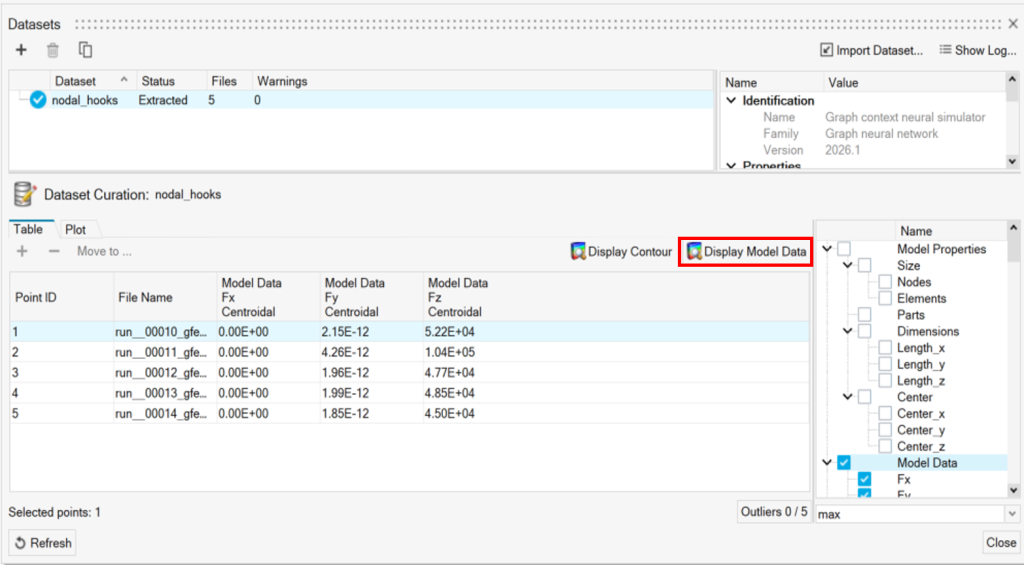
A great AI model starts with great data, and the time spent preparing that data is time that cannot be spent on engineering. In 2026.1, the dataset creation and curation workflow has been meaningfully streamlined. Engineers can now down-select results during dataset creation for faster processing, manage multiple samples simultaneously through batch move, copy, and delete operations, and benefit from response-aware outlier detection that updates dynamically based on the selected output.
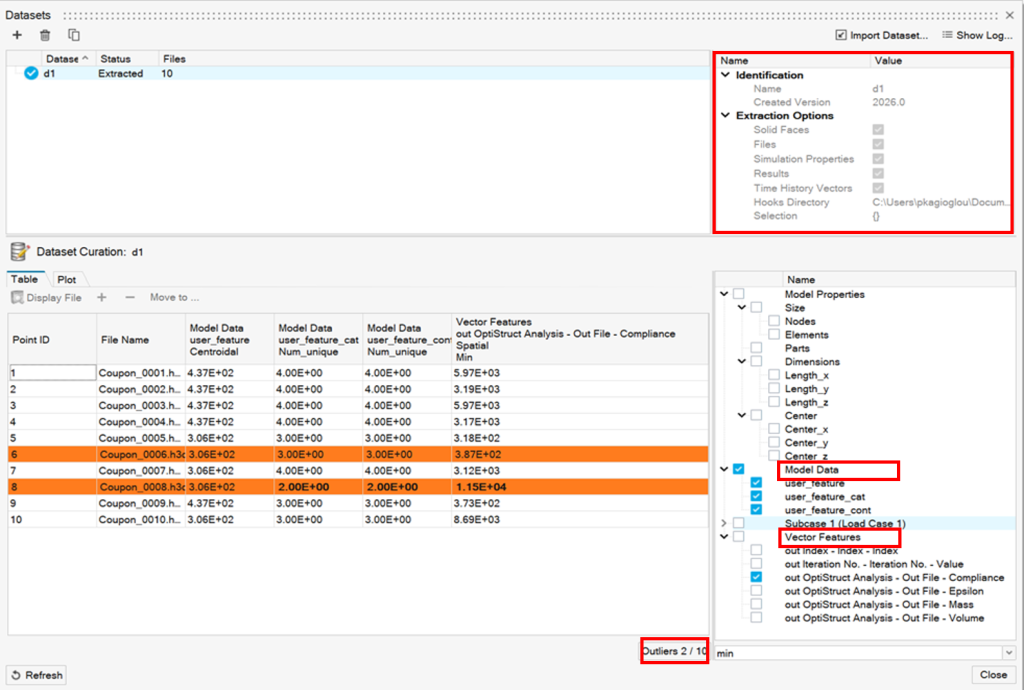
Vector features and custom metadata are now included in outlier analysis and displayed in the results tree and summary views, giving engineers a more complete picture of their data quality at a glance. Collectively, these enhancements make data preparation significantly more efficient and intuitive, reducing the most time-consuming step in building a surrogate AI model.
New welcome dashboard: A smarter, faster starting point
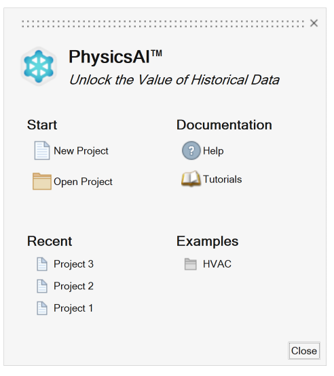
Sometimes the most impactful improvement is the one that gets engineers to value faster. The new Welcome Dashboard in 2026.1 delivers a clean, intuitive entry point to the Simcenter PhysicsAI, making it straightforward to create new projects, open existing ones, resume recent work, access tutorials, and browse built-in examples – all from a single, well-organized screen. Accessible directly from the familiar Simcenter PhysicsAI ribbon, the dashboard reduces the friction of getting started, particularly for new users or teams onboarding Simcenter PhysicsAI for the first time.
Trusted Outcomes
Improved stress and strain hotspot prediction for structural analysis
Finding stress hotspots accurately is not just an academic exercise – it is the difference between a design that passes fatigue life requirements and one that fails in the field.
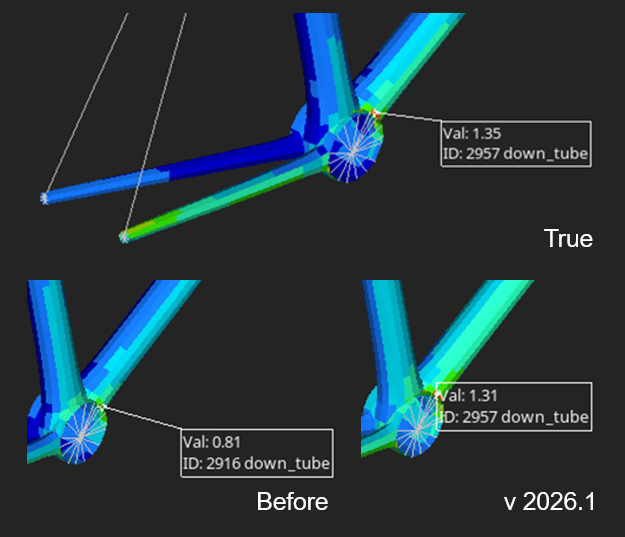
In 2026.1, Simcenter PhysicsAI predicts stresses, strains, and other element-bound fields directly on the elements themselves, bypassing interpolation entirely. A new “Preserve Output Bindings” discretization option ensures that the element or nodal definition of the original field results is faithfully maintained throughout the prediction pipeline. The outcome is sharper, more trustworthy hotspot maps – the kind of accuracy that gives structural engineers the confidence to act on AI predictions rather than simply validate them.
Custom input visualization: Transparency that builds trust in AI predictions
As AI models become more deeply embedded in engineering workflows, transparency becomes essential. Engineers need to understand not just what the AI predicts, but what information it is working with. In 2026.1, users can now visualize custom input features directly within the dataset and testing GUIs – whether those inputs are global scalars, nodal scalars, or vector fields. This gives engineers a clear, visual window into the data that drives the model, making it easier to validate inputs, catch data quality issues early, and build the kind of trust in AI predictions that supports confident decision-making.
New geometric similarity score: Predict with confidence, act with certainty
How do you know whether an AI prediction can be trusted? Simcenter PhysicsAI features a geometric similarity score – an indicator based on geometry and discretization that assesses how similar a new design is to the training dataset. Engineers can instantly assess the novelty of a design and whether a full solver run is warranted, enabling confident AI-driven design exploration while reducing the risk of acting on out-of-distribution results.
In 2026.1, that capability has been significantly strengthened. Previously, similarity scores ranged from −∞ to 1 – a range that was mathematically valid but intuitively difficult to interpret. The new similarity score is strictly bounded between 0 and 1, computed using a mathematically rigorous piecewise smooth curve as a function of the Euclidean distance between the feature encodings of the prediction sample and the nearest training sample.
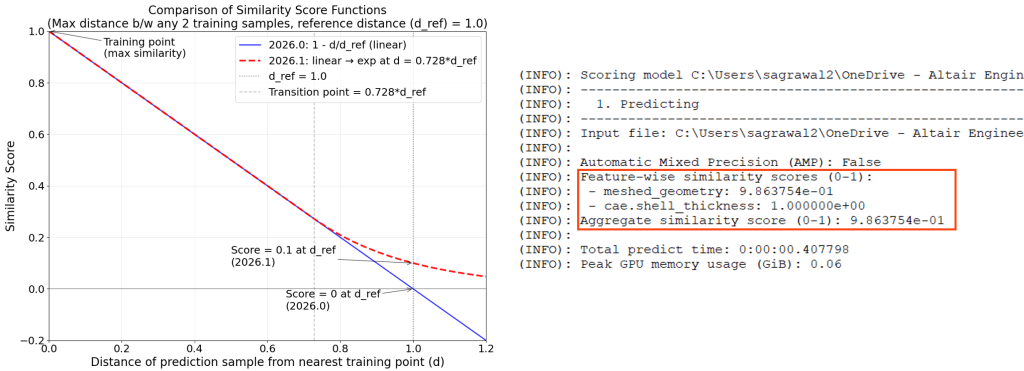
Equally important, the score is now feature-aware: each continuous input feature – shell thickness, meshed geometry, and others – receives its own individual similarity score alongside an aggregate score. This granularity helps engineers quickly identify which aspects of a new design are well-represented by the training data and which might warrant additional caution or supplementary simulation – making AI predictions not just fast, but genuinely trustworthy.
Simcenter PhysicsAI 2026.1 – A solution that keeps raising the bar
Taken together, the updates in Simcenter PhysicsAI 2026.1 tell a coherent story: a solution maturing rapidly across every dimension that matters to engineering organizations. Physics coverage is broader, reaching into SPH-based explicit models and modal dynamics. AI capabilities are more powerful, with generative design and spatial conditioning pushing the frontier of what is possible. Computational performance is dramatically improved, making larger problems tractable on existing hardware. And integration with the broader Simcenter ecosystem is deepening – bringing AI-powered prediction closer to the tools and workflows where engineering decisions are actually made.
Whether you are a NVH engineer predicting modal behavior across hundreds of design variants, a crash analyst working with SPH-heavy impact models, or a design team looking to harness generative AI for early-stage concept creation, Simcenter PhysicsAI 2026.1 has something substantive to offer. The future of engineering simulation is not just faster solvers – it is AI that learns from your data, speaks the language of physics, and delivers answers at the speed of design. That future is here, and it keeps getting better.
Want to learn more about Simcenter PhysicsAI and how it can accelerate your simulation-driven design workflows? Reach out to your Siemens representative or explore https://www.siemens.com/en-us/products/simcenter/engineering-data-science-ai/physicsai/
Note: Simcenter PhysicsAI Generate, spatial conditioning, and constant memory mode are introduced as experimental features in the 2026.1 release.