What’s new in Simcenter STAR-CCM+ 2606?
Simcenter STAR-CCM+ 2606 is now available, delivering advances that empower CFD engineers to tackle your most demanding simulation challenges with greater efficiency and precision. Compute magnetic fields in detailed e-motor geometries with enhanced speed and accuracy, enabling you to model the complexity of modern electrified powertrains. Train AI models up to 3x faster and iterate designs with greater confidence, helping you go faster from concept to validated solution. Accelerate complex combustion analysis and liquid fuel injection simulations in turbomachinery through GPU computing capabilities that dramatically reduce solve times. Monitor and reduce the energy footprint of your CFD simulations with in built reporting. And on the SPH front model complete heat transfer mechanisms in particle-based fluid simulations. Gain more insights with the ability to compare simulation results directly to identify solution differences and explore the possibilities of design variations with clarity.
Discover these enhancements and additional capabilities in Simcenter STAR-CCM+ 2606 to unlock new levels of productivity in your simulation environment. Explore the full range of new features in Simcenter STAR-CCM+ 2606 today.
Learn how to use Support Center
New enhancements in Simcenter STAR-CCM+ are designed to:
Model the complexity
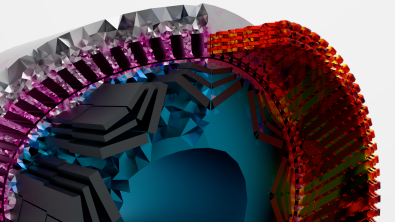
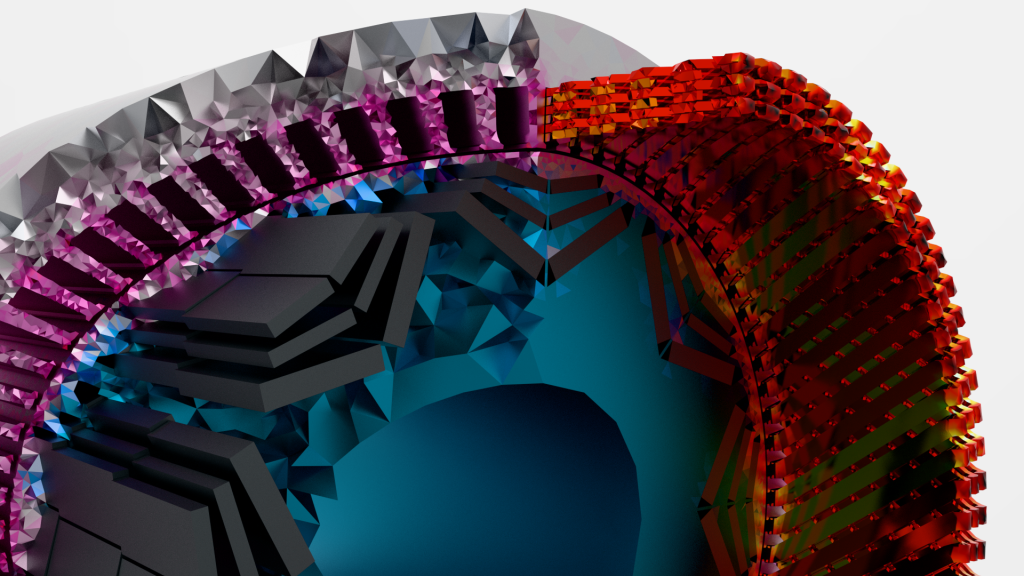
Accelerate electromagnetic simulations for full 3D e-machine CHT analyses
Computing accurate magnetic fields in e-motors has historically been a time-consuming process, often leading to significant delays in design iterations, especially when electromagnetic and thermal effects need to be evaluated together. This challenge can hinder the efficient development of e-machine designs that perform reliably under realistic operating conditions.
With Simcenter STAR-CCM+ 2606, we are introducing a new Finite Element (FE) Magnetic Field solver specifically designed for full 3D e-machine simulation. This powerful new capability significantly improves electromagnetic simulation efficiency while maintaining the accuracy required for reliable torque, loss and field predictions.
By accelerating high-fidelity electromagnetic analyses, motor engineers can more efficiently perform native electromagnetic-thermal simulations, helping reduce design cycle time while improving confidence in thermal hotspot predictions.
Explore the possibilities
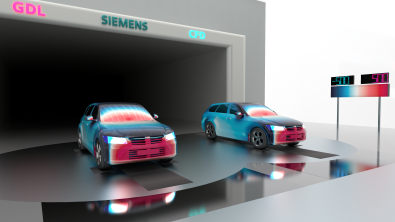
Compare simulation results directly to identify and quantify solution differences
When comparing CFD simulation results from different design iterations or parameter studies, side-by-side visualization often falls short. Subtle but critical differences in flow fields, temperature distributions, or pressure patterns can be nearly impossible to identify through visual inspection alone, leaving you uncertain about which changes truly matter.
The new Simcenter STAR-CCM+ 2606 release addresses this challenge with solution field subtraction operations that enable direct mathematical comparison of two solutions. You can now subtract one solution field from another to reveal exact differences in scalar and vector quantities across your entire computational domain. This capability allows you to identify subtle differences between simulation runs faster and with higher confidence, eliminating guesswork from your analysis workflow. You can quantify the impact of design or parameter changes without manual post-processing, saving valuable time in your iteration cycles. Additionally, you can validate model updates or convergence by measuring solution deltas numerically, ensuring your simulations meet quality standards with objective metrics. The difference fields integrate seamlessly into your existing visualization workflow, making comparison analysis a natural part of your process.
Explore field subtraction operations to accelerate your design comparison workflow and make data-driven decisions with confidence.
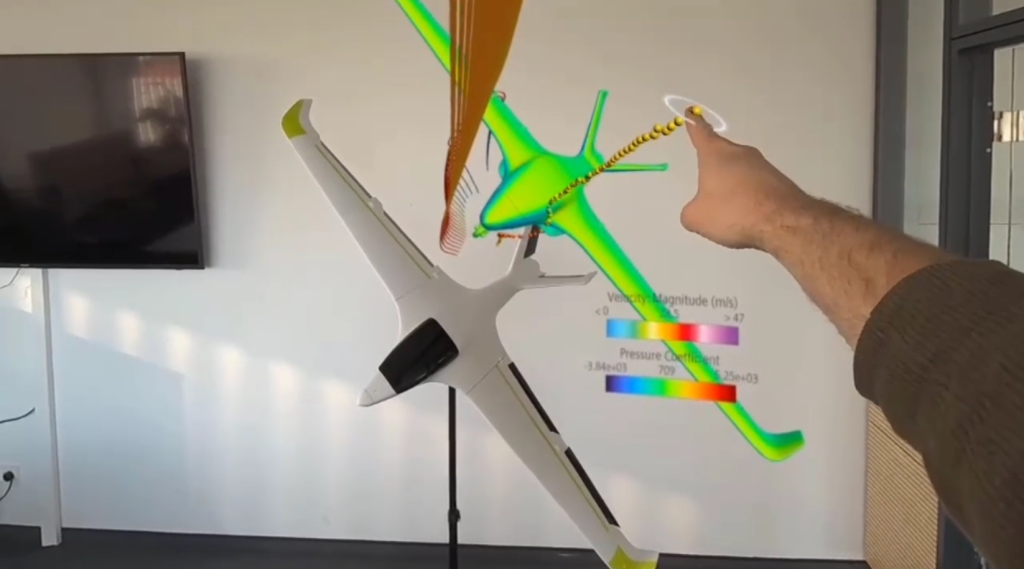
Overlay simulation results on physical products in augmented reality
Communicating complex flow physics and thermal behavior to non-technical stakeholders remains one of the most persistent challenges in engineering workflows. Traditional screen-based visualizations and abstract contour plots often fail to convey the spatial relationships between simulation results and actual products, leading to lengthy design reviews and stakeholder misunderstandings.
The new release of Simcenter STAR-CCM+ 2606 addresses this gap with Augmented Reality Passthrough with Hand Tracking, enabling you to project CFD results directly onto physical prototypes through a mixed reality headset. You can now overlay flow features, thermal patterns, and pressure distributions on the actual hardware in front of you, eliminating the cognitive leap required to translate simulation data to real-world context. This controller-free experience allows you to manipulate and explore results using natural hand gestures while maintaining focus on the physical product. You accelerate design reviews significantly by grounding simulation insights in tangible, spatial context that all stakeholders can immediately grasp.
The intuitive nature of seeing results exactly where they occur on real hardware builds confidence in simulation-driven decisions across your organization. You transform abstract data into compelling, spatially-accurate demonstrations that drive faster consensus and better-informed design choices.
Explore how augmented reality visualization transforms your CFD review workflows and stakeholder communication.
Go faster
Generate meshes for complex geometries in half the time
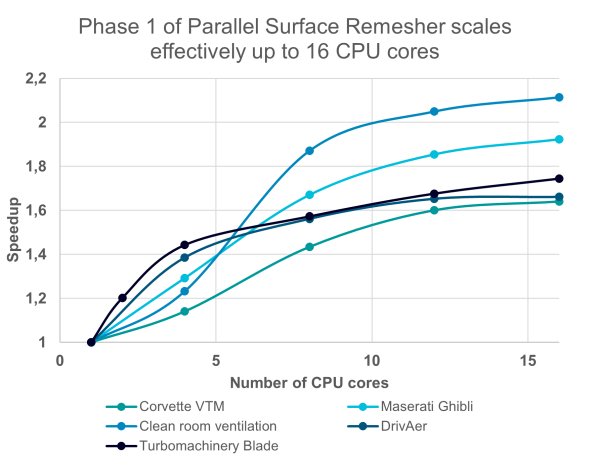
When you’re working with large, complex geometries, surface remeshing can consume a substantial portion of your meshing time, creating bottlenecks that delay simulation results and slow down your design iteration cycles.
The new Simcenter STAR-CCM+ 2606 release addresses this challenge with MPI parallelization of surface remeshing, offering scaling up to 16 CPU cores. You can now complete surface remeshing up to 2.1× faster on complex models, directly cutting down the time you spend waiting for mesh generation to finish. This speed improvement reduces your overall meshing time and accelerates your simulation throughput. You gain the ability to iterate more designs within the same project timeline, making your workflow more productive. By parallelizing what was previously a serial bottleneck, you unlock faster turnaround times from geometry to results. The efficient scaling means you can leverage your existing multi-core workstations without diminishing returns.
Explore how parallelized surface remeshing can accelerate your meshing workflow and boost your productivity.
Train AI models multiple times faster and iterate designs with greater confidence
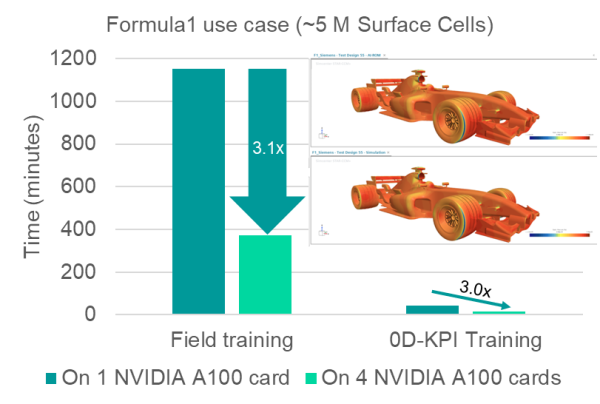
In today’s fast-paced product development environment, waiting days for AI model training creates bottlenecks that delay critical design iterations and slow your decision-making cycles. When training times stretch into extended periods, you lose valuable opportunities to explore design variants and optimize performance within project deadlines.
The new Simcenter STAR-CCM+ 2606 release addresses this challenge head-on with multi-GPU support for the PhysicsAI add-on, enabling you to distribute training workloads across multiple NVIDIA GPUs. You can now complete AI training in one third of the time thanks to near-linear GPU scaling performance. This acceleration allows you to iterate more design variants within the same project timeline, maximizing your exploration of the design space. You make data-driven decisions faster with accelerated inference workflows that keep pace with your engineering schedule. Reduce waiting time and increase productivity as your AI models train while you focus on innovation rather than watching progress bars. Your design process becomes more agile, responsive, and aligned with aggressive development timelines.
Ready to accelerate your simulation-driven AI workflows? Explore how multi-GPU support can transform your design iteration cycles today.
Accelerate liquid fuel injection simulations with GPU computing
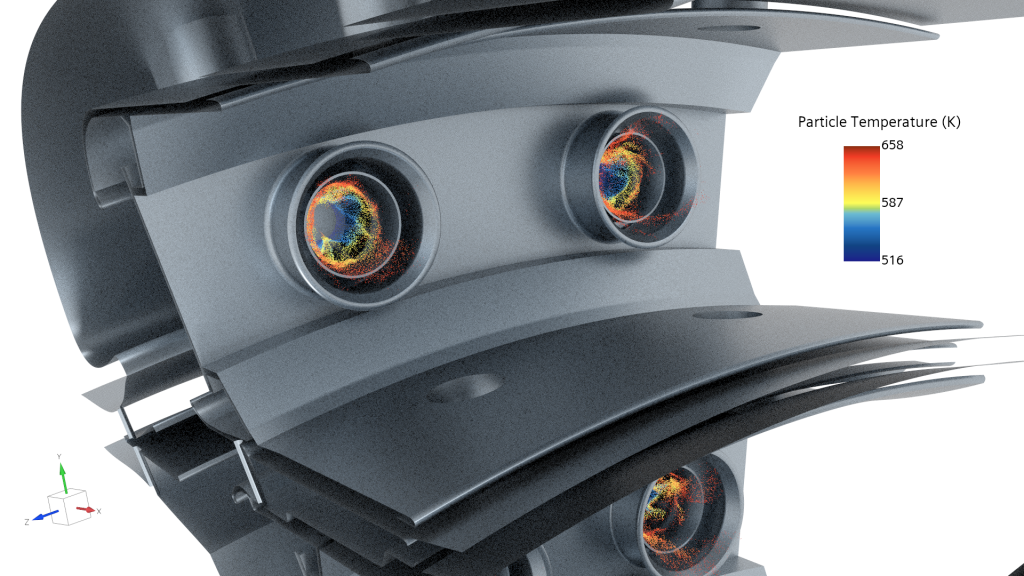
Designing efficient combustors for turbomachinery requires detailed simulation of fuel spray behavior, but traditional CPU-based Lagrangian spray simulations can take days to complete, creating significant bottlenecks in your design cycles. Every design iteration you want to test means waiting for lengthy compute jobs to finish, which delays critical decisions about injector configurations and combustor geometries.
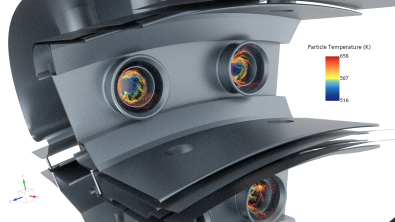
Simcenter STAR-CCM+ 2606 now brings GPU acceleration to the Lagrangian solver with full support for spray models specifically tailored to turbomachinery applications. You can now run the same high-fidelity spray combustion simulations on GPU hardware, dramatically reducing your turnaround time from days to hours. This speed-up allows you to iterate faster on fuel injector designs and explore more combustor configurations within the same project timeline. You reduce the computational cost per design variant, making it economically feasible to investigate a broader design space. Accelerate your path to optimized combustion performance while maintaining the physical accuracy your simulations demand.
Explore GPU-accelerated spray simulation capabilities in Simcenter STAR-CCM+ 2606 and transform your combustor development workflow today.
Accelerate complex combustion analysis with detailed chemistry on GPU
Combustion system designers face a critical bottleneck when analyzing flashback phenomena and emissions: direct species and reaction calculations consume enormous computational resources, slowing down your development cycles and limiting the number of design iterations you can explore. Traditional CPU-based approaches to detailed chemistry simulations force you to choose between accuracy and turnaround time, often leaving critical design questions unanswered until late in the development process.
Simcenter STAR-CCM+ 2606 introduces a GPU-native complex chemistry solver specifically designed for multi-species combustion simulations. This new capability enables you to run detailed combustion chemistry calculations significantly faster than conventional methods. You can now explore more design variants within the same project timeline, accelerating your path to optimal combustion system configurations. You reduce the time required to obtain accurate flashback and emissions predictions, enabling earlier design validation. Additionally, you assess combustion system performance with substantially less computational cost, freeing up resources for broader parametric studies.
Discover how GPU-accelerated complex chemistry can transform your combustion analysis workflow and compress your development timelines.
Stay integrated
Monitor and reduce the energy footprint of your CFD simulations

As HPC infrastructure scales to meet growing simulation demands, energy costs are becoming a significant portion of operational budgets. At the same time, engineering organizations face increasing pressure to meet corporate sustainability targets and reduce their carbon footprint. Yet most CFD users lack visibility into how much energy their simulations actually consume, making it nearly impossible to identify optimization opportunities or report on environmental impact.
The new Simcenter STAR-CCM+ 2606 release addresses this challenge with built-in energy monitoring and reporting that tracks power consumption throughout your CFD runs. You gain detailed insights into which simulation phases consume the most energy, enabling you to make informed decisions about solver settings and mesh strategies. You can monitor your compute resource allocation to identify potentials to reduce operational costs while maintaining simulation accuracy. The comprehensive reporting capabilities allow you to demonstrate measurable progress toward your organization’s sustainability and carbon reduction targets. By making energy consumption transparent, you transform it from an invisible cost into a manageable aspect of your simulation workflow.
Explore the energy monitoring capabilities in Simcenter STAR-CCM+ 2606 to start optimizing your simulation efficiency today.
Resolve Conjugate Heat Transfer mechanisms in conjunction with SPH particle-based fluid simulations
Modeling thermal effects with smoothed particle hydrodynamics (SPH) previously meant decoupling the fluids and heat transfer analyses and required manual data transfer between separate solvers, increasing setup time and introducing potential errors. This fragmented workflow slows down your analysis and creates consistency risks across your simulation chain.
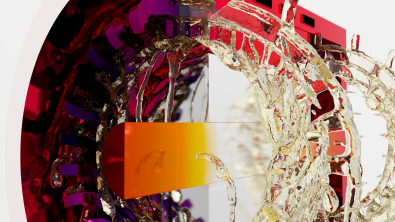
Simcenter STAR-CCM+ 2606 addresses this challenge by enabling the SPH solver to couple directly with the energy solver for conjugate heat transfer simulation. You can now capture fluid and solid temperature evolution simultaneously in a single environment, using direct coupling or a staggered approach to capture longer timescales. The coupled approach delivers more reliable predictions for a computationally efficient method for jet cooling simulations, reduces manual data transfer and eliminates post-processing overhead between separate thermal tools.
Explore how integrated conjugate heat transfer capabilities in SPH can streamline your thermal modeling workflow.
Capture airflow influence on liquid sprays and droplets in SPH simulations
Liquid sprays rarely exist in isolation, in many cases the incoming flow is wind driven, or the object of interest is moving. In simulation we want to account for that interaction with the turbulent airflow, or else there will be significant inaccuracies in predicting spray behavior and dispersion patterns.
The new release of Simcenter STAR-CCM+ 2606 addresses this challenge by enabling you to map FV flow fields directly to SPH simulations as background conditions with full drag coupling. This integration allows you to account for turbulent airflow effects using either transient coupling or a steady steady state flowfield snapshot in your SPH setup. This coupled simulation approach enables you to capture airflow-liquid interactions and predict wind-driven spray in exterior water management studies, or capture windage in drivetrain spray cooling with much higher confidence.
Explore how CFD flow field mapping to SPH simulations can enhance the accuracy of your spray predictions and accelerate your development process.
These are just a few highlights in Simcenter STAR-CCM+ 2606. These features will enable you to design better products faster than ever, turning today’s engineering complexity into a competitive advantage.
A new era for Simcenter
And it does not stop there. With the Simcenter June 2026 release we are bringing together Simcenter and Altair – two of the world’s most powerful simulation portfolios – in a defining moment for engineering.
Gain access to the broadest range of capabilities across modeling and visualization, mechanical, fluids, electromagnetics, systems, HPC, data science, and AI—helping accelerate innovation, simplify workflows, and drive smarter decisions with confidence.