Close encounters of the EMAG kind, hiding in plain sight among CFD. Unveiling the new Electromagnetic Solver in Simcenter STAR-CCM+
I remember very clearly the day I saw the job opening in the Simcenter STAR-CCM+ Product Management (PM) team. The position was called “Technical Product Manager – Multiphysics”. With a PhD in Combustion modeling (which some slightly biased people [a.k.a. every other combustion expert] might consider the pinnacle of “Multiphysics”) and a decent PM experience I applied without hesitation. And you guessed it, I was lucky enough to be hired by an excellent manager and joined a stellar team of talented product managers.
Then, quickly came the moment when I was introduced to what “Multiphysics” in the name was (actually) about. I was given responsibility for three development programs:
- the Fluid dynamics framework team (i.e., the building blocks of CFD solvers)
- the Heat Transfer team (i.e., well, that’s self-explanatory)
- the Electromagnetics (EMAG) team (i.e., yeah, insert here).
In that moment, just like Roy Neary (Richard Dreyfuss) in the 1977 Sci-Fi movie from the great Steven Spielberg, a new (shall we say electrifying?) journey started for me.

Mysterious waveforms hiding in plain sight
Ever since my fluid dynamics classes at university, I very soon had encounters of the CFD kind with Simcenter STAR-CCM+ and its excellent reputation in multiple communities, ranging from plasma to multiphase flows, combustion, external aerodynamics and all things Conjugate Heat Transfer (CHT), to say a few. However, when I started having close encounters of the EMAG kind in a Finite Element (FE)-based framework, built within the same codebase as the Finite Volume (FV)-based solvers, I immediately understood that something more profound was unfolding.
After many years in simulation engineering, it is not uncommon to tend to look at physics through the lenses of a computational scientist, where each set of equations (e.g., Maxwell or Navier-Stokes) is solved iteratively in a very specific sequence via advanced numerical algorithms on a purpose-built discretization made of 100s of 1000s of centroids (or vertices). The mandatory rigor of scientific programming, as well as the vertical nature of many simulation tools out there, may induce the perception that each physics (e.g., EMAG or Thermal) is somewhat detached from the others, just like an EMAG-Thermal co-simulation inherently is.
On the other hand, if one removes the computational science lens all together and reflects on what would be the pure physicist perspective, it is unmistakably apparent that there is no such thing as “detached physics”… nowhere in the universe I’m afraid.
Take Electromagnetics and thermal physics for example.
Their relationship looks simple from a distance, but it becomes wonderfully complicated the closer you get (kinda like an encounter of the third kind, but with fewer flamboyant UFOs and more subtle Joule losses). Magnetic fields generate currents, currents generate losses, losses generate heat, and heat quietly changes the material properties that the electromagnetic field depends on in the first place. In other words, the two disciplines are not just politely exchanging boundary conditions at the edge of the simulation domain; they are having a continuous and sometimes gentle, sometimes brutal 3D conversation inside the medium where the engineer arranged for their encounter.
And that, I like to think, was probably the true description of the challenge I signed up to when I applied for the “Multiphysics” product manager role in 2022.
The E-machine modeling conundrum in the E-era
Fast forward four years, and countless encounters of the EMAG-Thermal-Multiphase kinds, I was privileged to guide a team of brilliant EMAG developers. Together we decided to focus, among other things, on one of the hardest challenges of the Electrification era (E-era): the E-Machine modeling conundrum. From a modeling perspective, an oil-cooled e-motor is less a component and more a small multidisciplinary ecosystem with a rotating shaft. Electromagnetics decides where useful torque is produced and where the less glamorous losses (i.e., iron, copper, and magnet losses) are accumulated across an anisotropic 3D space. Thermal physics then goes to work and quantifies the temperature changes that those EMAG losses inevitably imply. Ultimately, multiphase flows arrive fashionably late, splashing oil through narrow gaps, around end windings, and across hot surfaces while pretending this was the plan all along.
Capturing all of this in a meaningful way requires much more than script-stitching together multiple codes. It requires a simulation environment where FE-EMAG, Heat Transfer, and FV-based fluid behavior can meet, argue, and eventually converge in the most efficient way. That is precisely what Simcenter STAR-CCM+ 2606 offers out-of-the-box. It gives these physics a powerful polymorphic, yet tightly coupled, modeling framework so the engineer does not have to play translator, referee, and occasional therapist between solvers, but rather focus on results assessment and faster design iterations.
The Status Quo and the 2D Elephant
Despite the tremendous innovation accomplished in recent years for traction e-motors, on average the digital product development cycle of e-machines relies on a de-coupled modeling approach. For a Permanent Magnet Synchronous Machine (PMSM) for example, EMAG physics is usually solved in a vertical FE-based tool on a 2D cross-section or on a series of 2D sections (often called a 2.5D approach). Quantities of interest (i.e., rotor and stator torque, iron losses etc.) are then homogeneously extrapolated from 2D results to the entire 3D domains (i.e., stator, rotor, coils and magnets). Such homogeneous losses are then used as fixed boundary conditions for the Thermal and Multiphase simulations performed in a separate 3D-CFD tool, often without the possibility of a feedback loop with the EMAG solver used in the first step.
Relying on 2D electromagnetic simulations to predict losses and then homogeneously mapping those losses onto a 3D thermal model is a bit like trying to paint a masterpiece with a single, broad brush. As investigated by Steentjes et al. as well as by Keum et al., electromagnetic losses, particularly those from eddy currents and hysteresis, are rarely uniform. They concentrate in specific, often localized, regions due to intricate 3D field patterns and material characteristics. Smearing these concentrated “hot spots” evenly across a larger 3D volume dilutes their intensity, leading to an underprediction of peak temperatures and thermal gradients.

Comparison of temperature predicted with presumed (2D) loss distribution (left) with temperature from converged two-way coupled 3D EMAG-Thermal analyses (right). Source Keum et al. IEEE ECCE 2022
A significant underprediction of the EMAG losses, could critically compromise the thermal design, potentially leading to localized overheating, material degradation, and ultimately, reduced component lifespan or even failure.
The brand-new FE-Magnetic Field (FE-MF) solver to the rescue
Despite the accuracy shortcomings, the 2D/2.5D approaches show a significant advantage in terms of computational efficiency compared to full 3D EMAG simulations (including end-windings). In fact, simulation cost is the main reason why most groups choose to compromise accuracy in favor of much shorter run-times.
Over the past few years, the Simcenter STAR-CCM+ EMAG teams stayed focused on a simple yet very bold mission: develop the best-in-class 3D Electromagnetics solver on both accuracy and performance. Thanks to a combination of state-of-the-art algorithms, flexible FE/FV architecture as well as world-class High Performance Computing framework of Simcenter STAR-CCM+, the newly developed FE-Magnetic Field Solver demonstrates strong performance and scalability, enabling engineers to obtain accurate results within a few hours using a reasonable, state‑of‑the‑art core count.
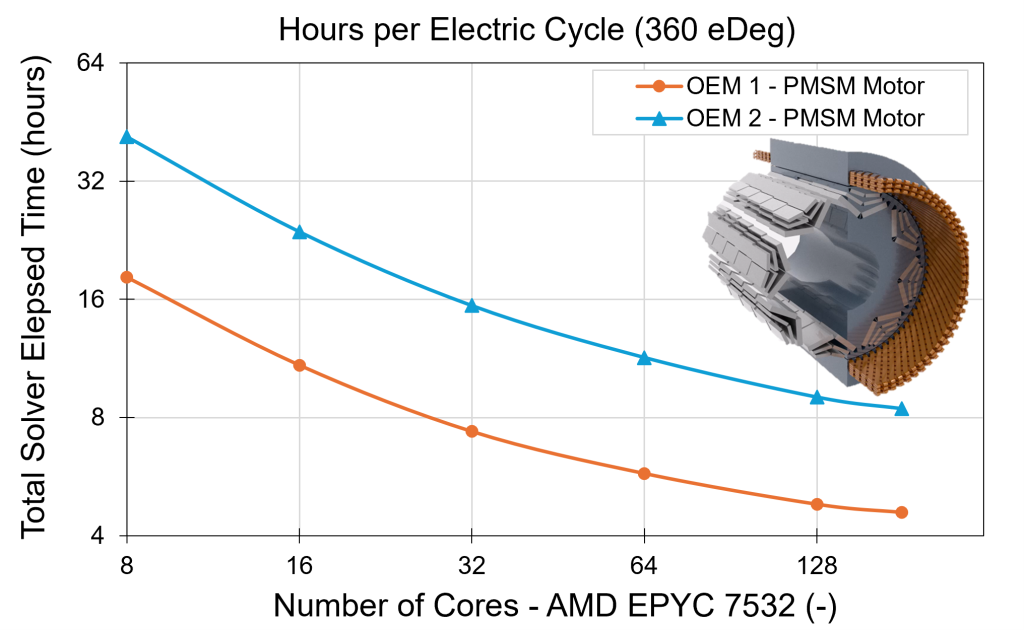
Simcenter STAR-CCM+ 2606 can solves fully featured industrial grade EV traction motors with hairpin end-windings within a handful of hours. It is even more fascinating to put these numbers into a broader perspective and compare total solver elapsed time between the legacy FE-Magnetic Vector Potential solver (FE-MVP) from just a few years ago (2310).
| Version | # of Cores | Total solver time (360 eDeg) | Speed-up |
| 2310 (18.06) FE-MVP | 350 | ~2.7 days | – |
| 2606 (21.04) FE-MF | 180 | ~4.7 hours | ~20x |
The brand-new EMAG-Thermal Template for E-machine analyses
As mentioned in previous paragraphs, another major hurdle of true Multiphysics workflows of e-machines is the efficient model setup, preparation and user-friendly (or lack thereof) run-time orchestration of the EMAG and thermal solvers. Simcenter STAR-CCM+ 2606 has also got you covered on the UX side of things. First, the fact that the FE-EMAG solver sits in the same codebase as a vast array of thermal and multiphase solvers inherently removes the need to repeat and-or transfer mesh and physics settings across different simulation tools. Secondly, a bespoke EMAG-Thermal focused simulation template has been developed for E-motor analysis to make it even easier for new users to get up to speed with Multiphysics workflows without having to grasp all the nuances of Simcenter STAR-CCM+. Furthermore, thorough investigations have been conducted prior to the 2606 release, and the optimized meshing, solver and automation settings have been embedded in the new EMAG-Thermal template.
In other words, using the new EMAG-Thermal template to setup E-motor cases will not only make you save a 1000+ mouse miles (give or take), compared to constructing the .sim file from scratch, but it will also feel like you got help from an elite STAR-user who did all the settings guess work for you, before you even load the CAD. Furthermore, a templated approach is the most solid foundation to ensure repeatability and traceability of complex Multiphysics simulation campaign across multiple CAE team members.
And yes, all the above comes out-of-the-box in Simcenter STAR-CCM+ 2606, courtesy of our stellar application specialists.
From Early design to Multiphysics validation with “one button”
Finally, another major improvement is embedded into the EMAG-Thermal Template, as well as the source code of Simcenter STAR-CCM+ 2606. Since a few releases we have streamlined E-Machine setup transfer from Simcenter E-Machine Design into Simcenter STAR-CCM+. In the 2606 release such connectivity has reached the mighty “one-button-solution” level. Thanks to a combination of new features, from Metadata usage in field functions, to native mapping and storing of quantities, all users have to do is:
- Work on the given design in Simcenter E-machine Design and, when ready, export the model in .scdx file format
- Open Simcenter STAR-CCM+ and import the .scdx file into the new EMAG-Thermal template
- Click on the “Running Person” icon and enjoy a coupled full 3D EMAG-Thermal e-motor analyses.
Such set of features is a game-changer not only because of the shear speed-up gained via the reduced guess-work/number of clicks, but also because it removes completely any kind of friction that may exist between different CAE team members sitting in different departments and in charge of different phases of the E-machine development process.
“This Means Something”
Looking back at the numerous impactful features for E-Machine engineering in Simcenter STAR-CCM+ 2606, and more broadly at my past few years as EMAG + Heat Transfer product manager journey, I still feel like Roy Neary when he, after having encountered unknown alien presence, says “This means Something!”.
Electromagnetic fields are invisible, but their impact on modern engineering is ever more evident. They shape how efficiently an electric motor converts electrical power into motion, how a transformer manages energy transfer, and how heat is generated, transported, and ultimately controlled inside increasingly compact electrified systems.

With Simcenter STAR-CCM+ 2606, a new Finite Element electromagnetic solver brings this physics closer to the rest of the multi-physics simulation workflow, enabling both EMAG and CFD engineering teams to have all kinds of full 3D EMAG-Thermal encounters, simulate design faster than ever before and iterate through designs with peak workflow efficiency via templates.
And if, somewhere in the distance, you see colorful lights and hear mysterious musical notes after clicking Run… don’t worry! It’s not an UFO, but probably just your EMAG, Thermal, and Multiphase solvers finally agreeing on something.