Simulation-driven performance analysis of hybrid-electric regional aircraft

1. Challenge: Designing innovative, performant yet clean aircraft
The air transportation sector is facing the daunting challenge of reaching climate neutrality by 2050, per the commitment made by most of the world’s economies in the Paris Agreement (COP21). Achieving this disruptive transition in such limited timeframe calls for new technology options for realizing climate-neutral aviation1. Innovative technologies are needed to reach the clean aviation goals, and to further improve the performance of aircraft2. Aircraft manufacturers must manage the complexity of the aircraft design process, while incorporating new technology evolutions and responding to shifting consumer and societal demands on aviation.
The shift towards climate-neutral regional aviation will lead to new performant and clean hybrid-electric regional aircraft. Regional aircraft can serve as starting point to implement low or zero-emission technologies, lower the climate and environmental impact of regional aviation2. Developing a hybrid-electrical regional aircraft is highly complex, as one must incorporate new materials, additive-manufactured structures, electrical propulsion systems, and advanced onboard software. Extensive virtual and physical testing are required to ensure the aircraft safety, reliability, performance and cost-effectiveness3.
Towards addressing the clean aviation challenge, Siemens Digital Industries Software partners in the research project HERA (see further: section ‘Acknowledgements’), focusing on technology innovation towards achieving performant and clean future hybrid-electric regional aircraft.
2. The Digital Twin enables aircraft performance analysis
To enable the integration of hybrid-electric propulsion systems into future aircraft, we adopt a simulation-based approach to analyze the hybrid-electric aircraft performance, which is an ongoing R&D activity together with our HERA partners University of Naples Federico II and Leonardo S.p.A. This technology innovation work comprises the development and validation of a parametric digital twin of the ATR72-600, aimed at supporting the integration of hybrid-electric propulsion for future demonstrators4. The architecture of the flight demonstrator is presented in Figure 1.

The digital twin was implemented using JPAD, a Java-based tool for conceptual and preliminary aircraft design. The model incorporates detailed aircraft geometry, an updated propulsion system based on the PW127XT-M engine, and a complete mass breakdown including structural, system, and payload components. A dedicated balance module tracks center-of-gravity shifts under different loading scenarios. The aerodynamic model calculates lift and drag polars using semi-empirical and surrogate methods, enabling the evaluation of trimmed aerodynamic efficiency and static stability.
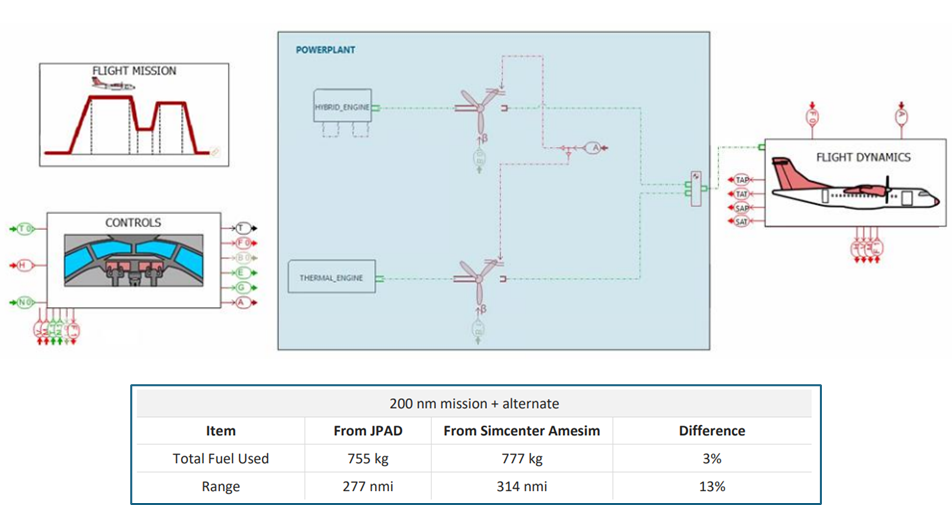
Figure 2 illustrates the Simcenter Amesim5 model from the HERA project and the comparison of 2 important metrics with the JPAD model. The correlation found justifies and motivates to explore more deeply the 2 models results4.
3. Aircraft performance simulation and validation results
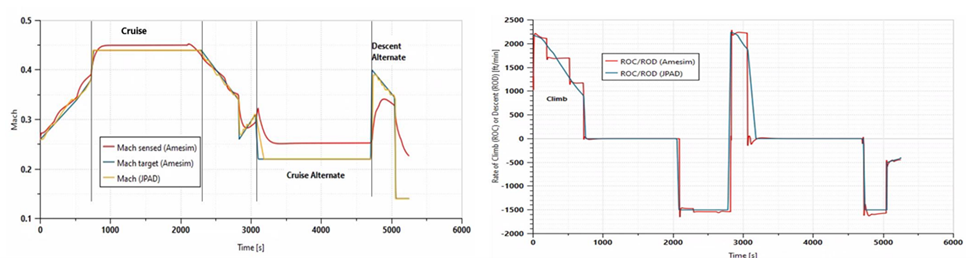
The primary goal was to simulate and validate the aircraft’s performance across a representative mission, providing a benchmark against which hybrid configurations can be assessed. Key point and mission performance metrics – such as Mach number (Figure 3), climb gradients (Rate of Climb / Descent (RoC/RoD)) (Figure 3), ceiling altitudes, cruise fuel burn, and emissions – were computed and compared with publicly available ATR data6. The results showed deviations within 2-3%, demonstrating the model’s accuracy and reliability4.
The validated model was subsequently used to assess a preliminary hybrid-electric configuration featuring asymmetric propulsion: one side retaining the thermal engine, the other equipped with a 200 kW electric motor powered by a 100 kWh lithium-ion battery. Adopting the validated model, it has been possible to reduce the cruise-phase fuel consumption with about 5%, despite an increase of 500kg in powerplant mass. Specific air range improved by up to 3% at representative altitudes and Mach numbers. These results validate the effectiveness of a cruise-phase battery boost via iso-power hybridization4.
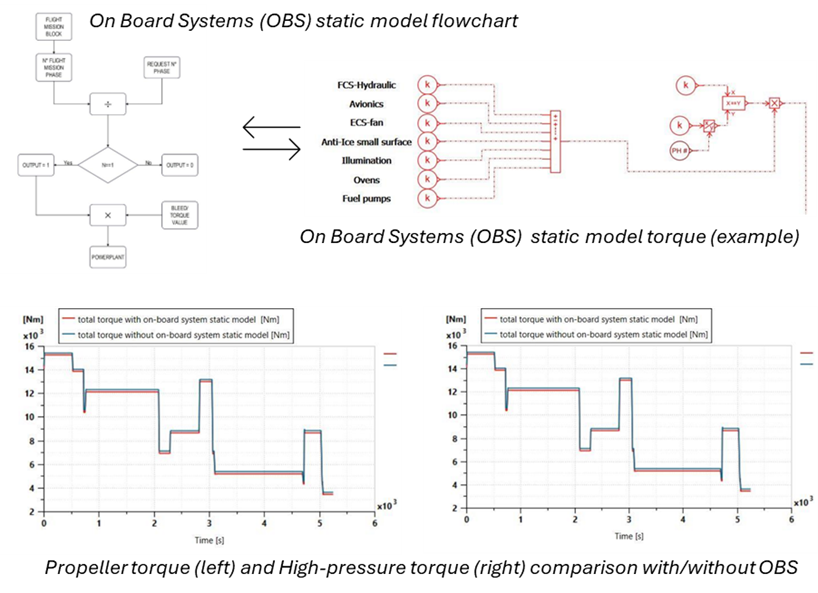
Complementary integration in Simcenter Amesim5 enabled dynamic verification of flight profiles and energy consumption, confirming agreement with the JPAD-based results and enhancing confidence in system-level trends. The modelling approach also evaluated the impact of on-board system loads and cooling demands, guiding design constraints for thermal management and Environmental Control System (ECS) sizing.
4. EASN conference (Madrid, October 2025): Join to learn more!
Siemens Digital Industries Software is proud to contribute to the upcoming EASN 15th International Conference, taking place October 14-17, 2025 in Madrid, Spain. Join to learn more about innovation in aviation & space towards sustainability. To learn more about the research presented in this blogpost, please check out the presentation4 by lead author Vincenzo Cusati (University of Naples, Federico II) and colleagues, with also co-authors of Siemens Digital Industries Software and Leonardo S.p.A. Please check the conference website for the latest planning information.
Acknowledgements
The R&D work leading to this publication has been performed in the frame of the research project HERA (‘Hybrid-Electric Regional Architecture’, nr. 101102007), coordinated by Leonardo S.p.A. as part of the Horizon Europe Joint Undertaking Clean Aviation (CA). The European Commission (EC) is gratefully acknowledged for their support.
References
- Siemens Digital Industries Software, White paper – Carbon neutral aviation by 2050, 2023. ↩︎
- Pacome Magnin, Clean Aviation by 2050? The EU’s public-private partnership approves €380 million for eight new Clean Aviation projects, Simcenter Blogpost, March 19, 2024. ↩︎
- Thierry Olbrechts, Driving digital transformation in aviation (with capable engineering simulation software), Simcenter Blogpost, November 21, 2024. ↩︎
- Vincenzo Cusati, Mario Di Stasio, Fabien Retho, Fabrizio Nicolosi, Rocco Gentile, Valeria Vercella, Performance Analysis of a Hybrid-Electric Regional Aircraft Demonstrator using JPAD and Simcenter Amesim, Proceedings of the 15th EASN conference, Madrid, Spain, October 14-17, 2025. ↩︎
- Siemens Digital Industries Software, Simcenter Amesim, Retrieved 2025. ↩︎
- ATR, retrieved from ATR Aircraft, 2025. ↩︎