Beyond Rule-Based controls: How Reinforcement Learning Optimizes BEV Energy Management
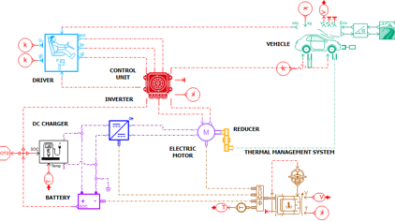
How the Simcenter technology stack integrates multiphysics system simulation, reduced-order modeling, and reinforcement learning (RL) to synthesize optimal control strategies for complex xEV architectures.
In this article, you’ll learn:
- Why BEV thermal and energy management becomes difficult to scale with rule-based control
- How reinforcement learning differs from DP, PMP and MPC approaches
- Why physics-based system simulation is important for RL controller development
- How reduced-order models can accelerate RL training
- How Simcenter Amesim, Simcenter Reduced Order Modeling and Simcenter Studio support the workflow
- Why multi-agent approaches can help address increasingly complex control problems
- How RL controls can be used to extrapolate explainable rule-based logics to be further embedded in ECUs
Battery electric vehicles (BEV) are transforming not only the powertrain, but also the way control systems are engineered. As thermal and energy architectures become more integrated, control software must coordinate more actuators, constraints, and competing objectives across a wider operating envelope.
Conventional development translates physical understanding into rules, thresholds, maps, and calibration parameters. This remains effective and transparent, but it becomes difficult to scale when battery, electric-drive, cabin, coolant, and refrigerant systems interact dynamically.
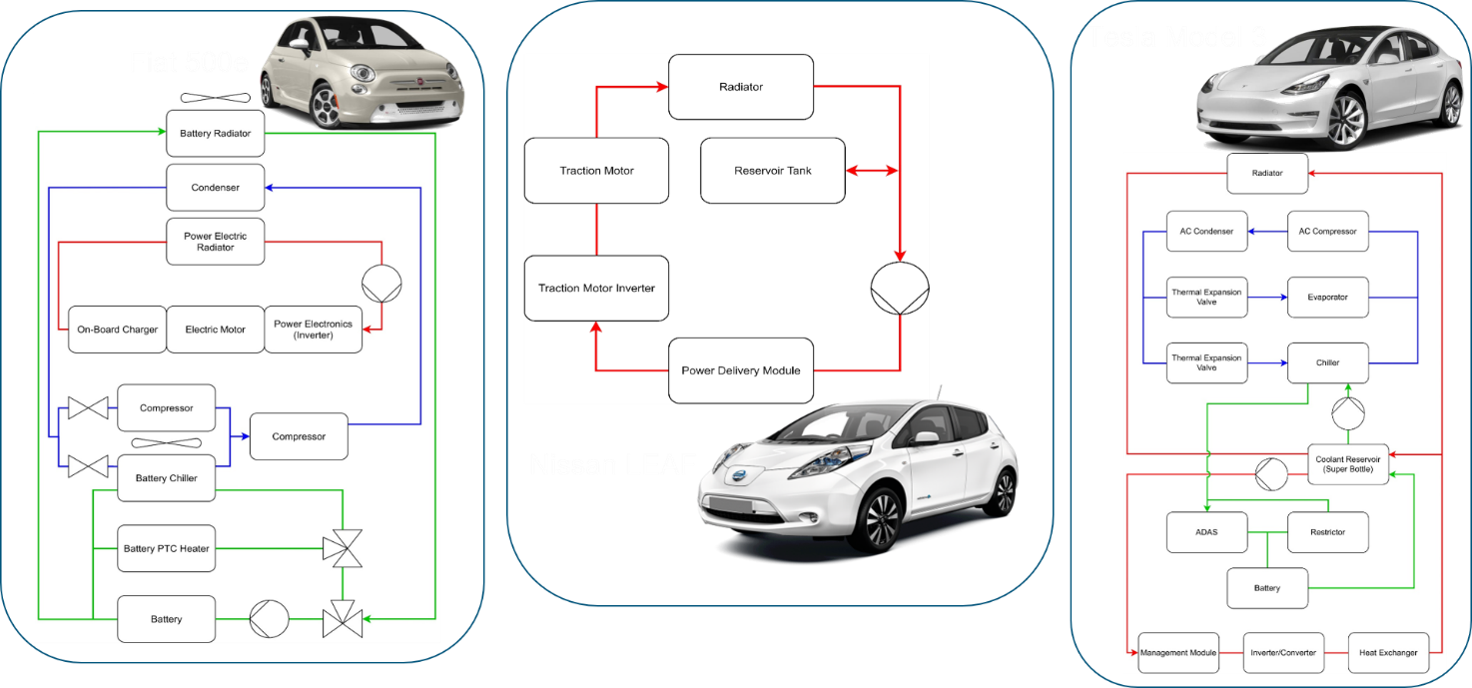
Consider vehicle thermal management. Battery, electric motor and inverter temperatures must remain within defined operating windows. At the same time, heat generated by the electric drive can potentially be reused rather than rejected, while pumps, heaters, compressors, valves, fans and active aerodynamic devices can all influence the vehicle’s energy balance.
Some commands are continuous; others are discrete. The controller must protect components while minimizing energy consumption across changing ambient conditions and operating states. In practice, this becomes a mixed-integer, multi-input multi-output nonlinear optimization problem.
The question is shifting from “Which rules should I write?” to “What should the controller achieve and can simulation help discover the strategy?”
This shift from rule engineering to objective-driven control synthesis is where optimal control and Reinforcement Learning become especially relevant.
In this context, reinforcement learning uses a virtual vehicle simulation environment to learn control strategies that balance objectives such as energy consumption and driver thermal comfort while respecting subsystems’ thermal constraints and preserving component integrity.
Why BEV control is outgrowing rules alone
Rule-based control encodes engineering knowledge directly. Optimal-control methods instead determine the actions that optimize a defined objective. Dynamic Programming (DP), Pontryagin’s Minimum Principle (PMP), Model Predictive Control (MPC), and Reinforcement Learning (RL) among others optimal control methods aim to balance optimality, computational effort, scalability, and real-time applicability differently.
Rule-based control is not inherently inferior. Its strengths are precisely why it remains so widely used: engineers can understand the decisions, boundaries can be explicitly defined and controller behavior can be calibrated.
Scalability is the central challenge. Adding an actuator creates new interactions and operating modes rather than simply one more rule. A system embedding three ON/OFF binary valves and one three-level actuator already has 24 possible action combinations at every decision point.
BEV control is also inherently dynamic: the best action now may depend on future demand, available waste heat, thermal inertia, and downstream constraints. Heating the battery, activating cooling, or accepting a small auxiliary load can be beneficial if it prevents a larger penalty later.
The control theory landscape
There is no universal “best controller.” Each approach addresses the problem differently.
Rule-based control: encode engineering knowledge
With rule-based control, engineers define the control strategy explicitly. Temperature thresholds can activate pumps or fans. Maps determine actuator commands. State machines select operating modes. Parameters are calibrated against different operating scenarios.
Its limitation appears as system complexity increases. Considerable engineering effort can be required to formulate and calibrate a prototype controller, while increasing numbers of coupled actuators expand the combinations and operating conditions that engineers need to consider.
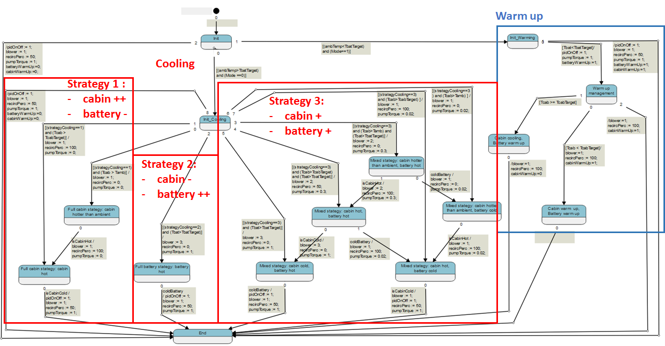
The more integrated the architecture becomes, the harder it becomes to determine whether individually sensible rules produce globally efficient vehicle behavior.
Dynamic Programming and Pontryagin’s Minimum Principle: establish the optimal benchmark
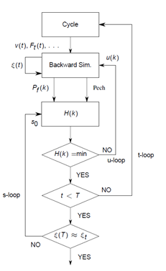
DP and PMP change the perspective by treating control directly as an optimization problem that combines a cost function, system constraints, instantaneous cost and future cost. Optimal-control literature describes these methods as powerful approaches for finding optimal solutions over a defined control problem (i.e. best control setup for a predefined vehicle architecture along a well defined driving cycle).
One of their fundamental limitations, however, is the computational effort required as the dimensions of the state and control spaces increase, commonly referred to as the curse of dimensionality. Those methods are therefore particularly valuable as offline optimization and target-setting methodologies (pseudo closed-loop systems), especially when engineers want to understand what performance could theoretically be achieved over a defined horizon.
They can help answer an important question: what would an optimal controller do if sufficient knowledge of the complete problem were available?
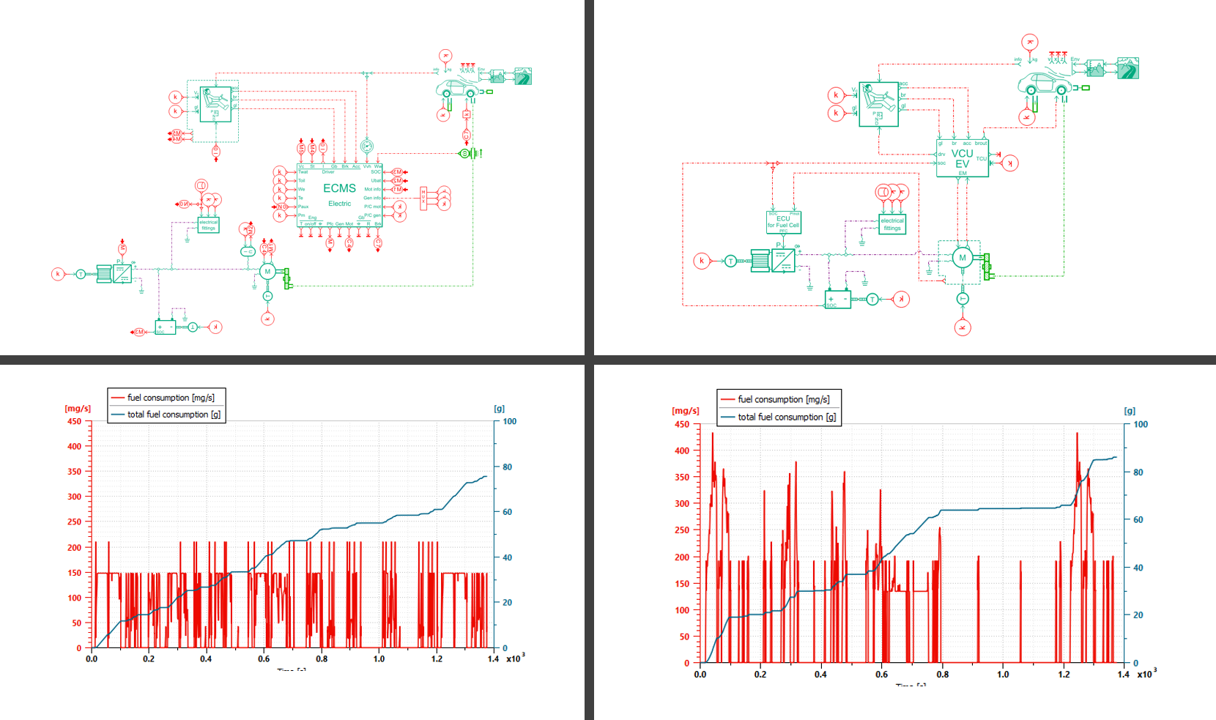
The resulting solution can then provide an important benchmark against which implementable controllers are evaluated.
Model Predictive Control: optimize in operation
MPC brings model-based optimization into closed-loop operation. At every controller sample time, MPC obtains or estimates the current system state, formulates an optimization problem using a plant model, objective and constraints, solves the problem over a prediction horizon and applies the first calculated control action. The procedure is then repeated at the next controller step
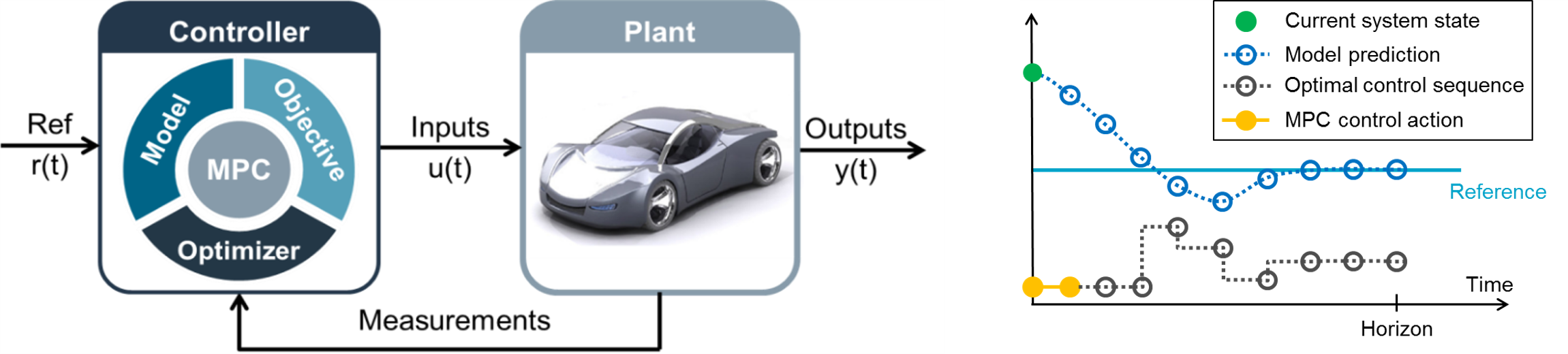
This creates an elegant bridge between modeling, prediction and control. Constraints and competing objectives become an integral part of the controller rather than being handled entirely through manually constructed logic.
However, there is an important engineering trade-off; MPC must solve its optimization problem sufficiently quickly for online operation but faces challenges when dealing with highly nonlinear problems and long prediction horizons.
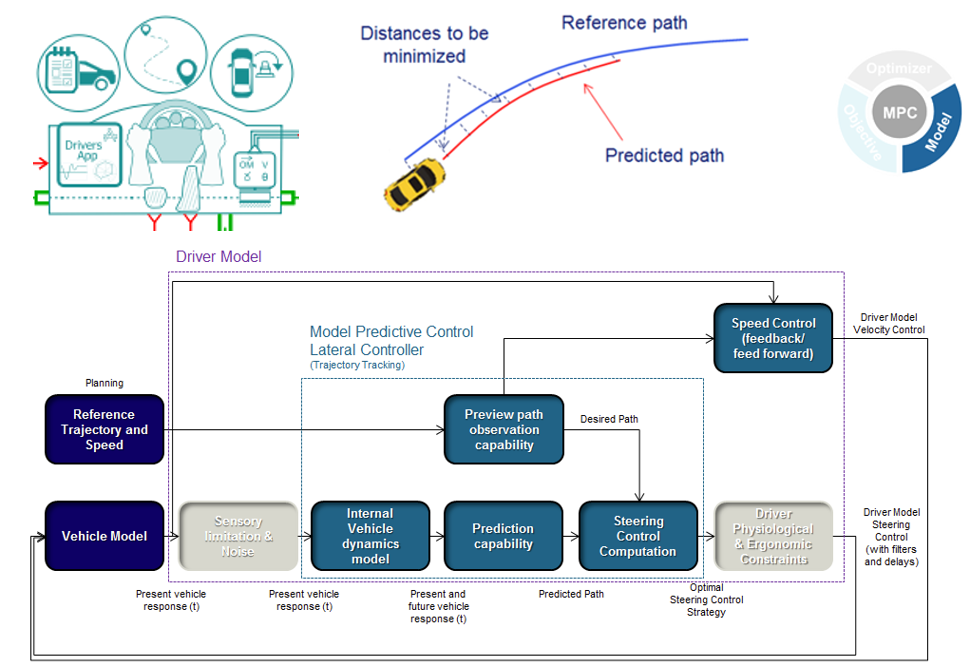
That leaves an intriguing space between exhaustive offline optimization and repeated online optimization. This is where Reinforcement Learning (RL) enters the picture.
Reinforcement Learning: learn through interaction
Reinforcement Learning approaches control from another direction. Rather than providing predetermined correct actions, engineers define an environment and a reward structure. An agent interacts with that environment, observes the system, applies actions and receives rewards. Training seeks a policy that maximizes accumulated reward.
In engineering language:
- Rules become objectives.
- Simulation becomes the learning environment.
- Interactions become training experiences.
- The learned policy becomes a candidate controller.
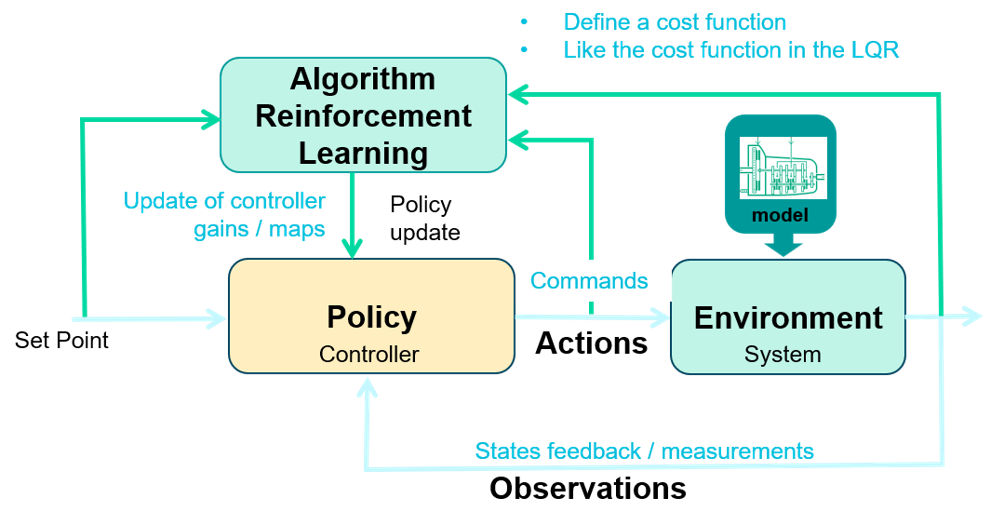
A considerable part of the computational effort can also be shifted to the offline training stage. Once trained, the policy provides control actions during operation. At the same time, RL introduces challenges of its own, including training effort, scenario coverage and the black-box nature of neural-network policies.
This creates a fundamentally different control-development paradigm. Instead of manually specifying the complete strategy, engineers specify the objectives, constraints and learning environment from which a strategy can emerge.
Why system simulation is essential for RL control engineering
An RL agent needs an environment in which to learn. For controller development, strategies can be explored safely and systematically within a sufficiently representative virtual vehicle.
This means that effective RL-based control engineering depends considerably more than selecting a machine-learning algorithm. The virtual environment needs to reproduce the physical interactions that determine whether an action is beneficial. Depending on the control problem, this can include:
- battery electrical and thermal behavior;
- electric-drive efficiency and thermal losses;
- coolant and refrigerant circuits;
- pumps, valves, compressors, and fans;
- vehicle dynamics and operating scenarios;
- boundary and initial conditions.
This is where system simulation becomes a fundamental enabler for AI-based control development.
A three-layer technology stack: physics, speed and smart control
The value comes from connecting 3 complementary tools of the Simcenter portfolio:
- Simcenter Amesim for multiphysics system modeling and closed loop simulation
- Simcenter Reduced Order Modeling for computational acceleration
- Simcenter Studio for RL control setup, training and algorithm synthesis
Together, these technologies create a pathway from physical understanding to automated control-strategy exploration.
Layer 1: Simcenter Amesim provides the physics foundation
The first layer is Simcenter Amesim, providing the multiphysics system model representing the virtual vehicle and its subsystems.

A full vehicle energy-management model can integrate vehicle and thermal-management systems, control, boundary conditions, initial states and a driver scenario; this matters because optimal control cannot be separated from system architecture.
A controller may discover an efficient strategy because a particular thermal architecture makes that strategy possible. Conversely, a promising architecture may not deliver its full potential if the controller is unable to exploit interactions between subsystems.
Combining controller exploration with physics-based system simulation therefore creates the opportunity to investigate plant and control simultaneously much earlier in development.
Layer 2: Simcenter Reduced Order Modeling makes training computationally practical
High-fidelity physics models provide valuable system insight, but Reinforcement Learning introduces another critical requirement: repetition.
Training an RL controller can require large numbers of interactions between the agent and the virtual environment. As training scenarios and episodes are repeatedly evaluated, the CPU time required by the underlying plant model can become a practical constraint.
This is where Simcenter Reduced Order Modeling becomes particularly valuable; a ROM provides a computationally efficient representation of a more complex system while preserving the behavior required by the intended application. In an RL context, the objective is not necessarily to replace the entire physics-based vehicle model with reduced models; instead, ROM can be applied selectively to the subsystems responsible for the largest computational burden.
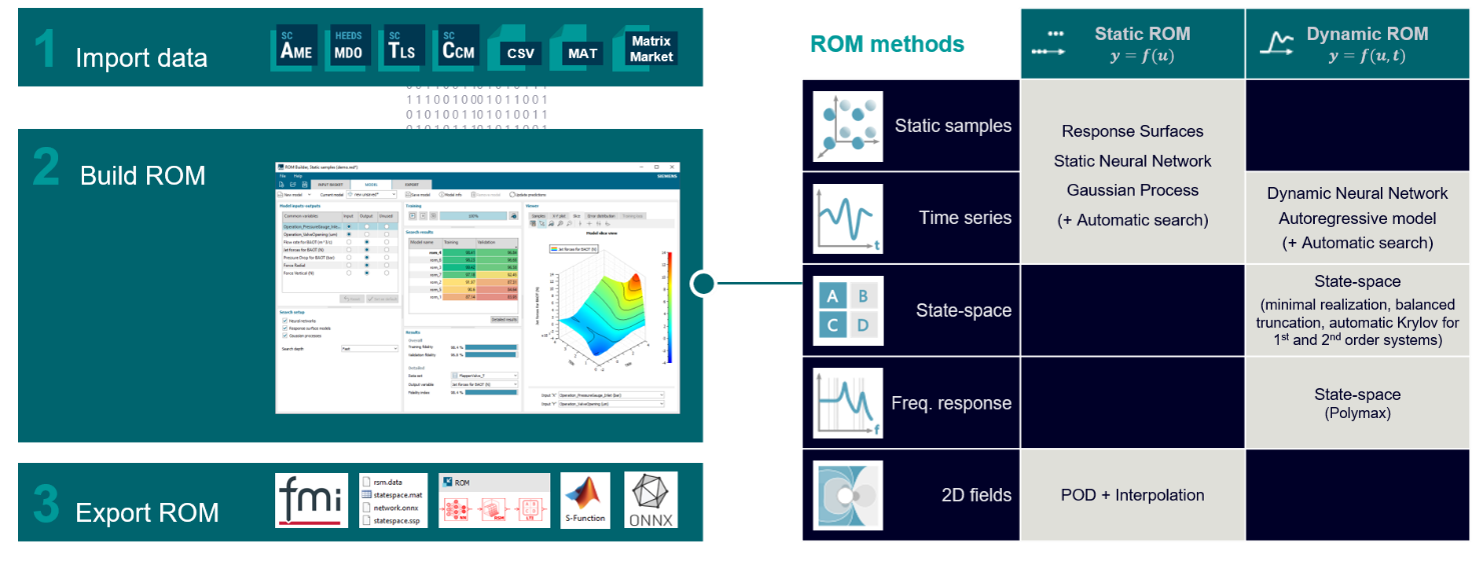
For BEV thermal and energy management, refrigerant circuits are particularly strong candidates for reduction. Two-phase flow combines nonlinear phase-change physics, fast and slow dynamics, and a richer set of state variables representing liquid and vapor fluid media. A detailed refrigerant loop can therefore become one of the most computationally demanding parts of a full-vehicle thermal model.
Simulation results from a physics-based HVAC model can train a dynamic neural-network ROM; the reduced representation can then replace the detailed subsystem during RL training while remaining connected in closed loop with the controller, cabin, and the vehicle.
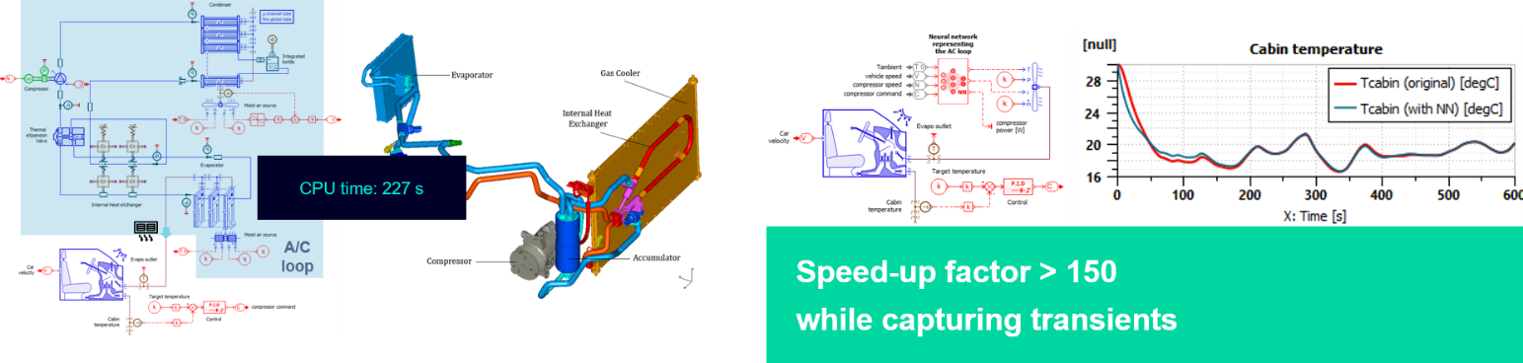
This selective approach retains explicit physics where runtime is acceptable and accelerates only the subsystem that limits training throughput. The result is a faster learning environment without discarding the system dynamics that matter to control performance.
Layer 3: Simcenter Studio supports RL-based control engineering
The third layer connects the system simulation environment with the controller generation framework leveraging FMI standards.
Simcenter Studio provides a framework for generating controllers using Reinforcement Learning on nonlinear plant models, with the objective of accelerating controller generation during early engineering phases.
From an engineering-workflow perspective, this positions Simcenter Studio as the environment in which the RL control problem is configured, calibrated and the control strategy synthesized, with the simulated plant providing the environment with which the RL agent interacts.
Scaling from one agent to specialized teams
Another important consideration emerging from engineering practice is the scalability of the RL architecture itself. A sophisticated BEV contains many actuators with fundamentally different characteristics. Asking one agent to control the complete system can itself become a scalability problem.
As an example, consider extending the control problem from a few binary heating actuators to a complete heating-and-cooling system with several valves and actuators; as the joint action and observation spaces expand, controlling the entire system using a single RL agent can become impractical.
A hierarchical multi-agent architecture provides an alternative by decomposing the problem into supervisory and specialized control functions.
- Supervisory agent: selects the operating mode and strategic intent
- Specialized heating agent | Specialized cooling agent: determine the appropriate thermal actions by operating individual continuous and discrete actuators
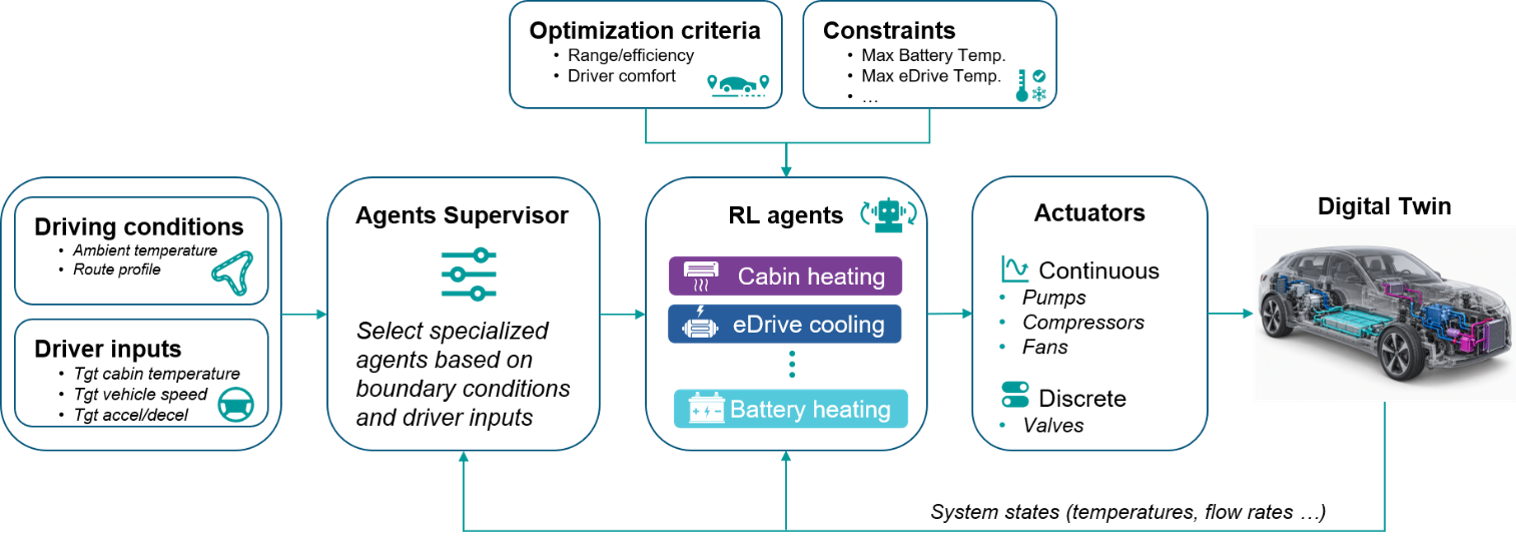
This choice reflects an important systems-engineering principle: decompose a complex control problem according to responsibilities and decision types.
A supervisor can handle strategic decisions while specialist agents handle operational execution. This opens an interesting path toward scalable AI control architectures rather than relying exclusively on a single monolithic neural-network controller.
What benefits can this approach bring?
The real question, of course, is whether additional sophistication can produce meaningful system-level benefits. A physics-based Simcenter Amesim vehicle thermal-management model can be combined with model-reduction techniques and multi-agent Reinforcement Learning to explore alternative energy-management strategies.
A Hyundai Motor Group case study reports energy savings of up to 30% when targeting thermal-management-system losses with this type of approach.
The methodology provided by Simcenter Engineering Services has boosted efficiency in exploring the optimal control strategies of different thermal system architectures from the early vehicle development phase. This solution empowers engineers to prioritize KPIs, streamlining the virtual development process and saving time
Hwanghi Park, Hyundai Motor Group
The exact improvement will always depend on architecture, baseline controller, operating cycle, objectives, constraints, training coverage, and reward formulation so varying case by case. More broadly, RL can expose control strategies that engineers might not naturally express through conventional calibration rules. Its value is therefore twofold: improving performance and accelerating strategy discovery.
Learning-based control still needs engineering knowledge
There is an important caveat. A trained neural-network policy can provide attractive performance while remaining difficult to understand, verify or ultimately deploy within conventional engineering processes.
The black-box limitation of RL therefore deserves attention alongside its optimization potential. One possible direction is particularly interesting: instead of automatically considering the RL policy to be the final controller, RL can be used to discover an effective strategy from which a more interpretable controller can subsequently be derived.
This suggests a compelling philosophy: RL does not necessarily have to be the final controller. It can be the technology that helps discover what the final controller should do. In this interpretation, RL can become a teacher, benchmark or strategy explorer.
As an example, trained agents can be exercised across multiple scenarios, generating observations and actions from which interpretable decision-tree models can be trained. The derived rules can then be simplified, checked for physical meaningfulness and compared with the original RL policy in simulation.
This creates a potential bridge between AI exploration and engineering interpretation, verification and deployment.
For increasingly integrated BEVs, control software is a decisive lever for extracting value from the physical architecture. The engineering environment must connect three capabilities:
- Simcenter Amesim provides the physics – a system-simulation environment that can represent the interactions between battery, electric drive, thermal circuits, actuators and the overall vehicle.
- Simcenter Reduced Order Modeling provides the speed – Reduced Order Modeling can target computationally demanding portions of the virtual vehicle, such as a detailed two-phase refrigerant circuit, while preserving the dynamic behavior required by the controller.
- Simcenter Studio enables the environment to train and synthesize RL controls -Reinforcement Learning can then explore how the simulated system should be controlled against the engineer’s objectives and constraints.
Together, this technology stack enables an engineering workflow capable of addressing questions that become increasingly difficult to solve through manual rule development alone:
- What is the best achievable energy performance of this architecture?
- Which actuators should cooperate, and when?
- How should thermal protection and energy consumption be traded against each other?
- Which control strategy best exploits a new thermal architecture?
- Can an effective control strategy be discovered before the physical vehicle is available?
The goal is not to replace the control engineer with AI. It is to give engineers a scalable way to explore the expanding design space created by electrification while keeping every decision connected to vehicle physics.
The next generation of BEV control may therefore be designed less by writing ever more complex rules and more by combining physics, fast-running models, optimization, and learning to discover what those rules should be.
Frequently Asked Questions
What is Reinforcement Learning?
Reinforcement learning is an approach in which an agent learns control strategies by interacting with a simulated environment and receiving rewards based on defined engineering objectives.
Why use Reinforcement Learning instead of rule-based control?
Rule-based control remains transparent and effective, but managing interactions between many actuators, constraints and operating conditions becomes increasingly complex. Reinforcement learning provides another way to explore control strategies based on objectives and constraints.
Why is system simulation important for Reinforcement Learning?
Reinforcement learning requires an environment in which the agent can repeatedly explore different actions. Physics-based system simulation can provide a virtual representation of the vehicle and the interactions between its electrical, thermal and mechanical systems.
How can reduced-order modeling help Reinforcement Learning?
RL training can require many interactions with the simulated vehicle. Reduced-order models can replace computationally demanding subsystems with faster representations while retaining the behavior needed for the control problem.
Can Reinforcement Learning replace conventional vehicle controllers?
Not necessarily. The blog presents RL not only as a potential controller but also as a strategy-discovery tool. Learned behavior can potentially help engineers derive more interpretable control approaches.
How do Simcenter tools support Reinforcement Learning control development?
The workflow described combines Simcenter Amesim for multiphysics vehicle modeling, Simcenter Reduced Order Modeling for computational acceleration, and Simcenter Studio for RL control setup, training and synthesis.
Want to try Simcenter Amesim yourself?