Smart virtual sensing for EV battery durability testing

If you’ve been following the electric vehicle revolution, you know the headlines: EVs are getting heavier, batteries are expensive to replace, and recalls related to battery issues are on the rise. In fact, carmakers have recalled close to one-fifth of all electric vehicles sold in the U.S. over the last decade due to battery or charging problems. With batteries representing about one-third of a vehicle’s total weight and replacement costs hovering around 37% of a $30,000 car’s value (as of 2024), the stakes for getting battery durability right have never been higher.
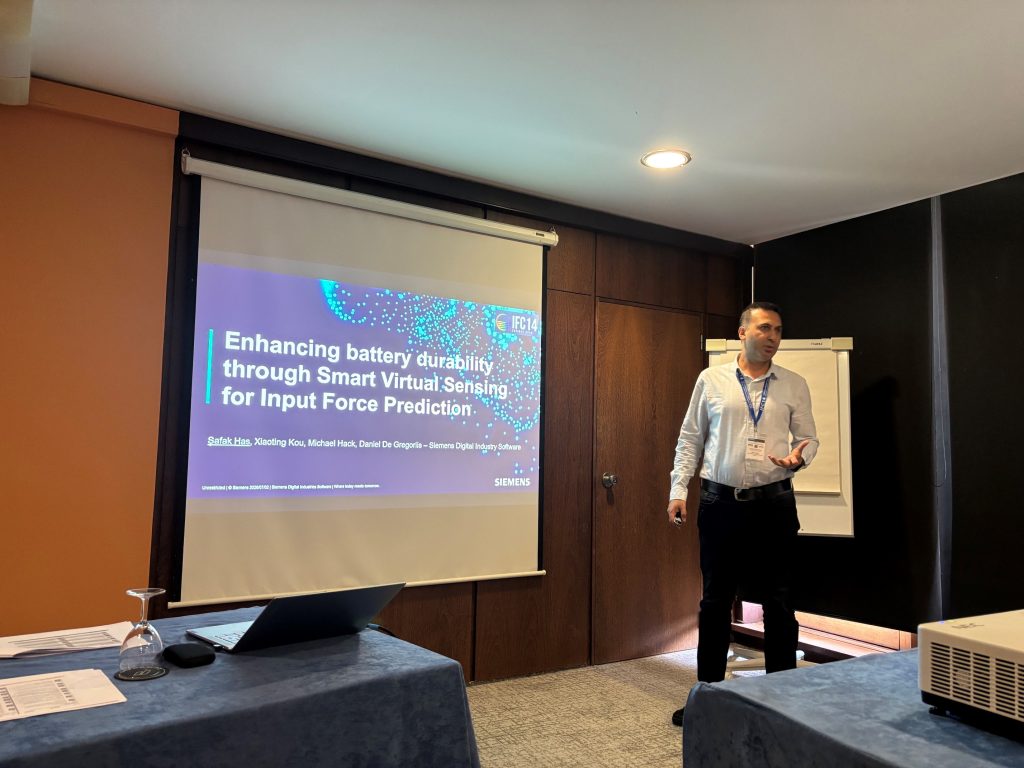
This was the backdrop when my colleagues and I embarked on a project that we recently presented at the 14th International Fatigue Congress (IFC14): enhancing battery durability through smart virtual sensing for input force prediction. The work brought together the best of simulation and testing, and I’m excited to share our journey with you.
The challenge: You can’t measure everything
Here’s the fundamental problem we face in battery durability testing: we need to understand the dynamic input forces acting on the battery structure, but traditional physical force measurement techniques are intrusive, costly, and limited in spatial resolution.
Think about it – battery packs in EVs are complex geometries mounted to the vehicle chassis, experiencing loads from every direction:
- Vertical loads from bumps, potholes, obstacles…
- Longitudinal loads from braking, acceleration…
- Lateral loads from cornering, slalom maneuvers…
- And often, a combination of all three simultaneously which will give some multi-axial phenomenon.
In order the capture operational loads impacted by those different conditions, we need to instrument massive amount of sensors. But here, the questions are:
- Do we have enough number of sensors?
- Do we have enough time and resources for extensive instrumentation?
- Are all critical sensor locations even accessible?
The answer is often “no” to at least one of these questions. That’s where our smart virtual sensing approach comes in.
Our four-step workflow for battery durability
We developed a comprehensive workflow that bridges the gap between what we can measure and what we need to know. Let me walk you through it:
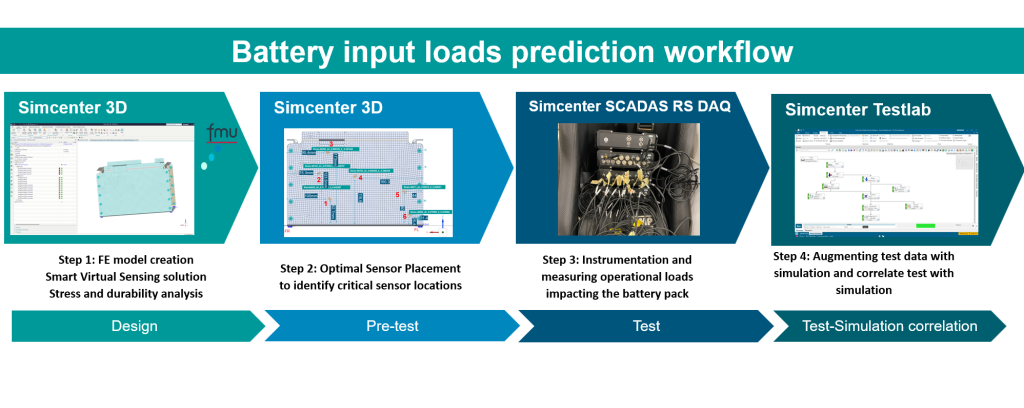
Step 1: FE model creation with smart virtual sensing
The foundation of our approach is a finite element model enhanced with smart virtual sensing capabilities enabled in our Simcenter 3D solution. This isn’t just any FE model – it’s a reduced-order model specifically designed for real-time data fusion. Using Kalman filtering techniques, the model combines limited physical measurements with simulation predictions, creating a predictor-corrector approach that minimizes uncertainty.
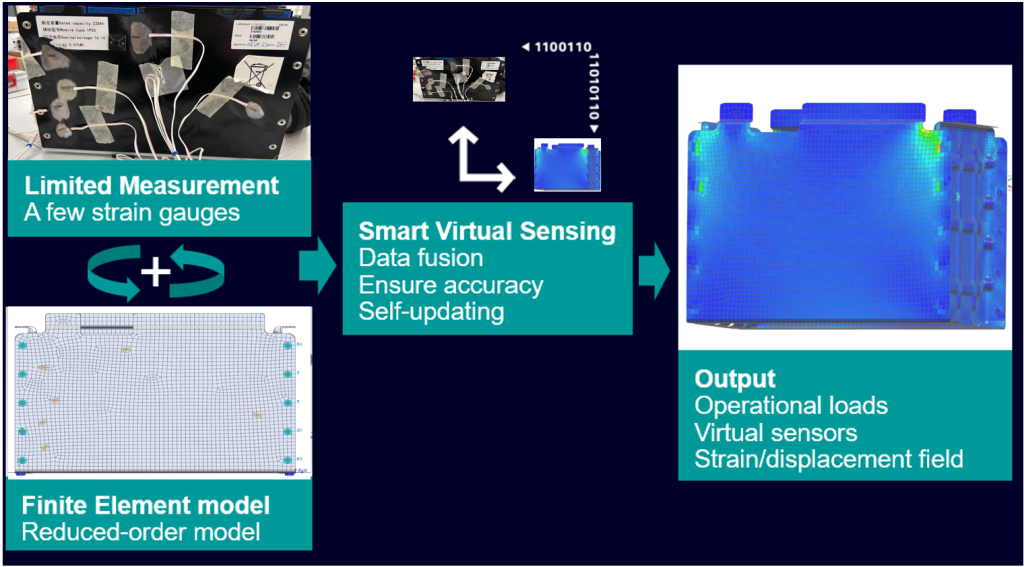
The beauty of this approach is that it inherently compensates for model inaccuracy and measurement noise through careful formulation of model uncertainty, measurement uncertainty, and unknown load uncertainty terms.
Step 2: Optimal sensor placement
Not all sensor locations are created equal. My colleagues used optimal sensor placement algorithms from Simcenter 3D software to identify the critical locations that would give us the most information about the battery’s structural behavior. The process involves:
- Starting with an initial sensor pool considering sensor type, distance, and direction
- Coarse screening based on highest response to estimated loads
- Iteratively removing sensors with the lowest contribution to observability
- Quantifying the impact of sensor count on load estimation uncertainty
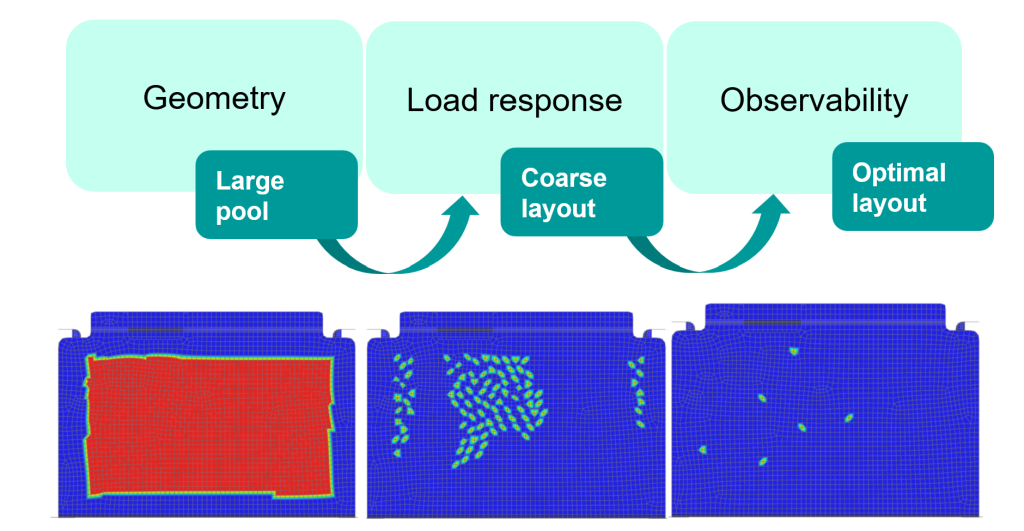
This step was crucial for making the testing phase efficient and focused.
Step 3: Instrumentation and measuring operational loads
Armed with the optimal sensor placement strategy, I got to work instrumenting our Simrod EV test vehicle. We equipped the battery pack with 29 channels of measurement:
- 12 strain gauges strategically positioned on the battery structure
- 4 three-axial accelerometers to capture dynamic motion
- 1 force washer for direct force measurement
- 4 GPS channels for position and velocity tracking
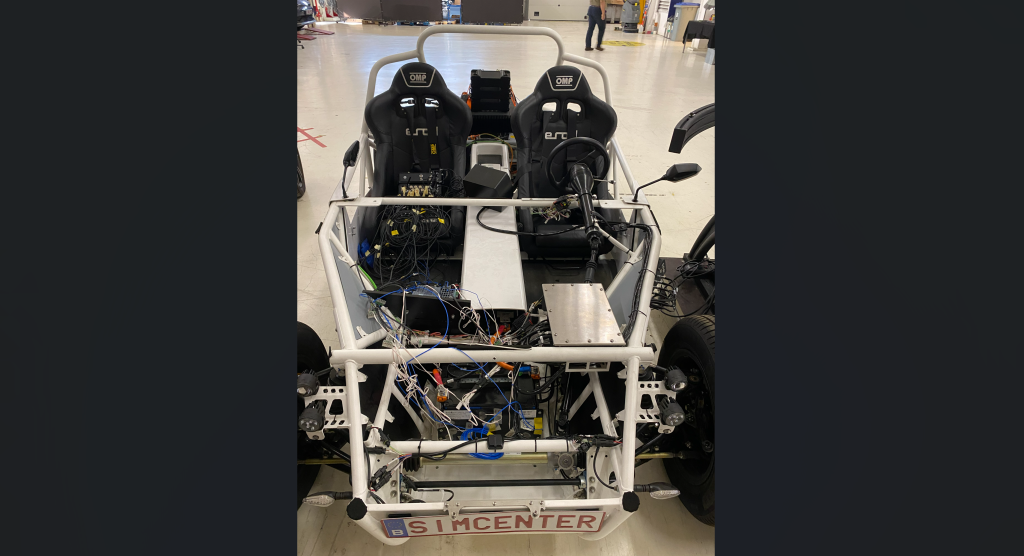
We then performed 5 carefully designed test runs with our multi-physics hardware, Simcenter SCADAS RS, with a good selection of road conditions designed to simulate real-world usage. Each run included vertical loads (bumps, holes), longitudinal loads (braking, accelerating), lateral loads (cornering, slalom), and mixed maneuvers that combined all three.
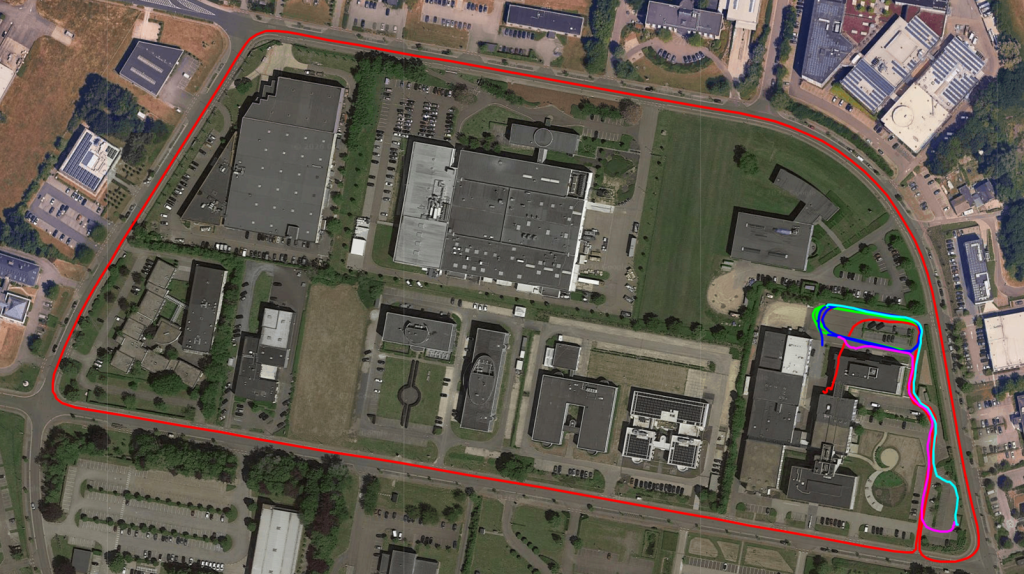
The data we collected during these runs became the foundation for validating our virtual sensing approach.
Step 4: Augmenting test data with smart virtual sensing and correlation with test data
This is where things got really interesting, and where I spent most of my time. Step 4 is all about bringing test and simulation together to create something greater than the sum of its parts.
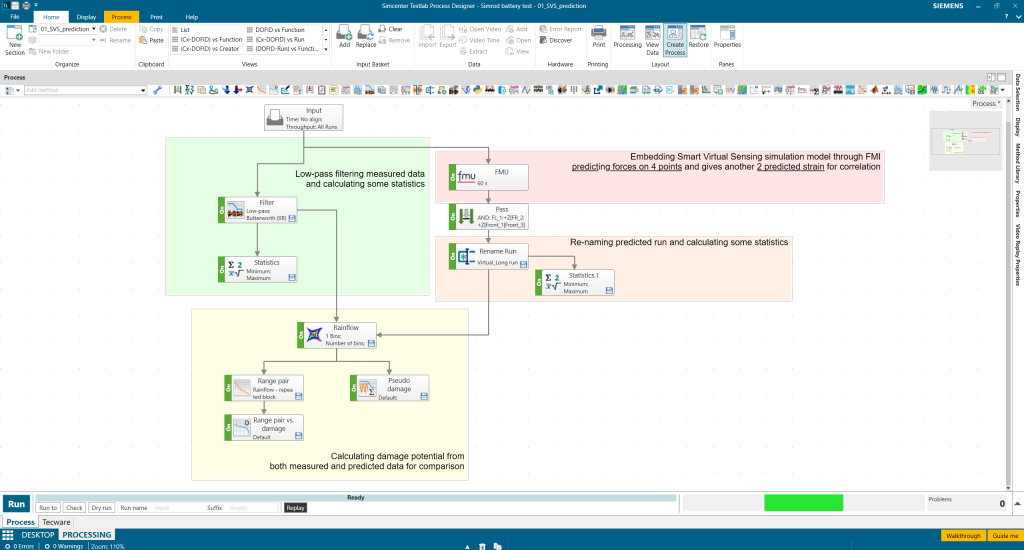
and correlate test with simulation
In this section, I used Simcenter Testlab software to augment our physical measurements with virtual sensing predictions. The process involves:
- Embedding the smart virtual sensing simulation model through FMI (Functional Mock-up Interface)
- Low-pass filtering the measured data to remove noise
- Feeding the measured strain and acceleration data into the virtual sensing model
- Predicting forces at all 4 battery attachment points (FL, FR, RL, RR)
- Generating 2 additional predicted strain channels for correlation
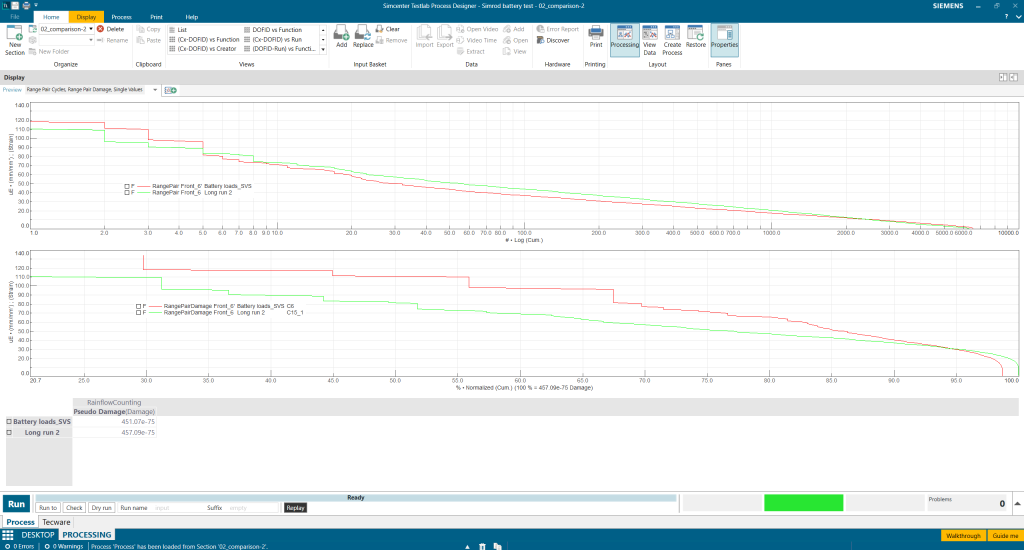
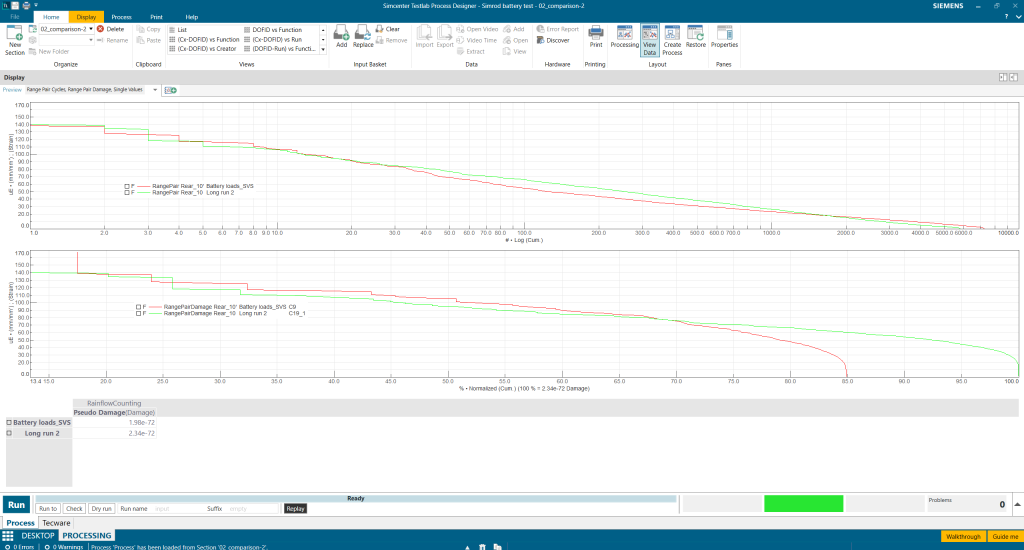
- Calculating durability potential analysis (incl. Rainflow counting, Range Pair, Pseudo-damage…) for both measured and predicted data
The workflow in Simcenter Testlab allows us to process time history data, apply the virtual sensing model and immediately see how well our predictions match reality.
The results: Validation that speaks for itself
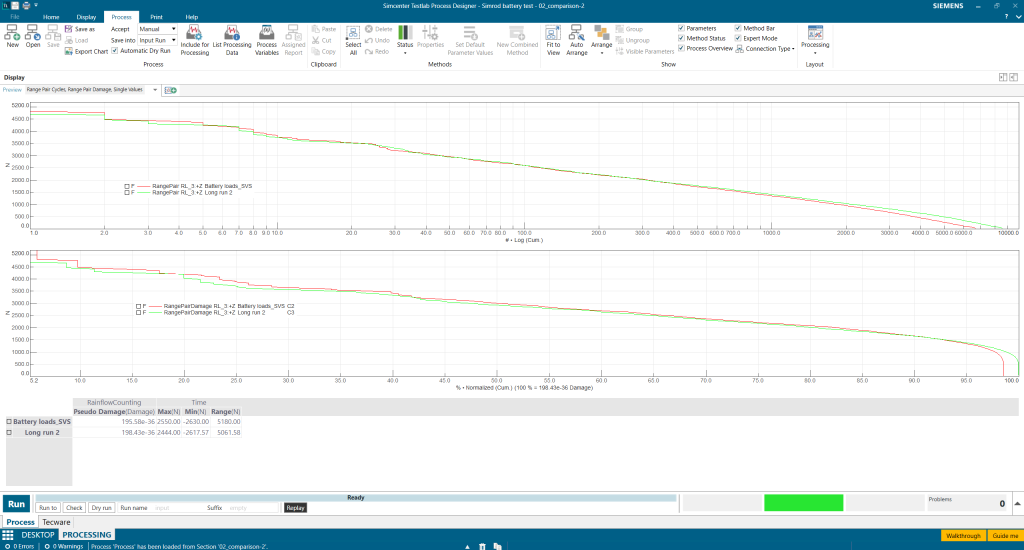
The correlation results exceeded our expectations. When we compared the virtually predicted forces and strains against our physical measurements, we found:
- 98.5% correlation on pseudo-damage for the rear-left (RL) force channel
- 98.6% correlation on pseudo-damage for one of our strain location on the front battery plate
- 84.6% correlation on pseudo-damage for another strain on rear plate
The amplitude ranges and cycles matched almost perfectly between test and simulation. These aren’t just good numbers – they represent a fundamental validation that our virtual sensing approach can accurately predict battery input loads with minimal physical instrumentation.
What this means for battery durability engineering
The implications of this work extend far beyond our specific test case:
- Reduced instrumentation effort: We can gain comprehensive load insights with fewer physical sensors, saving time and money.
- Access to inaccessible locations: Virtual sensors can predict loads and strains in locations that are physically impossible or impractical to instrument.
- Enhanced durability validation: By understanding the full-field strain distribution and input forces, we can better predict fatigue life and identify potential failure modes early in the design process.
- Accelerated development cycles: The combination of optimal sensor placement, efficient testing, and virtual sensing enables faster iteration and validation.
Key takeaway: Simulation augments, not replaces
One of the most important lessons from this project is something I want to emphasize: simulation should be used for data augmentation, not as a full replacement for testing.
We cannot – and should not try to – measure everything. It’s costly and time-consuming. But we also can’t rely solely on simulation, because models always have uncertainty. The sweet spot is right where we landed: using strategic physical measurements to anchor and validate virtual sensing predictions, creating a hybrid approach that leverages the strengths of both domains.
Acknowledgments
This work was truly a team effort. I want to thank my colleagues Xiaoting Kou, Daniel De Gregoriis, Jan Debille, Korcan Kucukcoskun, Michael Hack and Mark Lamping for their invaluable contributions. Their expertise, dedication and willingness to support made it all possible.
It was an honor to present this work at the 14th International Fatigue Congress, where it resonated with researchers and engineers facing similar challenges in battery durability engineering across various industries.
Want to learn more about virtual sensing and battery vibration testing? Check out these related resources:
- Road Roughness Guide to Durability
- Combine Test and Simulation to Create Accurate Virtual Sensors
- Virtual Damage Sensor: A new smart tool to measure machine failure
- Unlock the power of predictive virtual testing with Simcenter 3D Smart Virtual Sensing
- Realistic electric vehicle battery vibration testing