Why 3D ICs need a mindset shift and how to make it happen
What if the most revolutionary advances in semiconductor design aren’t about making things smaller, but about fundamentally reimagining how we connect them together?
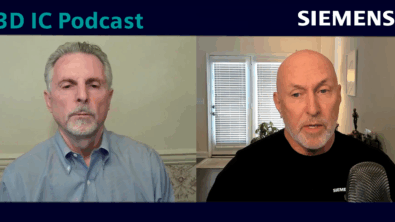
In this episode of the Siemens EDA Podcast Series on 3D IC chiplet ecosystems, I welcome Tony Mastroianni, Siemens EDA Advanced Packaging Solutions Director, to discuss the evolution of 3D IC design, the cultural transformation in semiconductor development, and how AI is revolutionizing chip integration to address trillion-transistor challenges.
Have we been approaching the semiconductor evolution all wrong?
Listen in as Tony shares his four-decade journey from RCA to Siemens, exploring how the industry evolved from simple transistors to complex 3D IC design. He discusses the pivotal moment when high-bandwidth memory (HBM) changed everything, requiring a fundamental shift in design approaches. Tony reveals how Siemens transformed from a product-focused company to a solutions-based organization to address the multi-dimensional challenges of modern semiconductor design.
Whether you are a semiconductor professional, an EDA tool user, a technology executive, or an industry analyst looking for insights on 3D IC evolution, AI integration, and the cultural transformation needed for modern chip design, this podcast is for you!!
This episode explores:
- How HBM technology revolutionized traditional semiconductor design workflows completely
- How the cultural shift from product-focused to solutions-based approach drives innovation
- Why AI is essential for managing trillion-transistor chip complexities
- Why cross-divisional collaboration is crucial for successful 3D IC implementation
- Why future designs require machine learning for optimal performance
Podcast highlights: Key insights from Tony Mastroianni
Episode Highlights with Timestamps:
- [01:02] Tony’s journey through 40+ years in semiconductor evolution
- [06:34] The HBM moment that changed everything in chip design
- [15:10] Critical cultural transformation from products to solutions
- [16:52] AI’s expanding role in addressing 3D IC design complexity
- [28:47] Future innovations including photonics and co-package optical technology
Watch the full 3D IC technology discussion
Bookmark our 3D IC podcast YouTube playlist for more insights on semiconductor innovation!
Complete episode transcript: The hidden heat challenge of 3D ICs: And what designers need to know
Click here to view the episode transcript
3DIC Podcast: Taking 3D IC Mainstream with Tony Mastroianni
John McMillan (00:01.262):
Hello and welcome to the Siemens EDA podcast series where we dive into exciting world of a semiconductor chiplet integration and advanced technology platforms using two and a half and 3D techniques brought to you by the Siemens Thought Leadership Team. I’m your host, John McMillan. In this podcast series, I talk with industry leaders and subject matter experts to discuss the latest on 3D IC chiplet ecosystems, industry trends and roadmaps. In today’s podcast, I’m excited to be rejoined by my first guest ever over three years ago in the 3DIC podcast, Siemens EDA Advanced Packaging Solutions Director, Tony Mastroianni. Our debut podcast with Tony was very popular. Tony provided an introduction to 3DIC and the impact 3DIC was expected to have. If you haven’t listened to that episode, I’ll put a link to it in the show notes. Welcome back, Tony. It’s great to have you back. And before we dive into today’s discussion on taking 3DIC mainstream and overcoming cultural barriers and 3DIC design, Please tell our listeners a little about yourself and your current role.
Tony (01:02.98):
Sure, John, good to be speaking to you again. It’s been a while and a lot has changed since then. But I started my career back in 1980, right out of school. I joined RCA, no longer in existence, but I was in the semiconductor division in 1980. And back then, this predates EDA and things were quite a bit different back then, but the semiconductor IC was invented back in 1959, a year I was one year old when it was invented. And the first microprocessor was invented in 1971, and I started pretty early in the semiconductor industry. And I’ve been involved in the semiconductor industry until the last seven or eight years. So I started out at RCA back then.
We had our own CAD tools, know, much more limited in scope and capabilities. We did our own designs. We had our own fab. We had our own packaging. So total vertical integration. So that did give me a unique background in terms of starting from a data sheet all the way to working with getting the part out into production.
So back then, the industry was migrating from 4000 series. Basically one chip had maybe dozens of transistors in there. And it was starting to get into MSI and LSI, large scale integration and medium scale integration. So migrating from dozens to hundreds to thousands of transistors. Today we’re talking about billions and getting close to a trillion transistors on one chip. you know, I first started, it was a .6 mil, not microns, so about 17 micron older process. And then the first design I did was in five microns and then about 1985 or so we were doing two and a half microns, which was state of the art for CMOS.
John McMillan (02:52.515):
Yeah.
Tony (03:15.994):
And at that time, it was the first time I really heard of Moore’s Law. And they were saying, you know, by the time we get to one micron, which is about two, three years away, that’s it. We’re not going to be able to scale anymore. And I said, oh, I’m just starting my career, and it looks like transistors are not going to get any smaller. Here we are 40 years later, and now we’re talking about hundreds of billions and trillions of transistors in a single chip.
You know, back then we were migrating from analog and digital designs where a lot of the layout parts of it were done manually. So we had draftsmen drawing schematics. We had draftsmen doing the layout. But we started getting some automation in terms of digital designs. We had place and route tools back then. So we were automating the placement. You the cells were hand created. And then… you know that was pretty much the standard and then EDA industry came out and started developing commercial tools and the entire design process really you know migrated from manual to place and route I was at RCA about five years and then I joined a startup company that was doing silicon compilation so you could do standard cell for basic logic but if you’re doing high-performance processors and DSPs you really couldn’t get the performance you needed out of traditional place-and-route tools. So that’s where silicon compilation allowed much more higher performance, more programmable automation to get the higher performance. Then eventually synthesis came into play in the early 90s, early to mid 90s.
And really that has been the state of the art in the semiconductor industry until the advent of HBM memories, high bandwidth memories, and everything changed at that point. So I was with a couple startups and then ended up at eSilicon back around 2002. eSilicon was a fabulous semiconductor and we were designing chips.
The first one we started with was 0.13 micron. Now we refer to it as 130 nanometers. So I started out with mils and then went up microns and then nanometers. we got up to seven nanometers in the 2021 time frame.
Tony (06:03.194):
so can was eventually acquired and i ended up at Siemens and i’m are uh… advanced packaging strategy
John McMillan (06:14.146):
Gotcha. Yeah, that’s quite a lot of growth over the many decades now. We’ve seen just acceleration there. So as you look back, so what was the point in which you realized something needed to be done about the 3D IC workflows your company was using?
Tony (06:34.874):
Yeah, so it was at E-Silicon and really as I mentioned, we got our first design that had an HBM memory. So the HBM was invented by SK Hynex back in 2012 or 2013 or so and went into production in 2015. And we landed our first design in 2016 or so and it had this thing called an HBM in it and we said wow that was cool. But the sales team was very excited. This was the hottest startup in Silicon Valley at the time. They were doing an AI chip that had these HBM memories. So that was my first exposure to that. You know I was responsible for all the design management of IC design.
And we worked closely with the package team, but they were really run out of the operation. So there was a little bit of collaboration that happened in, you know, working with the packaging guys to get the part packaged up and a little bit of working with the test folks to get it into production. But it was pretty much a hands off process. Once we got into this design, everything changed. You know, the way we did everything really changed dramatically. So that’s where we realized that, you know, something needed to change.
John McMillan (07:59.106):
Speaking of changes, did you meet any resistance while trying to implement those changes?
Tony (08:04.186):
yeah changes you know people in general don’t necessarily like change you know once particularly engineers you know once they become experts and comfortable you know getting them to change is you know some people embrace it and many don’t but it’s interesting as i mentioned you know htm started back in you know twenty twelve twenty thirteen time frame and
And at the time, one of our package architects started talking about this high bandwidth memory and it was going to revolutionize the industry, right? It was going to change chip design the way it is. And you know, lot of the engineers said, yeah, yeah, OK. But we didn’t really understand the implications of that technology.
He actually presented it to the board. said, you know, Moore’s Law is ending and this is going to be, all chips are going to be designed using this packaging technology. And they listened to him. It was very interesting, but they said, yeah, we don’t think so. So, really it was the first point when this was new technology, we presented it to the senior management, to the actual board of directors of the company.
and it was just too much of a change. So that was it. So really until we actually got a design, there was no change on the management side. Once we were under contract, we had no choice. We had to figure out how to do this. that’s where I started getting heavily involved in figuring out how we’re going to do this problem. So we were able to get the first chip done and actually worked out of the chute, first cut silicon, which was
Quite an accomplishment, but it was incredibly painful. Everything changed and there was new things we didn’t know about, so we had to invent on the fly, you know, what is this thing called, an interposer, and you know, who owns that, so we ended up having someone in our Vietnam team figure out how to lay that out. And the packaging guys were, you know, had to deal with new terminology and new technology, things that…
Tony (10:20.122):
they never exposed to know gts and rtl and all these things so uh… very very big changes and and again do you know they they tried using the the tools that we had been we we were able to do it but it was just not a scalable process so at that point we realize that you know we had to change the way we’re doing things and that’s that’s where i started getting involved really and focusing how we’re going to support this new type of uh… design scenario
John McMillan (10:49.038):
So when you moved over to Siemens, what were the most important things for you to change and or to educate about?
Tony (10:57.53):
Yeah, so after Siemens was acquired, I was actually working very closely with Mentor at the time, but it was still a Siemens company. And I was trying to develop this strategy and I was working closely with some of the lead AEs from Mentor. I actually brought them over to Romania and they…
understood the scope of the problem that I was trying to solve. it’s not just the packaging problem, but we have to worry about, you know, silicon interposers, how we have to worry about tests, we had to worry about thermal, all these things, know, simulation, just so it really exposed, you know, the the Mentor folks that, you know, this was a much bigger problem. It wasn’t just the packaging problem.
things and much tighter coupling. So Mentor came to me and they said we’d like you to kind of continue what you were doing there at Siemens. And so the first thing I did is kind of put together a strategy on how all these tools would work together to address these challenges. that, you know, we came together pretty quickly with that. Looked at
you know, a proposal to implement some of these changes and get the divisions to work together. And, you know, the… The there was that we had to take a new approach and get these tools to work together. So what I had proposed is to get a design team, a team of subject matter experts that had expertise in the different areas required to support these types of design to work together to drive how to solve this complete design.
Tony (12:58.25):
new design paradigm. So working with the individual tool vendors to figure out how these tools need to work together. So that was the proposal and you know it pretty much took three or four years before you know we got to a point where we realized that this was something that we need to execute. So we understood the problem. They were generally receptive but until we
decided that we needed to invest in this technology and hire people, that took several times. So it did, it was a major cultural change for Siemens and a lot of that had to do with the way the company was structured. was a product company, we were selling point solutions and these point solutions need to work together. So it did require the divisions to work together.
And there was a lot of resistance to that change. But more recently, have built the team and we are investing. we’re finding that the, was talking to all of the engineers in each of the divisions and they were all very interested in this new technology and anxious to learn about it and work together. But at the end of the day, they still had their.
their job and their focus. So the issues were really more at the kind of divisional level and senior management level to really focus that on new change that was required to be able to accommodate this. So what we did is we formed a central engineering organization that would work and collaborate with all the divisions and we’re well into that and we are developing these workflows that are required.
to meet these new challenges.
John McMillan (14:59.906):
Gotcha. You mentioned cultural change. Why was it so critical at this point to make that collaborative cultural shift?
Tony (15:10.212):
Well, the biggest cultural shift was migrating from a product-oriented company to a solutions-based company. And some of that goes back to some of the previous management and philosophical agreements. The other reason is Siemens’ mentor has been very successful with its caliber products and test and products. So they really
much of the revenue was being generated by, you know, Moore’s Law and, and new technology nodes. So there was a little bit of reluctance in the, the fact that, you know, there’s a new paradigm in town and, and we need to change the way we do things. But, you know, as we realized that this is an important thing and, and there were some new…
Changes in management, think that is the biggest change that I we needed to change our culture and even make organizational changes and really escalate the importance of this as a strategic corporate initiative. And once we did that, I think we overcome a lot of those inertial challenges that were.
kind of a status quo in the way the company had been operated for the last twenty years or so.
John McMillan (16:42.094):
We’re in a current world of AI everywhere. So can you tell us how AI is being used today within 3D IC design workflows?
Tony (16:52.474):
Sure. AI is really the key driver, as I mentioned back in the first chip that we did. It was an AI chip. And the idea with the HBM memories is you were bringing in a lot of memory much closer to the processor. So traditionally, that memory has been external on a board.
But by having this new technology of HBM memories, and it was actually stacked DRAM chips, so you can get a tremendous amount of memory in a small footprint. And that could be literally placed microns away from your chip. So you’d have very short distances. So you have much lower power and much higher speed. that is kind of what is driving and continues to drive
the need to build these bigger and more complex chips. So heterogeneous integration really, I like to define a chiplet as an IC that’s been designed and optimized to be integrated into a package. Now we are slowing down on Moore’s law. at a point now where we’re just coming out with two nanometer transistors. And we’re looking at next generation
probably a couple more generations where it’s physically not going to be able to scale those devices any smaller. So we’re talking about 0.18. They’re calling it 18 angstroms. So we’re changing the units that we measure these devices. So we’re now in angstroms. And when I started, we were in mils, 1,000th of an inch.
So, and the appetite for more and more complexity is just exploding. So that’s really what’s driving this technology and it continues to drive it. So it’s really the hyperscalers that are developing these chips and they were the early adopters and they continue to be pushing the technology. So if you’re doing the maximum size chip, you can make a reticle sized die. We can fit tens of billions of transistors in that.
But, you know, AI wants more. So that’s where, you know, the 2.5D came in initially. was just allowing us to integrate these memory chiplets with a processor. But now, essentially, the same technology by putting these on a silicon interposer. It’s basically a substrate where you mount the chips. And rather than connecting on board with big, big wires and long distances away, you’re dealing with
John McMillan (20:19.192):
Mm-hmm.
Tony (20:46.97):
kind of IC type dimensions, so very tiny, tiny wires that are very close. that same technology can be leveraged to put multiple chips together. So you don’t necessarily need to build your chips at a reticlesize. You can build smaller chips that have higher yield, which is a lower cost, so you get the benefits of cost by integrating chips together.
So the HBM was the first chip, but now you can generally break your system out into different chiplets and integrate them onto a substrate. And there are some practical limitations on how large the silicon is. We’re at a point now where you can basically go three reticles. So you could build a silicon, you know, D by 60 millimeters or so. So you can fit a lot of transistors on that. But again, AI wants more.
John McMillan (21:25.666):
Great.
Tony (21:40.908):
So there have been some advancements since we last spoke in substrate technology. organic interposers, this is basically using traditional PCB type technologies. So you don’t get the same performance as you would out of silicon interposer, but you can build those structures much, much larger. But again, there’s some limitations in the performance. But we’re talking about now.
with organic interposers and even glass interposers is the latest technology that’s been coming out. a lot of government research and R &D funding is being done in those areas and we’re talking about building substrates that are a full panel size. the initial targets are about 500 millimeters, that’s half a meter on a side, up to close to a millimeter on a side. So just imagine if you can populate
a thousand chiplets with trillions of transistors. We’re talking about systems which are incomprehensible, trillions and trillions of transistors. So in the traditional interposer layout for organic interposer, that’s been largely using very manually intensive layout technologies because you have to deal with the very specific type of geometries for the manufacturability of those organic structures. But when you’re dealing with trillions of connections, it just becomes at a point where that is not going to be something that can be done manually. mean, you can’t put thousands of people working on a layout. It’s just physically going to be impossible. So AI is actually creating the problem.
So we’re gonna have to use AI to actually solve the problem. So we are doing that today and we’re gonna continue to see more and more of that. So right now we’re getting productivity boosts and using AI for the actual tools. So we’re doing some interesting things like SPICE simulations. SPICE simulator’s been around for 50 or 60 years ago. But using AI, when you’re…
Tony (24:01.518):
developing an analog circuit, you’re changing the transistors and re-simulating it to get the performance you need. But basically you have to re-simulate the whole circuit every time you simulate. But if we can leverage machine learning to only focus on what changed and kind of learn the design as you’re simulating, we’ve gotten 10 to 50x performance increases in a basic SPICE engine that really hasn’t changed in 50 years.
So that’s one advantage, we’re getting more productive tools in leveraging machine learning. There’s other examples of using, multi-dimensional optimization technologies where we can actually have a optimization platform where we can integrate different tools and engines and solvers and simulators, and then we can create parameterized
components or building blocks and then define the design criteria. And then there is automation there that will use some very efficient algorithms to come up with automating an optimal solution rather than having a designer try something simulated and see how that works. So we’re automating that process through some of these.
optimization technologies. And another area, AI, is large language models. So we’re using that to assist in documentation and training, taking written material and having that information assist in the productivity. We’ve done things in some of the layout tools where we’ve used machine learning to kind of
Monitor the way a user use those tools so they can start predicting you know how they work and what what commands they’re gonna do so that’s a productivity gain and then Kind of the next generation that we’re gonna see is the AI agents So this is where you know we can kind of encapsulate workflows that solves because this is a multi-dimensional problem 3D IC we have system level
Tony (26:25.262):
architects, have package design, have IC design, we have tests, and all of these are very integral workflows that need to work together. So we’re building a foundation that enables these tools to work together. We’re also integrating the data management. And the other thing we’re trying to do is develop and drive new standards where rather than using, you know,
PDF documents and written documents to describe the rules and the material properties and some of the dimensional properties, put them in machine readable language which lends themselves more readily to scripting and EDA tools and eventually it’s going to make it more AI friendly. So the idea is if we can have these workflows that are highly optimized to solve one type of problem,
we can kind of create an AI agent that understands that. And then we have another part of the design process rather than having to, let’s say we’re going to do some high level floor planning of a chiplet and we want to look at different micro architectures that are coming out of this system level. Folks, if we have an AI agent, we can just say, you know, what are the salient points that we need out of that part of the process?
to get the information that we need to solve our problems. So it’s gonna actually make it, we can put in simple language, this is the information that I need and allow these agents to actually talk together. We’re still gonna need this technology, the AI, to manage the complexity, but it really does need to be.
managed and under control so the models that we build up for these processes need to be developed but you know we can kind of compartmentalize those and have these different agents you know working under the direction of users to who are designing the problem and kind of directing it to get these different workflows working together.
John McMillan (28:38.754):
Gotcha. Well, I know I’m certainly excited to see the continued evolution of 3D IC design. Any final thoughts or comments before we close out this podcast?
Tony (28:47.4):
i mentioned some of the new substrate technologies but another challenge that that we’re we’re starting to see is you know when you’re putting thousands of chiplets on a single substrate all that information right now has to come out of the bottom of that chip and the problem is if you have a meter you know a very very large substrate those chips in the middle by the time they get
you know out to to to another board or come out of a chassis or whatever you know that that’s a meter you know that that becomes a a problem because you know the problems that we’re solving with HBM memories are you know we’re having things very close and so we don’t need a lot of power to drive this so what we’re starting to see now is introduction of photonics and rather than having this IO coming out at the bottom
if we could just have the electrical signals connected within the chips and then to get the data out of that chip actually translate that electronic data into photonic data and have that come out directly to optics. So co-package optical is currently there’s a lot of research and within the next five years we’re going to see yet another set of technology that’s going to create new and exciting challenges so I think that’s probably something that you know is going to continue to
John McMillan (30:25.006):
That sounds like a great future topic to cover on this podcast. Yeah. Okay. Yeah.
Tony (30:28.026):
Absolutely, absolutely. I’ve been in the last couple of years, I’ve, you know, they’ve been talking about in academia for a few years, but now we’re starting to see, you know, Nvidia did a presentation, they’re doing it. So it’s happening. It’s going to take some time to get out there. So those are things that we’re looking into today to address these needs to feed the AI monster.
Tony (31:00.516):
Thank you, John. We look forward to our next podcast, in the next three years or so.
John McMillan (31:17.518):
Great, thanks Tony. Thanks for taking the time to join me today and sharing your knowledge and insights on how 3DIC is becoming mainstream. You know, that’s it for today’s episode of the 3DIC podcast. To all our listeners and viewers, I hope you found this podcast as informative as I have. Thanks for joining us today and be sure to check out the show notes to learn more about today’s topic and be sure to follow this podcast on YouTube or your favorite streaming service so you don’t miss the next episode of the 3DIC podcast. Thanks Tony.
Tony (31:43.962):
Very good. Thank you, John. Take care.