Simcenter Feko: Milestones in its history – Part 2: Expanding horizons (2014–today)
2026 marks 35 years of development for Simcenter Feko, a journey that began as an academic research project in 1991 and evolved into a comprehensive electromagnetic simulation solution.
The first part of this historical retrospective, The early years (1991–2013), explored the software’s academic origins, commercialization and technological milestones that laid the foundation for its subsequent development.
The year 2014 marked the beginning of a new chapter. Following its acquisition by Altair Engineering, Feko entered a period of expanding capabilities, broader applications and continued technological development. In 2024, Siemens announced its acquisition of Altair Engineering, which was completed in 2025, paving the way for the integration of Feko into the Simcenter portfolio.
This second part traces these developments, highlighting the innovations and milestones that have shaped today’s Simcenter Feko.

Joining Altair Engineering
In June 2014, Altair Engineering acquired EM Software & Systems (EMSS), bringing FEKO into the Altair HyperWorks portfolio and laying the foundation for Altair’s expanding electromagnetic simulation portfolio. The acquisition also broadened the software’s global reach and created new opportunities for technological development.
It also paved the way for closer integration with Altair’s broader simulation technologies, particularly in CAD preprocessing, meshing, high-performance computing (HPC), optimization and artificial intelligence and machine learning (AI/ML).
Expanding into wireless network planning
The acquisition of AWE Communications by Altair in 2016 marked another important milestone, bringing WinProp radio propagation and wireless network planning technologies into the Feko portfolio.
While Feko had traditionally focused on detailed electromagnetic simulation, the addition of WinProp extended its capabilities to large-scale radio propagation and wireless network planning. By combining deterministic ray-based methods with empirical propagation models, WinProp enables the analysis of complex environments, including urban and rural areas, indoor spaces, tunnels and scenarios involving terrain and vegetation.
These capabilities support a broad range of wireless communication systems, including cellular networks (GSM, UMTS, LTE and 5G), WLAN, vehicle-to-everything (V2X) communication, non-terrestrial networks (NTN), TETRA and broadcast applications.
Applications range from conventional cellular network planning to radio coverage analysis in airports, stadiums, railway corridors, industrial facilities and other complex environments. Additional use cases include interference analysis, satellite link budgeting, UAV communication, smart city IoT deployments, emergency communication networks and indoor positioning.

An important connection between Feko and WinProp is the use of antenna radiation patterns from electromagnetic simulations in system-level propagation studies. For example, in an automotive virtual drive test, different antenna positions can be evaluated to investigate connectivity with cellular base stations, including single-input single-output (SISO) and multiple-input multiple-output (MIMO) configurations.
In 2020, Altair acquired WRAP International AB, adding WRAP software and radio spectrum management capabilities to the Feko portfolio. WRAP supports the coordination of frequency allocations, allotments and assignments for civilian and military applications at national and international levels. It also provides radio planning, interference analysis and coverage calculations using a wide range of ITU-R models.
Optimization and machine learning in computational electromagnetics
Optimization has long been an important part of the software’s development. Parametric models created in CADFEKO enable engineers to explore different designs and improve electromagnetic performance.
The integrated optimization tool, OPTFEKO, provides several algorithms, including particle swarm optimization (PSO), genetic algorithms (GA), the Nelder–Mead simplex method, adaptive response surface method (ARSM) and global response surface method (GRSM).
Following the acquisition by Altair in 2014, Feko users also gained access to HyperStudy, extending the possibilities for design exploration, optimization and machine learning.
One important development was the use of surrogate models to accelerate simulation-driven optimization. Instead of performing a full electromagnetic simulation for every design candidate, a surrogate model can be trained using existing simulation results to predict the performance of additional designs. Such models include radial basis functions (RBF) and moving least squares method (MLSM) regression.

Accelerating antenna optimization with surrogate models
An example using an offset reflector antenna operating at 12 GHz illustrates this approach. The optimization involved five geometric design variables and two performance objectives: antenna gain greater than 35 dBi and a side-lobe suppression target greater than 23 dB.
Using a conventional simulation-based approach, 60 full electromagnetic simulations required 175 minutes and identified seven Pareto-optimal designs. However, none satisfied both performance objectives.
Rather than continuing with conventional optimization, an additional 40 space-filling samples were generated, bringing the total to 100 simulation samples for developing a moving least squares method (MLSM) surrogate model.
The resulting surrogate model was used with a multi-objective genetic algorithm to evaluate 4,309 candidate designs in just 35 seconds, identifying 446 predicted Pareto-optimal solutions. These figures refer to surrogate evaluations, rather than full electromagnetic simulations, and do not include the simulations and training required to build the surrogate model.
From parametric optimization to geometric deep learning
During the 2020s, advances in geometric deep learning introduced new approaches for predicting simulation results directly from geometric representations. These technologies are available in Simcenter PhysicsAI, including the graph context neural simulator (GCNS), transformer neural simulator (TNS) and shape encoding regressor (SER).
Unlike traditional surrogate models that typically rely on predefined design parameters, these approaches can process more complex inputs, such as geometric shapes and meshes. Although training deep learning models generally requires greater computational effort, they can provide rapid predictions once trained.
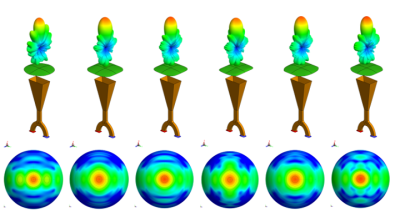
One example involves predicting the radar cross-section (RCS) patterns of aircraft across 146 different wing designs. Of these, 131 designs were allocated to training and validation, while 15 were reserved for testing. The GCNS model was trained in approximately two hours using 2.9 GB of memory. Training and validation errors were monitored to evaluate model performance and identify potential overfitting or underfitting. The trained model was subsequently evaluated using the previously unseen test datasets.

Advancing solver performance and modeling capabilities
Over the past three decades, advances in computing hardware, parallel processing and numerical algorithms have significantly expanded the scale of electromagnetic problems that can be simulated. For Feko, these developments have been particularly important for the multilevel fast multipole method (MLFMM), enabling increasingly complex models to be solved with improved computational efficiency. Alongside these performance improvements, new modeling methods and features have further expanded the range of electromagnetic applications.
From hours to minutes: The evolution of MLFMM performance

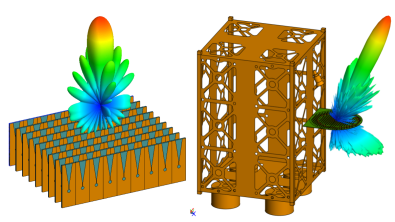
A 32 GHz reflectarray model provides a striking example of this progress. Originally designed in 2012 using FEKO Suite 6.1, the electrically large structure required approximately 20 hours and 38 GB of memory to solve using MLFMM. Ten years later, improvements in numerical algorithms, parallelization and computing hardware reduced the simulation time to approximately three minutes in Feko 2022.2.
With further solver improvements, including the introduction of FGMRES in Simcenter Feko 2026.0, the same example could be solved in approximately one minute with Simcenter Feko 2026.1. This illustrates how advances in numerical methods and computing technology have dramatically improved electromagnetic simulation performance.
Reducing memory requirements with advanced iterative solvers
Computational efficiency is not limited to simulation time. For many large-scale electromagnetic problems, memory consumption is equally important. The Advanced Iterative Solver (AIS), introduced in Simcenter Feko 2026.1, addresses this challenge by reducing memory requirements, although this may involve longer simulation times.
For the reflectarray example, memory consumption was reduced from 32 GB to 5.8 GB when using AIS instead of FGMRES. When the CubeSat was included in the reflectarray model, memory requirements decreased from 63 GB to 17.7 GB. These developments make it possible to tackle demanding electromagnetic simulation problems with substantially lower memory requirements.
Expanding modeling capabilities
Beyond performance improvements, numerous features have expanded the modeling capabilities of Feko over the past 12 years. Some notable developments include:
- 3D anisotropic materials: FEM and FDTD solvers support anisotropic materials for analyzing complex devices such as circulators.
- Component library: Predefined parametric antenna models can be adapted to specific design requirements and optimized using built-in optimization tools.
- Thick multilayer coatings: Enable efficient modeling of radar-absorbing materials (RAM).
- Faceted UTD (fUTD) solver: Supports frequency-independent meshing for high-frequency antenna placement applications and can be hybridized with the method of moments (MoM).
- Discontinuous Galerkin domain decomposition: Enables the use of discontinuous meshes.
- Characteristic basis function method (CBFM): Supports efficient radar cross-section (RCS) simulations.
- Perfect magnetic conductor (PMC) boundary conditions: Enable the modeling of artificial impedance surfaces, including electromagnetic bandgap (EBG) structures.
- Characteristic mode analysis (CMA) for dielectric structures: Supports the analysis and optimization of dielectric resonator antennas (DRA), lenses, radomes and nano-antennas.

The evolution of model complexity in electromagnetic simulation
Aircraft models offer another perspective on the evolution of electromagnetic simulation. In the 1981 handbook of the Numerical Electromagnetics Code (NEC), an aircraft was represented by a simplified model consisting of just 29 wire elements.
By the release of FEKO Suite 1.0 in 1996, considerably more realistic aircraft models were possible. One example featured a monopole antenna operating at 60 MHz, with 1,992 unknowns solved using the method of moments (MoM) and a magnetic symmetry plane. Although the simulation required only 34 seconds, its memory consumption of approximately 150 MB represented a substantial computing requirement at the time. Model input was still provided through text files.
Today, electrically much larger and more detailed aircraft models can be analyzed. A recent example involving a monopole antenna operating at 1 GHz contained 20.8 million unknowns. Using MLFMM with AIS in Simcenter Feko 2026.1, the model was solved with 48 parallel processes across three CPUs in approximately 10 hours, requiring 161 GB of memory. Together, these examples illustrate the extraordinary progress in model complexity, solver capabilities and computing resources throughout the evolution of Feko.

The Simcenter era
In 2025, Siemens completed its acquisition of Altair Engineering, bringing Feko into the Simcenter portfolio. As part of this transition, Feko was renamed Simcenter Feko, with Winprop and WRAP continuing as dedicated modules within the portfolio. This new chapter opened opportunities for closer integration with the broader Simcenter simulation ecosystem, building on decades of technological development.
The next release, Simcenter Feko 2612, is planned for December 2026 and will continue this evolution. From its origins as an academic research project in 1991 to today’s comprehensive electromagnetic simulation capabilities, the 35-year history of Feko reflects sustained advances in numerical methods, computational performance and engineering applications.