What’s new in Simcenter Feko 2026.1
Electromagnetic simulation is essential for developing modern communication, radar, satellite and sensing systems. As designs become more connected and complex, engineers need to simulate larger models, evaluate realistic environments and make design decisions faster.
Following the integration of Feko into the Simcenter portfolio, Simcenter has strengthened its high-frequency electromagnetic simulation capabilities. Building on decades of experience, Simcenter Feko 2026.1 introduces enhancements across electromagnetic simulation, antenna engineering, wireless system analysis and connected engineering workflows.
Getting started with Support Center
Simulate larger and more complex electromagnetic systems
As electromagnetic systems continue to increase in size and complexity, engineers must analyze larger antenna arrays, more detailed platform models and increasingly realistic operating environments. Maintaining simulation scalability while controlling computational cost remains a key challenge.
Advanced iterative solver (AIS) technology for MLFMM simulations
One of the major highlights in Simcenter Feko 2026.1 is the introduction of the advanced iterative solver (AIS) technology for multilevel fast multipole method (MLFMM) simulations. Designed for large-scale electromagnetic analysis, AIS significantly improves memory efficiency and convergence robustness. In benchmark examples, memory requirements can be reduced by up to 87%, enabling substantially larger models to be solved using existing computing resources.
By reducing memory consumption while maintaining solution accuracy, AIS helps engineers tackle increasingly demanding electromagnetic simulation challenges without the need for additional hardware resources. While the focus of AIS is improved memory efficiency rather than raw solver speed, it enables simulations that would otherwise be impractical due to memory limitations. This enables larger antenna arrays, more detailed platform models and more realistic electromagnetic environments to be analyzed with greater confidence.
Efficient modeling of multilayer dielectric structures
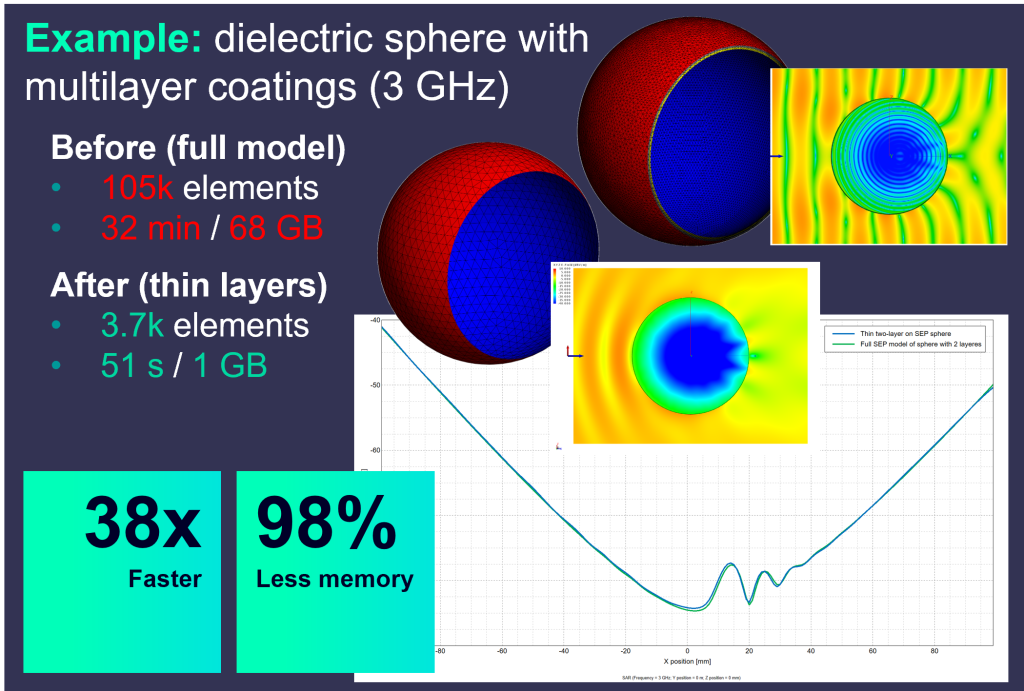
Scalability improvements continue with enhancements to thin-layer modeling for multilayer dielectric structures. By representing thin dielectric layers on surfaces modeled with the surface equivalence principle (SEP), engineers can dramatically reduce mesh complexity while maintaining simulation accuracy.
The result is lower memory requirements, faster simulations and more efficient analysis of complex dielectric structures, including multilayer coatings, radomes and aerospace applications.
Enhanced RL-GO performance for electrically large simulations
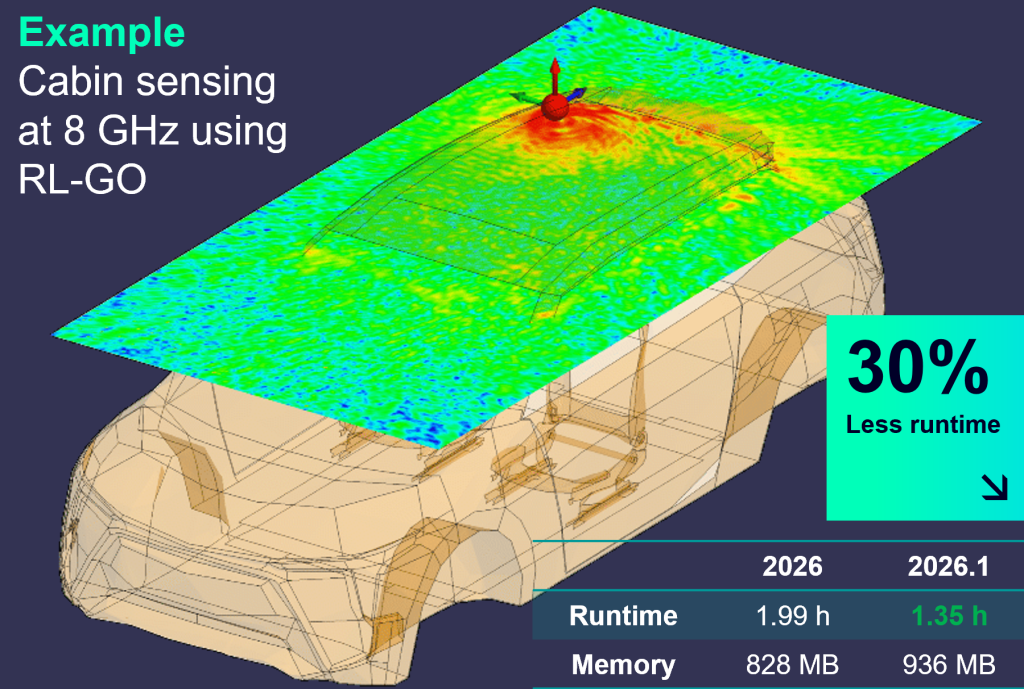
For electrically large and high-frequency applications, Simcenter Feko 2026.1 introduces enhancements to the ray-launching geometrical optics (RL-GO) solver. A more uniform ray-launching approach improves simulation efficiency and reduces source-location dependencies, enabling faster and more consistent analysis of complex electromagnetic environments, including automotive sensing, cabin radar, wireless coverage and large platform applications.
Accelerate antenna and communication system workflows
Beyond solver technology, Simcenter Feko 2026.1 introduces several enhancements designed to improve modeling productivity and streamline engineering workflows.
The CADFEKO component library has been expanded with nine new fully parameterized antenna models, further broadening the range of ready-to-use antenna building blocks available to engineers. Including lens and conformal patch antennas, these configurable components help accelerate model creation and support rapid design exploration across a wide range of antenna applications.
A new Optical Coverage tool enables fast line-of-sight and field-of-view assessment directly on CAD geometry without requiring meshing or launching a solver. Engineers can quickly evaluate antenna visibility, compare placement options and identify potential coverage limitations, helping accelerate antenna placement studies and communication system design workflows.
Advance wireless system analysis and radio channel modeling
As wireless networks, satellite communication systems and connected environments continue to evolve, engineers require more efficient tools for radio channel, network planning and radar system evaluation.
Simcenter Feko Winprop 2026.1 continues to expand wireless system analysis capabilities, supporting advanced propagation modeling, network planning and emerging non-terrestrial network (NTN) applications. A key enhancement in this release is the introduction of unified multi-time satellite constellation modeling, which significantly simplifies the setup of dynamic satellite communication scenarios through automatic satellite position calculations over time.
For network planning applications, Simcenter Feko WinProp 2026.1 introduces major performance improvements for trajectory-based analyses. Optimized processing of large trajectory datasets enables engineers to evaluate high-density mobility scenarios without simplifying trajectory descriptions. In examples containing more than 16,000 trajectory samples, runtime was reduced from about one hour to less than twenty seconds, enabling significantly faster evaluation of cell assignment and transmission mode studies.
Additional enhancements further strengthen support for modern wireless communication systems. New MIMO modeling capabilities enable more realistic representation of radio units and antenna configurations across operating bands and polarizations, while support for vertical uniform linear arrays (ULA) improves the modeling of advanced beamforming and multi-element antenna systems used in cellular and wireless infrastructure applications.
The release also introduces several usability enhancements across the WRAP tools, including improved handling of satellite constellation data, broader support for external map formats and enhanced visualization on high-resolution displays.
Connect simulation and optimization
As electromagnetic designs become increasingly complex, engineers are often required to evaluate large design spaces and balance multiple performance objectives. Manual design iterations can quickly become time-consuming and difficult to manage.
Simcenter Feko 2026.1 strengthens connectivity with Simcenter HEEDS, enabling automated design exploration and optimization workflows directly from electromagnetic simulation models. Engineers can automatically evaluate design alternatives, identify high-performing solutions and gain deeper insight into design trade-offs, helping accelerate simulation-driven product development.
By combining the simulation capabilities of Simcenter Feko with the optimization technologies of Simcenter HEEDS, engineering teams can accelerate decision-making and bring better-performing products to market more efficiently.
Looking ahead
Simcenter Feko 2026.1 introduces a range of enhancements designed to help engineers simulate larger electromagnetic systems, accelerate antenna and wireless engineering workflows, and to connect simulation with broader design processes.
Building on decades of experience in high-frequency electromagnetic simulation, Simcenter Feko continues to support the development of next-generation communication, radar, satellite and sensing technologies.