Effective methods to simulate radiation in turbomachinery
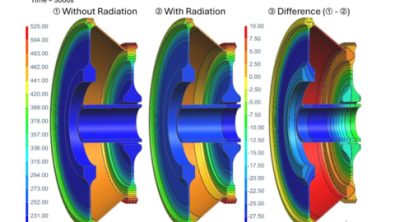
Designing modern gas turbines is a balancing act between physics and performance. As temperatures soar, even small thermal miscalculations can dramatically affect component life. This is where radiation heat transfer modeling comes into play. Radiation heat transfer is important when convection is weak, especially in enclosed or low-flow regions like cavities.
Think of it like standing near a fire: you don’t need to touch the flames to feel the heat. In turbomachinery, components “radiate” heat toward each other in a similar way, influencing temperature distribution across the engine.
This blog introduces advanced approaches to simulate radiation in both 2D axisymmetric models (simplified representations assuming rotational symmetry) and 3D models (high-fidelity geometries). It also explores cyclic symmetry modeling, where only a small segment of a repeating structure is simulated, and GPU-accelerated radiation computation, which speeds up otherwise heavy calculations.
The goal? Achieve accurate thermal predictions without overwhelming computational cost.
Understanding the impact of radiation in engine design
In high-performance turbomachinery, heat is a critical design constraint. Components like compressor discs, seals, and turbine blades are exposed to steep temperature gradients, especially in cavities where convection is weak and radiation dominates.
Ignoring radiation in such environments for particular mission transients can lead to underestimation of temperatures. The consequences are significant:
- Cooling systems may be under-designed
- Thermal stresses may be miscalculated
- Component life may be reduced
In fact, even moderate temperature differences can significantly impact durability. This makes accurate thermal modeling essential for reliability and safety.
However, there’s a major challenge: radiation modeling is computationally expensive. Unlike conduction or convection, radiation requires calculating “view factors”, i.e. how much each surface “sees” every other surface. This creates a dense network of interactions that scales poorly as models grow in complexity.
Engineers are therefore stuck in a trade-off:
- 2D simplified models → fast but may miss critical physics
- Full 3D models → accurate but slow and resource-intensive
This tension slows down design iterations, limits exploration of design alternatives, and increases development cost.
So, how to keep accuracy where it matters, while improving performance? In the following we will explore the different options offered by Simcenter 3D.
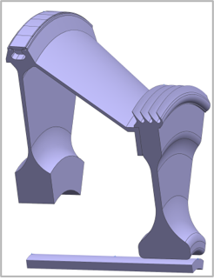

How advanced radiation modeling balances accuracy and speed?
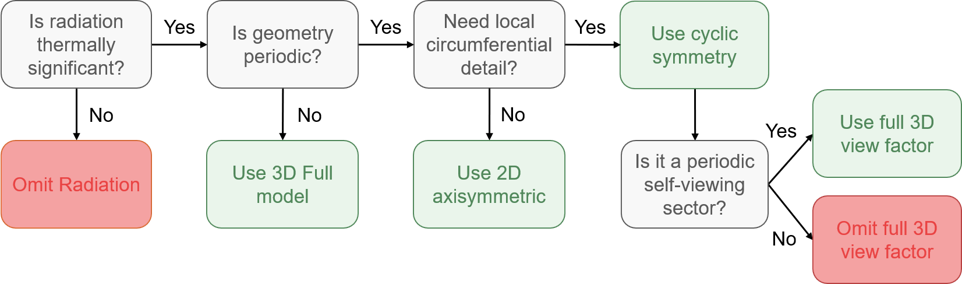
At its core, the approach is about intelligent simplification without losing thermal fidelity. Let us evaluate several modeling strategies and how they handle radiation heat transfer.
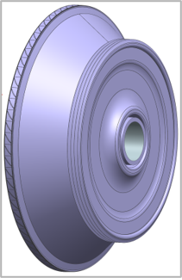
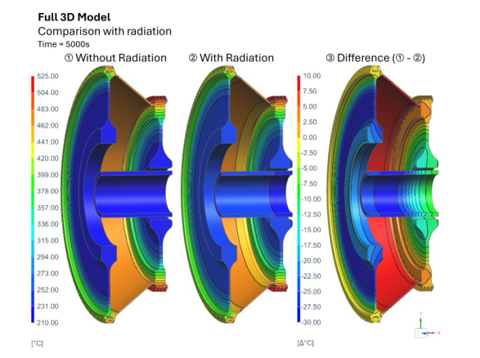
1. Start with a full 3D reference model
This is the “ground truth”:
- All components are modeled in full geometric detail
- Radiation is computed between all surfaces
- View factors are calculated exhaustively
This gives the most accurate result, but at a high cost in time and memory.
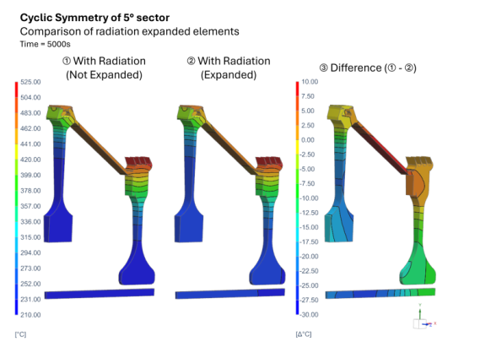
2. Apply cyclic symmetry to reduce model size
Many turbomachinery components are periodic (e.g., blades arranged in a circle). Instead of modeling the full geometry:
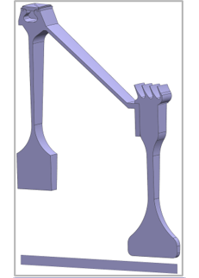
- Only a sector (e.g., 5° or 45° slice) is simulated
- The rest is inferred through symmetry
However, radiation introduces a challenge: surfaces outside the sector still contribute to heat exchange.
Two options are explored:
- Radiative rotational periodicity (with expanded elements)
- Replicates the full 3D radiative environment
- Maintains accuracy but keeps computational effort reasonable
- Without expanded elements
- Scales radiation artificially
- Faster but often inaccurate due to missing “self-viewing” effects
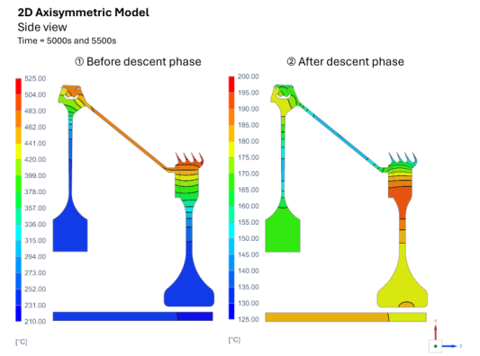
3. Use 2D axisymmetric models for maximum speed
For simpler geometries:
- The model is reduced to a 2D cross-section
- Assumes perfect rotational symmetry
- Radiation is computed using simplified methods (e.g., Monte Carlo)
This approach is extremely fast but cannot capture circumferential variations (e.g., blade effects).
4. Accelerate radiation computation with GPUs
Radiation calculations, especially view factors, are the bottleneck.
Different approaches:
- GPU-based ray tracing → fast, parallel computation
- Monte Carlo methods → flexible but often slower for large models
GPU acceleration significantly reduces pre-processing time compared to traditional CPU-based methods.
5. Evaluate trade-offs: accuracy vs performance
Each approach is benchmarked based on:
- Temperature accuracy
- Runtime (pre-solve and solve phases)
- Memory usage
For example (qualitative insight):
- Full 3D → highest accuracy, highest cost
- 5° cyclic symmetry with periodicity → near-3D accuracy, much faster
- 2D axisymmetric → fastest, but less precise in localized regions
Design challenges
| Challenge | Solution | Engineering Impact |
| Faster design iterations in gas turbine development | Use 2D models for early-stage screening Switch to cyclic symmetry models for refinement | Rapid exploration of design alternatives without waiting for full 3D simulations |
| Accurate thermal assessment of cavities and seals | In regions where radiation dominates (e.g., compressor cavities): Cyclic models with correct radiation capture temperature increases that simpler models miss | More reliable cooling design and reduced risk of overheating |
| Whole-engine modeling (WEM) | Use 2D models and cyclic symmetry models | Better system-level thermal understanding without prohibitive computation times |
| Optimization of cooling strategies | Accurate radiation modeling reveals: where heat accumulates and how it redistributes during transient phases | Improved cooling layouts and longer component life. |
| Leveraging GPU acceleration in CAE workflows | By switching to GPU-based radiation: Pre-processing times drop significantlyLarge models become tractable | Enhanced productivity and reduced turnaround time for simulations |
Faster Insights, Better Designs: Rethinking Thermal Simulation Strategy
Radiation heat transfer is a critical factor in turbomachinery thermal design. Here we show that it doesn’t have to be a computational bottleneck.
By combining cyclic symmetry, intelligent simplification, and GPU acceleration, engineers can achieve near-3D accuracy at a fraction of the cost. The key is knowing when to simplify—and when not to.
As simulation-driven design continues to evolve, these techniques provide a clear pathway to faster iterations, better thermal predictions, and ultimately more reliable engines. If you’re working with high-temperature systems, it’s worth exploring these approaches in your own workflows.
Key takeaways
- Radiation matters: Ignoring it can lead to inaccurate temperature predictions in critical regions
- Full 3D is not always necessary: Cyclic symmetry can deliver near-equivalent accuracy
- View factors are key: Incorrect handling leads to major errors
- 2D models are powerful but limited: Ideal for early-stage analysis
- GPU acceleration is a game changer: Makes complex radiation modeling practical
- Simcenter 3D provides scalable radiation fidelity throughout the design process
Further reading
- Kuzmin, A., Daou, H., Collard-Daigneault, A., Bonniol, F., Barnes, C., and Medema, J., 2025, “Radiation Heat Transfer in Turbomachinery: Accelerating Cyclic Symmetric Analysis of 2D and 3D Models”, Proceedings of the ASME Turbo Expo 2026, GT2026-178194
- Radiation modeling
- Radiation modeling for cyclic symmetric models with rotational periodicity