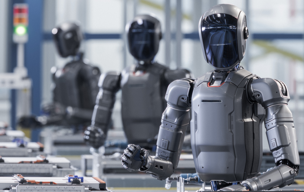
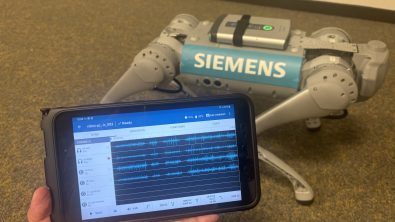
Industrial humanoid robots for logistics: System simulation, the missing link between Physical AI and factory deployment

The manufacturing industry is entering a new era where Physical AI, autonomous robotics and industrial automation converge. Yet moving from an impressive laboratory demonstration to a productive robot operating on a busy factory shop floor remains one of the biggest challenges in modern engineering.
System simulation helps bridge this gap, enabling industrial humanoid robots to be designed, optimized and validated before hardware is deployed.
For industrial logistics applications, the objective is not to build robots that perfectly imitate humans. The objective is to create reliable, efficient and scalable robotic workers capable of supporting material flow, tote handling, component transport, kitting operations and intralogistics across manufacturing facilities.
A different vision of the industrial humanoid
When people think of humanoid robots, they often imagine bipedal machines walking like humans and manipulating objects with highly articulated hands.
However, factory environments have very different requirements.
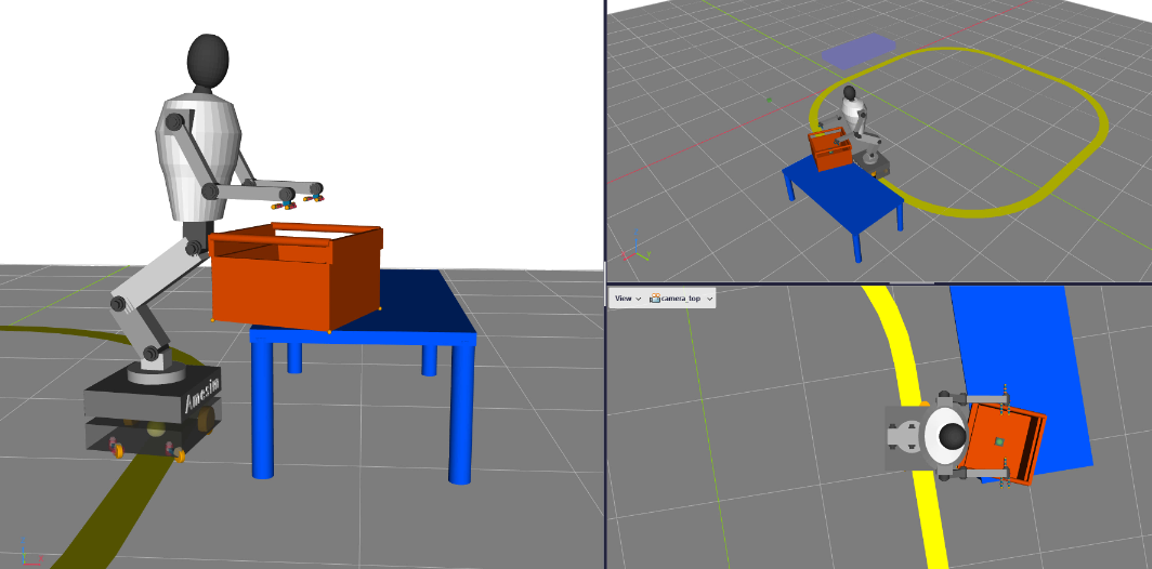
Production halls, warehouses and logistics areas are highly structured environments. Routes are known. Floors are flat. Material handling processes are standardized. In these conditions, a much more efficient architecture emerges: a robotic torso mounted on an Automated Guided Vehicle (AGV), equipped with two robotic arms and simple three-finger grippers.
This configuration delivers exactly what industrial logistics requires:
- Autonomous navigation between workstations
- Tote and container handling
- Material replenishment
- Pick-and-place operations
- Shop-floor transport tasks
- Manufacturing line support
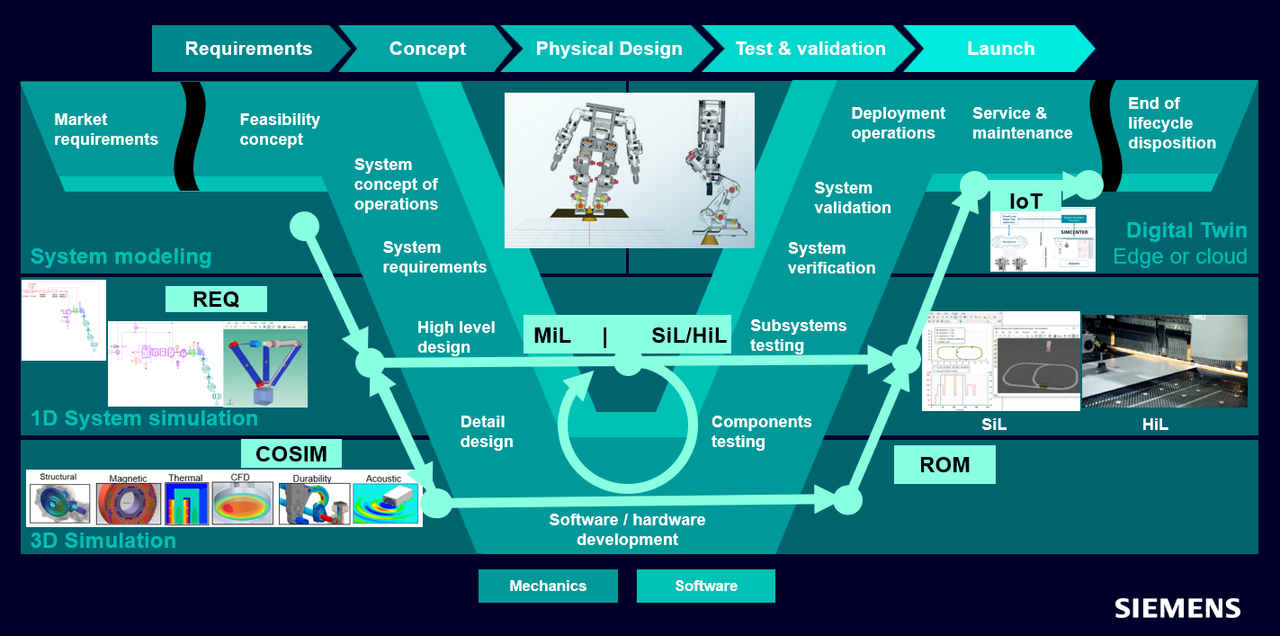
Instead of spending energy balancing on two legs, the robot focuses on creating value through throughput, uptime and reliability. The same architecture can easily be adapted to factory logistics, warehousing, component delivery, machine tending, production support operations, or intralogistics workflows.
Solving engineering challenges before hardware exists
Perhaps the biggest advantage of system simulation is the ability to answer difficult engineering questions early.

While tools like NVIDIA Isaac Sim handle visual rendering, spatial perception, and AI control policies downstream, Simcenter Amesim acts as the core multiphysics digital twin upstream. It evaluates how mechanical, electrical, thermal, and control systems perform as an integrated system before and during physical operations.
Let’s go through typical challenges that are easily solved by Simcenter Amesim:

Mechanical dynamics & Balance stability
Moving rigid totes filled with changing weights shifts the humanoid’s center of gravity unexpectedly.
- Dynamic load transfer: Simcenter Amesim captures joint compliance, gear backlash, friction, and structural elasticity when the robot picks up or sets down boxes.
- Disturbance recovery: It allows virtual validation of control algorithms that prevent the robot from losing balance or tipping over when handling asymmetric or heavy tote loads on logistics factory floors.
Actuator selection & Thermal management
Lifting totes and balancing motion puts heavy dynamic loads on joints (torso, elbows, grippers).
- Optimization: Prevents over-specifying motor torque (which adds unnecessary weight) or under-specifying motor torque (which leads to joint failure or dropped boxes).
- Thermal safety: High-frequency lifting can overheat joint motors and power electronics. Simcenter Amesim models the co-dependent thermal-electric behavior, predicting motor temperature spikes before thermal throttling occurs.

Electric sizing & Mission-based energy analysis
Humanoid robots in continuous logistics routes (e.g., carrying 60+ tote moves per hour) face severe power constraints.
- Battery sizing: Engineers can size battery packs precisely, avoiding over-weighting the robot while ensuring it meets target shift runtimes (e.g., continuous 30+ minute duty cycles between charges).
- Battery autonomy: Simcenter Amesim simulates total energy consumption over full operational profiles – squatting, lifting heavy totes, carrying boxes across distances, and acceleration/deceleration.
Gripper mechanism & Contact force validation
Destacking or transferring boxes requires careful handling to avoid damaging goods or dropping totes.
- Grasping stability: Simcenter Amesim simulates end-effector contact mechanics, evaluating grip stability and contact forces between the robot’s hands/grippers and industrial tote materials.
- Underactuated gripper optimization: Helps design lightweight, energy-efficient end effectors tailored to standard logistics tote dimensions or object shapes.
Virtual commissioning & Sim-to-Real transfer
Physical testing of multi-hundred-pound humanoids in a live production facility poses safety risks and causes factory downtime.
- Co-Simulation with control logics: Simcenter Amesim connects directly with PLC controllers from Siemens, but not only, and motion planners (e.g., via ROS or Functional Mock-up Units/FMUs).
- Synthetic data & Edge cases: By modeling realistic physical edge cases (e.g., slippery floors, sudden load drops, obstacle avoidance), Simcenter Amesim generates high-fidelity synthetic physics data. This accelerates AI training, improves Sim-to-Real transfer, and reduces physical prototyping costs.
From Physical AI to Industrial AI
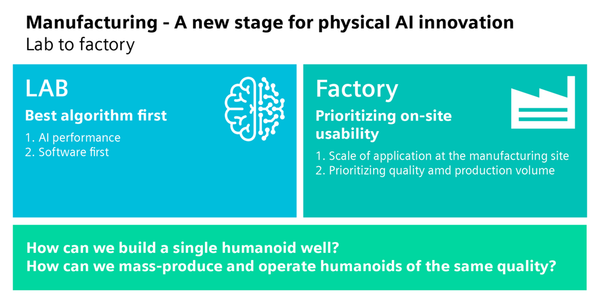
The challenge is no longer building a single robot. The challenge is deploying hundreds or thousands of robots with predictable performance in real production environments.
This is where System Simulation becomes essential. A humanoid robot is a complex cyber-physical system combining mechanical structures, actuators and transmissions, battery systems, thermal management, motion control, autonomous navigation, AI software, sensor systems.
Optimizing each subsystem independently is not enough. True performance comes from understanding interactions across the complete system. Battery size impacts weight. Weight impacts motor sizing. Motor sizing impacts thermal behavior. Thermal behavior impacts operational uptime. Control strategies influence energy consumption. Everything is connected.
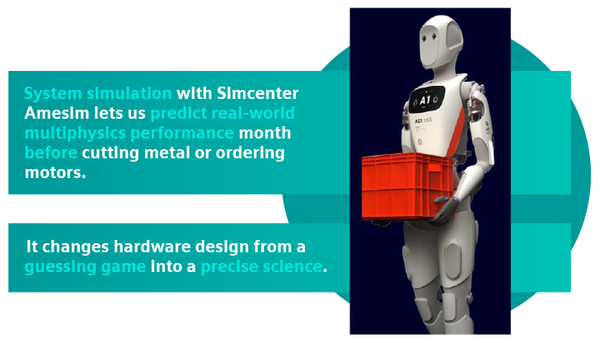
System simulation enables engineers to analyze these interactions from the earliest stages of development.
Industrial humanoids need to be practical, not human replicas
One of the most interesting conclusions from the Siemens logistics proof-of-concept was that the ideal design is not necessarily the most human-like design.
For industrial logistics, a more pragmatic architecture delivers better results. It includes a torso mounted on an AGV (Automated Guided Vehicle), two robotic arms, simple but capable 3-finger grippers, and an autonomous navigation on factory floors. This configuration eliminates many sources of complexity while preserving the capabilities needed for logistics applications.
Why wheels instead of legs? Factory floors are generally flat and highly structured environments. The routes are known in advance and do not require climbing stairs or navigating unpredictable terrain. As highlighted in the Siemens Erlangen project, wheels provide greater reliability, better energy efficiency, higher payload capability, simpler maintenance and lower control complexity. Rather than spending computational power balancing a walking robot, developers can focus on logistics performance and operational throughput.
Why grippers instead of human-like hands? Many industrial objects have known geometries: totes, containers, boxes, trays, material carriers. A robust 3-finger gripper is often sufficient for grasping these items successfully. It is easier to control, easier to validate, more reliable and typically more cost-effective than anthropomorphic hands with many degrees of freedom. The objective is not to reproduce a human hand. The objective is to move products safely and efficiently.
A digital twin that computes real physics
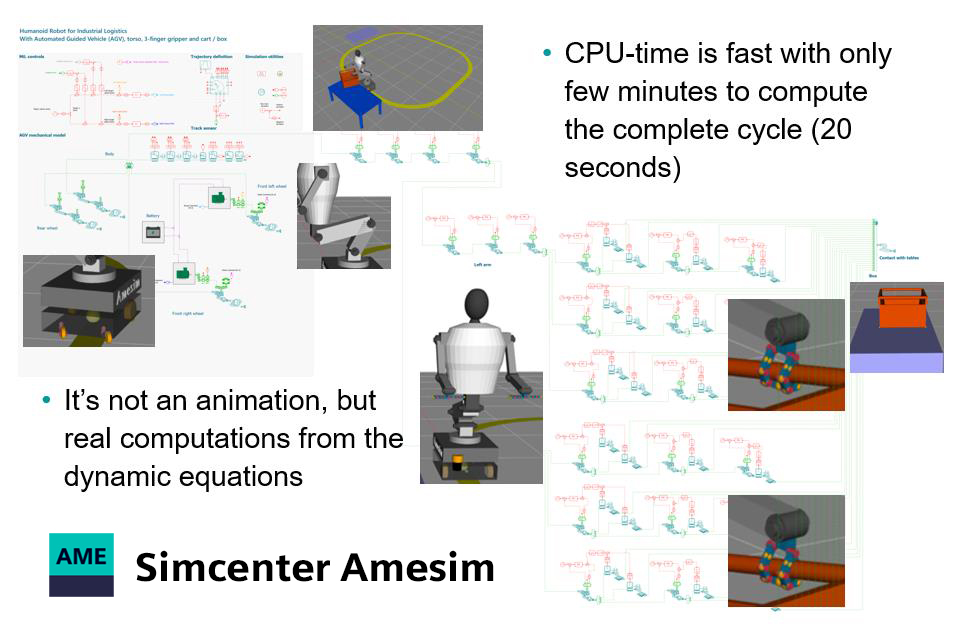
One of the biggest misconceptions about digital twins is that they are merely 3D visualizations or animations. The reality is very different. The digital twin developed in Simcenter Amesim is based on real multiphysics models and dynamic equations. The simulation computes the actual physical behavior of the system, including vehicle dynamics, electrical power consumption, 3D mechanics, controls, contact forces and energy flows.
This means engineers can access results for virtually every physical domain: position and trajectories, joint torques, gripper forces, motor currents, energy consumption, battery State of Charge (SoC), vehicle stability, thermal performance, power losses, or control system behavior.

The result is a digital twin that becomes a genuine engineering asset rather than a visualization tool.
The foundation for Physics AI
As Physics AI gains momentum, the quality of training data becomes increasingly important. Real-world robot testing for verification can be expensive and sometimes unsafe. System simulation provides an alternative. Because the digital twin is based on the underlying physics, it generates realistic data that can be used for:
- Physics AI development
- Industrial AI applications
- Reinforcement learning
- Control optimization
- Synthetic data generation
- Sim-to-Real transfer strategies
Engineers can expose virtual robots to thousands of operational scenarios before deploying a single machine onto the production floor. Examples include different payload weights, unexpected load shifts, variations in battery charge levels, emergency braking events, changing production schedules, or high-throughput logistics operations.
The resulting datasets help accelerate training while reducing dependence on expensive physical experimentation.
Edge AI starts with physics
Edge AI applications require fast and reliable decision-making directly on factory equipment. To achieve this, AI models must understand how physical systems behave under real operating conditions.
System simulation provides that understanding. A digital twin can predict energy consumption throughout a shift, stability margins during transport, battery autonomy for mission profiles, motor heating during repetitive cycles, or gripping performance on different object types.
This information becomes an important source of knowledge for AI models running at the edge, allowing robots to make better operational decisions in real time. In other words, simulation generates the physics intelligence that supports industrial intelligence.
Proof of concept at the Siemens Erlangen Factory
The value of this approach was demonstrated cross-checking the dynamic behavior of the Simcenter Amesim digital twin with the humanoid logistics proof-of-concept at the Siemens Electronics Factory Erlangen. The project showed how robotic logistics concepts with its hardware parts can be validated in a real manufacturing environment and connected to a broader digital enterprise ecosystem. We considered the same scenario and we validated the digital twin which mimics the real behavior within the factory.
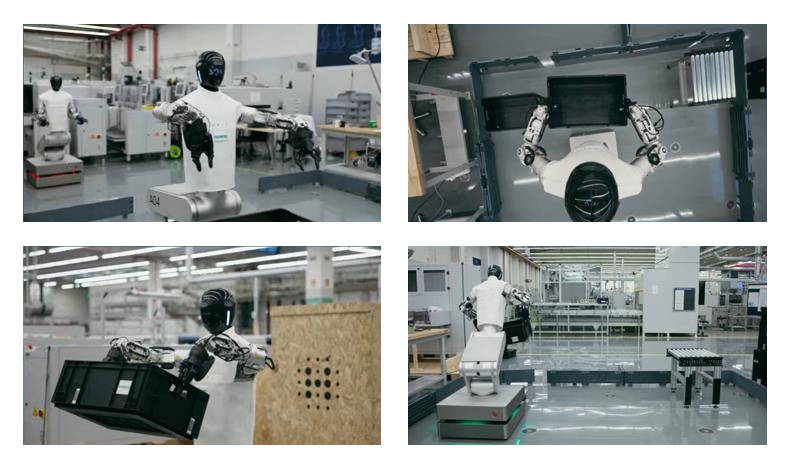
The real system (hardware) demonstrated 60 tote moves per hour, more than 90% pick-and-place success rate, multiple tote handling capabilities, continuous autonomous operation, and sustained uptime in an industrial setting. Most importantly, the project illustrated a scalable model for deploying Physical AI into industrial operations.
We can finally observe similar dynamic behaviors in the digital twin. Typically the torso balancing when unloading the payload, or the cartbox motion when the 3-finger grippers release it onto the table. On purpose we kept the same behaviors with simple control logics, but for sure they could all be improved with smoother motion considering more advanced control logics or new AI strategies with learning process.
Takeaway: Engineering the future of factory logistics
In a nutshell, we could summarize the benefits of using Simcenter Amesim in the context of industrial logistics:
- The future of industrial robotics will not be defined by robots that most closely resemble humans. It will be defined by robots that deliver measurable manufacturing value. For industrial logistics, the winning formula is often surprisingly pragmatic: AGV mobility + torso + robotic arms + intelligent grippers + AI + system simulation.
- By combining these technologies with physics-based digital twins in Simcenter Amesim, manufacturers can evaluate performance, autonomy, energy efficiency, controls and operational robustness months before hardware exists. The result is faster development, reduced prototyping costs, safer deployment and more reliable industrial robots.
- As Physical AI moves from research labs onto factory shop floors, system simulation is becoming the engineering backbone that transforms robotic concepts into productive industrial assets. It provides the physics, the data and the digital twin foundation needed to power the next generation of Industrial AI for manufacturing, logistics and autonomous production systems.
Learn more about Simcenter Amesim
Simcenter Amesim is the leading integrated, scalable system simulation platform, allowing system simulation engineers to virtually assess and optimize the performance of mechatronic systems.