System Simulation for humanoid robots – Turning complexity into competitive advantage with Simcenter Amesim
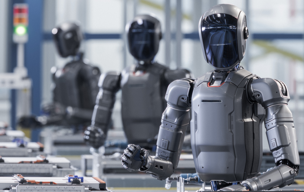
Humanoid robots are no longer science fiction. They are quickly becoming a strategic technology for industry, logistics, healthcare, and service applications. Yet designing a humanoid robot remains one of the most complex engineering challenges ever attempted.
What separates successful humanoid programs from stalled prototypes is not just better hardware — it is the ability to understand, predict, and optimize the entire system early on.
This is where system simulation with Simcenter Amesim becomes a decisive enabler.
Why System Simulation changes everything – Designing intelligence, not just machines
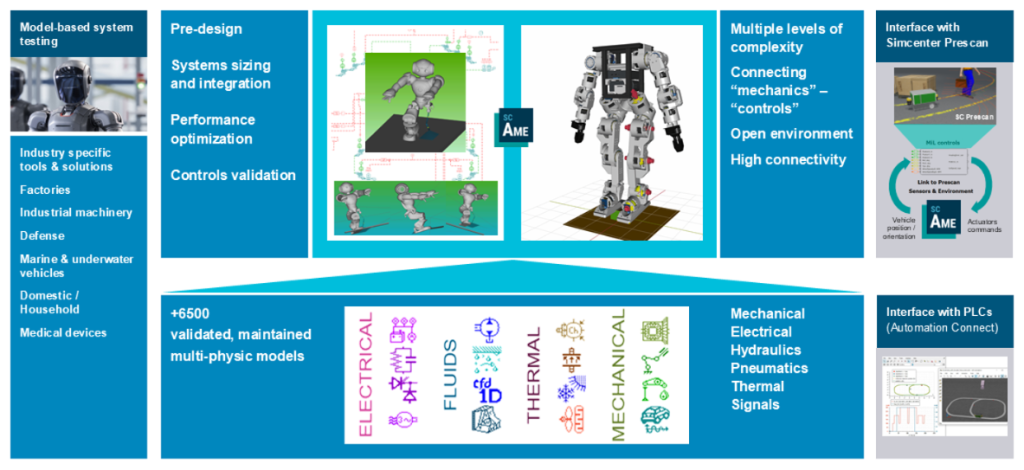
Humanoid robots are much more than mechanical assemblies. Every design choice impacts performance, safety, energy consumption, autonomy, and ultimately feasibility. Tight packaging, thermal limitations, power constraints, and real‑time control requirements all compete within a human‑sized form factor.
System simulation allows teams to answer critical questions before hardware exists:
- Can this robot walk dynamically without sacrificing stability?
- How much energy will a real mission truly consume?
- What is the impact of actuator choice on autonomy and weight?
- How do control strategies behave under realistic physics?
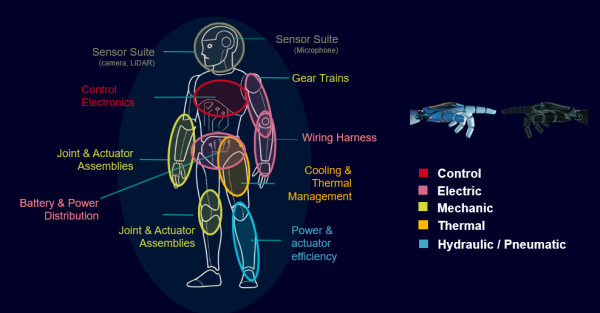
With Simcenter Amesim, engineers create a virtual digital twin that connects mechanics, electronics, controls, and energy into one coherent system. This transforms humanoid development from trial‑and‑error into informed design decision‑making.
Locomotion and mobility – The challenge of building something human
Movement defines a humanoid robot. Walking, climbing, balancing, and recovering from disturbances are what allow robots to operate in human environments rather than specially adapted ones.
System simulation enables engineers to:
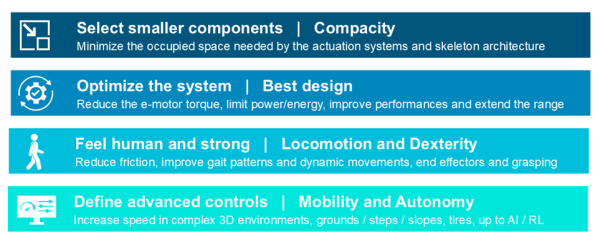
- Explore walking and dynamic motion early
- Validate balance and stability strategies virtually
- Understand how arms, legs, and torso interact dynamically
- Test mobility across slopes, steps, and complex terrain
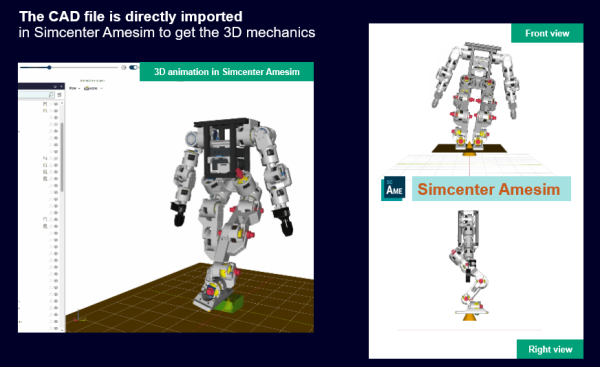
Instead of discovering limitations late in physical testing, teams can refine locomotion concepts digitally — faster, safer, and with far less cost.
Actuation systems – Teaching machines to move like us
Actuators are the muscles of the humanoid robot — and the source of many design trade‑offs. Power density, efficiency, responsiveness, weight, and thermal behavior all matter.
Simcenter Amesim supports a wide range of actuation technologies, including electric, hydraulic, and hybrid architectures. This allows teams to:
- Compare architectures objectively
- Optimize torque, speed, and efficiency
- Balance performance against mass and energy usage
- Reduce over‑design and unnecessary margins
By simulating actuation at system level, humanoid developers can select the right technology with confidence, rather than relying on assumptions.

Manipulation and dexterity – From motion to meaning
True usefulness comes from interaction. Humanoid robots must grasp, manipulate, and adapt to a wide variety of objects — often with human‑like dexterity.
System simulation makes it possible to:
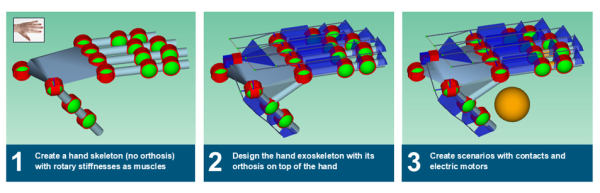
- Virtually prototype hands, grippers, and end effectors
- Evaluate grasp stability and contact forces
- Explore lightweight and underactuated designs
- Optimize mechanisms before building hardware
This approach accelerates innovation in dexterous manipulation while reducing costly physical iterations.
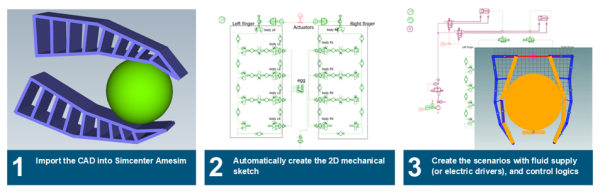
The digital twin is now ready for its mechanical parts. Let’s go to other key aspects like power and energy management to ensure the Humanoid Robots stay alive during their complete missions. It’s more at the electric and thermal sides of the components considering their system integration and interactions.
Power and energy systems – The invisible constraint
In humanoid robotics, autonomy is everything. Battery size, charging time, thermal limits, and power management directly constrain what a robot can do in the real world.
Simcenter Amesim enables:
- Mission‑based energy analysis
- Battery sizing and range estimation
- Evaluation of auxiliary power consumption
- Thermal safety and component lifetime assessment
Instead of reacting to “battery anxiety” late in development, teams can design autonomy as a first‑class requirement from day one.
Autonomy and 3D environment – Autonomy in a human world
Humanoid robots must operate safely and robustly in environments designed for humans — not robots. This demands behavior that adapts to the unexpected.
System simulation supports:
- Virtual 3D environments and terrain
- Sensor integration and perception workflows
- Evaluation of navigation and obstacle avoidance
- Early validation of control strategies in realistic scenarios
By testing autonomy in the virtual world, teams dramatically reduce real‑world risk while speeding up deployment readiness.
Well done! The multiphysics aspects of these humanoid mechatronic systems are now being managed effectively. The next challenge is now to develop an optimal controller quickly. Let’s explore the appropriate workflow that combines both online and offline approaches. This includes the use of Artificial Intelligence (AI) techniques such as Reinforcement Learning (RL), or to put it simply: “Physical AI”, or “Physics-Induced Machine Learning”, up to the “Hybrid Analytics” for the “Sim-to-Real” training of the robots.
Let’s have a deeper look at the “Sim-to-Real” transfer. It’s the process of training a policy in a physics simulation tool and deploying it on physical hardware, bridging the reality gap with domain randomization.
AI needs physics – Not the other way around
Modern humanoids increasingly rely on intelligent control and machine learning to achieve robust behavior. However, collecting real‑world training data is slow, expensive, and risky.
Digital twins enable:
- Generation of high‑quality synthetic training data
- Safe exploration of edge cases
- Faster training and iteration of AI models
- Improved sim‑to‑real transfer
By combining physics‑based simulation with AI, Simcenter Amesim helps bridge the gap between theory, training, and real‑world performance.
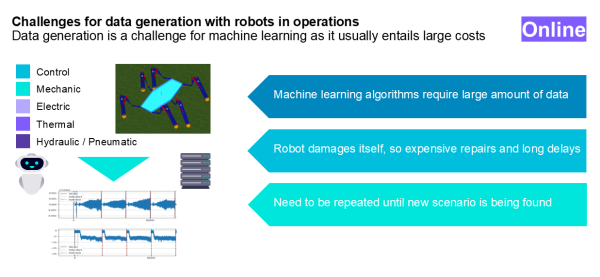
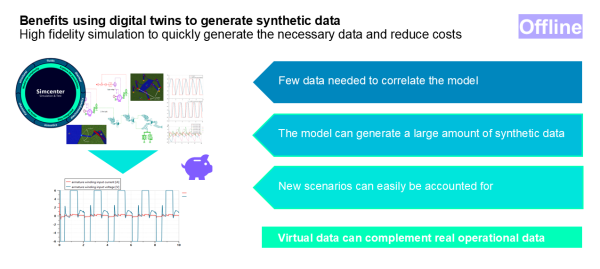
This is about not reinventing the wheel. The robot is already programmed with everything it needs to know about physics. It’s about how the robot adapts to environmental uncertainties — varying road slopes, uneven terrain, and the different friction characteristics of materials and surfaces.
So, in fact, the robot needs just 10 seconds of real-world data to learn and optimize its behavior, a significant breakthrough in efficient robot training.
The business impact – Key benefits for users
System simulation is not just an engineering tool — it is a strategic accelerator:
- Faster time to market
- Reduced development risk
- Optimized performance and energy efficiency
- Higher confidence in design decisions
- Scalable innovation from concept to deployment
For organizations investing in humanoid robotics, Simcenter Amesim provides a foundation to build smarter, lighter, more capable robots — faster than competitors.
Takeaways – The future of humanoid robotics
Let’s summarize the key benefits of using System Simulation to address your challenges when designing Humanoid Robots:
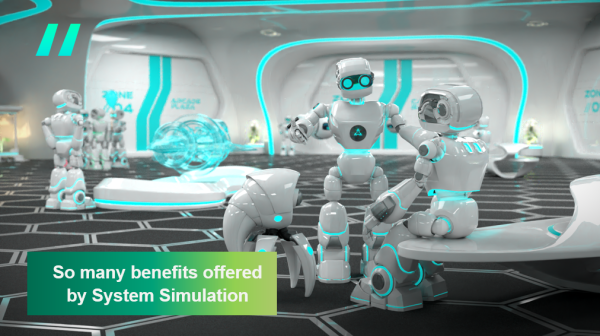
- Humanoid robots are stepping into the real world : Humanoids are transitioning from research labs to real industrial and societal roles — but success depends on mastering complexity.
- Everything affects everything : In humanoids, mechanics, energy, control, and behavior are inseparable.
- System simulation changes the game : System simulation shifts humanoid development from trial‑and‑error to informed decision‑making.
- From motion to interaction : Dexterity determines whether a humanoid is useful or just impressive.
- Autonomy is designed, not discovered : Energy defines availability — simulation makes autonomy predictable.
- Smarter AI starts with better physics : Digital twins generate safe, scalable synthetic data for AI and controls.
And finally, a brief outcome:
- The humanoid advantage goes to those who master complexity : The winners in humanoid robotics will be system thinkers.
Simcenter Amesim drives innovation for the future of Humanoid Robots. It enables smarter, lighter, more capable humanoids — starting in the virtual world.
Learn more about Siemens Simcenter Amesim
Simcenter Amesim is the leading integrated, scalable system simulation platform, allowing system simulation engineers to virtually assess and optimize the performance of mechatronic systems.