Generate physics-aware 3D engineering design concepts with Simcenter PhysicsAI

Simcenter PhysicsAI Generate, available in Simcenter Hypermesh, uses diffusion-based generative AI trained on historical design and simulation data to produce novel, physics-aware 3D engineering design concepts – directly from dimensional targets and performance KPIs – in seconds. This blog explains how it works, walks through a real electronics housing case study, and shows how it transforms your engineering workflow from the very first concept.
Breaking the CAD-simulation iteration loop that’s slowing you down
It’s 9 AM on a Monday. A new set of requirements has just landed in your inbox – dimensional constraints, structural targets, a tight deadline, and a customer who wants to see concepts by the end of the week. You grab your coffee, open your CAD tool, and stare at the blank screen for a moment. And then you do what you’ve always done: you start building.
You sketch a concept based on intuition, past experience, and a healthy dose of gut feel. A few hours later, you have something that looks reasonable. You clean up the geometry, set up the mesh, define the boundary conditions, and submit the simulation. Then you wait. Sometimes it’s 20 minutes. Sometimes it’s a few hours, depending on the complexity. You check your emails, attend a stand-up, and grab another coffee.
The results come back. The displacement is too high. The stress concentration near that corner is worse than you expected. So you go back into CAD, tweak the geometry – maybe thicken a wall here, add a rib there – and submit again. Rinse and repeat.
By Wednesday, you’re on iteration six. Some of those runs didn’t even make it to results because you’d already spotted a modeling error halfway through. The deadline is Thursday. You’re not panicking yet, but you’re acutely aware that of all the hours you’ve spent this week, only a fraction of them have involved actual thinking. The rest? Waiting, fixing, resubmitting. The loop is relentless.

Sounds familiar? If you’ve spent any time in a design role, I’d wager it does. This isn’t a complaint about any one tool or any one team – it’s simply the reality of how engineering design has worked for decades. Requirements come in, you build manually, you simulate, you iterate. It’s a process that has produced extraordinary products. But it has also consumed extraordinary amounts of time – time that, if we’re honest, could be spent on the parts of the job that actually require human creativity and judgment.
The pressure to compress this loop has never been greater. Product lifecycles are shrinking. OEMs are demanding more design variants with tighter performance windows and faster turnaround. The old rhythm of manual CAD plus physics solver, while still essential, is no longer sufficient on its own.
The industry needed a smarter way forward – not just faster evaluation, but a way to generate new design concepts directly from requirements and prior simulation knowledge. That’s exactly what Simcenter PhysicsAI was built to do.
The evolution of Simcenter PhysicsAI
Simcenter PhysicsAI didn’t arrive fully formed overnight. Like the best engineering solutions, it evolved – shaped by real problems that real engineers were facing, and refined with each step to deliver something more powerful than the last.
It began with faster answers to the questions you were already asking
Simcenter PhysicsAI started by tackling the part of the loop you probably dread most: the waiting. You still designed manually in CAD, but instead of submitting to a full physics solver and stepping away for a coffee or two – Simcenter PhysicsAI delivered real-time predictions across any engineering domain – whether structural, thermal, electromagnetic, fluid, or manufacturing. The model had learned from historical simulation data using Geometric Deep Learning and could predict on new geometries in a fraction of the time. For teams running hundreds of design iterations, this was a genuine gamechanger. Those hours of solver time? Compressed into seconds.
It was a meaningful leap, and it proved something important: AI, trained on real simulation data, could genuinely understand the relationship between geometry and physics. That insight opened a door to an even more ambitious vision – if Simcenter PhysicsAI could evaluate designs with such speed and accuracy, the next question was “how much further can we go?” – and the answer was to put that deep, learned understanding to work even earlier in the design process, at the very moment a concept is born.
Can we go from KPI prediction to design generation?
Rather than just evaluating your designs faster, Simcenter PhysicsAI now helps create them. You supply your design requirements – dimensional targets, performance KPIs and Simcenter PhysicsAI generates novel design concepts that are engineered to meet them. Your design process no longer starts with a blank canvas and a gut feeling. It starts with a physics-aware, AI-generated concept that’s ready for your refinement and judgment.
This is the leap from simulation acceleration to concept generation – and it changes not just how fast you work, but how you work, fundamentally.
Welcome to Simcenter PhysicsAI Generate.
Under the hood: How do diffusion models generate engineering designs?
If you’ve ever marveled at how tools like DALL·E or Stable Diffusion conjure photorealistic images from a text prompt, you already have an intuition for what’s happening inside Simcenter PhysicsAI Generate – except here, the output isn’t a 2D image. It’s an engineering geometry, conditioned on real physics.
The backbone of Simcenter PhysicsAI Generate is a diffusion model – the same class of algorithm that has become the state of the art for generating images, videos, and music. This isn’t marketing language. It’s grounded in some of the most influential research in modern AI. Ho, Jain, and Abbeel’s landmark 2020 paper, Denoising Diffusion Probabilistic Models, established the mathematical framework that enabled high-quality generative AI practical at scale. Building on this, Song et al.’s Score-Based Generative Modeling Through Stochastic Differential Equations extended the theory further, showing how a neural network could learn to reverse a noise process across continuous time – giving rise to the generation pipelines that now power everything from image synthesis to, as you’re about to see, 3D engineering design.
Simcenter PhysicsAI Generate stands on these foundations and redirects its power toward something the original researchers likely never envisioned: helping an engineer staring at a blank CAD screen on a Monday morning find their first great concept before the coffee goes cold.
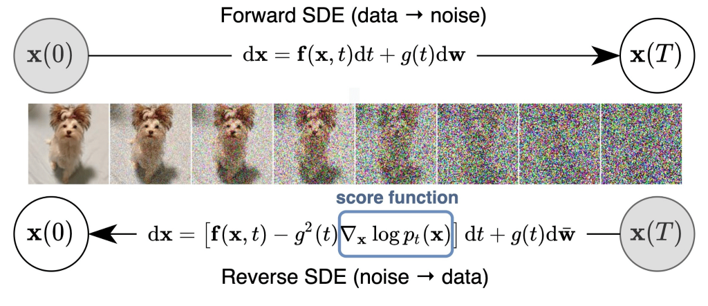
Here’s how it works:
Training phase – Learning from what exists
The model is trained on a library of historical designs you already have – each paired with its corresponding design parameters and simulation outcomes (KPIs such as displacement, stress, or temperature). During training, the model learns to corrupt these clean designs into pure noise progressively – think of it as systematically “forgetting” what a good design looks like, step by step. Simultaneously, a neural network learns the reverse: how to denoise – to reconstruct meaningful geometry from that noise.
After a focused training period, the model has internalized the deep relationship between your design parameters, physics performance, and geometry. It has, in essence, studied every design your team has ever produced and learned the rules that connect shape to performance.
Generation phase – Creating what doesn’t yet exist
At inference time, the process runs in reverse. You start with random noise and provide your design targets – dimensions, performance thresholds, KPIs. The neural network then progressively denoises that random noise, guided by your conditioning inputs, until a coherent 3D design emerges – in just a matter of seconds. What once required lengthy solver runs and manual iteration can now happen almost instantaneously, on demand.
One of the most powerful aspects of diffusion models is their inherent diversity. Because generation starts from randomly sampled noise, each run with a different seed produces a different design – all of which satisfy the same input targets. Engineering solutions are rarely unique, and Simcenter PhysicsAI Generate embraces this reality. Rather than handing you a single answer and calling it done, it gives you a distribution of valid design concepts to explore. The random seed becomes your creative dial – turn it, and you get a new concept every time.
Real-world impact: The electronics housing case study
Theory is compelling. But nothing makes the value of a technology more tangible than watching it solve a real engineering problem – one that looks a lot like the kind of challenge sitting in your own project queue right now.
The challenge
Picture this: you work for a company that designs plastic electronic housings for a range of OEMs. A new Request for Quotation (RFQ) lands on your desk. The customer has specific requirements – outer dimensional constraints and a maximum allowable structural displacement under load. Standard stuff, on the surface. But your design space is rich: housing length, width, wall thickness, base plate dimensions, and the presence or absence of internal ribs all interact in ways that aren’t always intuitive. Getting a concept that satisfies all the targets without spending a week in the iterate-and-simulate loop is the real challenge.
Traditionally, you’d start sketching concepts, run FEA on each, iterate, and eventually converge on something that works. With a rich enough design space, that process can eat days or weeks. And if the RFQ requirements are outside the range of what your team has built before? You’re navigating unfamiliar territory with nothing but experience and instinct to guide you.
Training the generator
With Simcenter PhysicsAI Generate, your team feeds its library of historical housing designs into the system. Each design is tagged with its key parameters – length, width, wall thickness, rib configuration and the resulting maximum displacement from simulation. These become the design targets that condition the generator.
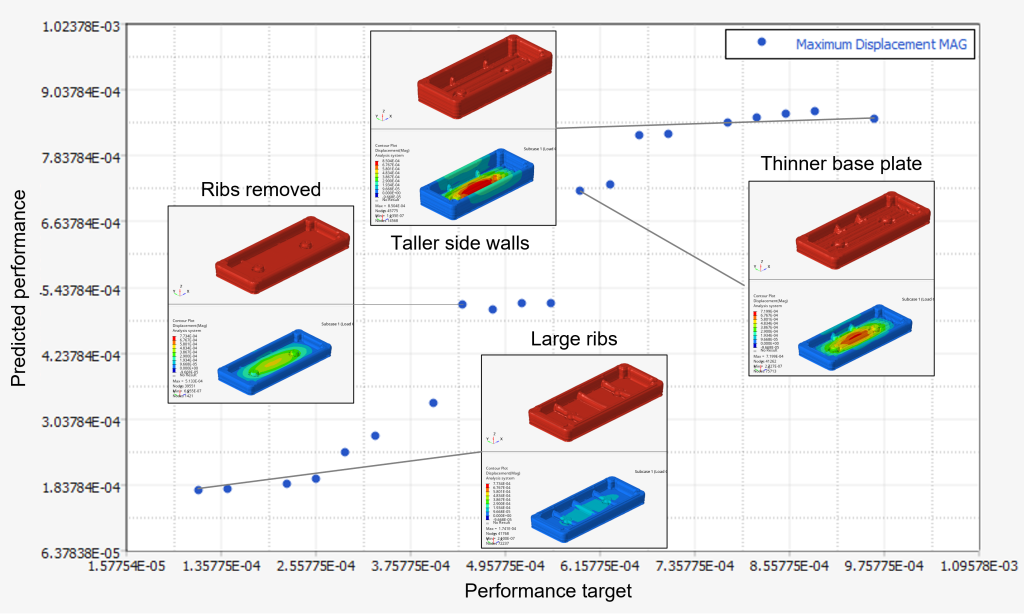
After training, the model has learned something remarkable: the nuanced, non-linear correlations between housing geometry – including subtle features like the presence or absence of ribs, variations in base plate thickness and the resulting structural performance. It understands that taller side walls or a thinner base plate shift the displacement response in specific ways, and that rib placement can compensate for other geometric trade-offs. In short, it has absorbed the collective simulation knowledge your team has built up over years and knows how to use it.
Generating novel design concepts
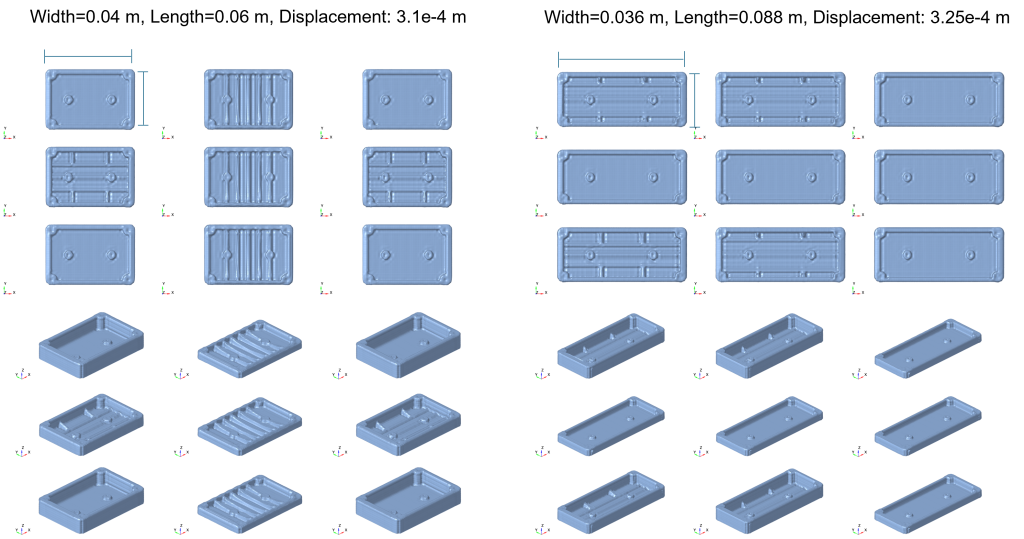
Now comes the part that transforms your lengthy product design process. The new RFQ arrives with specific targets – say, a width of 0.04 m, a length of 0.07 m, and a maximum displacement of 0.001 m. You enter these directly into the Simcenter PhysicsAI Generate interface as design targets. In under 10 seconds, the generator produces a novel housing geometry it has never seen before – one architected to meet those targets. The predicted displacement correlates closely with the performance target you passed to the generator, validating that the generated design isn’t just geometrically plausible – it’s physically meaningful.
What’s particularly striking is that the generated design isn’t simply the closest match from your training database. Visualizing the design space – plotting length against displacement for designs near a given width reveals that the generator can produce concepts that sit in regions of the design space where no training sample exists. It is genuinely creating novel designs that are grounded in physics.
And by varying the random seed, you get multiple distinct housing concepts – each meeting the same RFQ targets but exploring different geometric strategies. One might use a thicker base plate with minimal ribs. Another might use a thinner base with a more aggressive rib pattern. You’re no longer searching for a needle in a haystack – you’re being handed a curated shortlist of needles to choose from, and the choice of which one to take forward is yours.
How does generative AI change your engineering workflow?
The implications of Simcenter PhysicsAI Generate extend well beyond faster concept generation. They touch the fundamental economics and creativity of how you work every day.
- Faster RFQ response: When a new set of requirements arrives, the time between “requirements received” and “first viable concept ready for review” collapses from days to minutes. For teams competing on responsiveness, this is a decisive advantage.
- Broader design space exploration: You, like every engineer, are constrained by time. That constraint naturally pushes you toward familiar patterns and proven geometries. Simcenter PhysicsAI Generate does not exhibit such bias. It explores the full learned distribution of designs, surfacing geometries you might never have considered – and some of them turn out to be better.
- Physics-first concept design – The concepts Simcenter PhysicsAI Generate produces aren’t just geometrically interesting – they’re trained on real simulation data, meaning they’re physics-aware from the very first moment of their existence. You’re not starting from a pretty shape and hoping it works. You’re starting from a shape that already understands the physics.
How does Simcenter PhysicsAI Generate compare to other generative design approaches in the market?
Most geometry-driven generative design tools work by manipulating geometry within a predefined design envelope, with physics constraints applied after a shape is proposed, as a filter. The tool proposes; the physics check follows. Simcenter PhysicsAI Generate inverts this logic entirely. It uses diffusion models trained on your own historical simulation data, meaning the generated concepts are conditioned on real physics from the very first step.
There is one further distinction worth noting. Most generative design tools return a single optimised solution. Simcenter PhysicsAI Generate, by contrast, produces a distribution of valid concepts – each satisfying the same input targets, each exploring a different geometric strategy. By simply varying the random seed, you get a new concept every time – all physics-grounded, meeting your requirements.
AI as your design partner
For decades, simulation has been a tool for evaluating your designs. You brought the creativity and domain knowledge; simulation told you whether your ideas worked. The roles were clearly defined.
Simcenter PhysicsAI begins to blur that boundary – in the best possible way. AI is no longer just a validator sitting at the end of your workflow; it is becoming a collaborator at the start. It brings a learned understanding of how geometry and physics interact across thousands of prior designs, and uses that knowledge to propose new solutions that you can then refine, validate, and bring to life. Simcenter PhysicsAI Generate marks a shift in what that collaboration looks like – from AI as a simulation validator to AI as a design collaborator, one that arrives at the concept table with physics knowledge already built in.
This doesn’t replace you. It amplifies you. The creative judgment, the manufacturing insight, the customer relationship, the engineering instinct built over years of hard-won experience – those remain yours. What changes is the laborious work of translating requirements into viable geometry. That early-stage search can now happen faster, with broader exploration and stronger physics guidance.
Your next great design might be a few seconds away
Simcenter PhysicsAI Generate is available1 in Simcenter Hypermesh. Getting started is straightforward: set up your training dataset with design parameters and KPIs, train your generator, and start producing novel design concepts in seconds. The future of engineering design isn’t just faster simulation. It’s smarter generation – physics-aware, data-driven, and ready to work alongside you from the very first concept.
Interested in learning more about Simcenter PhysicsAI and the Generate feature? Register for Simcenter PhysicsAI webinar using the link below or reach out to your Siemens Digital Industries Software representative. Drop your questions, thoughts, or use cases in the comments section – we’d love to hear what design challenges you’re looking to solve.
- Simcenter PhysicsAI Generate is currently available as an experimental feature in Simcenter Hypermesh 2026.0, 2026.1 and will be officially available in Simcenter Hypermesh 2612 release. ↩︎