Solve complex NVH challenges across the development process with Simcenter

Ok, where does this Noise come from? A practical journey into Transfer Path Analysis (TPA)
During a late-stage vehicle test, an engineer notices a persistent noise in the cabin. The engineer cannot immediately determine where it comes from. The powertrain seems quiet, the team recently updated the mounts and optimized the insulation. Yet the issue remains.
This situation sounds familiar. Noise, vibration and harshness (NVH) challenges rarely originate from a single source. Instead, they result from multiple interacting components, each contributing through complex transmission paths. Observing the symptoms is straightforward but understanding the cause is far more difficult.

Identifying the source of noise is not straightforward: multiple contributors are often involved
This is where transfer path analysis (TPA) comes in.
TPA provides a structured way to move beyond observation. It allows engineers to break down a complex NVH problem into its physical contributors and understand not just what happens, but why it happens.
From a complex response to a structured model
Faced with the cabin noise issue, the engineer reframes the problem using a simple but powerful model: source, path and receiver.
- Where are the excitations coming from?
- How do they travel through the structure?
- And how do they combine at the receiver?
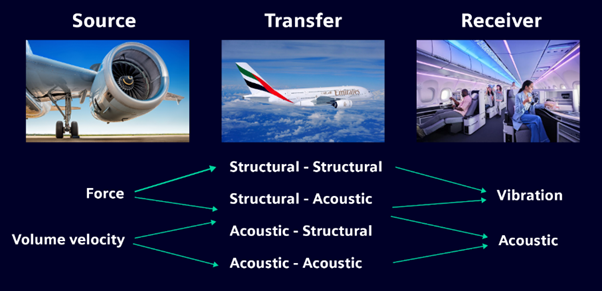
Source–path–receiver decomposition
By defining the system in this way, the problem becomes more manageable. Each source introduces forces into the system. Transfer paths describe how those forces propagate. The receiver captures the final response that the user hears or feels.
Instead of treating the noise as a single, unexplained outcome, the engineer can now reconstruct it. By combining operational loads with transfer functions, each path contribution can be quantified. Some paths turn out to be negligible. Others dominate the response.
The problem is no longer abstract: it is measurable, rank able and actionable.
From troubleshooting to earlier insight
Engineers typically perform this type of analysis when a full system is available.They work with a physical prototype, performs measurements and identifies the dominant contributors to the issue.
This approach works well, but it comes with a cost. Insight arrives late. By the time the root cause is clear, teams may already find design changes difficult or expensive to implement.
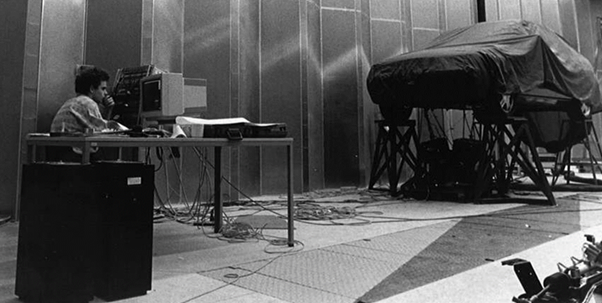
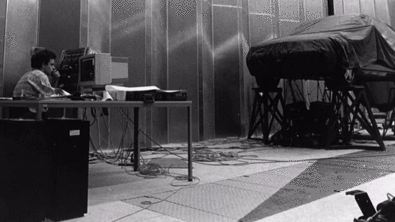
Classical TPA full system testing
In today’s development environment, this is increasingly a limitation. Programs move faster. Variants multiply. Waiting for a prototype to understand NVH behavior is no longer always an option.
The question becomes: can the same level of insight be achieved earlier?
Expanding the approach
This is where component-based transfer path analysis (TPA) comes into play. Instead of waiting for the complete assembly, engineers characterize individual components separately and capture their behaviour in a way that remains valid regardless of where they are used. They can then combine these components virtually to represent a full system.
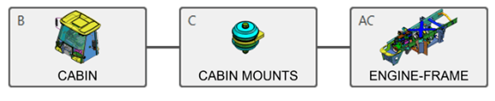
Component-level representation of cabin excitation transfer
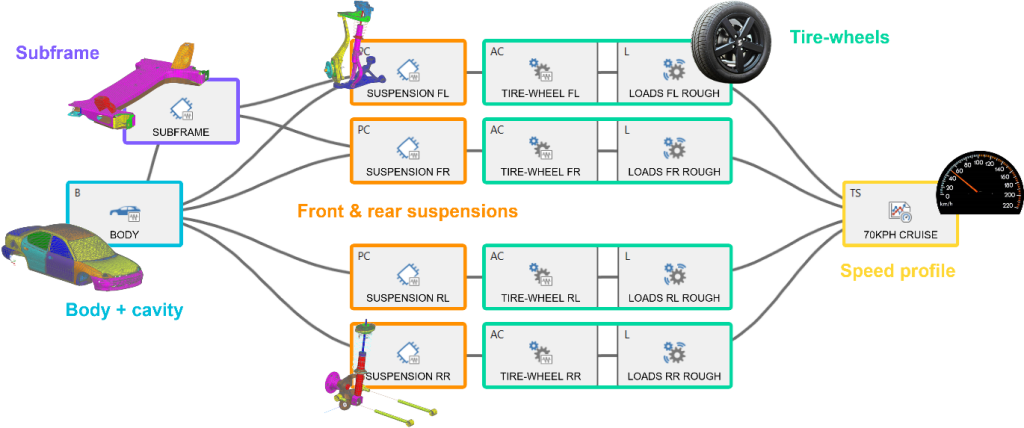
System-level representation of multi-path load transfer across vehicle
Now engineers can explore the impact of design choices much earlier. What if a mount stiffness changes? What if a new component is introduced? What if the system architecture evolves?
Now, engineers can answer these questions without building the full prototype.
This is the shift toward component-based TPA and it fundamentally changes how NVH engineering is performed.
Bringing the workflow together
As the process evolves, another challenge becomes apparent: connecting all the pieces.
Measurement data must be reliable and consistent. Engineers need to apply different TPA methods depending on the situation. Component data must be reusable. Virtual assemblies need to reflect real system behavior.
This is where a structured workflow becomes essential.
Simcenter brings these elements together into a coherent approach, supporting both classical and component-based TPA workflows from measurement to virtual system prediction. It supports the engineer throughout the process: starting with guided measurements, continuing with classical troubleshooting methods and extending toward component-based testing and modelling, ending with virtual system prediction.
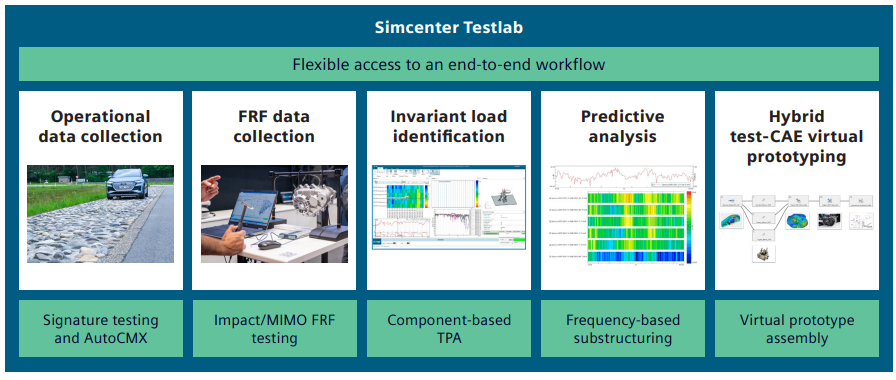
End-to-end TPA workflow
In practice, this means:
- Teams can plan and validate measurements to ensure data quality from the start.
- Classical TPA methods remain available for root cause analysis on physical systems.
- Teams can characterize components once and reuse them across multiple configurations through component-based TPA.
- Virtual assemblies enable system-level prediction without relying on full prototypes.
- Engineers can evaluate results not only numerically, but also perceptually through auralization.
- Teams can standardize and automate workflows to ensure consistency.
Rather than a set of isolated tools, this becomes a continuous process: from data acquisition to engineering decisions.
A different way of working
Returning to the original problem, the engineer now has more than a solution to a specific noise issue.
- There is a structured way to understand system behavior.
- There is the ability to predict the impact of design changes earlier.
- There is a connected workflow linking measurement, analysis and simulation.
Transfer path analysis is therefore no longer limited to troubleshooting. It becomes part of a broader engineering approach: one that supports both understanding and prediction.
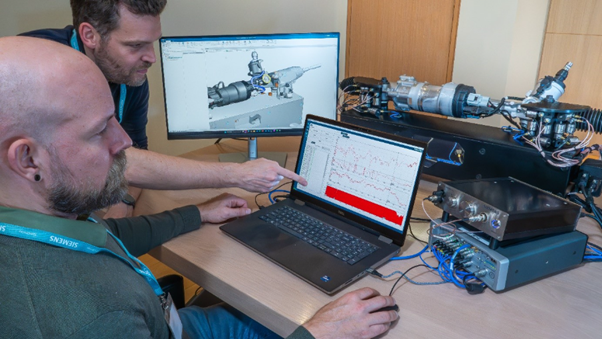
Automated component model extraction with Simcenter
Explore the full guide
For engineers looking to apply these concepts in practice, the Transfer Path Analysis solution guide provides a structured overview.
It walks through the methodology, explains the available capabilities and shows how engineers can use TPA across development stages: from identifying issues on physical prototypes to predicting system behavior in virtual assemblies.
👉 Download the solution guide to explore how the Simcenter physical testing transfer path analysis solutions can support your NVH development process from first insight to confident design decisions.