Wheel force measurement is essential, but it doesn’t need to be so expensive thanks to AI
This blog post was co-written with Wouter Vandermeulen, principal engineer for Simcenter Engineering Services.
Understanding the forces on wheels is critical for automotive OEMs. This tells them the loads that the vehicle will be subjected to and how it needs to be built to withstand them.
Typically, engineers attach transducers to each wheel of a vehicle and then carry out test runs with a variety of different types of maneuvers to measure all the forces it experiences.
But these wheel force transducers are quite costly, running anywhere from €250-500k for a set of four for one car. And manufacturers also need to consider how their vehicles will be used in different countries – forces will vary depending on factors such as driving style, types of road surface, amount of traffic, and weather conditions.
So, if you want to understand the forces in four separate countries using four vehicles, that’s a total of €1M just for the transducers.
They also take a considerable amount of time to set up and calibrate to ensure they give accurate measurements. And they’re not small, so they increase the width of vehicles significantly which can make driving on some roads impractical or even illegal. This extra width also puts them at risk of damage on narrow roads, which is hardly affordable given their cost.
These forces must be measured as otherwise design trade-offs are difficult to achieve. This can result in vehicles that either degrade too quickly or are over-engineered, leading to uneconomical development costs.
Fortunately, there is another way, and it has already proved successful for one customer. This Siemens-delivered solution achieved a 66% reduction in costs and halved the total testing ground time from two weeks to one week for wheel force measurement. Let’s explore how.
Combining tiny ubiquitous sensors with simulation and AI
Simcenter Engineering Services has developed a new solution that combines the existing transducers with cheaper and easily configurable sensors, simulation, and AI models to deliver the same results much faster and at a fraction of the cost.
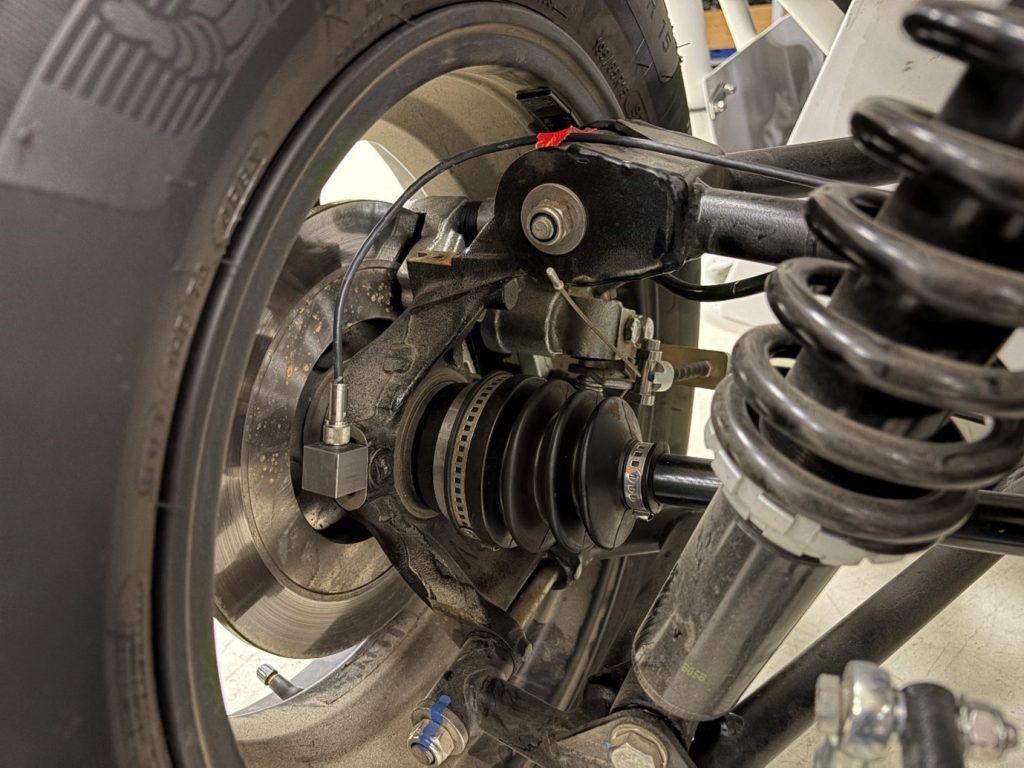
One set of expensive wheel force transducers is still required to provide ground truth, enabling benchmarking of the data captured by virtual wheel force sensors. But this can all be gathered on a proving ground without the need to go out on public roads.
Proving grounds are typically busy with limited time slots available, meaning efficiency is key. But a wide variety of different maneuvers need to be performed to cover as many real-world scenarios as possible. This includes acceleration and braking runs, lateral events (e.g. cornering), vertical events such as speed bumps and hills, and different road surfaces.
Simcenter SCADAS RS makes it easy and fast to set up each test run as multiple people can connect to it to perform several tasks in parallel. For instance, while one engineer is inputting channel names, another can attach the sensors and adapt the directions in the channel set-up, and a third engineer can carry out sanity checks on the installed sensors.
The software also uses event markers which make it easy for the test driver to annotate each measurement with a description of the test condition, meaning there is no need for another engineer in the vehicle at the same time. This creates a channel in the dataset, making it easy to analyze after the results are recorded.
Virtual sensor creation
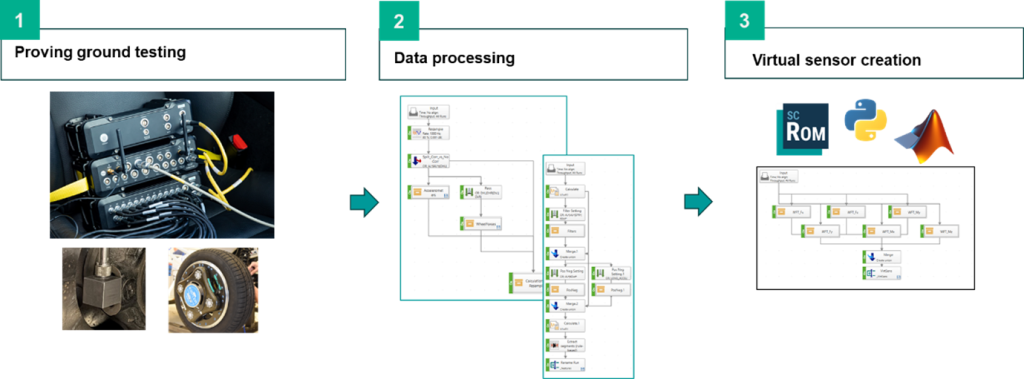
Simcenter SCADAS RS captures and processes the data, then passes it to Simcenter Testlab Neo Process Designer. This automatically removes sensor drift in accelerometers and accounts for sensitivity issues and direction mistakes. It also ensures that the AI model has the quality and reliability needed to estimate the forces.
Further processing in Simcenter Testlab Neo extracts more information from the measured data. For instance, instead of acceleration data it can use the jerk of the filtered part of a certain accelerometer between 60 and 100 hertz. Simcenter Testlab Workflow Automation enables engineers to apply this across hundreds of runs overnight without the need for manual work.
Simcenter Reduced Order Modeling is then used to create a model that predicts the wheel forces based on the data from the cheaper sensors.
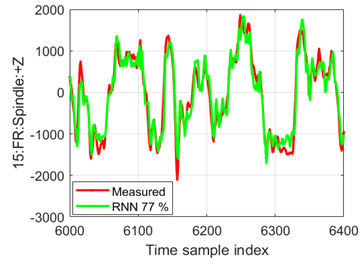
This graph shows how the forces predicted by the AI model in green match closely with the measured forces in red.
Wheel force measurement costs reduced by 66%
Based on carrying out testing in four countries, this new solution offers the same results with a 66% reduction in wheel force measurement cost. It also halves the total testing ground time from two weeks to one week.
These significant savings mean that manufacturers can also consider running tests on more vehicles while still being much cheaper than using traditional methods for fewer vehicles.
This specific use case focused on durability, ensuring that vehicles are built to last. It could also help predict when vehicles will require maintenance either sooner or later than average estimates. And the same methods could be adapted for NVH optimization, predicting how noise and vibration affect cabin comfort in different conditions.
The secret to significant time and cost efficiencies achieved in this use case lies in the end-to-end approach developed by Simcenter Engineering Services, covering everything from data acquisition to processing and AI model training with Siemens tools. These remarkable gains are fully enabled by advanced data and AI solutions. Contact Simcenter Engineering Services to learn how the Simcenter simulation and physical testing solutions (including Simcenter SCADAS and Simcenter Testlab) allow to integrate your data into AI and automated workflows can provide a powerful competitive market advantage for your development.
To learn more about how Simcenter Engineering Services can help you integrate AI into your engineering workflows, check out the resources below: