Mastering the PCB designer’s triangle: Broad embedded verification for enterprise PCB excellence

Within the global enterprise ecosystem, where product innovation, operational efficiency, and market leadership are paramount, the underlying integrity of your technological foundations is non-negotiable. For organizations operating at scale, the PCB is far more than a mere component; it’s a critical enabler of product functionality, a determinant of market competitiveness, and a significant factor in enterprise-wide risk management.
In the high-stakes domain of enterprise product development, every PCB design decision is a strategic negotiation. Mitigating risk is a persistent challenge. We constantly strive to balance the competing PCB design perspectives of Solvability (does it all fit and work as intended?), Performance (how well does it work?), and Manufacturing (can we build it efficiently and cost-effectively?). These competing perspectives, known as the “Designer’s Triangle,” define the landscape of innovation, where success hinges on a holistic approach.
Broad embedded verification coverage is the enterprise’s indispensable strategy for navigating this complex interplay. It’s not merely a collection of engineering checks; it’s an integrated framework that ensures your PCB designs are robust, reliable, and ready for market, transforming potential trade-offs into synergistic advantages. By embedding comprehensive verification within the design process, you optimize your product development lifecycle, mitigate enterprise-level risks, and secure a competitive edge.
This is precisely why broad embedded verification coverage in PCB design must evolve from a departmental engineering task into a strategic enterprise-level mandate. It represents a holistic, integrated approach that ensures not just the technical viability of individual designs, but the systemic resilience, scalability, and market readiness of your entire product portfolio. For the enterprise, this isn’t merely about avoiding design flaws; it’s about optimizing your innovation pipeline, securing your supply chain, and fortifying your brand globally.
Consider the enterprise-wide implications: a single PCB design flaw can ripple across R&D, manufacturing, supply chain, sales, and customer service, incurring exponential costs and eroding market trust. By embedding comprehensive verification into your core processes, you transform potential liabilities into strategic advantages.
Let’s explore how this integrated approach addresses each perspective of the Designer’s Triangle:
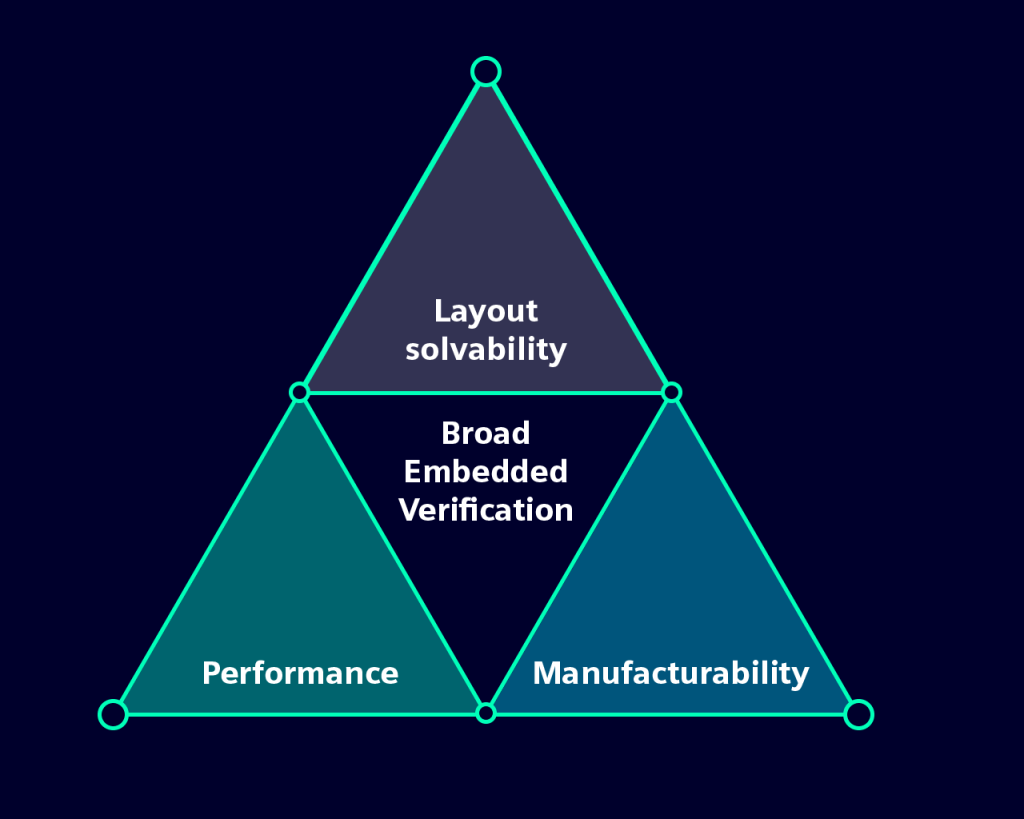
First perspective: Ensuring fundamental solvability and reliability
This category of verification ensures the fundamental integrity and functionality of the electronic system, preventing issues that would render the product fundamentally “unsolvable” or unreliable.
Integrated verification for solvability: Functional, signal integrity (SI), power integrity (PI), and electromagnetic interference (EMI)
- Focus: These critical pillars collectively guarantee a design’s inherent functionality and stability (solvability). Functional verification confirms core operation, while SI maintains the fidelity of high-speed signals. PI delivers the stable, clean power essential for reliable component function, and EMI verification ensures the product operates without self-disruption or interference. Together, these measures prevent fundamental failures that would render a product unusable, significantly reducing costly re-spins and field issues, thereby optimizing manufacturing.
- Value: By integrating these checks, you proactively minimize costly post-launch defects, safeguard brand equity, and reinforce customer trust. This approach streamlines global market entry, mitigates regulatory risks, and ensures products operate flawlessly from day one, protecting revenue streams and accelerating time-to-market.
Second perspective: Maximizing performance and durability
Beyond simply working, enterprise-grade products must perform exceptionally and endure the rigors of their operational environments. This category of verification optimizes speed, accuracy, and physical resilience.
Integrated verification for performance & durability: Analog/mixed-signal (AMS) accuracy, thermal management, vibration & shock resilience, and stress analysis
- Focus: This comprehensive suite of verifications elevates a design from merely “working” to performing exceptionally and enduring over time (performance). AMS accuracy delivers the precision needed for differentiated products, while thermal management guarantees sustained optimal operation, preventing heat-induced degradation. Crucially, vibration & shock resilience and stress analysis ensure physical integrity and long-term reliability in real-world conditions, significantly reducing warranty claims and field failures, thus benefiting Manufacturing.
- Value: This integrated focus ensures consistent high performance, strengthens market perception, and enables highly differentiated products for premium markets. It extends product lifecycles, lowers total cost of ownership, and reinforces your reputation for robust, reliable, and durable solutions in demanding sectors, ultimately strengthening customer trust and competitive advantage.
Third perspective: Optimizing for efficient and cost-effective manufacturing
A brilliant design is only truly valuable if it can be produced efficiently, reliably, and at scale. This category of verification streamlines the transition from design to production, directly impacting profitability and time-to-market.
Integrated verification for manufacturing: Design for manufacturability (DFM)
- Focus: DFM is the cornerstone of efficient production (manufacturing). It ensures that designs are inherently optimized for high-volume, cost-effective production, minimizing waste, improving yields, and simplifying assembly. While primarily focused on manufacturing, DFM indirectly supports consistent performance and functionality (performance, solvability) by ensuring the product can be built as intended without introducing defects.
- Value: A robust DFM framework drives down unit costs, improves production yields, and enhances supply chain resilience. This directly contributes to healthier profit margins, accelerates product availability, and ensures that your global manufacturing footprint operates with maximum efficiency and consistency.
The enterprise mandate: Integrating verification for strategic advantage
For the modern enterprise, broad embedded verification coverage is no longer a localized engineering discipline; it is a critical component of your overall business strategy. It transcends a mere technical checklist; it’s a strategic enabler for the modern enterprise. By addressing the three competing perspectives of the Designer’s Triangle and integrating these comprehensive verifications across your product development lifecycle, you achieve:
- Accelerated innovation cycles: Faster, more reliable product development translates to quicker market entry and sustained competitive advantage.
- Enhanced operational efficiency: Reduced manufacturing costs, streamlined supply chains, and fewer field failures optimize resource allocation and profitability.
- Mitigated enterprise risk: Proactive identification and resolution of design flaws prevent costly recalls, regulatory penalties, and catastrophic reputational damage.
- Strengthened brand equity: Consistently delivering high-quality, reliable, and durable products builds enduring customer trust and market leadership.
- Scalable growth: Ensuring designs are robust, compliant, and resilient enables seamless expansion into new markets and product categories with confidence.
Investing in a comprehensive, enterprise-wide verification strategy for PCB design is an investment in the future resilience, profitability, and innovative capacity of your entire organization. It transforms potential weaknesses into pillars of strength, ensuring that every product you bring to market is a testament to your unwavering commitment to excellence at every level, mastering the Designer’s Triangle for unparalleled success.