Why verification traceability must evolve for modern systems

Verification traceability is becoming one of the most important challenges in modern system development. As products expand across system architecture, electronics, silicon, and embedded software, verification can no longer be treated as a single-domain activity. At the same time, requirements continue to change and complexity keeps increasing, making it harder for teams to understand how verification results connect across the lifecycle.
In many organizations, verification evidence is still fragmented across tools, teams, documents, and domain-specific environments. Requirements are managed in one place, while models, parameters, tests, and results are stored somewhere else. Although each artifact may be valid individually, they often do not come together in a way that clearly shows overall verification status.
As a result, teams are left asking:
- What exactly was verified?
- Against which requirement or parameter?
- Under what configuration or assumptions?
- What changed, and what needs to be re-verified?
- How complete is verification across the lifecycle?
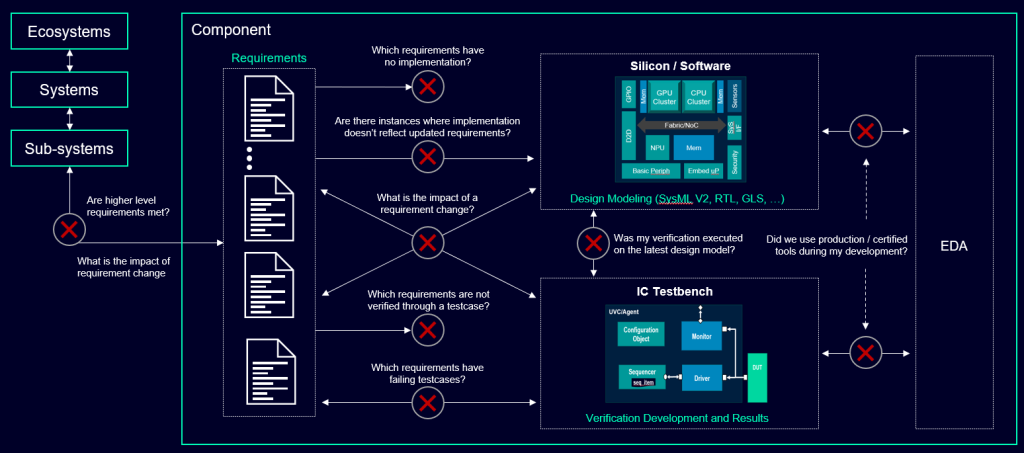
These are not just reporting questions. They affect impact analysis, audit readiness, reuse of engineering knowledge, and confidence in the final product.
Why traditional traceability is no longer enough
For years, traceability has often been treated as a downstream activity, something reconstructed after verification is complete, often through manual linking, static reports, or disconnected documentation. That approach becomes increasingly fragile as development grows more multidisciplinary and more iterative.
Modern systems require a more connected view. Verification must be traceable not only to requirements, but also to the parameters, models, tests, configurations, and exact design context that produced a result. Without that context, teams may know that something passed or failed, but not always why, under what conditions, or what the result means when change inevitably occurs.
And change always occurs.
Requirements are updated. Architectures are refined. Performance budgets shift. Software is patched. Derivative products inherit partial designs and introduce new constraints. In these environments, fragmented verification evidence slows decision-making and increases uncertainty.
A digital verification thread built on Verification Capture Points
This is where Questa One VeriThreader comes in.
Questa One VeriThreader is designed to help engineering teams establish a comprehensive digital verification thread and verification traceability across the lifecycle. At the core of this approach is the Verification Capture Point (VCP), a structured verification artifact that links a parameterized requirement to the relevant verification evidence, including models, tests, configurations, and results.
That structure matters.
By capturing verification activity in a consistent, reusable form, VCPs help teams move beyond isolated test outcomes and toward a traceable, queryable body of verification knowledge. Instead of piecing together evidence after the fact, organizations can build verification traceability directly into the lifecycle.
This creates important advantages across modern development:
- stronger traceability across domains and abstraction levels
- better visibility into what has been verified and in what context
- improved impact analysis when requirements or designs change
- more measurable and auditable verification coverage
- better reuse of lessons learned, including knowledge from failures
In other words, verification becomes more than a collection of disconnected activities. It becomes a connected engineering capability.
From system architecture to silicon
One of the biggest obstacles to lifecycle-wide verification is that every discipline works differently. Architects, PCB engineers, RTL teams, FPGA teams, and software verification teams all use different tools, abstractions, and workflows. But they are still contributing to the same fundamental objective: proving that the system behaves correctly against its intended requirements.
Questa One VeriThreader supports a normalized approach to this challenge, helping organizations connect verification information across diverse workflows without forcing teams to abandon specialized domain tools. This makes it possible to bring broader visibility and consistency to verification while preserving the depth and rigor of domain-specific methods.
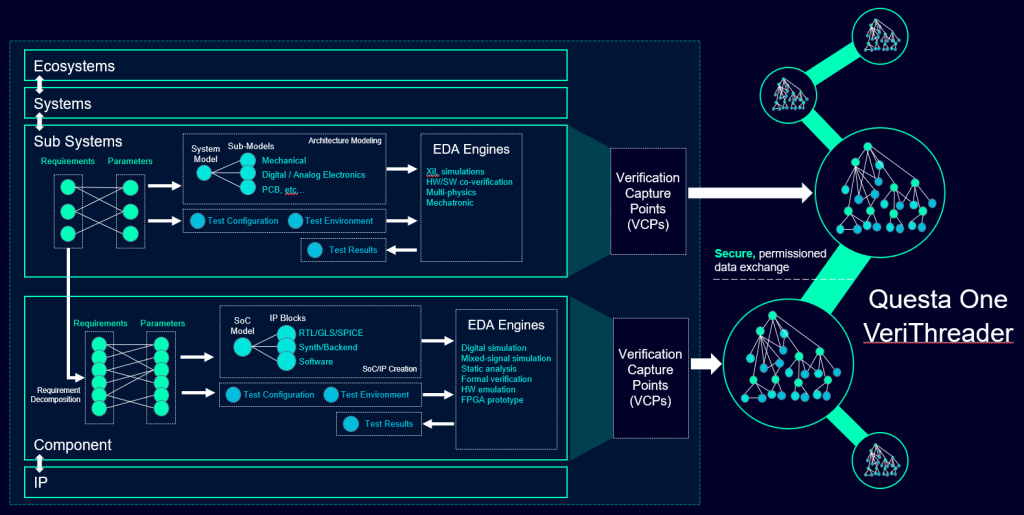
The result is a more scalable path toward lifecycle-wide verification insight; one that supports both local engineering needs and broader program-level understanding. Advanced role-based access helps ensure verification thread data remains secure, with access limited to authorized users based on their permissions.
Why this matters now
As systems become more software-defined, connected, and safety-critical, expectations for verification rigor continue to rise. Teams need verification traceability to understand not only whether verification occurred, but how evidence connects across requirements, artifacts, configurations, and outcomes over time.
That is the difference between fragmented traceability and a true digital verification thread.
If your organization is struggling with disconnected verification evidence, difficult impact analysis, or limited visibility across the lifecycle, this is exactly the challenge our new white paper explores.
Read the white paper
The white paper, “Questa One VeriThreader: Rethinking Verification Traceability for Modern Systems,” takes a deeper look at:
- Why traditional traceability approaches fall short
- How Verification Capture Points work
- How a digital verification thread improves lifecycle visibility
- Why connected verification matters for impact analysis, reuse, and audit readiness
- How organizations can move toward a more scalable verification methodology
Download the white paper to learn more.