Virtual Integrated Aircraft: Designing cryogenic hydrogen storage through the digital thread

As the aerospace industry explores hydrogen-powered flight, one challenge quickly rises to the top: where do you store liquid hydrogen on an aircraft? Unlike conventional fuel, liquid hydrogen must be maintained at cryogenic temperatures, introducing complex requirements for thermal management, structural integration, safety, and mission performance. Solving these cryogenic hydrogen storage challenges efficiently requires a new approach to engineering.
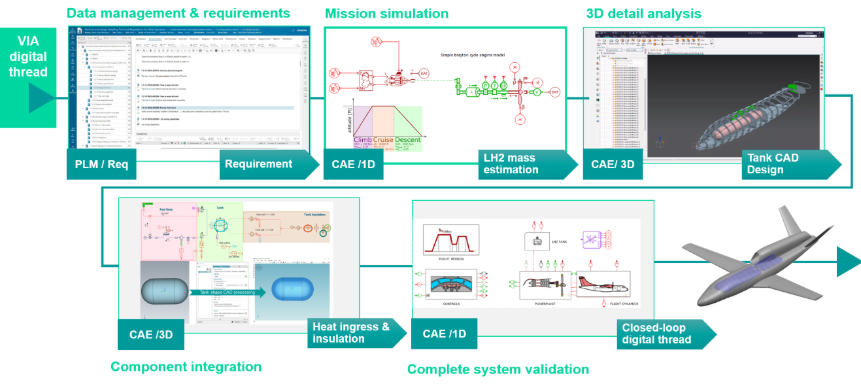
Siemens’ Virtual Integrated Aircraft (VIA) methodology addresses this challenge by connecting requirements, simulation, design, and verification activities within a single digital thread. Using a hydrogen-powered UAV as a demonstration platform, engineers evaluated and optimized a cryogenic hydrogen storage system in the early design stage of the concept phase.
How much hydrogen does the mission require?
Every aircraft design begins with mission requirements. For this project, Siemens used the fictitious Angel Owl reconnaissance UAV as a reference platform and set an ambitious goal: replace the original kerosene-based fuel system with liquid hydrogen while preserving the existing airframe and mission capability.
Using Simcenter Amesim, engineers created a mission-level model that captured aircraft performance, propulsion characteristics, flight profiles, hydrogen properties, and fuel consumption. The simulation also accounted for cryogenic losses through a conservative boil-off assumption of approximately 0.1% of stored hydrogen mass.
This early analysis provided a clear answer to a critical question: exactly how much liquid hydrogen was needed to meet endurance and range requirements before detailed design work began.
Can the hydrogen tanks fit inside the aircraft?
Knowing how much fuel is required is only part of the challenge. Liquid hydrogen is stored near 20 K (-253°C), which means tanks require significant insulation and occupy more volume than conventional fuel tanks.
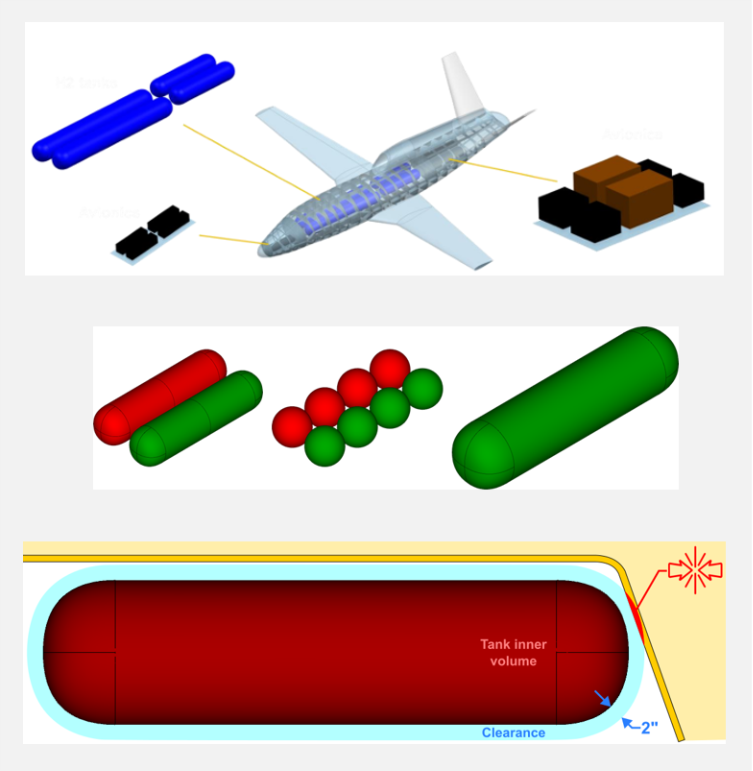
To find the best solution, engineers performed CAD-based packaging studies within the available fuselage volume. Design rules required enough space for both the hydrogen and the insulation system, including a two-inch clearance around each tank.
Several concepts were evaluated, and the results revealed that four smaller tanks provided a better balance between available space, insulation requirements, and installation constraints than a single larger tank. By linking CAD models directly to requirements and simulation data, the digital thread ensured full traceability throughout the decision-making process.
How do you keep hydrogen cold?
Cryogenic hydrogen storage performance depends heavily on minimizing heat leakage. Even small amounts of heat ingress can increase tank pressure and cause valuable fuel to boil off.
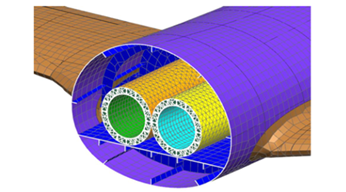
To evaluate the thermal design, engineers used Simcenter 3D to analyze extreme operating conditions. One scenario considered a UAV sitting on the ground in Dubai during summer, exposed to ambient temperatures approaching 50°C with minimal airflow. The analysis included conductive, convective, and radiative heat transfer effects acting on the tank system.
A series of parametric studies compared insulation thickness options and automatically eliminated designs that exceeded allowable heat-load limits. The result was an optimized insulation configuration that balanced thermal performance with available installation space.
What happens during a real mission?
A tank that performs well in a static thermal analysis must also perform throughout an entire flight.
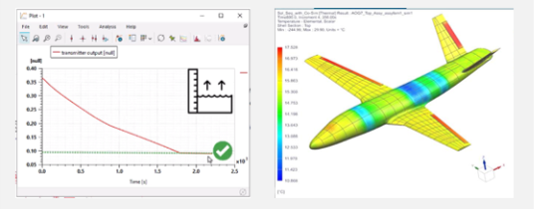
To answer this question, engineers connected Simcenter Amesim and Simcenter 3D in a co-simulation environment. The coupled model captured hydrogen consumption, boil-off generation, venting behavior, changing environmental conditions, and detailed aircraft thermal responses during takeoff, cruise, and landing.
As the simulation ran, the two models continuously exchanged thermal and fluid-system data, creating a realistic representation of hydrogen tank behavior throughout the mission.
The results were encouraging. The selected design maintained stable hydrogen temperatures, limited liquid-to-gas conversion, and sustained thermal gradients exceeding 200 K across the insulation system. These findings demonstrated that the storage system could effectively preserve liquid hydrogen while minimizing boil-off losses.
From analysis to confidence
This cryogenic hydrogen storage tank study demonstrates the value of a simulation-driven development process. Instead of relying on multiple rounds of physical prototyping, engineers were able to evaluate fuel requirements, optimize tank placement, refine insulation design, and validate mission performance within a connected digital environment.
By linking requirements, design models, simulations, and verification activities through a digital thread, the Virtual Integrated Aircraft methodology helps teams identify integration issues earlier, explore more design alternatives, and make better-informed decisions with greater confidence.
As hydrogen-powered aviation continues to evolve, integrated digital engineering approaches like VIA will play an increasingly important role in reducing development risk and accelerating innovation.
Looking for more information?
Special thanks to Jens de Boer, Brian Benoy, Victor Dezobry, Aziz Abdellahi and Florian Sanchez, who made this illustrative case of an engineering workflow possible.
A detailed presentation about this topic has been published at AIAA AVIATION Forum:
Implementation of a Closed-Loop Digital Thread for Cryogenic Tank Insulation Design in Liquid Hydrogen (LH2) Fuel Systems | AIAA AVIATION Forum
Want to try Simcenter Amesim yourself?