Supercharge Battery Virtual Testing with the Simcenter Amesim Battery Cycler

As the demand for high-performance batteries continues to rise, battery engineers are under increasing pressure to validate performance, durability, and control strategies across an ever‑growing range of operating conditions. Yet setting up representative battery test cycles (especially when they include dynamic loads, rest phases, and temperature‑dependent behavior) can be time‑consuming and difficult to reproduce consistently in the lab.
With the Battery Cycler component in Simcenter Amesim, engineers can now bring lab‑style battery testing directly into their simulation workflows. By defining realistic charge, discharge, and rest sequences through a simple text‑based approach, you can simulate everything from standard CC/CV cycles to dynamic driving profiles and aging tests—before committing to physical testing.

This component is included in the Electric Storage library and designed to ease and accelerate the simulation of battery test scenarios. It offers a flexible and powerful way to replicate laboratory-style cycling procedures directly in a virtual environment.
Continue reading to find out how the battery cycler component helps you to accelerate simulation, improve accuracy, and reduce the need for physical prototyping.
What is the Battery Cycler component?
The Battery Cycler is a versatile submodel that enables the definition and execution of complex sequences of charge, discharge, and rest phases to a battery cell model. Users can specify complex test procedures through a simple, text-based syntax and simulate a wide variety of scenarios, including:
- Constant current (CC) or constant power (CP) charge/discharge cycles
- Constant voltage (CV) operations
- Dynamic driving cycles (e.g., WLTC)
- Battery aging and characterization tests (e.g., HPPC)
- Custom current profiles imported from external .data files
Whether you are validating a new chemistry, calibrating a Battery Management System (BMS), or studying long-term degradation, the Battery Cycler provides the flexibility needed for both simple and advanced testing workflows.
Define test scenarios with ease
Test procedures are described in a plain text file using keywords such as:
charge, discharge, rest, repeat, and more.
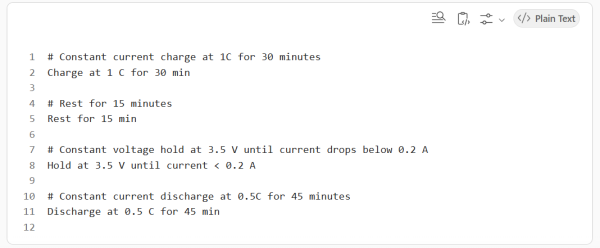
This clear, step-by-step approach ensures test scenario scripts are easy to read, maintain, and reuse. Ideal for collaborative engineering teams or automated test campaign setups.
Leverage external profiles and dynamic inputs
The Battery Cycler supports a variety of advanced capabilities, including:
- Importing external test profiles defined in .data files (e.g., current vs. time)
- Real-time input dependencies—such as cell temperature or voltage—to make test conditions adaptive and more realistic
This allows engineers to account for temperature-dependent behaviors (for example, waiting for thermal stabilization before proceeding) or combine environmental factors with electro-thermal responses for enhanced simulation fidelity.
Example simulation result
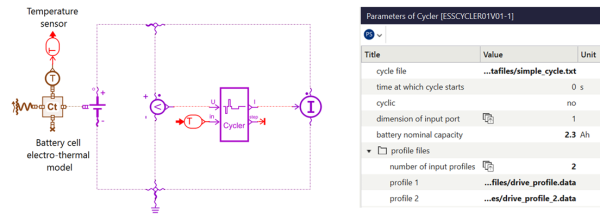
The figure below illustrates a typical setup where the Battery Cycler drives a battery cell model through a predefined test sequence. The cycler controls the applied current through a current source while using measured voltage and temperature as feedback. The test sequence is described in the file simple_cycle.txt.
Below is a visualization of the test sequence and corresponding simulation outputs. The example includes five phases:
- Rest until the cell temperature decreases to 26 °C
- Discharge at 2C for 10 minutes
- Rest for 200 seconds
- CC/CV charge sequence
- Dynamic cycling, applying two current profiles (Profile 1 and Profile 2) repeated three times or until the cell voltage drops below 3.097 V
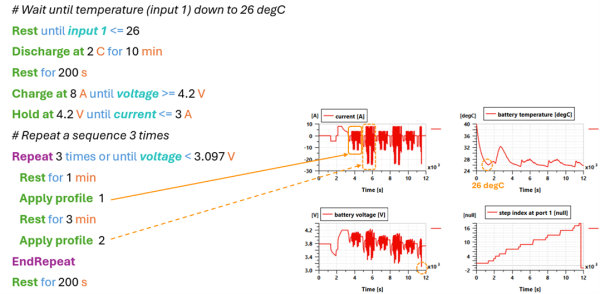
This example demonstrates how the Battery Cycler can handle both simple and advanced test definitions while reacting dynamically to model feedback.
Whether your focus is electric vehicles, consumer electronics, or grid-scale energy storage, this new component helps you to:
- Accelerate simulation and development workflows
- Improve test accuracy and repeatability
- Reduce the need for physical prototyping and laboratory time
Conclusion
Virtual battery testing is no longer just about early validation, it’s about working faster, more consistently, and with greater confidence. The Simcenter Amesim Battery Cycler enables you to translate real test procedures into simulation‑ready scenarios that adapt to voltage, temperature, and operating conditions in real time.
Whether you’re developing new cell chemistries, calibrating a BMS, or studying long‑term degradation, this approach helps you reduce dependency on lab resources while improving test repeatability and insight.
Learn how real users think about Simcenter Amesim
Want to try Simcenter Amesim yourself?
Try the Battery Cycler in Simcenter Amesim today and start building realistic battery test scenarios.