Excavator closed-loop simulator: From fuel to soil
Can you improve excavator productivity without increasing fuel consumption or mechanical failures?
Anyone involved in excavator design knows the dilemma. Increasing digging speed often leads to higher fuel consumption. Improving hydraulic smoothness can introduce new structural loads. And changing soil conditions can quickly invalidate carefully tuned assumptions.
In reality, excavator performance is always a balance between competing factors. Productivity, fuel efficiency, and durability are deeply interconnected, yet they are often evaluated separately.

This is where the concept of a closed-loop excavator simulator changes the game, where engineers can analyze all these interactions at once, and before a single prototype is built.
Why traditional development approaches fall short
Excavator development has historically been organized in silos. Mechanical teams focus on kinematics and structural behavior, hydraulics specialists work on actuation and control, and validation often comes only during physical testing at the end of the project.
This fragmented approach inevitably leads to late surprises. Design issues are discovered when changes are costly, prototypes multiply, and trade-offs only become visible once machines are tested in real conditions.
The financial impact is substantial. Fuel consumption alone can represent between 30 and 45 percent of the total cost of ownership, making early optimization critical for competitiveness.
A new paradigm: the excavator closed-loop simulator
A closed-loop excavator simulator connects all the physics that drive machine performance into one coherent simulation environment. Instead of analyzing domains independently, engineers can model and dynamically simulate the full interaction between mechanical system, powertrain, hydraulics, control strategies, and soil behavior.
In this approach, machine motion influences soil interaction, which in turn generates forces that impact structure, hydraulic pressures, energy consumption, and control response.
The key advantage is clear: engineers can evaluate productivity, fuel consumption, and mechanical stress simultaneously, rather than making trade-offs based on incomplete or disconnected information.
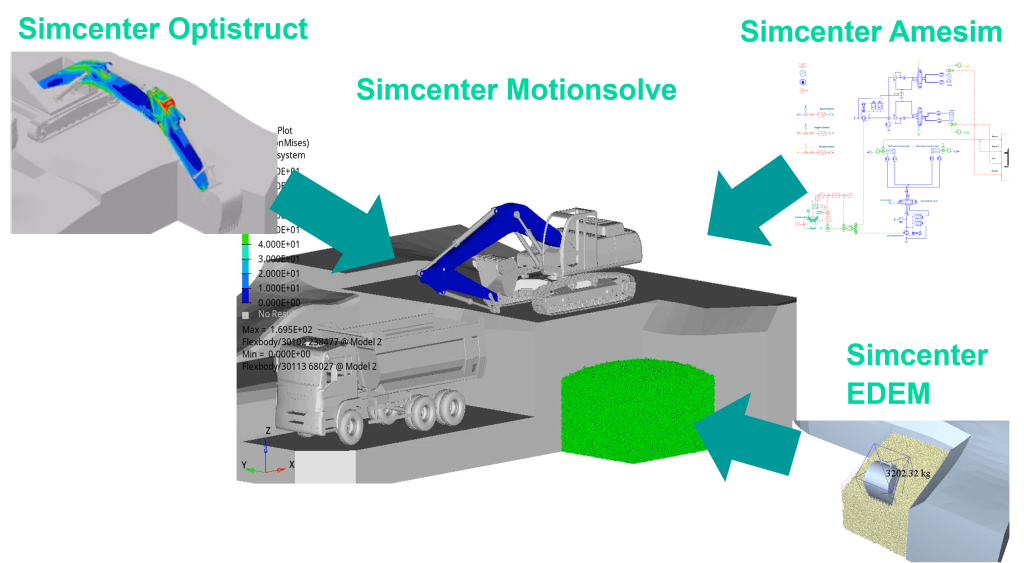
The workflow is based on the Simcenter portfolio and particularly on Simcenter Motionsolve, Simcenter Optistruct, Simcenter EDEM and Simcenter Amesim. Let’s see how this simulator was built step by step.
1. Building the foundation: from CAD to realistic machine behavior
The process begins with CAD data. Using multibody simulation, engineers create a dynamic model of the excavator that reflects its real motion and mechanical behavior during representative duty cycles, such as truck loading operations.

Flexible bodies can be imported from Simcenter Optistruct to account for structural deformation, allowing engineers to analyze stresses and loads early in the process. This step provides valuable insight into how the machine behaves under realistic operating conditions, even before additional systems are integrated.
👉 Learn more about Simcenter mechanical simulation capabilities.
Early validation of kinematics and structure significantly reduces the risk of rework later, when hydraulics and soil interactions are added.
2. Bringing the machine to life with Simcenter Amesim
Once the multibody model is built, the Simcenter Amesim model of the powertrain, the power hydraulics and the distribution valves control is connected to the Simcenter Motionsolve model. The connection is built as a co-simulation relying on the Functionnal Mock-up Interface (FMI) standard.
Through this integration, engineers can simultaneously evaluate cycle time and fuel consumption while testing different control strategies. For instance, modifying engine speed may only slightly affect productivity but can have a significant impact on fuel consumption.
It’s worth mentionning that this kind of analysis could be performed in Simcenter Amesim alone, since it features a 3D multi-body dynamics library. However, this would be limited to rigid body only and accounting for flexible bodies is easier by leveraging Simcenter Motionsolve and Simcenter Optistruct together.
👉 Discover how Simcenter system simulation capabilities enable this level of analysis.
This ability to explore trade-offs early allows teams to right-size components and fine-tune control strategies long before physical testing begins. At the same time, realistic actuator forces are fed back into the mechanical model, ensuring consistency across the simulation.
3. Replacing assumptions with real soil interaction
Until bulk material behavior is included, digging forces remain approximations. However, excavators operate in highly variable materials, from loose soil to dense aggregates, and these differences have a major impact on performance.
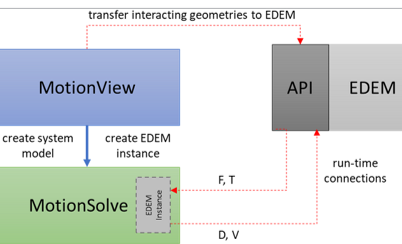
By introducing discrete element modeling with Simcenter EDEM 2026.1, engineers can simulate bulk materials as collections of particles with defined physical properties such as density, cohesion, and compressibility. This makes it possible to capture real soil-tool interactions and generate accurate digging forces directly from the simulation. The connection with Simcenter Motionsolve is easy to perform and the co-simulation between both tools can be executed on GPU for faster execution.
The impact is significant. Engineers can evaluate true productivity based on the actual volume or mass of material moved per cycle, assess how different materials affect performance, and identify risks such as spillage or excessive wear.
👉 Learn more about Simcenter EDEM.
This shift from assumption-based to physics-based modeling dramatically increases confidence in simulation results.
4. Closing the loop: capturing the full system behavior
The real breakthrough comes when all these elements are combined into a single closed-loop simulation. In this environment, hydraulics drive motion, motion interacts with soil, soil generates forces, and those forces directly influence both structural behavior and energy consumption.
This continuous exchange of information creates a realistic representation of how the excavator behaves in operation.
Changing a single parameter, such as the type of material being handled, immediately affects multiple performance indicators. Fuel consumption may increase, stresses may rise, and productivity may change, all within the same simulation.
For the first time, engineers can analyze these effects together, rather than in isolation.
And if you want to replicate that workflow by yourself and get the models, there is a Knowledge Base Article available on the Support Center for that. Check it out!
From engineering challenge to competitive advantage
This integrated approach fundamentally transforms excavator development. Instead of relying on sequential validation and costly testing cycles, OEMs can explore design alternatives in a fully virtual environment.
Every duty cycle can be translated into a digital verification scenario, allowing performance to be validated against real operating conditions from the earliest stages of design.
What enables this transformation is the connection between disciplines. Multibody simulation, system simulation, bulk material modeling, and structural analysis are no longer separate tools, but part of a continuous digital thread.
This digital continuity ensures that information flows seamlessly from one domain to another, enabling a holistic understanding of machine performance.
Explore what’s possible
The shift toward closed-loop simulation is already reshaping how leading OEMs design excavators.
Are you ready to move from isolated analysis to fully integrated performance optimization?
Want to try Simcenter Amesim yourself?
Discover how the Simcenter portfolio enables a complete excavator digital twin, from CAD to real-world operation, and start exploring your next generation of machines with confidence.