Leg-based robotics with System Simulation: Why it’s transforming the industry with accelerated innovation

The rise of legged robotics
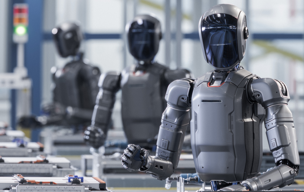
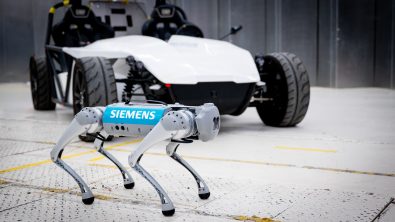
Just a few years ago, robot dogs seemed like futuristic demonstrations. Today, they are becoming valuable industrial assets. Energy operators use them to inspect substations and offshore facilities. Mining companies evaluate them for operations in hazardous environments.
Legged robots are becoming essential technology for surveillance and autonomous operations. At the same time, other types of leg-based robots like insect-inspired robots are opening entirely new possibilities. Thanks to their exceptional stability and ability to navigate confined or irregular environments, hexapod robots are emerging as promising solutions for inspection and exploration applications.
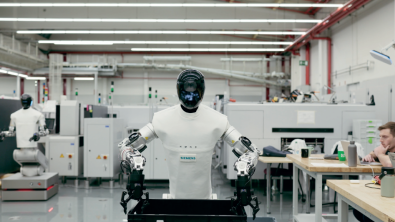
Behind every successful robot lies a complex combination of mechanical design, actuation systems, controls, software, sensors, power management and AI. As competition intensifies and development cycles shorten, robotics companies can no longer rely solely on physical prototyping.
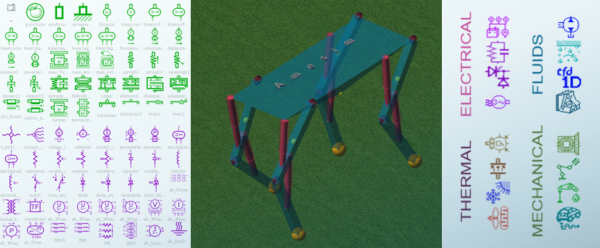
This is where Simcenter Amesim provides a decisive advantage. Through multi-domain system simulation, engineering teams can evaluate, optimize and validate robot architectures before building hardware.
Why System Simulation is key
Customers purchasing robotic platforms expect more than a machine that can walk. They expect a robot that can operate reliably, safely and efficiently in real-world environments.
To achieve this, developers must answer critical questions early:
- Will the robot remain stable on uneven terrain?
- How much payload can it carry?
- How long will the battery last?
- Which actuator technology is optimal?
- How will the control system respond to disturbances?
- Can autonomy algorithms handle unexpected obstacles?
System Simulation enables engineers to answer these questions virtually. The runs are executed in few seconds of CPU-time, not hours. Users can access all variables for the computed results like the forces, torques, velocities, accelerations, temperatures, currents, voltages, pressures or any types of results they want to predict thanks to the digital twins.
It’s not just animations with imposed displacements, but real physical quantities computed directly from dynamic equations for all types of physics: mechanics, electrics, hydraulics, pneumatics, thermal, controls, …
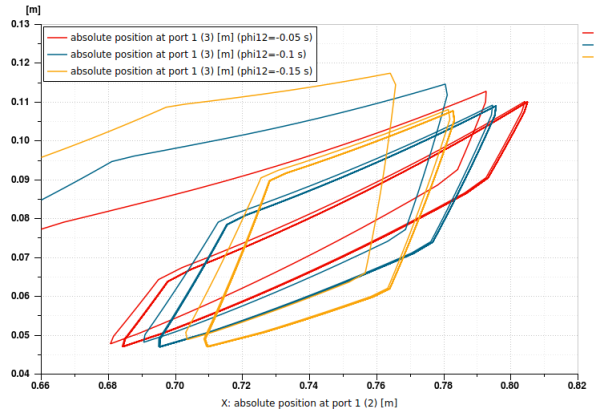
Using Simcenter Amesim, teams can combine mechanical dynamics, hydraulic systems, electric powertrains, controls and energy management into a single digital model. Problems can be identified before costly hardware iterations are required.
The result is faster innovation, lower development risk and higher-performing robotic platforms.
From hydraulic quadrupeds to electric ant robots
Let’s see how Simcenter Amesim is accelerating legged robotics development with system simulation. Actually it’s just a matter of learning from Nature’s most successful walkers. Nature has already solved many mobility challenges. Modern robotics increasingly borrows these solutions.
The two Simcenter Amesim digital twins that we introduce hereafter show complementary robot architectures: a four-legged articulated robot driven by hydraulic actuators and servo-valves, and a six-legged ant-inspired robot driven by electric motors. Together, they illustrate how system simulation can support the development of advanced mobility systems before physical prototypes are built.
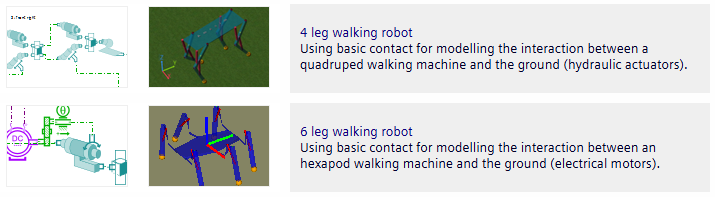
Let’s start first with the robot dogs and quadruped platforms. This Simcenter Amesim quadruped digital twin showcases how four-legged robots achieve a balance between speed, agility, mobility and stability. Its articulated legs, hydraulic actuation system and advanced gait control strategies enable:
- Stair climbing
- Obstacle crossing
- Navigation of rough terrain
- Stable payload transportation
The model demonstrates both trotting and walking gaits, highlighting the importance of coordination between leg pairs and body stability. For industrial customers, this capability translates into robots capable of reaching locations inaccessible to wheeled systems.
Let’s now move to the second example of mechanical ants and hexapod robots. This digital twin of the six-legged mechanical ant demonstrates a different philosophy. Using a tripod gait, three legs always remain in contact with the ground while the other three advance.

This approach delivers high static stability, excellent terrain adaptation, reduced risk of overturning and reliable motion in confined spaces.
Therefore, there are many possible applications like inspection inside industrial facilities, pipelines, tunnels, underground infrastructure and remote exploration environments. That’s impressive, isn’t it?
Gimbal systems for advanced observation
Let’s now go a bit further in the analysis by adding some auxiliary systems that are more present in legged robots. Indeed, modern quadruped robots are increasingly becoming mobile sensing platforms rather than simply walking machines.
One emerging trend is the integration of stabilized multi-axis gimbal systems mounted on top of the robot. These intelligent payloads can carry optical, thermal, LiDAR or multi-sensor packages while maintaining a stable line of sight even as the robot traverses uneven terrain.
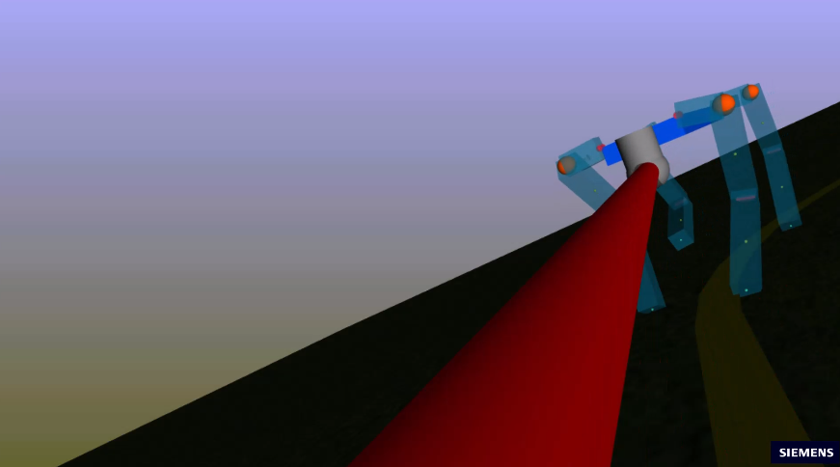
This is actually a six-degree-of-freedom (6 DoF) challenge. Theoretically speaking, we could imagine it’s not so easy to solve, while it’s finally quite straight forward to get impressive results in the Simcenter Amesim environment. Indeed, all subsystems and all physics can be combined in few clicks, while the intelligent solver computes all equations instantaneously, from slow dynamics to very fast transients or high-frequency phenomena. Such a successful approach can be conducted while including all detailed physics inside, from mechanical frictions, to hysteresis, gaps, leakages, …
The quadruped robot constantly experiences body motion caused by locomotion, terrain irregularities, acceleration and turning maneuvers. At the same time, the onboard sensor payload needs to continuously track and observe a moving point of interest within a dynamic environment. The challenge here is to ensure that the sensor payload remains accurately pointed while the robot itself is in motion.
Developing such an integrated system requires understanding the interaction between mobility, sensing and controls. Simulation helps identify whether performance limitations originate from the robot platform, the gimbal mechanics, the control strategy or the sensor architecture.
Virtual validation of tracking performance
A digital twin enables engineers to assess thousands of tracking scenarios before hardware testing begins. Possible scenarios include:
- Observation of moving objects at varying speeds
- Rapid changes in direction or elevation
- Operations on rough terrain
- Vibrations induced by trotting or walking gaits
- Temporary loss of line of sight
By combining robot dynamics, gimbal mechanics and control algorithms within a single simulation environment, teams can evaluate the overall mission effectiveness rather than optimizing individual components in isolation.
The strategic advantage of simulation-driven robotics
As industrial companies expand their use of autonomous systems, expectations for reliability, autonomy and efficiency continue to rise. Organizations developing robot dogs, hexapods and future generations of autonomous inspection robots need engineering tools capable of managing this growing complexity.
By validating performance virtually before hardware deployment, robotics companies can reduce development risk, accelerate innovation cycles and bring more capable robotic platforms to market faster.
We can for example consider developing the advanced controls for two-legged robots standing up (let’s say it’s a “chicken” robot), whose challenge is to ensure the right balancing while the actuation effects and body dynamics impact its motion depending on its speed (slow or fast motion). That’s a matter of finding out the right control logics to ensure its equilibrium at all times. And counter-intuitively, we found that the highest speeds were easier to manage compared to slow motions, since the balance momentum is reduced.
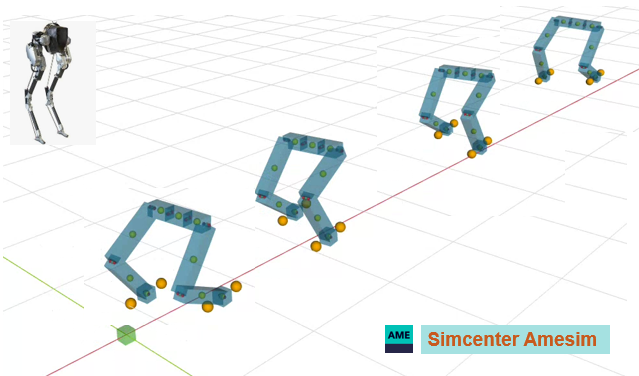
With Simcenter Amesim, engineering teams can evaluate its locomotion, actuation, energy systems, controls, autonomy and AI workflows within a single simulation environment. You can even connect joysticks to pilot it remotely thanks to the dynamic live simulation capabilities of the Dashboard with controller inputs in Simcenter Amesim.
Even to the point of designing robot reindeers
Let’s go further with some more fun. Let’s pull Santa Claus’ sleigh with some robot reindeers, it’s faster and cheaper than real reindeers. To improve productivity and delivery task planning (it’s key to deliver thousands of gifts on time), Santa Claus converted his moose and reindeers into their robotized versions. It’s finally more efficient, you just program the path to follow and the robot reindeers self-drive the sleigh to the selected GPS location to deliver the gifts to the right locations.
Chuut, even Santa Claus got inspired by someone else. “Ho-ho-ho, it reminds me of something”, said Santa Claus.

Takeaways – Experience so many benefits using system simulation
It’s now time to conclude and summarize the benefits of using System Simulation when designing legged robots.
Simcenter Amesim enables engineers to evaluate complete robotic systems through multi-domain system simulation, helping teams optimize locomotion, actuation, power systems, control software, and AI-enabled autonomy before physical prototypes are built.
From robot dogs inspecting industrial facilities to insect-inspired robots exploring confined spaces, legged robotics is transforming how industries operate. However, achieving the right balance between mobility, autonomy, energy efficiency, intelligence, and reliability requires a comprehensive engineering approach.
By adopting model-based engineering and digital twin methodologies, organizations can accelerate innovation, reduce development risk and bring more capable robotic platforms to market faster.
The future of quadruped and multi-legged robotics will be built not only in hardware laboratories, but first in the virtual world through advanced system simulation.
Learn more about Simcenter Amesim
Simcenter Amesim is the leading integrated, scalable system simulation platform, allowing system simulation engineers to virtually assess and optimize the performance of mechatronic systems.