What’s new in Simcenter Ultrafluid 2026.1?
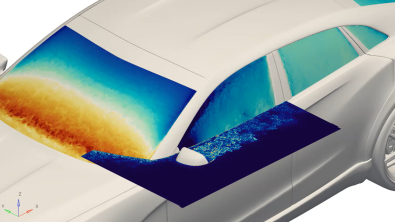
Simcenter Ultrafluid 2026.1 is now available for aerodynamics and aeroacoustics CFD engineers seeking enhanced simulation and analysis capabilities based on a GPU-native Lattice-Boltzmann Method.
Simcenter Ultrafluid is a transient, compressible CFD solver that inherently captures both flow and acoustic fluctuations. In aeroacoustic simulations, the acoustic signal is typically several orders of magnitude smaller than the flow-induced pressure variations. This makes identifying meaningful noise sources in complex, transient flows particularly difficult and time-consuming.
Simcenter Ultrafluid 2026.1 addresses this challenge with three new post-processing capabilities designed to isolate, interpret, and analyze acoustic content more effectively. These advances enable faster identification of acoustic wave sources, more precise frequency-based analysis, and clearer separation between acoustic and flow-related phenomena. Together, they streamline the path from raw simulation data to actionable insight, enabling a deeper understanding of noise generation mechanisms while improving overall workflow efficiency from simulation setup through post-processing.
Discover how Simcenter Ultrafluid 2026.1 can accelerate your aeroacoustic simulation projects.
Learn how to use Support Center
Identify acoustic waves in transient aeroacoustic simulations
In transient, compressible simulations, acoustic waves correspond to small-amplitude density fluctuations, which are directly linked to dilatation (∇·u). The dilatation field therefore provides a direct measure of compressibility effects associated with acoustic propagation.
Pressure fields in complex flows are dominated by larger variations associated with the underlying flow and its spatially varying mean state. These variations can be orders of magnitude larger than the acoustic fluctuations, making the identification of sound sources based on the pressure field ambiguous and difficult to interpret. Extracting meaningful acoustic information from pressure data requires significant post-processing effort, slowing down the identification of noise-generation mechanisms.
To address this challenge, Simcenter Ultrafluid 2026.1 introduces a dedicated dilatation field output. By focusing on density-related fluctuations, it provides a clearer and more direct representation of the acoustic field, largely decoupled from flow-driven pressure variations. This enables precise localization of acoustic sources in transient simulations without the need for extensive signal interpretation.
This direct access to acoustic content reduces post-processing effort and accelerates the analysis of flow-induced noise, allowing for faster and more reliable identification of noise-generation mechanisms.
Isolate and visualize pressure fluctuations by frequency to pinpoint noise sources
In transient aeroacoustic simulations, pressure signals contain a wide range of fluctuations originating from both flow dynamics and acoustic phenomena. These contributions overlap in space and time, making it difficult to associate observed pressure variations with specific noise-generation mechanisms. This challenge becomes more pronounced when analyzing tonal or band-limited sources, such as blade-passing frequencies, where the relevant acoustic content is embedded within broadband pressure fluctuations. As a result, direct interpretation of raw pressure fields is often ambiguous and time-consuming.
To facilitate the analysis of the pressure data, Simcenter Ultrafluid 2026.1 introduces the option to generate band filtered pressure animations as a post-processing step. By extracting pressure fluctuations within user-defined frequency ranges, it enables direct access to the spectral content of interest. This allows clear identification of noise sources associated with specific frequencies, such as vortex shedding or blade-passing tones. By isolating these contributions, you can directly relate spatial flow structures to their corresponding pressure signatures, without interference from unrelated frequency components.
As a result, frequency-targeted analysis becomes more efficient and robust. You move from broadband, difficult-to-interpret signals to focused, physically meaningful insights, accelerating the identification of aeroacoustic sources and supporting more effective noise reduction strategies.
Separate acoustic waves from turbulent fluctuations for clearer aeroacoustic analysis
Turbulent flow structures often dominate the signal, while acoustic waves remain lower in amplitude and propagate differently. These two contributions are very different phenomena, turbulence being convected at flow speed, while acoustic content is propagated at sound speed. It is extremely challenging to directly separate them in the raw pressure data, especially in regions where turbulence intensity is high. As a result, the acoustic content of interest is often masked by hydrodynamic fluctuations, making source identification ambiguous and requiring complex, time-consuming post-processing.
Simcenter Ultrafluid 2026.1 introduces an acoustic–turbulence separation capability based on spatial wavenumber filtering. On locally flat surfaces, this approach leverages the distinct wavenumber signatures of acoustic waves and turbulent structures to separate propagating acoustic components from convective flow fluctuations on a per-frequency basis. This provides direct access to the acoustic field, isolated from turbulence-induced contributions. You can therefore identify noise sources with greater clarity, even in highly turbulent regions, and analyze how specific flow features contribute to sound generation across your frequency range of interest.
By removing ambiguity in the interpretation of simulation results, this capability significantly improves the reliability and speed of aeroacoustic analysis, supporting more informed and targeted noise reduction strategies.
Ready to uncover hidden noise sources in your simulations? Explore how Simcenter Ultrafluid 2026.1 can sharpen your aeroacoustic analysis.


