Streamlining power integrity analysis for 3D IC designs
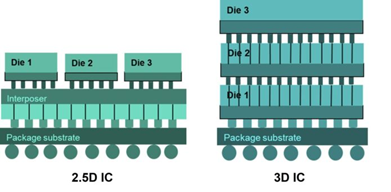
The rules of semiconductor scaling have changed. With traditional transistor scaling slowing, advanced packaging has emerged as the primary driver of performance. In today’s complex 2.5D and 3D IC designs, power integrity (PI) issues rarely originate in isolation. Achieving reliable PI demands a unified, system‑level analysis that spans the entire stack—capturing dynamic currents, distributed parasitics, and cross‑domain electromagnetic effects that define modern heterogeneous integration.
Siemens Innovator3D IC™ solution suite delivers a fully integrated PI solution, combining centralized system assembly, high-resolution die power modeling, field-accurate interposer and TSV extraction, and broadband package electromagnetic analysis into an automated workflow.
Innovator3D™ IC Integrator uses a digital-twin data model targeted at the core workflow of 2.5 and 3D IC heterogeneous integration and acts as a central cockpit orchestrating:
- mPower™ for accurate chip power models
- Calibre® xACT3D for high-fidelity resistance, inductance, capacitance, and substrate coupling (RLCK) extraction with ultra-fast, field-based through-silicon via (TSV) modeling
- HyperLynx Advanced Solvers for package-level electromagnetic analysis
Innovator3D IC Integrator as the system cockpit
Innovator3D IC Integrator provides a unified cockpit that brings together design data from all dies, interposers, bridges, and package elements into a single, coherent system model. This centralized environment eliminates the inconsistencies that commonly arise when data is exchanged across multiple tools and formats.
By serving as a single source of truth, Innovator3D IC Integrator ensures that electrical connectivity, bump assignments, and power-domain definitions remain synchronized throughout the entire design and analysis flow.
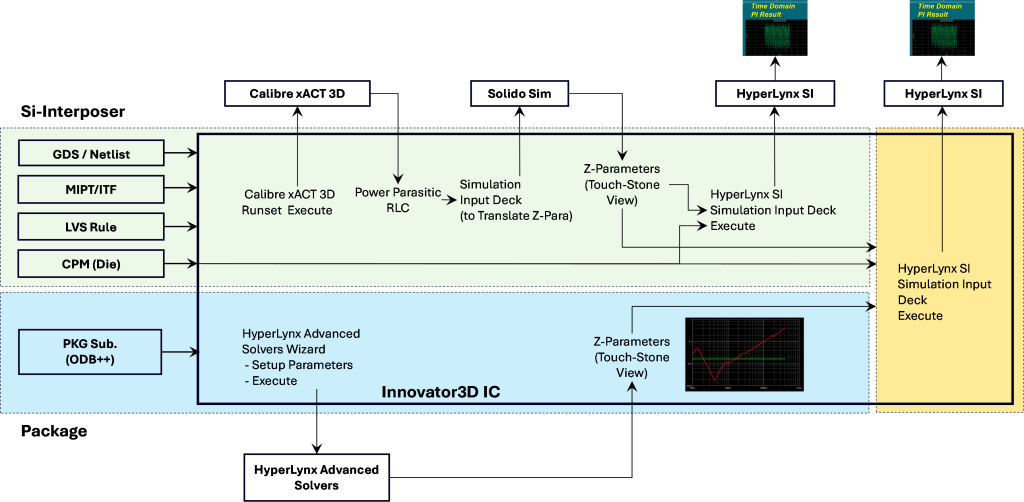
Within this cockpit, designers can intuitively visualize system-level connectivity across dies and physical layers, quickly identify layout-level mismatches, and understand how VDD and ground networks are distributed throughout the 2.5D/3D IC. A guided, GUI-driven flow allows users to select specific VDD rails or power domains for PI analysis, eliminating the need for time-consuming manual setup. Once a power network is selected, Innovator3D IC Integratorautomatically orchestrates high-fidelity extraction using Calibre xACT3D and electromagnetic analysis with Innovator3D IC Advanced Package Solvers, and then it assembles a complete system-level PI testbench in HyperLynx™ SI/PI. This enables rapid evaluation of voltage droop, noise, and overall PDN behavior at the system level—dramatically accelerating analysis and improving design confidence.
Die-level power modeling with mPower
Siemens mPower provides high‑resolution chip power modeling through its chip power model (CPM) generation flow. A CPM encapsulates both static and dynamic current behavior for a die, enabling accurate power consumption and PI simulation at the system level. The CPM reflects how the die responds to real switching activity, making it a critical component for predicting VDD droop and SSN across the full 3D IC.
The CPM workflow begins with PDN parasitic extraction inside the die layout After extraction, mPower computes detailed current waveforms that reflect workload‑dependent switching. These waveforms are embedded into the CPM model, allowing system‑level tools to accurately mimic die behavior when evaluating droop, IR‑drop, and transient events. By exporting CPMs in standards‑compliant formats, mPower ensures seamless integration into HyperLynx SI/PI and other system simulation environments.
Interposer and/or bridge extraction with Calibre xACT3D
Siemens Calibre xACT3D delivers high-fidelity RLCK extraction for interposers and silicon bridges—critical components in 2.5D and 3D IC designs where distributed parasitics have a significant impact on power delivery. Calibre xACT3D extraction comprehensively models TSVs, micro-bumps, redistribution layers, and multiple conductors running in parallel. Its multi-conductor RLCK extraction captures both magnetic and electric field coupling between closely spaced nets—effects that become increasingly critical as bump pitches continue to shrink. Frequency-aware RLCK components ensure that the resulting PDN models used in HyperLynx SI/PI remain accurate across both low- and high-frequency switching scenarios.
TSVs require specialized handling during extraction. Calibre xACT3D employs a highly scalable, purely field-based approach. Each TSV is represented as multiple vertical current segments embedded within a layered silicon substrate, using Bessel and Hankel basis functions. Magneto-quasi-static Green’s functions are then used to model how currents in each segment generate electromagnetic fields in the substrate and to compute self and mutual coupling among TSV segments. These interactions are assembled into a frequency-dependent impedance matrix, solved numerically, and fitted to compact R-L-C models that are efficiently exported for circuit simulation, delivering both high accuracy and scalability for TSV-rich 3D IC designs.
Package extraction with HyperLynx Advanced Solvers
The package contributes a major portion of the total PDN impedance in modern multi‑die systems. HyperLynx Advanced Solvers provide electromagnetic extraction to accurately model plane capacitance, via inductance, trace coupling, and resonances created by the package’s physical structure using S-parameters. These solvers support broadband modeling, ensuring that impedance characteristics across megahertz to gigahertz frequencies are captured.
Package extraction is essential for identifying return‑path disruptions, anti‑resonance peaks, and plane resonant modes that can amplify SSN or worsen droop under dynamic load conditions. By incorporating these high‑resolution package models into the system netlist, engineers gain deeper insight into how switching activity on one die affects the supply voltage seen by other dies in the stack. This is especially valuable in multi‑tenant power domains or high‑bandwidth memory systems where simultaneous burst traffic can cause substantial noise.
System-level netlist creation and simulation flow
The final stage of the PI workflow is the creation of a unified, system-level electrical netlist within HyperLynx SI/PI. Innovator3D IC’s automated flow seamlessly gathers CPMs from mPower, high-fidelity RLCK data from Calibre xACT3D, and package-level models from Innovator3D IC Advanced Package Solvers, then it intelligently stitches them together into a complete, multi-domain PDN, as illustrated in Figure 3.

This unified netlist enables engineers to run comprehensive system-level simulations across a wide range of operating scenarios, including worst-case SSN, dynamic voltage droop under varying workload profiles, and frequency-domain impedance analysis. A representative droop and SSN plot is shown in Figure 4. By analyzing the cascaded impedance across dies, interposers, and the package, designers can quickly identify resonance peaks, uncover PDN weaknesses, and optimize decoupling and power distribution strategies. This holistic simulation environment significantly reduces design risk and enables earlier detection of PI issues—well before fabrication—resulting in higher confidence signoff and faster time-to-market.
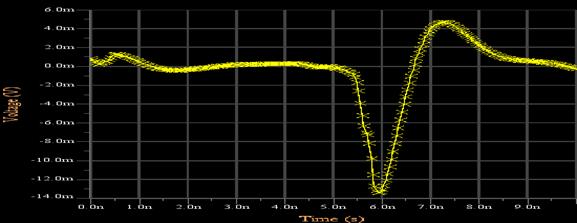
Figure 4: Normalized transient drop at VDD_die.
Siemens Innovator3D IC solution simplifies the complexity of 3D IC design by unifying die-level and package-level PI and signal integrity analyses in a single, intuitive environment, enabling fast, comprehensive evaluation across the entire power delivery network.
To learn more, see the full paper and discover how system-level PI analysis can de-risk your next 2.5D or 3D IC design.