How You Can Improve LAER Maturity Without Building a Large CS Team
For many Siemens partners, the issue is not whether customers see value in the technology itself. The problems usually begin after the deal closes and the customer goes live.
Sales has moved on.
Services is focused on deployment and project milestones.
Support handles incoming tickets.
Renewals appear later, often under pressure.
That model can work for a while. Then accounts begin to drift. The customer may technically be live, but productive usage slows down, executive sponsors become less engaged, and the only consistent interaction becomes technical support.
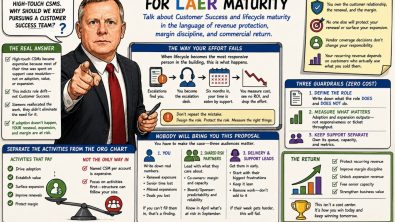
Most partners do not need to copy an enterprise Customer Success organization to fix this. In many cases, they simply need stronger operational discipline around customer ownership, adoption visibility, escalation management, and renewal readiness.
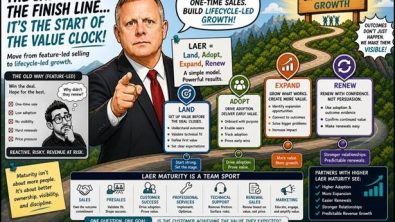
This is really about building a practical lifecycle operating rhythm that helps customers move successfully from Land to Adopt to Expand to Renew.
Start with ownership, not headcount
If you are a partner owner or executive, do not start by asking whether you need to hire Customer Success Managers.
Start by asking where ownership breaks down after the sale.
Adding headcount without clear accountability usually adds cost before it adds results. In smaller partner organizations, one person may wear multiple hats across Sales, Services, Support, Renewals, and Customer Success responsibilities. That is normal.
What matters is that important customer moments are not left unmanaged because everyone assumes someone else owns them.
The first version of this does not need to be sophisticated. In some organizations, it may initially live in a spreadsheet and a recurring leadership discussion. That is still significantly better than relying on tribal knowledge and disconnected customer conversations.
At a minimum, the business should know:
- What outcome the customer is trying to achieve?
- Who owns the next customer-facing action?
- When the account will be reviewed again?
Step 1: Identify the lifecycle gaps creating the most customer risk
Most partner organizations see the same patterns repeatedly after go-live:
- Weak or incomplete handoffs
- Customers that are technically deployed but not operationally productive
- Adoption that slowly loses momentum
- Renewal planning that starts too late to influence the outcome
Start small. Pick two or three gaps that appear most frequently.
Examples:
- Sales closes the deal, but the post-sale team never receives the full customer context.
- Business objectives discussed during the sales cycle are never documented in a Customer Success Plan (CSP).
- Onboarding focuses heavily on installation but never clearly defines first productive use.
- Usage visibility is limited, so teams rely on instinct instead of measurable adoption data.
- Support cases are treated as isolated issues rather than signals of broader adoption or renewal risk.
- Expansion opportunities are discussed informally but not tied to customer outcomes.
- Renewal activity begins after the customer has already decided how they feel about the relationship.
Then review five recent or active customers and ask:
- Do we understand the business outcomes the customer expects?
- Did we document why the customer bought?
- Did we define what successful first use looks like?
- Was there a clean transition from Land to Adopt?
- Do we have evidence the customer is actively adopting the solution?
If several answers are “no,” that is probably where the organization should start tightening execution. But, do not try to solve everything at once. The goal is to reduce recurring friction, not build a perfect framework.
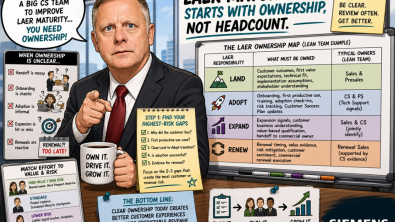
Step 2: Improve LAER maturity by assigning ownership by responsibility, not title
Do not start with org design. Start with accountability.
Create a simple ownership map that answers one practical question:
Who is responsible for the next meaningful action in each LAER phase?
| LAER phase | Primary responsibility | Executive question |
| Land | Capture the value thesis, buying assumptions, sponsor, and handoff context. | Will Services or CS know why this customer bought? |
| Adopt | Own onboarding, first productive use, training, and CSP updates. | Is the customer using the solution in a way that creates value? |
| Expand | Log credible expansion signals and qualify them against customer outcomes. | Is expansion based on value, or just seller optimism? |
| Renew | Own renewal readiness, value evidence, risk mitigation, and commercial execution. | Are we preparing early enough to influence the outcome? |
For renewal discipline, the timing matters. For a one-year agreement, renewal readiness should typically begin around 180 days before expiration. For a three-year agreement, that window is often closer to 365 days. That does not mean sending a quote immediately. It means the partner is actively managing value realization, sponsor engagement, adoption trends, and commercial risk while there is still time to improve the situation.
Step 3: Build lifecycle motions that can survive a busy month
Many operational models fail because they only work when teams have extra time.
That is not realistic.
The process has to survive quarter-end pressure, delivery escalations, staffing constraints, and shifting customer priorities. If the motions are too heavy, teams will stop following them.
A practical starting point usually includes:
- A lightweight Land-to-Adopt transition discussion with documented notes in the CSP
- A first productive use milestone with agreed owners and target dates
- A monthly adoption review for priority accounts
- A visible escalation path with owners, next actions, and customer communication expectations
- A basic expansion tracking process tied to customer outcomes
- A renewal readiness checkpoint focused on value evidence, sponsor alignment, adoption risk, and execution planning
Most partners already perform many of these activities informally. The difference in a more mature LAER operating model is consistency, visibility, and accountability.
Step 4: Make the monthly lifecycle review operationally useful
A monthly lifecycle review is usually enough to create accountability if the discussion drives action. The meeting itself is not the objective. What matters is whether customer follow-up changes afterward. Review active accounts across Adopt, Expand, and Renew. Identify which accounts are stable, which are drifting, and where intervention is needed before risk compounds.
A practical agenda might include:
- Which accounts have changed status since the last review?
- Which customers still have not reached productive operational usage?
- Which escalations require ownership, customer communication, or executive attention?
- Which accounts show credible expansion potential tied to customer outcomes?
- Which renewals are approaching preparation windows, and what evidence supports the value story?
Keep the review practical. The goal is visibility and coordinated action, not presentation quality.
A practical starting point for this month
Select five active customers or upcoming renewals.
Create or refresh a simple one-page CSP for each account. It does not need to be polished. It needs to be operationally useful. You should capture:
- Why the customer bought and who currently sponsors the relationship
- The first productive use milestone, owner, and target date
- Current status: Green, Yellow, or Red
- Key blockers or risks with mitigation ownership
- Available value evidence, including adoption activity, operational progress, or customer feedback
- The next customer-facing action and review date
Then run the lifecycle review.
Leave the meeting with:
- The top risks requiring attention
- The next actions for each account
- Clear ownership for customer communication before the next review
What good looks like
You will know the process is improving when fewer customer issues appear as surprises.
Teams begin operating from a shared understanding of account health instead of fragmented conversations and assumptions. Expansion discussions become more connected to customer outcomes. Renewal preparation becomes earlier and more predictable.
Most importantly, customers experience a more coordinated relationship instead of feeling like they are being handed between disconnected teams.
That is the practical version of LAER maturity for many partners.
- Not a massive organizational redesign.
- Not an enterprise-scale Customer Success department.
- Just clearer ownership, better visibility into customer risk, and a repeatable operating cadence that supports adoption, retention, and expansion readiness.
Start with five accounts. Review them consistently. Improve the process as the organization matures. That is enough to begin improving the system.
When will you start your journey to improve LAER maturity?
*This is the second in a three-blog series on LAER maturity. The first two-part, can be found here.
About the author
William McInnis is a Global Partner Development Executive at Siemens Digital Industries Software, where he focuses on global go-to-market programs, partner operations strategy, customer success, renewals, and Siemens’ XaaS transformation. With more than 25 years of experience across Accenture, Lockheed Martin, Microsoft, Autodesk, and Siemens, William has led global programs spanning customer success, cloud adoption, solution delivery, business integration, and enterprise transformation. He is especially focused on helping partners adopt LAER-based customer engagement practices that improve customer outcomes, renewal performance, and sustainable growth.