What LAER maturity means for you as a Siemens partner: part 1
Moving from feature-led selling to lifecycle-led growth
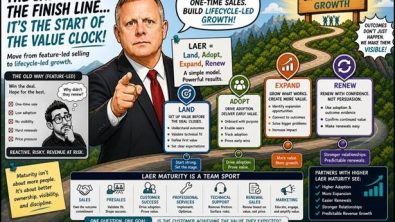
Winning the initial sale still matters. But in a recurring revenue model, the sale is not the finish line. It is the start of the value clock.
Many Siemens Partners have built strong customer relationships by understanding technical requirements, positioning the right solution, closing the opportunity, and helping the customer get started. Those strengths remain important. But customers do not renew simply because they purchased Siemens software. They renew when they adopt it, use it effectively, achieve meaningful business outcomes, and believe the relationship will continue creating value.
That is why LAER maturity matters.
LAER maturity gives you a practical way to organize the customer lifecycle across Land, Adopt, Expand, and Renew. It helps you move from selling functions and features to managing customer outcomes and value over time.
What LAER maturity means
LAER stands for Land, Adopt, Expand, Renew. It is a simple lifecycle model, but maturity is not created by knowing the acronym. Maturity is created when you can execute each phase consistently, visibly, and repeatably.
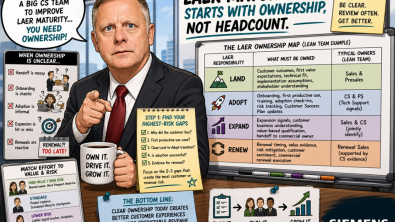
For you, LAER maturity means having clear ownership after the deal is signed. Customer outcomes are not lost between sales, services, customer success, support, and renewals. Adoption progress is tracked. Expansion opportunities are connected to demonstrated customer value. Renewal conversations are supported by evidence, not last-minute persuasion.
This is broader than simply having a Customer Success function. Customer Success is an important capability, but LAER maturity is an operating model that connects your primary lifecycle responsibilities — Sales, Presales, Customer Success, Professional Services, Renewal Sales, and Technical Support — around one shared question: is the customer achieving the value they expected? Marketing can also support outcome-based messaging, customer education, campaigns, and advocacy.
For a very small partner, these may not be separate job titles or separate people. One person may wear several hats. The point is not to create a larger organization before you are ready. The point is to make sure each lifecycle responsibility is clearly owned.
At lower levels of maturity, success depends on individual effort. A strong salesperson remembers what was promised. A skilled services consultant keeps the customer moving. A trusted support contact resolves issues. These efforts are valuable, but they are often informal and person-dependent.
At higher maturity, you have a repeatable system: documented outcomes, a defined onboarding path, adoption checkpoints, visible risk signals, expansion criteria, and renewal readiness. The goal is not bureaucracy. The goal is consistency.
Why LAER maturity matters to you
You may have built your business through technical expertise, product knowledge, and trusted local customer relationships. Those strengths remain essential. But as more customer relationships shift toward subscription, cloud, and recurring revenue models, growth depends less on the original transaction and more on what happens after it.
Recurring revenue is earned over time. If your customers do not adopt the solution, they are unlikely to realize full value. If they do not realize value, they are less likely to expand. If value has not been demonstrated before renewal, the renewal conversation becomes harder, more reactive, and more price-sensitive.
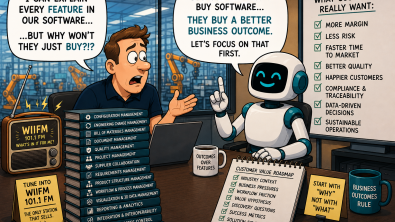
This is where you have an opportunity to strengthen lifecycle discipline. A feature-led sales motion may win the initial deal, but an outcome-led lifecycle motion protects and grows the relationship. Customers are not only asking, “What does the software do?” They are asking, “How will this help us improve the way we work?”
A customer may buy Teamcenter X, Designcenter X NX, Simcenter X, or another Siemens solution because of functionality, but they justify continued investment based on business outcomes: faster engineering cycles, better collaboration, reduced rework, stronger data control, improved quality, or accelerated project delivery.
LAER maturity helps you make that value visible. Sales and Presales set expectations during Land by connecting the solution to business outcomes and validating technical fit. Customer Success and Professional Services drive Adopt through onboarding, implementation, enablement, and value realization. Technical Support reveals friction, adoption blockers, and risk signals. Sales and Customer Success identify Expand opportunities when value has been proven. Renewal Sales uses adoption and outcome evidence to support Renew.
For a lean partner organization, this does not require a large new team. It requires clearer ownership, better handoffs, simple customer health visibility, and a regular operating rhythm. Maturity starts with discipline, not headcount.
*This is the first in a three-part series on recurring revenue growth and is published in two parts. The second part covers each lifecycle phase in detail and offers a practical starting point for partners at any stage.
About the author
William McInnis is a Global Partner Development Executive at Siemens Digital Industries Software, where he focuses on global go-to-market programs, partner operations strategy, customer success, renewals, and Siemens’ XaaS transformation. With more than 25 years of experience across Accenture, Lockheed Martin, Microsoft, Autodesk, and Siemens, William has led global programs spanning customer success, cloud adoption, solution delivery, business integration, and enterprise transformation. He is especially focused on helping partners adopt LAER-based customer engagement practices that improve customer outcomes, renewal performance, and sustainable growth.