What LAER maturity means for you as a Siemens partner: part 2
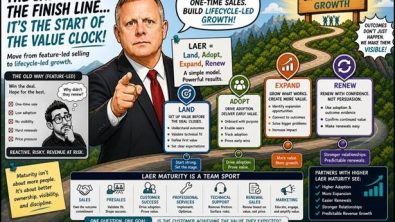
LAER maturity by phase
Land: Set up value before the deal closes
In a mature LAER model, Land is not just about winning the deal. It is about setting up adoption and value realization before the contract is signed. You should understand why the customer is buying, which outcomes matter most, who owns success inside the customer organization, and what first value should look like.
This requires moving beyond product functionality. Instead of only documenting what was sold, capture what the customer expects to achieve: the business problem, the process to improve, the realistic timeline, and the promises made during the sales cycle.
This does not mean every lifecycle role needs to meet with the customer before the deal closes. At a minimum, Sales and Presales should confirm the customer’s desired outcomes, first value milestone, implementation assumptions, customer responsibilities, and key stakeholders. For larger or more complex opportunities, Customer Success may also join before signature to validate the adoption path and set expectations.
Do not rely on a single customer contact to define success. The economic buyer may care about cost, productivity, or growth. The project lead may care about implementation success. End users may care about daily workflow improvement. IT may care about security, integration, and supportability. A mature Land motion identifies these perspectives early so the Customer Success Plan reflects the full customer view of value.
After the deal closes, hold a Land-to-Adopt transition meeting. The people involved in the sales process should transfer the full customer context to those responsible for Adopt: Customer Success, Professional Services, Technical Support, and anyone else supporting onboarding, implementation, training, or early value realization. The goal is simple: make sure what was promised in Land can be executed in Adopt.
Adopt: Turn purchase into productive use
Adopt is where your customer begins to determine whether the purchase was the right decision. Implementation, onboarding, training, usage, and change management all come together here.
Do not treat adoption as technical go-live alone. A customer can be technically live and still fail to realize value. Mature adoption focuses on whether the right users are enabled, core use cases are being executed, early value milestones are being achieved, and the customer is building confidence.
Simple actions matter: define the onboarding plan, confirm user groups, establish a training path, monitor usage where data is available, review open issues, and hold early check-ins tied to the customer’s outcomes.
Usage data is valuable, but it is not the only way to manage adoption. If you do not have reliable usage data, use practical adoption signals: training completion, stakeholder participation, milestone progress, support ticket patterns, customer feedback, champion input, and evidence that users are applying the solution to real workflows.
Lack of usage data should not become a reason to avoid Customer Success. A CSM can still be successful without usage data, but only with a deliberate cadence of check-ins, outcome reviews, risk tracking, and customer-confirmed progress. Adoption is where you earn the right to be viewed as a trusted advisor, and is a key step in LAER maturity.
Expand: Grow only where value supports the conversation
Expand should not feel like a random sales push. In the realm of LAER maturity, expansion is the natural result of value delivered, new use cases identified, and customer goals evolving.
Look for expansion signals: high usage, new teams requesting access, support conversations that reveal unmet needs, leadership interest in broader process improvement, or a customer initiative that maps to additional Siemens solution capabilities. But qualify those signals through the customer’s outcomes.
To identify the right expansion opportunities, you need more than product knowledge. You need a practical understanding of the customer’s business: priorities, workflows, constraints, stakeholders, and success metrics. That is what allows you to connect an expansion recommendation to a real business need instead of positioning it as “more software.” When you understand what the customer is trying to improve, expansion becomes a value conversation, not a sales pitch.
The discipline is simple: do not expand a customer who is not yet healthy. First prove value, then connect the next recommendation to the customer’s goals.
Renew: Make renewal the result of value already proven
Renewal should not begin 30 days before expiration. By then, the customer has already formed a view of the relationship.
Within Siemens, the renewal process should begin with 180 days remaining for a one-year contract and 365 days remaining for a three-year contract. Use that window to track adoption progress, confirm value delivered, identify risks, resolve open issues, and ensure the customer knows what has been achieved. The renewal conversation then becomes a business review supported by evidence, not a last-minute commercial defense.
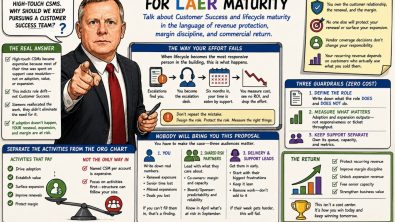
Customer Success should bring the value evidence and risk view. Renewal Sales should lead the commercial path. If the same person owns both hats, separate the thinking: first confirm value, then handle the renewal transaction.
Your strongest renewal position is earned throughout the year and is sign of LAER maturity.
A practical starting point
You do not need a full organizational redesign to begin improving LAER maturity. The first step is visibility, and the best place to create that visibility is a simple Customer Success Plan.
For many partners, a one-page plan is enough. Capture the customer’s desired business outcomes, the first use case to activate, the stakeholders involved, agreed success measures, onboarding actions, risks or blockers, and the next review date. The purpose is to align your team and your customer on what success looks like.
Once the plan is created, review it on a simple cadence. For higher-value or more complex customers, use monthly adoption check-ins and quarterly value reviews. For smaller customers, a lighter quarterly or semiannual review may be enough. Each review should confirm progress against the first use case, update risks, document value achieved, and agree on the next action. A Customer Success Plan that is not reviewed becomes a document. A Customer Success Plan that is reviewed becomes a lifecycle management tool.
Start with a small set of active customers or upcoming renewals and ask five questions:
- Do we know the customer’s top business outcome?
- Do we know the first use case the customer must activate quickly?
- Do we know whether the customer is adopting the solution successfully?
- Do we know the current risks or blockers?
- Do we know what evidence will support the next renewal conversation?
Then focus on speed to first productive use. The faster your customer starts using the solution in a real workflow, the faster they build confidence, validate the purchase decision, and create momentum for broader adoption. Do not wait for every possible configuration, integration, or advanced requirement to be complete. Identify the first meaningful use case, help the customer get there quickly, and document progress in the Customer Success Plan.
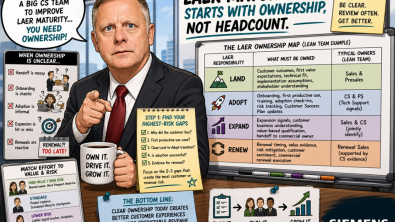
Finally, assign ownership across Land, Adopt, Expand, and Renew. Keep it simple. In a smaller organization, one person may cover multiple responsibilities across Sales, Presales, Customer Success, Professional Services, Renewal Sales, or Technical Support. The important point is that the responsibilities are explicit and clear, even when the same person wears multiple hats.
LAER maturity begins when you can see where each customer stands in the lifecycle, what outcome they are trying to achieve, what first use has been activated, and what action is needed next. Assess where your organization is strongest and weakest across Land, Adopt, Expand, and Renew. Pick one gap in each phase. Close those gaps before adding complexity. That is how lifecycle discipline starts, and it is how you can build customer relationships that last.
*This is the second part of a two-part blog, the first in a three-blog series. The first part, published last week, defines LAER maturity and explains how it affects SaaS success.
About the author
William McInnis is a Global Partner Development Executive at Siemens Digital Industries Software, where he focuses on global go-to-market programs, partner operations strategy, customer success, renewals, and Siemens’ XaaS transformation. With more than 25 years of experience across Accenture, Lockheed Martin, Microsoft, Autodesk, and Siemens, William has led global programs spanning customer success, cloud adoption, solution delivery, business integration, and enterprise transformation. He is especially focused on helping partners adopt LAER-based customer engagement practices that improve customer outcomes, renewal performance, and sustainable growth.