The economics of LAER maturity: why lifecycle discipline protects partner margins
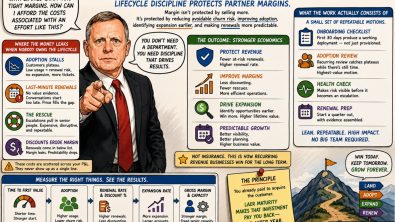
“I’m a small partner with limited staff and tight margins. How can I afford the costs associated with an effort like this? It seems better suited for enterprise deals.”
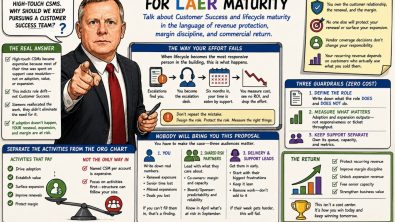
A principal said that to me earlier this year, and if you run a partner business you have probably thought some version of it. It’s a reasonable objection. For a long time my answer to it wasn’t very good. I’d talk about starting small, about lean motions, about how you don’t need a department. All true, and all of it dodges what you’re actually asking, which is whether this is affordable for a firm your size.
So take the arithmetic seriously for a second.
If you have forty customers, one bad renewal removes two and a half percent of your recurring base. A firm with four hundred customers loses a tenth of that from the same event. Your margins are tighter, so you have less cushion to absorb it, and your bench is thinner, so the recovery costs you people you can’t spare. Concentration cuts against you in every direction here. Whatever else is true, you are not the one who can afford to be casual about renewals.
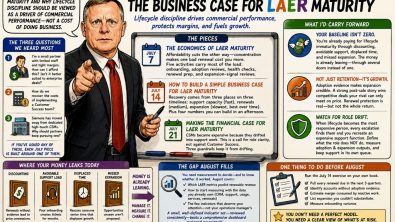
But affordability is the wrong axis for this decision, and the rest of this piece is about the right one. The activities in question are the same ones that win you new customers, get them productive faster, surface expansion earlier, and make renewals easier to close. They aren’t insurance bolted onto your business. They’re how a recurring revenue business generates its second, fifth, and tenth year of revenue from a customer you already paid to acquire.
Where the money goes when nobody owns the lifecycle
Your P&L probably looks strongest right before it gets worse. That isn’t a paradox so much as an artifact of how recurring revenue lands on your books. A strong booking quarter shows up immediately. The consequences of a weak onboarding show up eleven months later in a renewal that suddenly needs a discount, an escalation, and two weeks of your calendar. By then the cost is real, but it has scattered itself across support hours, sales rework, and a softer renewal rate. It never appears as a single line, so you never manage it as one.
That scattering is the whole problem. Low lifecycle maturity rarely hands you one dramatic loss you can point at in a partner meeting.
It looks like a customer who buys, gets provisioned, trains a handful of users, and then plateaus. Nothing breaks. Nobody complains. Usage sits at a fraction of what they bought, and that account is now a renewal risk, an expansion dead end, and a support consumer at the same time, while still looking perfectly healthy in your CRM because the stage field reads “Closed Won.” When adoption stalls like that, your ticket queue absorbs the difference, which means your most expensive technical people spend their week answering questions onboarding should have handled. If you have three consultants, that is most of a consultant.
It also looks like the renewal you start preparing thirty days out, where the first serious conversation about value happens after the notice goes out and your customer has nothing in front of them showing the investment paid off. Neither do you. What fills that gap, nearly every time, is price.
About that renewal discount
I want to spend a minute here, because it’s the clearest case of a lifecycle failure that gets filed under the wrong heading.
When one of your renewals comes in below list, the internal conversation is usually about pricing strategy, competitive pressure, or the customer’s budget cycle. Sometimes that’s accurate. Often the actual sequence was: the customer never fully adopted, so they can’t point to value, so they treat the renewal as a discretionary purchase rather than a continuation, so they ask what you can do on price. The discount is the last event in a chain that started at implementation.
If you run adoption reviews through the year, you walk into that conversation with something different available to you. Not a harder negotiating stance. A better-informed one, where you can say what changed, who is using what, and what their own team reported.
The rescue
Here’s the cost you feel and almost certainly don’t count.
When an account goes sideways, who gets pulled in? Not your junior people. It’s you, or a principal, or your best technical consultant. Those hours come off billable work, off pipeline development, off the account that was going fine and now gets less attention. In a twenty-person firm there is no second owner picking up what you dropped while you spent three weeks stabilizing one customer.
Lifecycle discipline won’t eliminate escalations. It converts some share of them into problems caught earlier, by someone less expensive, when the fix is still small.
What the work actually consists of
None of this requires a Customer Success department, and I think the department framing is part of why the return is hard to see. The work is a small set of repeatable activities, most of which you are already doing informally and inconsistently.
An onboarding checklist, so the first thirty days produce a working deployment rather than a provisioned one. A recurring adoption review, which is the highest-value item on this list, because it’s the one that catches a plateau while there’s still time to do something. A standard health check that makes risk visible before it becomes an escalation. Renewal preparation that starts a quarter out instead of a month out, with evidence assembled as you go. And an expansion-signal review, which for most firms is fifteen minutes of an existing monthly meeting spent asking which accounts are ready for more.
Five things. Each needs a named owner and a trigger. None needs a new hire to start, and September’s piece works through the templates.
What matters here is what they produce for you. Adoption reviews and health checks are what let you reach a renewal without a discount conversation. Expansion-signal review turns a proven deployment into your highest-margin revenue, because the relationship, the environment, and the trust are already paid for. Onboarding discipline compresses time to value, which both drops your support load and gives the customer more months of realized benefit before you ask them to renew.
The part that surprises people: it helps you win
Most economics conversations about this stop at retention, and that undersells what you get.
When you walk into a competitive deal and describe specifically how you get a customer productive in the first sixty days, who owns their adoption, and what you review with them quarterly, you are making a claim your competitor probably cannot match with anything except price. Buyers of recurring software have been burned by implementations that stalled. They already know the risk isn’t the license.
Then there’s the reference effect, slower and more durable. Customers who genuinely realized value will say so, and three of those in one vertical shortens your sales cycle in that vertical considerably. That’s your Land motion benefiting from work you did during Adopt, which is the sort of connection the lifecycle framing exists to make visible.
The activities that keep your customers are largely the activities that win them. Post-sale execution is one of the few differentiators you have that a competitor can’t answer by cutting price.
The question worth asking yourself
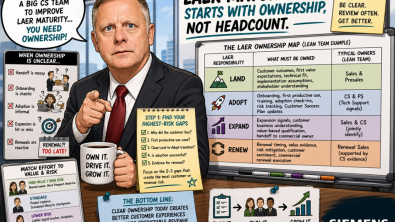
If you’re the owner, nobody is going to bring you a proposal on this. The decision starts with you, which means the framing you use on yourself matters more than usual.
The instinctive version is: can we afford to put someone on Customer Success? Fair question, wrong starting point, because it treats lifecycle capability as new spend against a baseline of zero. Your baseline isn’t zero. You are already paying for lifecycle immaturity, in avoidable support volume, in end-of-term discounting, in your own time spent on rescues, in expansion revenue nobody proposed. The money is already leaving. It leaves through four doors instead of one.
Better question, and a narrower one: which of those five activities are you not running consistently, and what did that cost you last quarter?
What to look at in your own numbers
Take your last four quarters and ask four things.
Which renewals closed below list, and for how many could you have produced adoption evidence at the time? How many support hours went to questions onboarding should have handled? Which accounts pulled you or a principal into a rescue, and what did that time not do instead? Which customers grew their use of what they bought without you proposing anything, or with a competitor proposing it?
Each of those maps to one of the five activities, which is the useful part. You aren’t looking for a total. You’re looking for which motion, run consistently starting next month, would have changed the most of what you just found.
That’s where the business case starts, and it’s what I’ll work through next week.
About the author
William McInnis is a Global Partner Development Executive at Siemens Digital Industries Software, where he focuses on global go-to-market programs, partner operations strategy, customer success, renewals, and Siemens’ XaaS transformation. With more than 25 years of experience across Accenture, Lockheed Martin, Microsoft, Autodesk, and Siemens, William has led global programs spanning customer success, cloud adoption, solution delivery, business integration, and enterprise transformation. He is especially focused on helping partners adopt LAER-based customer engagement practices that improve customer outcomes, renewal performance, and sustainable growth.