Library characterization takes too long – here’s how Solido Characterizer uses AI to change that

If your characterization flow still measures its runtime in weeks, it wasn’t designed for the complexity you’re dealing with today. As process technologies advance, the workload is growing faster than traditional characterization tools can handle. More PVT corners, tighter margins, and new formats like Liberty Variation Format (LVF) all add to the complexity, and to the pressure teams face when creating Liberty timing files.
Library characterization is the process of measuring and modelling how standard cells behave across different operating conditions. The output is Liberty timing files that the rest of the design flow depends on. It’s foundational work, and when it slips, everything downstream slips with it.
Traditional characterization tools were built for a different era, when corner counts were manageable, LVF wasn’t a requirement, and a few weeks of runtime was an acceptable cost. None of those assumptions hold today.

At User2User Europe in Munich in May 2026, we launched Solido Characterizer which addresses these challenges head on with powerful AI engines.
As the latest evolution in our Solido Characterization Suite, it covers everything from mature process nodes to the most advanced, and it’s designed to scale across multiple IPs and design teams without sacrificing accuracy or schedule predictability.
The result is 7x more throughput, cutting what used to take weeks down to days.
The AI engines behind Solido Characterizer’s speedup
This comes from two complementary AI innovations working together:
- AI-driven Liberty generation and advanced LVF techniques deliver a 5x speedup for multi-PVT creation and complex format handling.
- Solido LibSPICE, the industry’s first purpose-built AI-accelerated characterization simulator, adds a further 2x or more on top of that.
Together, they deliver the full 7x throughput gain. Here’s how each one works.
AI-driven Liberty generation and advanced LVF
Rather than running full SPICE simulations for every corner, Solido Characterizer builds a multi-dimensional model across your Liberty measurements and PVT variables, then uses that model to generate the data where it’s needed most. SPICE still runs, but only where it has to. The result is a 5x speedup for multi-PVT work and a 100x reduction in LVF simulation counts compared to brute-force Monte Carlo, with no approximations and full production accuracy. This approach draws on Solido Generator technologies, which have been the established standard for predictive Liberty generation for over a decade, and brings that same capability directly into the characterization flow.
Purpose-built AI-accelerated characterization simulator
Solido LibSPICE is the first simulator purpose-built specifically for library characterization. It’s optimized for the small designs typical in standard cell work, and it delivers a 2x or more speedup on top of everything the Solido Characterizer AI engine already provides.
Analytics in the loop enables real-time QA and interactive debugging
Speed matters, but so does what happens when something goes wrong. One of the real costs of long characterization runs is finding issues late, after a full cycle has completed, and having to start over again. That’s where a lot of schedule time disappears.
Solido Characterizer connects directly with Solido Analytics, which monitors runs as they happen rather than waiting until the end. When Solido Analytics spots an issue, Solido Characterizer reruns just that specific data point. Teams can debug in real time, fix problems as they surface, and avoid the repetitive cycles that turn a tight schedule into a missed deadline. AI outlier detection adds another layer of protection, catching anomalies and consistency issues in complex datasets before they make it through to signoff.
A complete AI-powered library characterization flow
The technical gains are meaningful on their own, but they only tell part of the story. What makes Solido Characterizer different in practice is how those gains compound across a complete, connected characterization flow.
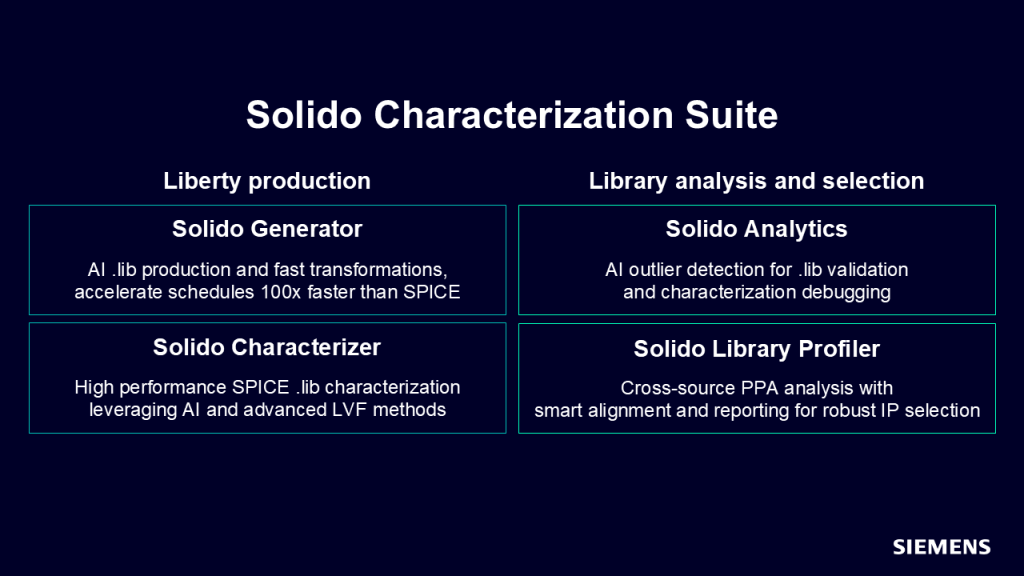
Solido Characterizer sits at the center of a broader suite that covers the full library lifecycle. Solido Characterization Suite includes:
- Solido Generator which handles AI-based Liberty generation for additional PVT corners, running up to 100x faster than SPICE alone.
- Solido Library Profiler brings internally characterized and externally sourced libraries together for side-by-side PPA comparison, making IP selection decisions easier to justify.
- Solido Analytics provides verification, comparison, and in-depth analysis across all Liberty sources, with the same outlier detection and debugging capabilities available throughout.
The idea is that each part of the flow connects to the next, so teams aren’t moving data between disconnected tools or losing context between stages during the characterization process.
AI tailored to the challenges of the characterization workflow
Solido has always been built on AI, and Solido Characterizer brings together three distinct AI types. Predictive AI powers the core engines, modelling Liberty data across PVT space to deliver the 5x characterization speedup without sacrificing accuracy. But speed alone doesn’t eliminate the human bottlenecks in the flow.
That’s where Solido Fuse comes in. Built on the Fuse EDA AI system, it layers Solido Fuse generative and agentic AI directly into the characterization workflow, turning what used to be manual, expert-dependent tasks into automated, conversational interactions.
The result is a characterization suite where AI doesn’t just accelerate the simulation engine. It accelerates the engineer too.
What Solido Characterizer customers have found in practice
The following quotes are drawn from the official Siemens press release issued at User2User Europe 2026 and highlight the real-world impact of Solido Characterizer for our users.
At GlobalFoundries, Solido Characterization Suite has been used to validate design margins and library files across multiple process technologies and high-profile customer engagements.
“Through Solido Characterization Suite, the GlobalFoundries team has been able to validate and create design margins and .libs of excellent quality. With Characterizer specifically, we were able to maintain production accuracy as correlated to SPICE models while enabling 20 to 30 percent speedup within our internal flows. Siemens’ Solido Characterizer’s adoption process was quick and straightforward due to the tool’s user-friendly setup capabilities and Siemens’ highly responsive and strong support. We were able to deliver signoff-ready margins and liberty for multiple, high-profile customers and GF technologies.”
— James Culp, Fellow, Design Enablement, GlobalFoundries
Anatrix, a developer of radiation-hardened IP for demanding environments, used Solido Characterizer for characterization of a radiation-hardened digital gate library, a domain where accuracy and confidence in results carry particular weight.
“Siemens’ EDA tools are critical to Anatrix success, with Solido Characterizer being a key enabler for characterization of our single event latch-up radiation-hardened digital gate library, helping us work efficiently and with confidence. Silicon testing of our analog and mixed-signal IP has verified that post-layout parasitic simulations using Siemens’ EDA flow accurately predicted IP behavior, reinforcing our trust in the results, and supporting first-pass success.”
— Greg Pauls, President, Anatrix
AI-powered characterization that turns weeks into days
The broader shift here is that AI in characterization is no longer about one clever trick in one part of the flow. Solido Characterizer is built around the idea that predictive, generative, and agentic AI each have a role, and that the real gains come when they work together.
Characterization runtimes are one of those problems that teams learn to work around rather than solve. Longer schedules, more conservative planning buffers, extra rerun cycles built into the timeline just in case. Solido Characterizer is designed to make those workarounds unnecessary, by making the process fast enough, accurate enough, and predictable enough that teams can plan around what their tool delivers and no longer keep their colleagues waiting downstream for the files they need.
Watch the Solido Characterizer launch video to see how teams are cutting characterization from weeks to days, and what that means for your next tapeout.