Interactive symmetry checking with Calibre RealTime accelerates analog IC design

By Mauli Shah, Product Engineer, Calibre Interfaces – Siemens EDA
Symmetry validation is critical for high-performance analog IC design. Matched devices must behave identically, differential pairs require precise geometric balance and current mirrors depend on layout symmetry to achieve the electrical matching that circuit performance demands. Yet traditional symmetry checking methods—manual ruler measurements, custom rule writing and parasitic extraction—discover violations late in the design cycle when fixing them is most expensive.
Calibre RealTime symmetry checking within Calibre DESIGNrev addresses this challenge by embedding symmetry validation directly into the layout environment, catching violations immediately when they are easiest to fix (figure 1).

The problem with traditional symmetry validation
Traditional symmetry validation methods create significant limitations:
- Manual ruler measurements don’t scale to complex layouts with hundreds of matched elements and provide no systematic validation
- Custom rule writing requires EDA expertise many teams lack, creating bottlenecks where only specialists can perform checks
- Cell mirroring assumptions are fragile—routing adjustments or fill insertion can silently break symmetry with no alert
The most damaging consequence is late discovery. When symmetry checking happens only at signoff, design managers have no visibility into whether layouts are actually symmetric until verification runs complete. Going back to debug violations in layouts created weeks earlier adds significant time to what should be straightforward corrections.
How interactive symmetry checking works
Calibre RealTime symmetry checking integrates seamlessly into Calibre DESIGNrev, letting designers validate symmetry without leaving their layout editor. The workflow is straightforward: select the Symmetry option from the Calibre RealTime toolbar, define the layout area and choose the applicable symmetry type (X-axis reflection, Y-axis reflection, 90-degree rotation or 180-degree rotation). Designers can select multiple options simultaneously to check different symmetry types in a single run.
Key capabilities and benefits of Calibre RealTime symmetry checking include:
- Auto-generated rule files with zero setup, eliminating the need for manual SVRF coding or EDA expertise.
- Smart axis detection, ensures the correct axis is considered from the design perspective even when designers select irregular layout regions, avoiding false violations.
- Instant results with visual markers, so designers can navigate to each violation, understand the asymmetry through visual feedback and apply fixes without external tools.
- Combined symmetry and DRC checking, lets designers confirm layouts are both symmetric and DRC-clean in a single pass.
- Validation at any design stage, from initial cell construction through full-chip assembly.
Workflow advantages of interactive symmetry checking in analog IC design
Organizations adopting interactive symmetry checking report workflow improvements that weren’t practical with traditional approaches. Immediate validation during layout creation catches violations while designers still have full context about the layout. When designers validate symmetry right after creating matched structures rather than deferring checks until signoff, problems become instantly identifiable rather than requiring reconstruction of design intent days or weeks later.
The tight feedback loops that interactive checking enables support design exploration that wouldn’t be practical with slow batch checking. Designers make a layout modification, check symmetry, see the impact immediately and adjust if needed—all within seconds. This rapid iteration transforms how designers approach complex symmetry requirements. Sophisticated symmetry checks that teams previously validated only at signoff become routine early activities when checking takes seconds instead of hours.
Debug cycles compress dramatically because designers can isolate exactly which change introduced a violation. When a symmetry error appears immediately after adjusting a route, the cause is obvious. This contrasts sharply with batch workflows where dozens of changes occur between clean runs, requiring extensive work to identify the culprit. The psychological relationship with symmetry validation changes as well. Instead of being an activity that interrupts design work, validation becomes part of the design process itself. Designers remain continuously aware of their layout’s symmetry status, making corrections natural extensions of layout work rather than separate debugging activities.
The complete workflow for symmetry checking and DRC validation
The end-to-end interactive symmetry checking workflow follows a simple sequence entirely within the design environment:
- Launch: Select the Symmetry option from the Calibre RealTime toolbar
- Select: Interactively define the layout area of interest for focused, fast checking
- Check: Choose applicable symmetry options and run the check—results and visual axis markers appear immediately
- Review: Launch Calibre RealTime RVE for a detailed, navigable list of all violations if needed
- Fix and revalidate: Apply layout corrections and re-check the modified region instantly to confirm resolution
- Symmetry + DRC: Optionally invoke back-to-back symmetry and DRC runs to confirm the layout is both symmetric and DRC-clean
This streamlined workflow lets design teams maintain verification momentum without leaving their layout environment, supporting shift-left methodology that moves validation earlier in the design process where issues are least costly to resolve.
Organizational impact of interactive symmetry checking
The benefits of interactive symmetry checking extend to team coordination and schedule predictability. When symmetry validation happens continuously throughout the design process, design managers gain better visibility into project status and can forecast schedules more accurately.
Shift-left methodology for analog design
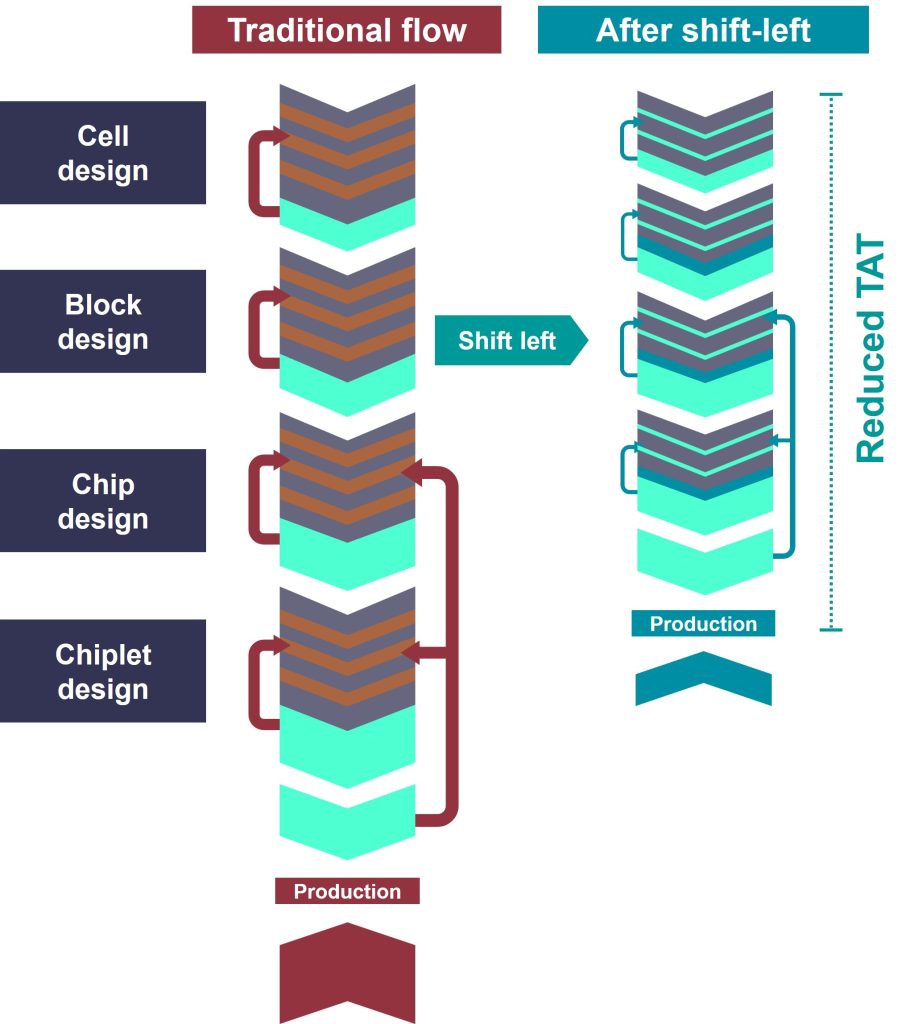
Interactive symmetry checking is part of a broader shift-left transformation in semiconductor design verification. Traditional methodologies concentrated verification at stage gates, creating schedule risk because issues discovered late require extensive rework. Modern shift-left approaches distribute verification throughout the design process, letting teams validate continuously rather than periodically (figure 2).
Making the transition to interactive symmetry checking
The transition to interactive symmetry checking is straightforward; it integrates directly into design environments, requires no rule writing or complex setup and uses familiar toolbar-based workflows. Designers don’t need to learn new verification languages or maintain separate checking scripts.
The methodology transition delivers compounding benefits. Early adopters typically start by using interactive symmetry checking for critical matched structures while maintaining traditional approaches for less sensitive layouts. As they gain confidence in interactive results and experience the productivity improvement, they progressively shift more symmetry validation earlier. Eventually, late-stage symmetry violations become rare because continuous checking catches problems immediately.
Transforming analog design productivity
Symmetry validation is non-negotiable for high-performance analog IC design, yet traditional checking methods discover violations late when fixing them is most expensive. Interactive symmetry checking within Calibre RealTime and DESIGNrev transforms this workflow by embedding validation directly into the layout environment.
Design teams using this approach validate X-axis, Y-axis, 90-degree and 180-degree symmetry with a few clicks from the toolbar. Auto-generated rule files eliminate the EDA expertise barrier, smart axis detection avoids false violations and instant results with visual markers let designers fix issues immediately.
Organizations adopting interactive symmetry validation report significant improvements in schedule predictability, compressed debug cycles and better resource allocation. When teams validate symmetry continuously throughout the design process rather than discovering problems at signoff, late-stage violations become rare and tape-out schedules become more predictable.
To learn more, download our technical paper: Interactive symmetry checking with Calibre RealTime in DESIGNrev