Calibre IC Manufacturing in 2025: The year’s biggest news

As we launch into an exciting 2026 for the Siemens Calibre IC Manufacturing group, let’s take a quick tour of the highlights of 2025. We introduced or expanded breakthrough solutions in computational metrology and accelerated the entire Calibre IC Manufacturing flow with machine learning (ML) and artificial intelligence (AI).
New computational metrology/inspection review tools
In 2025, the Calibre IC Manufacturing group proudly launched its new computational metrology/inspection review tools (MIR). This release includes the Siemens Machine-Learning ADC (automatic defect classification), a powerful tool that performs ML-based automatic defect classification, significantly enhancing the accuracy and performance of mask inspection. We also introduced the Siemens ART (actinic review tool) Simulator to accelerate mask defect dispositioning. This innovation directly improves the efficiency and turnaround time (TAT) of mask defect review processes, a critical step in semiconductor manufacturing.

Expanded monotonic machine learning technology
The year 2025 marked a significant milestone for monotonic machine learning technology (MML) within Siemens. The latest Calibre MML production release brought this cutting-edge technology to the forefront, enabling accelerated semiconductor innovation.
The impact of this technology was recognized through an invited talk at the prestigious IWAPS conference, highlighting its growing influence in the industry.
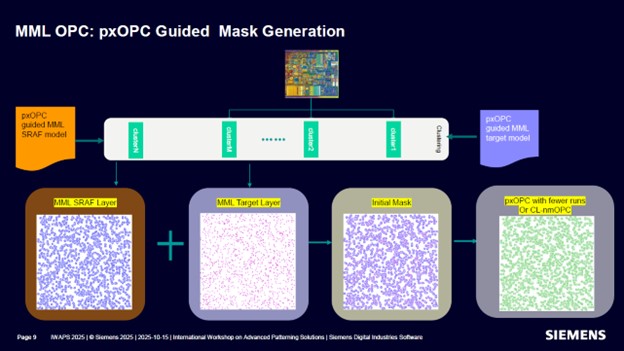
You will hear more about this technology in 2026, starting with our presentation of MML for curvilinear OPC retargeting at the SPIE Advanced Lithography + Patterning symposiums on 25 February, 2026.
Read more about our 2025 SPIE activities in this blog: Siemens shines at the 2025 SPIE Advanced Lithography + Patterning Symposium
AI/ML is everywhere in Calibre IC Manufacturing
AI and ML have become pervasive within the Calibre IC Manufacturing tools, and 2025 saw a consolidation of these advancements. We published a comprehensive technical paper summarizing the extensive AI/ML capabilities: Read AI and ML in Calibre IC Manufacturing: the intelligent solutions driving innovation.

At the 2025 TSMC OIP, we demonstrated the practical application and benefits of these integrated AI/ML solutions in real-world manufacturing scenarios. The work was performed in collaboration with AMD and presented jointly.

Learn more about AI in Calibre in this EETimes podcast: Calibre directions in artificial intelligence
New innovations supporting advanced EUV and high-NA EUV
We continued to drive innovation in advanced EUV and high-NA EUV technologies in 2025. A significant achievement was the Siemens-imec collaboration, which successfully reduced stochastic failures in EUV lithography by orders of magnitude, validated through rigorous wafer-level experimental testing. You can read all about it in this blog post, Siemens-imec collaboration reduces stochastic failures in EUV lithography by orders of magnitude in wafer-level experimental validation.

We also focused on enhancing EUV lithography resolution at high numerical aperture, pushing the boundaries of what’s possible. In a paper presented at SPIE Advanced Lithography 2025, we explored a novel approach to enhancing resolution and depth of focus for EUV lithography under high-NA conditions. The key to our solution lies in the use of aperiodic multilayer masks, which offer significant advantages over conventional periodic multilayer designs. Read a summary in our blog, Enhancing EUV lithography resolution at high numerical aperture.
We delivered an invited talk on high-NA stitching at the 2025 SPIE Photomask Technology + Extreme Ultraviolet Lithography (BACUS) conference. The paper, presented jointly with imec and KLA was demonstrated collaborative advancements in this critical field.

Learn more about the Calibre EUV solutions.
Accelerating lithography with GPUs
Graphics processing units (GPUs) are rapidly transforming the landscape of lithography, and in 2025, the Calibre IC Manufacturing group was at the forefront of this acceleration. We presented a poster at the International Conference for High Performance Computing, Networking, Storage, and Analysis (SC25), Massively Parallel GPU Rasterizer for Next-Generation Computational Lithography, detailing the massive parallel GPU rasterizer developed for next-generation computational lithography.
The group’s contributions were also highlighted at the 2025 BACUS conference, where Danping Peng, VP of Engineering for Calibre, delivered an invited talk on model calibration on GPU and full-chip ILT on GPUs, demonstrating the power of GPU acceleration. You can watch the presentation, Mask correction to silicon: a holistic approach, on the SPIE digital library.
Further solidifying our leadership, we gave a presentation at the 2025 IEEE ACM conference focused on GPU-optimized ILT for full-chip implementation, underscoring the practical benefits of this technology.

Looking ahead
Keep your eye on Calibre IC Manufacturing in 2026 to learn about the latest innovations!