ML for Industrial CAE – “Just scale it”
The research story behind the Geometric Deep Learning capability within Simcenter STAR-CCM+
Imagine being able to fast-forward through complex engineering simulations, exploring hundreds of design variations in the time it once took for just one. This isn’t science fiction; it’s the incredible potential of Machine Learning (ML) in Computer-Aided Engineering (CAE). Instead of solving rather complex equations step-by-step, ML models can learn from past data to become highly efficient at solving new problems, as compared to traditional CAE solvers. By scaling up ML, engineers can more quickly iterate and optimize their product design, thanks to faster simulations. ML can moreover speed up traditional methods, which makes it easier to integrate their capabilities within established company software and processes
This blogpost reports on our ongoing research mission to unlock the potential of ML in industrial CAE, which is performed together with KU Leuven in the frame of our research project ML4SIM, with support from the Flanders Innovation & Entrepreneurship Agency (VLAIO).
1. Challenge: CAE calculation time increases with product complexity
In the fast-paced world of industrial product innovation, virtual prototyping based on numerical simulations has become crucial, allowing engineers to predict and optimize the performance of their products during the design phase. Traditional calculations are done by capturing the future product design into a Computer-Aided Engineering (CAE) model and calculating complex physical phenomena as fluid dynamics and heat transfer1, structural dynamics, motion2, acoustics, etc., followed by design iteration and optimization to improve the product design. For complex industrial products such as cars and aircraft3, calculating many variants of the product model demands substantial computational resources. As a result, these resource-intensive simulations create a bottleneck in industrial R&D. To keep development cycles within acceptable timeframes, engineers are forced to limit the number of design iterations and variants explored, which constrains the innovation potential. This burden arises because traditional CAE calculations, for example Computational Fluid Dynamics (CFD), rely on solving complex Partial Differential Equations (PDEs), requiring substantial computational power and time.
The use of Machine Learning (ML) is a promising strategy for improved handling of complex models, as ML follows a different strategy to find solutions to CAE calculations based on PDEs. More specifically,1 ML learns patterns rather than solving equations, which allows it to learn input-output model relations directly from existing data;2 Once trained, an ML surrogate model can predict new simulation outcomes in seconds, versus the hours or days needed for traditional numerical PDE solvers. This dramatically expands what engineers can accomplish within a given timeframe: they can evaluate more variants, vary more parameters, run a larger optimization study, etc. Finally,3 ML can augment traditional solvers: parts of traditional solvers can be accelerated, by learning optimal parameters, improving convergence by initializing solvers with ML-predicted solutions, or providing faster approximations for complex terms within the PDE, etc. The end user will expect that an augmented solver still follows the same workflow, solving the same design engineering challenge, just hopefully even more accurately and/or efficiently thanks to the added power of ML capabilities. For further insights, see Siemens’ The Art of the Possible blogpost4.
Scaling ML to speed up industrial CAE solvers holds a great promise, but unfortunately, this is not yet a done deal in engineering practice today. Several industry-specific challenges are in place that prohibit the wider introduction of ML to increase efficiency of CAE-based design engineering, including:
- Data Scarcity: Industrial simulation data is expensive and time-consuming to generate, with each high-fidelity simulation potentially requiring hours to days of computation time. Engineering teams typically work with a limited number of simulations, maybe tens to hundreds, whether from previous projects or newly generated for a specific study. Yet, ML models require large, high-quality datasets for effective training, which are not always available, which creates a mismatch of data needed vs. data available.
- Data heterogeneity: Industrial simulation datasets exhibit significant variability across design studies. Each dataset may use different discretization approaches (mesh types, resolutions, refinement strategies), cover different ranges of design parameters (geometric variations, operating conditions), employ different solver configurations, and use inconsistent naming conventions or output formats. This heterogeneity makes it difficult to combine datasets from different projects or to transfer models from one design context to another.
- Size of data: Each simulation in an industrial dataset can contain (hundreds of) millions of data points representing field quantities (velocities, pressures, temperatures, stresses) across the computational domain. When working with collections of such simulations, this increases the scale of the data size that must be stored, managed, and processed for training and inference.
- Geometric Complexity: in industrial design engineering, geometries exhibit intricate, irregular structures with diverse topologies, presenting demanding requirements for ML models. These models must remain invariant to mesh structure and discretization choices while generalizing across arbitrary geometric configurations, varying spatial and temporal resolutions, with complex operating conditions including loads, boundary conditions and material properties. Moreover, small geometric changes can have significant impacts on simulation outcomes, requiring models to capture subtle design variations accurately.
Clearly the forward direction to speed up industrial CAE simulation with ML is very promising, but the above challenges must first be addressed. While the scientific literature has made significant progress in demonstrating the feasibility of ML approaches for simulation5, it has not (yet) addressed the full complexity encountered in real-world industrial contexts, leaving this as an important challenge and opportunity for research.
2. Solution: R&D to scale up ML to industrial applicability
The above challenges underline that new research is needed to scale up ML to be capable of speeding up simulations of industrial engineering complexity.
2.1 ML4SIM Project: R&D to scale up to ML to industrial applicability
Siemens is carrying out this research together with our long-term R&D partner KU Leuven, in the frame of the running research project ML4SIM (see further: Acknowledgements). This collaborative effort brings together Siemens’ internal research capabilities with academic expertise to tackle these complex challenges.
Siemens has a close partnership with KU Leuven already for decades, which has seen academic researchers and students work alongside Siemens engineers on multiple important research projects. In 2024, Siemens donated a Chair for Digital Twins for Smart and Sustainable Products6,7 to further support research and innovation at KU Leuven. “This is really important as it gives us a base funding to support the collaborative research we carry out,” says Professor Frank Naets, chairholder, KU Leuven Department of Mechanical Engineering. “With this Chair, we can further strengthen the ecosystem around developing and using Digital Twin in the manufacturing industry. Through these Digital Twin technologies, we can ensure that mechatronic products are designed, deployed, and managed more effectively”.
The ML4SIM research addresses these challenges by pursuing parallel research directions. It explores how to select and design ML architectures appropriate for industrial applications, while implementing uncertainty quantification to assess prediction reliability – essential for practical adoption in industry. The research also focuses on ensuring scalability for industrial-scale geometries and datasets, incorporating physical knowledge through physics-enhanced machine learning to improve accuracy, and developing modular frameworks that integrate seamlessly within existing CAE software and workflows. This multi-faceted approach aims to bridge the gap between academic feasibility studies and deployable solutions for engineering practice.
2.2 Technology solution
Recently, the Geometric Deep Learning (GDL) product capability for CFD was first announced within Simcenter STAR-CCM+ 26021,8 as Simcenter PhysicsAI. It integrates directly into the Simcenter STAR-CCM+ Design Manager workflows and covers data creation (when needed), AI surrogate model training & validation, and consumption for test studies, manual exploration, or optimization campaigns. This enables efficient design space exploration, allowing engineers to assess numerous concepts rapidly and run fast optimization studies, significantly reducing the time and cost associated with finding optimal designs.
The underlying technology utilizes state-of-the-art ML architectures to efficiently predict detailed CFD solutions across various physics domains. Accessible to CFD engineers without requiring deep AI/ML expertise, GDL models are trained on simulation data, learning complex relationships between geometry and physical performance from relatively small datasets. By scaling ML for industrial engineering simulation, the new GDL capability answers to the end user request to accelerate the industrial product design and development cycle.
The initial release was presented on an aerodynamics use case in automotive engineering8, where factors like passenger capacity, cargo volume, and stringent safety regulations influence a car’s fundamental shape. This leads to trained AI ROMs (Reduced Order Models) that can predict aerodynamic characteristics like drag coefficient, lift, or surface pressure distributions in a matter of minutes. Not hours, not days – minutes.
3. AI Surrogate Models in Action on an F1 Case Study
As an illustration, let’s honor the start last month of the 2026 Formula One championship. As the saying goes, the three most important things in F1 are aerodynamics, aerodynamics, and aerodynamics. Here, we examine external aerodynamics on a simplified F1 geometry, analyzing how minor front wing adjustments influence the car’s overall aerodynamic behavior.
3.1 Dataset Preparation
Simcenter STAR-CCM+ Design Manager was used to create a dataset of CFD simulations for training, validating and testing the AI surrogate model. The front wing is parametrized with 27 parameters, enabling the creation of diverse wing geometries (Figure 1). While new simulations were generated for this study, existing data from previous projects could alternatively have been leveraged, significantly reducing setup time and computational costs.
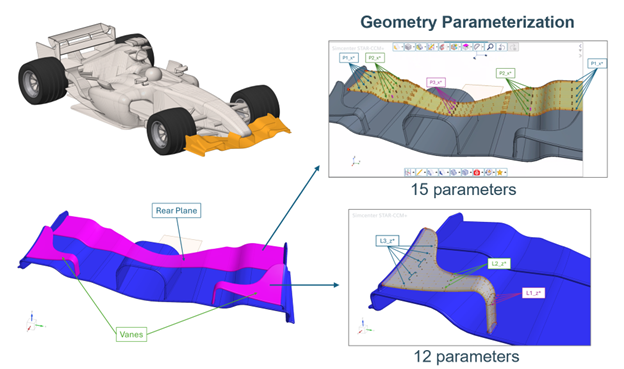
A total of 60 design variants were generated and simulated. From this dataset, 45 designs were allocated for training the GDL model, 5 for validation during the training process, and 10 kept aside for final testing. This relatively compact dataset demonstrates the capability to learn from limited data. Importantly, the underlying parametrization will not be passed to the ML model; the GDL approach handles geometry variations nonparametrically, learning directly from the surface representations. Each simulation contains approximately 5 million cells on the surface alone, representing the scale and complexity typical of industrial CFD applications. The training data includes surface pressure and wall shear stress fields, as well as a few scalar responses including drag and lift coefficients.
AI Surrogate Model Performance
Simcenter PhysicsAI is automatically called to train the AI surrogate model. Once training is complete, the model is deployed to predict aerodynamic solutions for previously unseen designs from the test set, with inference also performed seamlessly by Simcenter PhysicsAI.
Figure 2 illustrates a representative comparison for one test sample: the top panel shows the AI-ROM prediction of the surface pressure field, while the bottom panel displays the corresponding high-fidelity CFD simulation. The close agreement between predicted and simulated pressure distributions demonstrates the model’s ability to capture complex flow physics across the entire geometry. Beyond full-field predictions, the surrogate model simultaneously predicts scalar performance metrics such as drag and lift coefficients, delivering comprehensive aerodynamic characterization in seconds rather than the hours required for traditional CFD.

Once validated, this surrogate model can be deployed for design exploration and optimization studies, predicting new field solutions and scalar responses in seconds. Moreover, the dataset and trained models can be reused for new studies that do not necessarily focus on the front wing alone. This underlines the power of GDL: the ability to leverage learned knowledge across related design problems, building upon existing simulation investments rather than starting from scratch for each new study.

WHITE PAPER
AI surrogate modeling for industrial CAE
A technical landscape and Simcenter PhysicsAI approach
4. Conclusions and Outlook
Machine Learning (ML) presents a transformative opportunity for computationally intensive CAE simulations8. ML models can learn from existing simulation data to deliver predictions orders of magnitude faster, enabling engineers to explore vastly larger design spaces within practical timeframes. This complements traditional high-fidelity simulations, which remain essential for critical validation. However, realizing this potential in industrial practice requires addressing real-world challenges around data scarcity, geometric complexity, and integration with established workflows. The ML4SIM research project tackles these challenges targeting to develop scalable, trustworthy ML method that can handle industrial-scale problems while integrating seamlessly with existing CAE tools. The methods achieved through this research have been incorporated and will continue to shape the Simcenter technology offering for accurate and efficient engineering optimization.9
Going forward, Siemens and KU Leuven will continue their research mission to scale up ML to industrial engineering application, both within the frame of the ML4SIM research project and beyond. “Our focus is on further developing the technology to enhance its scalability and generalizability towards large-scale, multi-domain problems,” says Shuyang Zhang (KU Leuven, postdoctoral researcher at Department of Mechanical Engineering, in close R&D collaboration with Siemens). “Along with continuing to prove its trustworthiness and robustness this will show how useful it will be for industry.”.
The research team at KU Leuven’s Department of Mechanical Engineering sees this work as part of a broader evolution in engineering simulation. Professor Frank Naets feels there is much more research to be done to better understand the technology in relation to existing methods. “We strongly believe in conventional simulation but there are some things we’ve struggled with for decades. More research will help us better understand how to combine various technologies to most effectively solve important industry problems.”.Professor Elke Deckers echoes this sentiment, emphasizing that the growing ecosystem of novel methodologies offers significant potential. “New approaches are opening doors to capabilities we could not reach with traditional methods alone. It is impressive to see what can be achieved. At the same time, established simulation techniques remain indispensable for guaranteeing accuracy and reliability. The real opportunity lies in understanding how these traditional and emerging methodologies can be used hand in hand, leveraging their respective strengths to deliver deeper insights, greater efficiency, and robust engineering workflows.”. Ultimately, as Frank Naets concludes, “we hope that this will open up simulation to more users by reducing the required investment of time and money.”
Acknowledgements
The research has been supported by VLAIO (Flanders Innovation & Entrepreneurship Agency, ref. https://www.vlaio.be/en) in the frame of the research project ML4Sim (HBC.2024.0457 – Machine Learning for accelerated Simulations and faster designs).
References
- Bahaa Haddoukessouni, What’s new in Simcenter STAR-CCM+ 2602?, Simcenter Blogpost, February 24, 2026. ↩︎
- Mathijs Vivet, Adrien Scheuer, Stijn Donders, AI-accelerated gear stress analysis, Simcenter blogpost, August 27, 2025. ↩︎
- Daniele Obiso, A journey through the skies – lifting aerospace CFD engineers to new heights, Simcenter Blogpost, October 16, 2024. ↩︎
- Daniel Berger, Justin Hodges, Dirk Hartmann, “Beyond traditional engineering simulations: How Machine Learning is pioneering change in engineering”, Siemens The Art of the Possible Blogpost, October 10, 2023. ↩︎
- Haixin Wang et al., Recent Advances on Machine Learning for Computational Fluid Dynamics: A Survey, arXiv preprint arXiv:2408.12171 [cs.LG] (2024) ↩︎
- Siemens Digital Industries Software, Siemens and KU Leuven collaborate to research Digital Twin for Smart and Sustainable Products, Press Release, June 11, 2024. ↩︎
- KU Leuven, Siemens Chair Digital Twin for Smart and Sustainable Products, KU Leuven website, Retrieved 2026. ↩︎
- Cédric Tachot, Aaron Godfrey, The art of the automobile: why cars look the way they do (and how we make them better, faster) – Geometric Deep Learning for CFD, Simcenter Blog, February 18, 2026. ↩︎
- Siemens Digital Industries Software, Simcenter, Retrieved 2026. ↩︎
FAQs
Q: How does Machine Learning speed up CAE simulations?
Machine Learning can improve CAE in several ways: by enabling surrogate models that predict results quickly, by accelerating selected steps in traditional solvers or improving convergence, and by supporting copilot-style assistance that makes simulation workflows easier to use. The result is faster iteration, broader design exploration, and more accessible engineering insight.
Q: What is an AI surrogate model in engineering simulation?
An AI surrogate model is one example of how Machine Learning can accelerate CAE. Trained on existing simulation data, it learns the relationship between design inputs and simulation outputs. The AI surrogate model then acts as a fast stand-in for a full solver, and predicts quantities (such as pressure fields, drag, lift, or stress) for new designs in seconds rather than hours.
Q: Can AI replace traditional CAE solvers?
AI is most valuable when used alongside physics-based simulation, not as a replacement for it. Surrogate models and other ML methods can speed up exploration and optimization, while traditional solvers remain essential for validation, accuracy, and engineering confidence. At the same time, this is a fast-moving field, and it will be exciting to see how these approaches continue to evolve — and Siemens will be there to shape that journey with you.