Your next colleague is an agent: The dawn of agentic AI-aided engineering
Here is a number that should keep the engineering software industry awake at night: for every one engineer who can confidently run a simulation, there are roughly ten who urgently need one but cannot. Around 3 to 5 million people worldwide routinely use Computer-Aided Engineering (CAE) tools – the specialists who know which solver to trust, which mesh is fine enough, and why a result that looks right might be dangerously wrong. Behind them stand an estimated 30 to 50 million designers, architects, and product engineers who would give a great deal for that insight but have no way to get it without queuing for a specialist’s time. [1,2]
The bottleneck is not compute power. It is not software quality. It is human expertise – and for forty years, we have tried to close that gap by making tools easier to click. It hasn’t worked. But something has changed. For the first time, we can hand the expertise itself to a machine, and let it work alongside the engineer rather than waiting to be operated by one. We call it Agentic AI-Aided Engineering, and it is about to rewrite that 10:1 ratio.
1. The 10x problem hiding in plain sight
You have almost certainly lived this story. A designer finishes a bracket. Before signing it off, she needs one answer: does it actually survive the specified loads? So she files a request with the simulation team. It joins a queue. A specialist eventually picks it up, prepares the geometry and sets up the model – the right CAD granularity, the right boundary conditions, the right material, the right solver settings – and, days later, results come back. If the design fails, the whole loop starts again.
Nobody here is doing anything wrong. The specialist is brilliant. The designer actually needed that brilliance. The process is simply slow, expensive, and – the killer – it does not scale. There are only so many specialists, and the demand for their judgement grows faster than we can train them.
For decades the industry’s answer has been democratization: friendlier GUIs, guided wizards, vertical simulation apps tuned for one workflow. Each helped. None finished the job. Why? Because every one of them still demands that you already know the right question to ask. They lowered the wall; they never removed it.
So here is the question that has quietly haunted CAE since its inception: what if you didn’t have to operate the tool at all? What if you could simply describe what you want to know – and have something intelligent figure out the rest?
2. From tools you operate to agents that work with you
The answer emerging from the AI community is the concept of Agentic AI: systems that go far beyond executing predefined scripts. Unlike classical AI workflows – which automate a fixed sequence of steps predictably but inflexibly – an agentic AI system possesses autonomy. It can plan, reason over incomplete information, call tools, retrieve knowledge, and adapt its approach when circumstances change. [3]
Think of the difference between a vending machine and a capable colleague. A vending machine executes exactly the sequence it was programmed for; hand it an unexpected input and it stops. A capable colleague understands the goal, works out the steps, notices when something is off, and asks for clarification only when truly needed.
Applied to CAE, this shift opens a genuinely new paradigm: Agentic AI-Aided Engineering (A³E). In A³E, individual agents handle specialized tasks within an engineering workflow: retrieving a model from the PLM system, identifying the appropriate physics simulation, configuring boundary conditions, running the solver, analyzing the results, generating a report. During this workflow a human engineer retains strategic oversight. The engineer stops being the person who operates the tool and becomes the person who directs the process.
This is not science fiction. The foundational technologies – large language models capable of multi-step reasoning, standardized agent-to-tool protocols like the Model Context Protocol (MCP) [4], agent-to-agent protocols like Agent-to-Agent Protocol (A2A), multi-agent orchestration harnesses like LangChain DeepAgents, domain expertise standards for agents, like Skills, and fast interactive simulation – have all arrived within the last two years. The question is no longer whether agentic AI will transform engineering software. It is how to build it well.
3. The Engineering Foundry: a blueprint for A³E
The Simcenter Technology Innovation team has been working on exactly that question. Our vision for how A³E should be realized is the Engineering Foundry for Simcenter – a collaborative, multi-domain, and highly automated engineering environment designed to support real-time engineering across teams and disciplines.
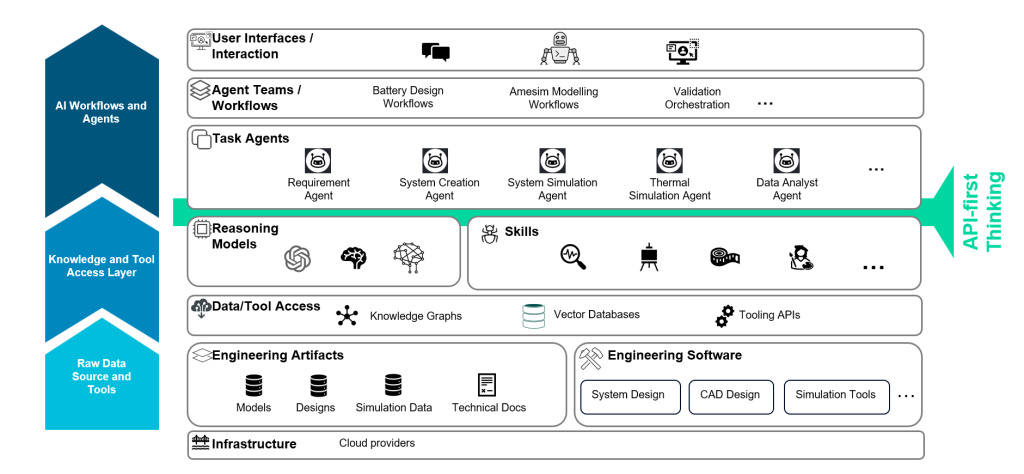
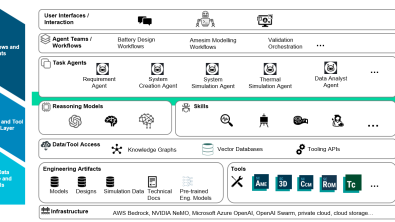
At the heart of the Foundry are Task Agents – individually focused AI agents, each expert in one slice of an engineering workflow. A 3D Simulation Setup Agent knows how to configure a CFD analysis. A Reduced Order Modelling Agent knows how to generate training data, fit a surrogate, and export it as a standard FMU. A PLM Interface Agent can browse Teamcenter, retrieve a CAD model, and extract the relevant material specifications from the digital thread. A Simulation Recommender Agent can match a new task to the most similar past analysis in a knowledge base.
Specialization is intentional. An agent scoped tightly to one task is far less likely to hallucinate than a general-purpose model asked to do everything at once. And because each agent exposes a well-defined API – ideally following the MCP standard – agents from different providers can interoperate. The Foundry is conceived as an open ecosystem, not a walled garden.
Task Agents are coordinated by Agentic AI Orchestrators that assemble them into Workflows configured by engineering experts. Those experts – the people who know the company’s best practices and standards – define how agents collaborate to solve a class of problem. The resulting workflow is then accessible to anyone: as a co-pilot chat interface, as a silent background process triggered by a design event, or as a familiar menu in an existing tool. The user interface adapts to the context; the intelligence underneath remains consistent.
4. What does it look like in practice?
Abstract architectures are always easier to assess against concrete use cases. Consider two very different problems the Foundry is designed to handle.
Scenario A: Battery pack overheating – a systems simulation challenge. An automotive battery engineer receives an urgent change request: a pack is overheating under certain drive cycle conditions. Normally this would require a sequence of specialists – someone to extract the 3D geometry, someone to generate a reduced-order model, someone to swap it into the existing system simulation model, someone to run the drive cycle and analyze results. In the Foundry, a coordinated team of agents handles that entire chain: retrieving the existing system model from the PLM, identifying the FMU interface the new battery component must satisfy, setting up the corresponding CFD project to generate training data, training the ROM, swapping it into the system model, running the test cases, and producing a report – with continuous status updates throughout. The engineer oversees the process and is prompted for decisions only at ambiguous junctures.
Scenario B: The junior analyst who does not want to ask. A new simulation analyst needs to run a high-fidelity aero-acoustics analysis of a car. She knows roughly what she is doing but does not know the company’s best-practice mesh settings for this class of problem. Normally she would need to find a senior colleague, wait for them to be available, and risk blocking her own work for days. A best-practice assistant – grounded in the company’s historical simulation knowledge via a knowledge graph – gives her an instant, detailed answer: here is the most similar analysis from the archive, here are the mesh quality thresholds that were applied, here is why. She gets back to work in minutes.
Neither of these scenarios requires agents to be perfect. They need to handle the common case reliably – and our thesis is that covering 80% of standard engineering tasks automatically is already sufficient to transform productivity across an organization. [5] Simulation Apps showed us the same lesson a decade ago: you do not need to automate everything to see step-change adoption.
5. New roles, new people, same engineering goals
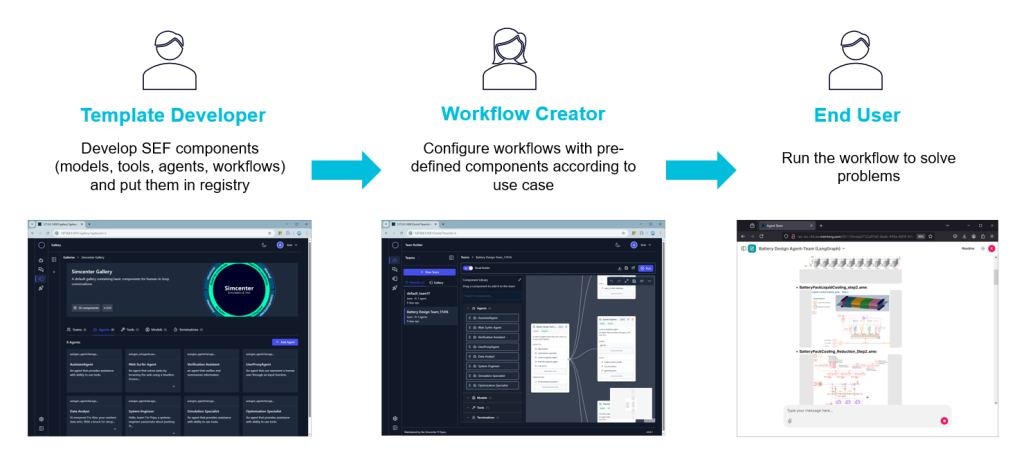
A³E does not replace engineers. It reshapes who gets to engineer, and what engineers spend their time on. Three new user profiles will emerge alongside today’s computational specialists:
- Template Developers build and maintain the task agents themselves – writing the prompts, assembling the skill sets, and placing agents in the registry. This is today’s simulation expert with an additional layer of AI-workflow expertise.
- Workflow Creators configure agent orchestrations for specific use cases, drawing on pre-built agents like building blocks. Senior engineers who understand company standards and best practices will naturally fill this role.
- End Users – the 30 to 50 million – run the configured workflows to solve concrete problems, via a chat interface, a co-pilot panel in their existing tool, or simply a button that kicks off an automated process.
The democratization of simulation has been a stated goal of the CAE industry for years. We believe Agentic AI is the first technology actually capable of delivering it – not by making today’s tools simpler, but by abstracting the expertise away entirely for standard tasks. As we explored in Imagine a world without toolbars or menus, the future of engineering software may not look like software at all – it may look like a conversation.
6. Conclusions and outlook
Agentic AI-Aided Engineering is not a single technology or a single product. It is a new way of organizing the relationship between engineers, AI, and simulation tools. The Engineering Foundry is our concrete vision for what that organization looks like: a layered, open, API-first platform where specialized task agents collaborate under expert-defined orchestration to handle the full complexity of multi-domain engineering workflows.
The change will be evolutionary, not overnight. Agents will first simplify individual steps in existing workflows – and those incremental wins will compound. Early demonstrators from our team are already tackling individual use cases (c.f., Figure 2); an overarching integrated prototype is in active development. And we are honest about what is not yet solved: best practices for agentic patterns in low-error-tolerance engineering contexts, the right balance between agent autonomy and human-in-the-loop oversight, and how to capture engineering knowledge in ways that are simultaneously useful to an agent and auditable for compliance. We do not expect agents to handle 100% of engineering tasks any time soon – but we are convinced that handling the standard 80% is enough to change the game.
There is also a deeper shift worth naming. As individual tool capabilities disappear behind agents, the old moats of the CAE industry – the high cost of switching tools, the years of training locked into a single interface – begin to erode. The durable advantage of the future will not be the software you cannot leave; it will be the engineering knowledge an agent can put to work, and the experience of using it.
If a world where any engineer can reliably tap deep simulation expertise sounds like one you want to help build, we would very much like to hear from you.
References
[1] Engineering.com (2022): Research Report: The State of Simulation, Prototyping and Validation.
[2] K. Hanna, I. Weinhold (2017): The Democratization of CFD. Mentor Graphics White Paper
[3] A. Ng (2024): AI Agentic Workflow. deeplearning.ai.
[4] Anthropic (2024): Model Context Protocol. https://modelcontextprotocol.io
[5] B. Courter (2025): Agentic Engineering: how AI automata will participate in engineering in 2025. Blog post.
[6] D. Vellante, G. Gilbert (2025): Nadella vs. Benioff: The real story behind AI’s agentic future. siliconANGLE.
[7] Simcenter Technology Innovation team (2025): From outdated to up-to-date: Modernizing deprecated code with multi-agents. Art of the Possible blog.
[8] Simcenter Technology Innovation team (2024): Agent studio: A multi-agent system for systems engineering. Art of the Possible blog.
[9] Simcenter Technology Innovation team (2025): The role of Generative AI in simulation tool automation. Art of the Possible blog.
FAQs
Q: What is the difference between an AI workflow and an Agentic AI system? An AI workflow is a predefined, rule-driven sequence of actions – reliable and predictable for routine tasks, but inflexible when circumstances change. An agentic AI system can plan, adapt, and make decisions dynamically. It can handle the unexpected because it reasons about what to do next, rather than following a fixed script. In practice, the Engineering Foundry supports both: simpler automatable steps use workflows; complex, context-dependent reasoning uses agentic AI.
Q: Will A³E replace simulation specialists? No – but it will shift what they do. Today’s specialists will increasingly become Template Developers (building the agents) and Workflow Creators (defining how agents collaborate for specific use cases). The goal of A³E is not to remove expertise from the system; it is to encode that expertise so it can benefit far more engineers. The knowledge of the best simulation specialist in your company should not be locked inside their head – it should be accessible to everyone on the team.
Q: When can we expect to see this in Simcenter products? The Foundry is a research vision and innovation roadmap, not a committed product delivery. Individual agent capabilities are already appearing in demonstrators and prototypes across the Simcenter portfolio. The roadmap is evolving quickly, and we expect to see increasing automation of individual workflow steps in the near term, with more integrated multi-agent orchestration following as the technology matures.
Disclaimer
This is a research exploration by the Simcenter Technology Innovation team. Our mission: to explore new technologies, to seek out new applications for simulation, and boldly demonstrate the art of the possible where no one has gone before. Therefore, this blog represents only potential product innovations and does not constitute a commitment for delivery. Questions? Contact us at Simcenter_ti.sisw@siemens.com.