An abstract digital visualization displaying data flow and network connectivity. Glowing lines in blue, red, orange, and yellow stream across a dark blue background filled with binary code, circuit patterns, and data analytics charts. Illuminated dots and nodes cluster on the right side, representing data points or network nodes. The left side shows various digital interface elements including graphs, percentages, and monitoring icons, creating a representation of big data processing, artificial intelligence, or network analysis.

Leveraging know-how with AI into efficient product design

Is your engineering data a hidden goldmine? Overcome the ‘cold start’ problem in AI by using geometric similarity and transfer learning to transform existing models and simulations into powerful assets, speeding up product design and innovation

Your next colleague is an agent: The dawn of agentic AI-aided engineering

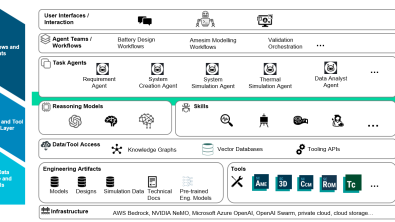
What if every engineer had instant access to simulation expertise? Agentic AI-Aided Engineering could transform engineering by putting intelligent AI agents alongside designers, automating complex CAE workflows, and breaking long-standing expertise bottlenecks. Discover how this emerging approach could democratize simulation and accelerate innovation across the engineering lifecycle

Fine-Tuning VLM

When off-the-shelf is not enough: fine-tuning for industrial part classification

Part identification in complex CAD assemblies is a bottleneck in simulation workflows, which can cost engineering teams days before the real work even begins. In this post, we explore how fine-tuning a Vision-Language Model on industrial components can improve the pre-processing phase.

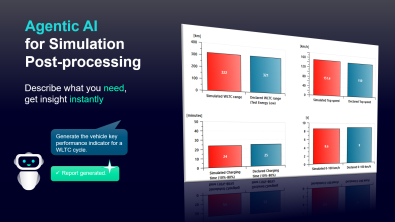
Agentic AI for simulation post-processing

Ask, don’t click: Agentic AI takes the pain out of simulation post-processing

Picture this. You have just finished a hydraulic drive-cycle simulation in Simcenter Amesim. The solver finished in four minutes. Excellent….

Automation with VLMs

Visual Language Models: Turning design chaos into order

Visual Language Models (VLMs) are revolutionizing design by combining visual perception with language understanding, enabling engineers to classify, search, and explore complex models with natural prompts. Their remarkable generalization abilities make them invaluable for component identification. With VLMs, design chaos transforms into streamlined efficiency.

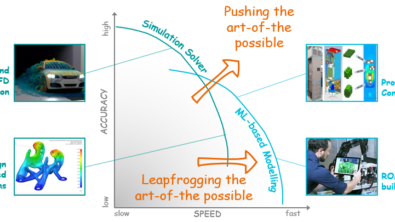
How to sustain the ongoing evolution of industrial simulation?

The evolution of industrial simulation has been marked by a transition from primarily scientific and proprietary software to a market dominated by sophisticated commercial products.

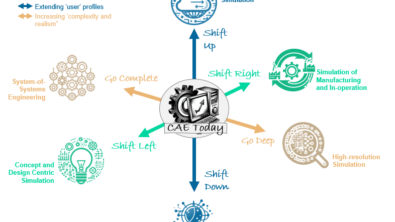
On the ongoing evolution of industrial simulation

Industrial simulation – from where it is today, to where it might be in the future. Simulation as of today is still only accessible by a very expert centric user group. Technical as well as non-technical barriers prevent adoption of simulation by anyone and all who might benefit from it. How can we enable the adoption of CAE to its full potential?

Enabling sound design through more accurate industrial vibro-acoustic trim models

Current-day product design engineers from many industries (manufacturers of cars, trains, planes, industrial machinery, white goods, smartphones, …) find themselves…

Computer Aided Engineering in the Industrial Metaverse – Part 2

The Industrial Metaverse (IM) is a virtual world in which one can interact with the digital twin. From a Computer…