Faster Decisions, Safer Operations with Industrial AI – Podcast Transcript
New technology is, without a doubt, cool. However, for that technology to have value it must be practical as well, offering real benefits to end users lest it be relegated to niche novelty status. Currently, copilots are working to move out of the realm of cool technology and into the realm of real value, offering strong user benefits and real, practical improvements to the way people do their work.
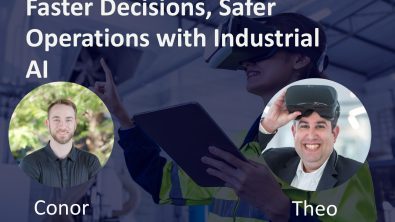
In this episode, host Conor Peick is joined by guest Theo Papadopoulos, senior consultant and head of the Metaverse Lab at Siemens to explore what it takes to bring AI copilots to the shop floor, how that benefits users and what the copilot itself needs to succeed.
Check out the full episode here or keep reading for a transcript of that conversation.
Conor Peick:
Welcome back to the Future Ready podcast, I’m your host, Conor Peick joined again by Theo Papadopoulos a senior consultant and head of the Industrial Metaverse lab at Siemens. Last time, we talked a lot about what’s happening behind the scenes for copilots to learn information and generate answers, but now I’d like to ask, what are these systems looking for? When the user is asking for guidance, what is the system looking for to provide useful guidance to that user, what does it need to know?
Theo Papadopoulos:
So first of all, the state of the machine. So what’s now the, let’s say the IOT data, what the machine is running, first of all, or not running? If there was an error, what’s the error? Look at the log books. Then also history is very important. Was this problem happened in the past? If yes, how someone fixed it? So that’s important, the history. And the last one is the intent. What you want to do as a user? Why you are asking this question? What’s the goal there? What you want to achieve with the question? So you want to fix it, you want to restart the process. So what’s there your stake? So this is our, let’s say, the industrial trinity. So to know these three facts in order to take the right decisions there.
Conor Peick:
Okay, and you also mentioned the user’s experience level as well earlier?
Theo Papadopoulos:
Yes, user experience is very important because you may have the best solution, but if the users are not excited to use it, then it will be obsolete in a matter of, say, hours or days, the people will not come back. And that’s also the problem, let’s say, also with the VR glasses. still today because the experience you are somehow detached from the environment the first days it’s okay but then you feel isolated then you see that the interest also for the VR glasses over time goes down in the consumer sector myself I have bought three, 4 glasses different along the years, played two months and now it’s myself.
Conor Peick:
Gathering dust. Exactly.
Theo Papadopoulos:
It’s because it’s part of the user experience there and also the lack of content, going back to the lack of content that we said we discussed before.
Conor Peick:
Right, It’s got to have that backing that makes it useful.
Theo Papadopoulos:
Exactly.
Conor Peick:
Yeah. So obviously as you guys were developing this technology and developing the solution, implementing it, of course, There must have been some times where you tested it out with workers on the shop floor. What was the first experience you had where someone offered really solid feedback of this really helped me in this way? Yeah. What was that experience like?
Theo Papadopoulos:
So first of all, we don’t do that because it’s cool. It’s cool, okay, the consumption. But it’s based on requirements we have from our factories and from our customers. And one of them was in one of our factories that overnight sometimes one machine can reach a critical condition. I mean, not downtime, but can reach critical condition. And if you don’t take actions, then it may lead to some downtime. And because overnight, the experts, the different levels of expertise, if you reach the highest level, and the expert is not available overnight, you have to wait till next day. And there for this specific machine, we did some tests, I mean, morning, not night, some tests with employees there. And we asked them, okay, how you would address the problem. And on the first, we went through manuals and it was very, let’s say, lengthy process to search, even with an iPad, I mean, just to put the right words, search the text, read the text, and the standard It was quite a lengthy process, and then we say, Okay, let’s try now with the glasses, take a picture and ask for it, and they said, Wow, and they filled out, as I said before, the empowerment because… I don’t have to read, but someone is here in my ear saying me what to do now step by step. So it’s slow based on my pace because you can define the pace. You can say, please repeat step one. Let’s go now to step 2. And that makes them also quite excited to use them again. They said, oh, that’s great. Also my hands are free because with the iPad, you have somewhere to keep the iPad while working. It maybe distracted your eyes. So they were really, really excited about this that they could very fast take actions. That was impressive. They didn’t have to go back to the office to get the iPad or they didn’t have with them, but they could take actions. But just by wearing the glasses, because wearing these glasses, it’s a normal, it’s not heavy, it’s 50 grams. So it’s normal glasses from the four factor. You can wear them all day and take faster reactions. I mean, when something happens.
Conor Peick:
Yeah, I love that you keep bringing it back to that idea of empowering the employees on the shop floor. Especially with AI, I think people get a little nervous.
Theo Papadopoulos:
Exactly. That’s why I also have pointed that AI here is your friend. We want to, as I said before, to give superpowers to employees to more staff, not that we want to replace them. We want to make their daily life easier, better, and also faster for solving problems in this case. And that’s why it’s also important to be humanized somehow, the AI, so how they deliver replies, so it’s not too computer, the voice is kind of natural. We try to have a natural voice, so it’s like a human, but a robotic voice. So the experience also for the, but the user experience, it’s really realistic for them close to reality, and it’s easily acceptable from the employees there. And As I said before, AI is your friend here. It’s not your enemy. You don’t have to be afraid of AI.
Conor Peick:
Yeah, not coming for your job. It’s coming to make your job easier.
Theo Papadopoulos:
Exactly.
Conor Peick:
So with this whole system, obviously, is it’s looking at industrial machinery and shop floor environments and breaking them down, understanding them on a pretty detailed level to be able to offer instructions and help users with maintenance tasks and repair, perhaps things like that. So with that, how important is the digital twin as kind of that basis to making these glasses really, really super useful in that environment versus more of a, I don’t know, a flashy kind of application, I guess?
Theo Papadopoulos:
So the digital twin is the brain of the whole hero backend. The glasses are just the eyes and ears. If I can say it’s just the a GoPro mounted on your head and the ear pods. But here the digital twin is really the brain. So it give us first of all the semantics, how the different information are connected to each other, the real time data, the IoT data we want, the simulation data, history data. So all this comes from a digital twin. And here I want to mention also that the digital twin can help us or can help AI to do what if scenarios. So while they are looking for a solution, they can go and ask the simulation, for example, the AI, if I change this parameter, what will be the effect on the machine? So this also gives you some predictions and they also help us take better decisions. And also if we think about safety here, digital twin brings another aspect. For example, we can get this real-time data and the AI can tell us, is it safe? To touch the machine is to hold, so you can think also brings the safety aspect here based on this, because it has this real-time data, so it’s a core element of the solution.
Conor Peick:
That’s really fascinating. So, you make a request and it’s essentially it’s pinging a digital twin that’s then able to simulate the state of the machine.
Theo Papadopoulos:
Wow, that’s it brings operation excellence. If I can, if I can, with one phrase to say that this brings the operational excellence here without that AI doesn’t have any context. I mean, for our specific use case, you may understand what kind of component it is, what machine. But the whole context is not perceived by AI without it.
Conor Peick:
Fascinating. So is that based on an executable digital twin or?
Theo Papadopoulos:
That’s one part. The executable digital twin that can offer us this real-time what-if scenarios or virtual sensing. I mean, is the machine hot here? It’s electricity there, so that can be delivered by executable digital twin. That’s one aspect.
Conor Peick:
Got it.
Theo Papadopoulos:
But you have to think more holistically digital twin or the whole data around this machine component?
Conor Peick:
Yeah, OK, great. Super cool. And I mean, it’s. It’s really, I think, really impressive the way that behind these glasses there’s this whole convergence of different technologies coming together from connectivity, AI, digital twin. It’s all coming together to deliver this.
Theo Papadopoulos:
Exactly.
Conor Peick:
Yeah, this solution.
Theo Papadopoulos:
And I think that we will see more to come the next years because now all these technologies have huge advancements. I mean, it’s impressive how the last five years, most of them have major leaps in multiple of these technologies. Now the simulation also go real time. They become faster and faster, almost real time. We’re going to see also new offerings coming here in this field from these developments the next year.
Conor Peick:
Super cool.
Theo Papadopoulos:
We’re working on some of them. I cannot reveal yet. Stay tuned.
Conor Peick:
Yeah, definitely stay tuned. Yeah. So I mean, we’ve got more things in development that will make maybe current technology already feel outdated.
Theo Papadopoulos:
Exactly.
Conor Peick:
Yeah. Amazing. Well, Theo, thank you so much for your time today. It’s been a really, really fun conversation. I really enjoyed it.
Theo Papadopoulos:
Thank you very much. And as I said, looking forward to meet you next year and see where we’re standing.
Conor Peick:
Yeah, that’d be great. Look forward to it.
Siemens Digital Industries Software helps organizations of all sizes digitally transform using software, hardware and services from the Siemens Xcelerator business platform. Siemens’ software and the comprehensive digital twin enable companies to optimize their design, engineering and manufacturing processes to turn today’s ideas into the sustainable products of the future. From chips to entire systems, from product to process, across all industries. Siemens Digital Industries Software – Accelerating transformation.