Roche: How to overcome the uncertainty of pharma plant design – Transcript
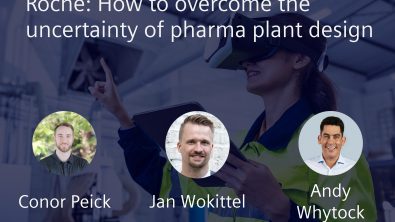
Listen to the podcast on pharma plant design.
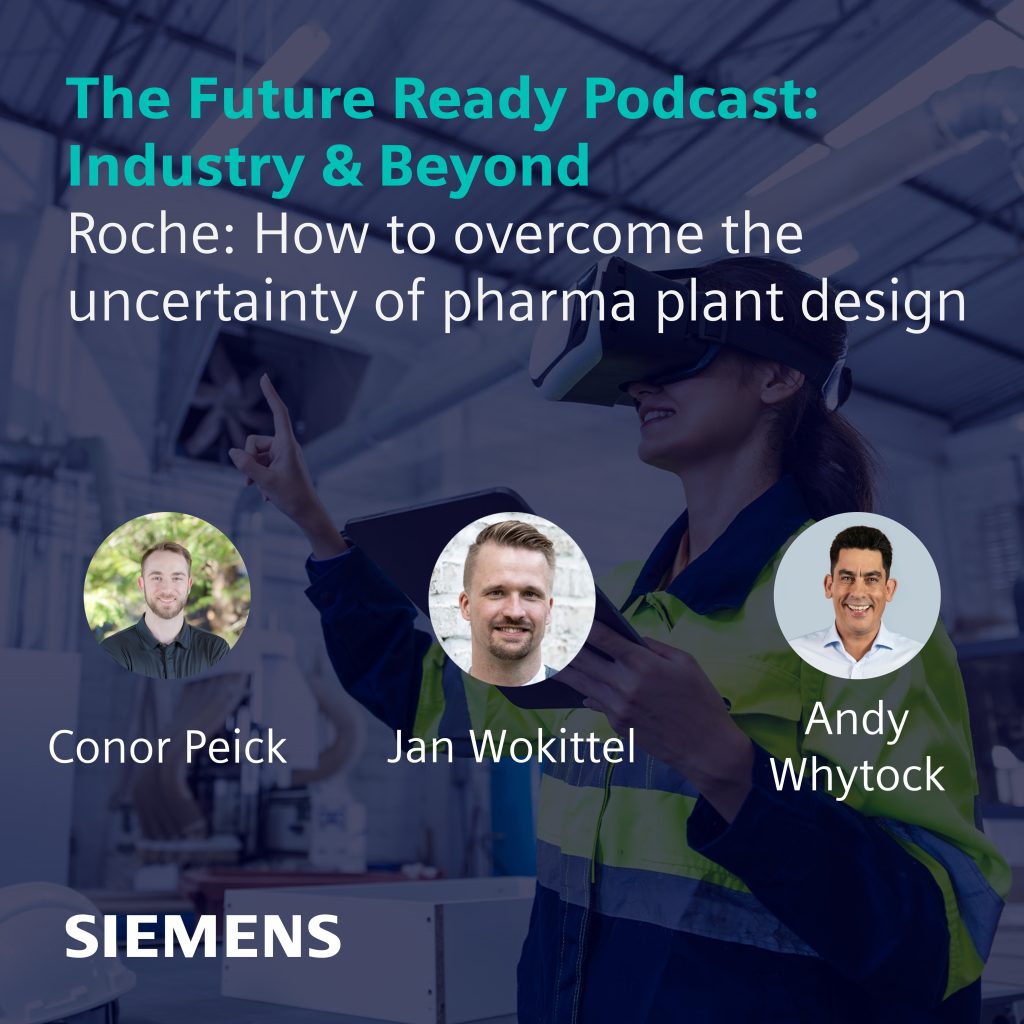
Conor Peick: Hello and welcome to the Future Ready Podcast. My name is Connor Peick, and I’ll be moderating the discussion today. I’m going to be joined by Andy Whytock, who is the head of Market Strategy and Thought Leadership for the Life Sciences Business Segment at Siemens Digital Industries Software.
Andy Whytock: Hello.
Conor Peick: And we’re also joined by Jan Wokittel, director of Smart Manufacturing at Roche. So, Andy and Jan, welcome to the podcast. [I am] really excited to have you both on to talk with us today. I was hoping you could both introduce yourselves and describe a bit of your background to our listeners.
Jan Wokittel: Yeah, thank you very much. Thank you very much for the invitation and [for] having me. My name is Jan Wokittel. I’m the director of, like you said, … smart manufacturing at Roche. And what does [that] mean? So, I’m responsible for the [digitalization] of our new greenfield facilities and [I] make sure that we have the right [technological] foundations in place to be successful in a more digitized future.
Andy Whytock: Very good. And my name is Andrew Whytock. Most people call me Andy. I’m working in a team that’s dedicated to our life sciences customers, so mainly pharmaceutical and medical device. Where we are really understanding the requirements of the pharmaceutical industry and bringing that back into Siemens. But, [we are] also articulating to the industry exactly what Siemens can do for them.
My role within this team is very much around thought leadership, understanding those trends, understanding how technology can change those and shape those, and again, articulating that with our customers, at a senior level, around what are those requirements and what technology can do for them.
Conor Peick: Excellent. We’re going to start, Jan, with you. And from where you sit in the pharmaceutical manufacturing industry, I would love to know what’s changing most dramatically for you right now, and maybe why those changes are taking place.
Jan Wokittel: So, actually, what I see is, and what I discover is, that most of these changes [are actually] driven somehow by technology. So, in a [shorter] lifespan, new technology is popping up, the adaptation of technology is changing. And it’s [easier] once the technology is more democratized, to apply them also for multiple fields of application. And I see that this is a very hard driver for me: how to move on with such a technology, how to apply this actually, and find … the business value behind … that.
And for me, it’s a constant waiting between robustness and flexibility. Because now, when we talked about that, I deal a lot with these new greenfield projects. And of course, I have a very hard time schedule, and I need to stick to that. But then these new technologies are popping up, I don’t know, in months, in weeks, and in the future, I would expect even shorter. And I need to [say,] “okay, what makes sense now to apply, or should I rely on already known, maybe also more past oriented technologies? [I] know they are robust and they will work.” [This] is a constant challenge for me.
Conor Peick: Yeah. [It] makes me think, I feel like there is a story about some, maybe it was a nuclear facility, I don’t know, but they still ran on floppy disks. [They used that] very old technology because it was well proven and well understood.
Jan Wokittel: Yeah, but also the floppy disk, you applied them for a very long time, right? [When] it comes to [that], I can imagine. Once I was part of a training program where we used this (floppy disks) for backups. Of course, there were already new solutions, but it (floppy disks) still has been proven. “Okay, maybe this is more robust, so let’s stick to that.” But yeah, of course: at [what] time [will a] new technology [be] so mature that you are willing to change, right?
Conor Peick: Yeah, absolutely. Excellent. So, Andy, turning to you. So, when a pharmaceutical company plans [the construction of] a greenfield plant today; I would love to know what the biggest uncertainties companies deal with as they plan such a project.
Andy Whytock: Yeah, no problem. I think when you even talk about greenfield, we don’t necessarily just have to talk about a brand-new plant. There’s repurposing or updating … existing [production] plants to change from one product to another.
The biggest problem is, in fact, that uncertainty. Often, they (pharmaceutical companies) don’t know exactly how much [product] they will need to be producing or [even] what they will be producing (when they’re starting the planning of that [pharma plant design]). If you think about that, it takes 10 years to 12 years to bring medicine to market, you go through this very long process, the authorization is given, the market authorizations are given, so you can now go and commercially produce that. They can’t then start thinking about building a plant.
So, they’re thinking beforehand how to start building that [pharma plant design], but also to have some flexibility within that to account for specific eventualities that might come up. So yes, speed, speed in terms of being able to build that plant and sometimes hedging bets in terms of [what] we’re going to build [in] this plant because we believe that this candidate will go through the clinical trials successfully. There’s some level of gambling, if you like, for want of a better word, in that.
In terms of numbers, I think it’s always interesting to think about that: for every day that a pharmaceutical company delays bringing a major drug to market [that delay] can cost them about a million, to a million and a half dollars per day in lost revenue. So of course, that’s not the case for every single type of drug, but that’s the sort of numbers that we’re dealing with because there is this finite commercial life, if you like, for a drug.
So … coming back to your original question, when I’m thinking about (as a pharmaceutical company) like Jan, “so we need to build this greenfield plant, I need that to be able to produce the right product and the right quantity and be able to be flexible in terms of making adjustments for those different types of drugs.” We’re no longer at that stage where it’s just simple drugs that are being produced. We’re looking at much more complex therapies, ingredients, processes and so on and so forth. [So,] being adaptable for that is really, really key.
Conor Peick: Okay, I see. Very good.
So, Jan, I do hear that Roche is maybe working on a project that can help pharmaceutical companies be more flexible and adaptable. That it can maybe help them change tactics and better navigate their challenges and uncertainties as they’re dealing with them. So maybe you could tell us a little bit about what that is and the goals.
Jan Wokittel: So internally, we call it “Apollo 11” because [it started similarly to the first] moon mission, right? Because also [then] (referring to the actual NASA mission), the people and the government invested a lot. And [they] had … this big, bold vision. [They] decided, “okay, you need to be there (on the moon), I don’t know [as early as], in the 60s? So, just make it happen.”
[With] this Apollo 11 project, [that we now have] internally, it’s our new greenfield site in North Carolina. And we know, okay, we need to be ready at that time for this … product. And now I have a time span of like three to four years just to make it happen. And now the interesting fact is how to deal with all of these uncertainties and new technologies, which will definitely pop up in these lifespans.
So, this is a big challenge, also what you said, Andrew, because of these lifespan of the project itself. Once you [started] planning and you said, okay, now I want to move forward with that, a lot of things will change on the road, until the moment you have the finished goods.
And we deal with all of these uncertainties [similarly]. We started quite small and also used what we already have in the brownfield before we actually made the decision, “okay, let’s apply this for the completely new greenfield site.” Why do we do this?
And we always, I want to be very transparent there, of course, have a plan B because we love to figure out if this will work. But I need to stick to this delivery goal, right? So, there’s still this Holy Grail of like time, quality and money.
Conor Peick: Yeah, right. Chuckles.
Jan Wokittel: And then, especially then in my team, we have the freedom and the possibilities to test things out. But nevertheless, if something also won’t work, I just need to make sure that everything is possible to be executed once it’s needed.
Andy Whytock: So, you had three to four years to build the plant, basically. Is that when you sort of got this: “Jan, team, go and build that plant. You’ve got three years because in three years’ time you’re going to get the recipe, the process and you need to make millions [of the product]?”
Jan Wokittel: So, one is, of course, just deliver, make it happen. [And] sometimes I feel a bit [like I’m] “sitting between the chairs” because you need to make this happen. But on the other side, you are still constantly being challenged. Okay, what’s now the new hot thing? What did you change? So, and why are we the best now? Because we applied, I don’t know, a new technology or something like that.
And this is still in this internal conflict of: create something very robust where you definitely [100 percent] know this will work. On the other side, you want to be at the forefront. You want to be before your competitors, like 3, 4 years once you open the facility. So, you need to [apply] something new. But this is what makes my job, I would say, so exciting. Because you [are] constantly figure this out.
Andy Whytock: It’s an interesting idea in terms of that timeline because we obviously work with Roche but with other pharmaceutical companies too who are at different stages of that thinking. And so, “we’re building a [pharma plant design] that needs to be ready in three to four years’ time. [And] we want a factory of the future.” And then they say, “but maybe not too futuristic because we have to be absolutely certain that it will work in three to four years.”
Jan Wokittel: Exactly. So, some people are saying, “okay, this will be the new lighthouse.” Just here (at Hannover Messe 2026) when we have been here on the stage, we talked about “the lighthouse.”
But then when you come from the project perspective, and totally I can understand this… They would say, “I don’t want to have a lighthouse. I just want to have something work, right? And I need the security [of] 100 percent that this will work.” So, I’m not in a field for experiments, right?
Andy Whytock: Yeah, risk [and] uncertainty [have] to be managed. Yeah.
Jan Wokittel: Exactly. But this is now where the fun part comes out of it, I would say.
Conor Peick: So, it kind of sounds like, I mean, obviously you’re in the development of this new greenfield site. And it [also] kind of sounds like it’s both: [developing] this new production facility. But is it also, packaged … like a new approach? Is that fair to say? Like, are you taking a different approach at how you would [produce a new facility]?
Jan Wokittel: Yeah, so our differences come from how we plan and execute such a project. This is definitely a new thing. In the past, and now I’ve been with Roche for more than seven years, and I know how we plan these capex (capital expenditures) projects, these big projects.
[This] changed by having the possibility of applying new technologies and the capabilities they bring by nature, right? Which is quite cool. But of course, it’s still also a challenge and it takes a lot of effort to massage, a bit, the organization [to be] open for these new things.
Conor Peick: Okay.
Jan Wokittel: But this is, I would say, part of my job. And it’s quite cool to do this because I feel this openness from everyone to move forward step by step, right? Which makes it very exciting. And of course, when you have the possibility, and let’s be honest, also the money, [then] you can realize such big projects, yeah? At the end, you can create cool things.
Andy Whytock: Yeah, so I think it’s interesting because you have this idea, “there’s a lot of technology out there, some proven, some not proven,” but there’s been huge [advancements] in the way that we can do engineering now. And engineering is quite a broad term, [it] can mean a number of things, whether I’m building:
- the walls and the whole thing,
- the process and the instruments that are going to be inside that,
- the automation system,
- the HVAC (heating and ventilation)
There are … so many different elements that need to be engineered. We have lots of tools within Siemens, but there are lots of tools out there that can help that engineering to be much faster. But the reality [is] that it’s quite complex to bring all of these things together.
And I think that’s what, from my perspective, Roshe has done very well in this project. It [didn’t just look] at individual ways in which new technology can help. [They looked] at, not … even best of breed, but how you can bring that (technologies) together to have an overall effect rather than just shaving a couple of weeks or months off this particular part of the engineering process.
And again, [with] engineering process, that [includes] dozens of engineers that you’re talking about. This isn’t one guy who’s sitting there with a big piece of paper and saying, “I’m engineering when you can’t.” It’s a complex project with many different stakeholders. And again, with these uncertainties that we were just talking about at the beginning.
Jan Wokittel: Yeah, and I’m also an engineer from the bottom of my heart, so I really love the technology behind … that. And it’s still… And it takes a lot of effort to align all of these different engineering stakeholder groups.
Conor Peick: Yeah, certainly.
Jan Wokittel: Right. And you also need to have, I would say, I would call it a bit of the “capability of marketing something new, right?” Because an engineer by nature once you go through … university and you get your degree, you’re an engineer, you always plan [for] like a factor [of safety of] two for security, right?
And then someone came and said, “hey, let’s use this new technology for one of our biggest projects.” Of course, you would say, “are you crazy? So, why should I do this?” And this is still a thing [that is] ongoing, right? But it’s quite cool once you figure it out.
Also [consider] a different engineering group [saying], “how [do we] do this.” The “how” is, I think, the most interesting part, because everyone can talk about these big visions, but once you figure out how to do this, [this] is where then the value comes from.
Conor Peick: Yeah. Well, and Jan, as you were talking about that, … it brings up also the idea of sort of the maturation of the [comprehensive digital twin].
To learn more about the Comprehensive Digital Twin, click here.
So, as you guys are … working with them, when do you think a digital twin moves from being “a model” to becoming more of “a strategic … decision tool.” [When is it] something that you can really leverage to drive decisions in your business? Is that dependent on those connections that we’ve been talking about, [these] data connections?
Jan Wokittel: It depends on the interfaces, data connections itself. So, I like the term of it’s **** in, **** out. Once you don’t have a good [data] foundation, you cannot expect that the result will be impressive, right? This won’t work. But the driver is always the business problem.
So, of course we started from the engineering perspective, “hey, there’s a new technology, maybe it should be cool to apply them.” But once we have this thought, you need the business problem where you can then build on that. And this was quite challenging for us, having this at the beginning, because it was so new for all the different disciplines.
[We] started very easy, I would say, with our architects, where it was about layout decisions. And then we just created simulations for two different layouts. And by nature, we [already had] these layouts. So, it was not so hard to get those kind of data sources. And we simulated the process of the material, the raw material, and the people. And this was just the beginning.
And from there, we have been able to move forward. Because now it was also very visible [to] the architects. Okay, what other things can … we do on the data they created, the 3D planning, right? Like I said, everyone today is doing this. So, [we started] with what was quite easy for us.
Andy Whytock: Yeah, you have to think about how … to simplify that, summarize “[what] is the impact?” How does it become used? We’ve worked a lot in the past [on] proof of concepts, whether they’re digital twins or digital topics. Let’s say, we talked about paper on glass, for example, for converting paper-based processes into digital. You don’t [necessarily have to] go the full way, as long as you can prove business impact. Once you start proving that, then you move that into being able to scale up and scale out these types of technologies.
That’s not easy. It’s not easy to do that. It’s not easy always to prove that. In fact, there was a term that we were using … when we were doing some road-mapping in the industry consortium that I was in, called “the proof-of-concept purgatory.” Conor and Jan chuckle. Proof of concepts are being developed everywhere, and they’re not having any impact. So why? Because the business impact is not being thought about.
As you said, the technology. is an enabler, not the driver. The business is the driver. And that’s how you make—whether it’s metaverse, [comprehensive] digital twins, AI, whatever it might be. It’s a relatively simple concept, but it has to come back to value.
And that doesn’t always have to be within six months. We can also think about extended time. We can think about things that are not so quantifiable, like sustainability improvements or things like this.
So, it’s often hard for, … for the people that I’m working with, to always have a very clear return on investment metrics to the implementation of the technology—especially when they’re doing it in isolated small places. Which takes them to that purgatory that I just was talking about.
When you have a much more joined-up and strategic approach, like I believe that Roche did, to bring that together and have a more holistic approach, then you can start to drive a lot more value than having lots of isolated things going on.
Jan Wokittel: So, what helped us a lot is we came with this big bold vision of having the metaverse in place for our new site. But of course, this can be very [hard] to get some kind of budget and approval. “Just do it,” right? So, what we did, and this is something I would underline because this helped us a lot, is that we created different phases.
So, in phase one, this is the little piece we want to achieve. And we [also gave] our leadership teams the possibility by having a decision gate in place to decide if we want to move on or not, based on the quantified numbers we then have.
So, and for phase one, we had a very low business case. But this was okay because we have been able to showcase … it worked. It works. And now for phase two, we [did exactly] the same. And we [now had] this phase approach in place and we [are] still [moving] forward with little steps to our bold vision.
But we also have the security line [underneath that]. And I think this is important when you work in such a big corporation because of course you can invest [in] something, but nevertheless you also need to be secure of what you are doing. And how do you measure that you … still bring impact? Right?
Andy Whytock: You talk about that vision that you had, I think which is… quite interesting. And then you talk about those phases. How much detail had you planned phase two, phase three, phase four? Or were you just like: “running after phase one, right, done, tick the box. [Now] onto phase two?” Or were you really thinking about that bigger vision all the way through as you’re going through those individual phases?
Jan Wokittel: So, we have the big vision always in our mind based on the content, which is already available, where you see like everything is connected, right? Also here on the fair, you see, wow, this is how it can look like at the very, very end.
But once we started, we just had the scope of phase one. And not for the upcoming phases, right? It was just phase one, okay, a very little part. And then for phase two, during the execution of phase one, we got more and more use cases from our [stakeholders.]
And then we created these, we [had] a bunch of use cases and said, “okay, now this is for phase two.” And just today I had conversations, “we now have more and more use cases for phase three, right?” And then we work on that, and this is now how we move on.
It’s quite interesting, but this [wasn’t] our initial intent. Right? We thought about, okay, one, two, three, these are the most common use cases. Let’s focus on that. And during the execution, it (buy in) totally shifts.
Andy Whytock: You need to build that internal momentum, I guess.
Jan Wokittel: That’s the point.
Andy Whytock: Where at the start, people can’t quite visualize what it might be. And then as you start to do it and prove it and you’re successful with it, then suddenly everyone wants to be part of your project. And they want to bring you more to do. And then hopefully they bring you a bit of money as well. Yeah, exactly. All laugh.
Jan Wokittel: Of course, the money comes with the requests, right? And the success then at the end. And now just last week, we had one week [packed full] with interviews and workshops with different SMEs (small to medium enterprises) in the USA because of the interest, right? And now it has been possible for us [to also] organize this, bring everyone together. And then suddenly you have the groups from warehouse, logistic, quality, all of those guys in one room.
And now the good thing is, once you have something, you can visualize it, right? And what you said, this is the big thing, because we as human beings, we are very good in visualizing things.
Once you can see something, you can imagine what it is. It’s not the strength of everyone, just imagine something, but you cannot see something. And now once you can present use cases, examples, the people get more and more creative. And this is where then you create the momentum.
Andy Whytock: Yeah, I agree.
Conor Peick: And using that, yeah, those successes power your momentum forward. It’s very interesting how when you adopt a technology, like you were saying, you don’t always know how you’re going to actually apply it because as you start to use it, you learn more and more about its capabilities and also your own pain points or things that you want to address.
All right. Well, thank you, Jan and Andy, so much for sharing your expertise and giving us some insight today on how companies in the pharmaceutical industry are embracing digital twin technology and doing so through a phased approach in which they’re taking these measured but strategic steps to bringing this really bold vision to life.
And of course, a massive thank you to our wonderful listeners as well for tuning in. We hope you enjoyed the discussion. And we do have more to come from Andy and Jan on the Future Ready Podcast feed.
So, we hope that you’ll join us again for those discussions.
To learn more, read: 5 big reasons Executable Digital Twins will surge in 2026.
About the voices:

Jan Wokittel, Director of Smart Manufacturing at Roche
Jan Wokittel is a director of Smart Manufacturing at Roche. He is responsible for the digitization technologies used in greenfield pharmaceutical and medical device production facilities. For over seven years, he has helped Roche plan and implement large scale capital expenditure projects.
Andy Whytock, Head of Market Strategy and Thought Leadership of Life Sciences at Siemens
Andy Whytock is the Head of Market Strategy and Thought Leadership of Life Sciences at Siemens. Andy is responsible for driving digital transformation initiatives and thought leadership activities in the pharmaceutical and life sciences sector and specializes in helping life sciences manufacturers embrace digital transformation, adopt cutting-edge technologies and evolve into fully connected, data-driven and sustainable enterprises.

Conor Peick, Marketing Professional for the Thought Leadership team at Siemens Digital Industries Software
Conor is a Marketing Professional creating forward-looking content for the Thought Leadership team at Siemens Digital Industries Software. Conor collaborates with industry experts and executives to produce impactful content exploring the challenges companies face and the technologies that can provide solutions.