Free data jails: How to build an industrial metaverse – transcript
Listen to the podcast on the industrial metaverse.
Conor Peick: All right, so hello and welcome to the Future Ready Podcast. My name is Conor Peick, and I’ll be moderating our discussion today.
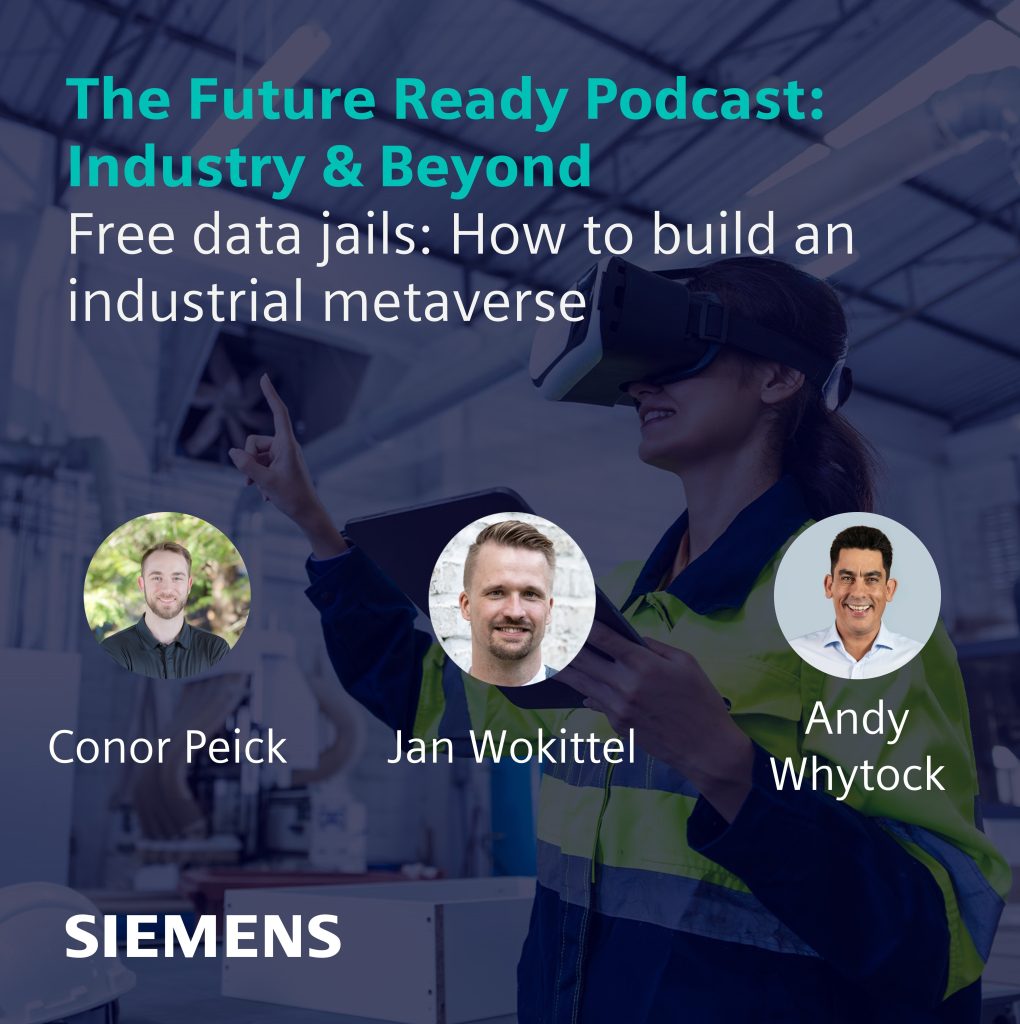
With me today, we have Andy Whytock, who is our head of Market Strategy and Thought Leadership for the Life Sciences Business segment at Siemens Digital Industry Software. And we’re also joined by Jan Wokittel, director of Smart Manufacturing at Roche.
Jan Wokittel: Mm-hmm, yes.
Conor Peick: So, this discussion of the engineering effort and how [we are] trying to pull together all these different engineering groups and things. It brings me on to, I think, this interesting topic that obviously has been out in … the industrial discourse and [it’s] one that Siemens is obviously very interested in: which is the industrial metaverse.
Learn more about the industrial metaverse, click here.
So, Andy, as we think about these things and the engineering effort behind [developing one of these pharmaceutical manufacturing] plants. What does [the] industrial metaverse mean in the context of the pharmaceutical industry? What do you think it will enable that these engineering teams maybe couldn’t do before?
Andy Whytock: I don’t think that the concept of the industrial metaverse is proprietary to the pharmaceutical industry. It’s a concept that is cross-industry in terms of what it can bring.
But I certainly feel that despite the pharmaceutical industry being quite innovative in some respects and having these time pressures and uncertainty pressures, there’s still this sometimes cautiousness, let’s say, in adopting new technology.
What the industrial metaverse brings is “it brings it together,” I think, when we’re talking about these different engineering approaches. We have an expression as well in Siemens talking about the comprehensive digital twin. I stood on stage at conferences years ago talking about the digital twin and what that might mean. And you can talk about the digital twin of the process, of a piece of equipment, of a plant, of the buildings, and so on and so forth.
What the metaverse does is it brings that digital world, these digital twins, if you like, into a joined-up view. I believe this is how I see it. And then we have the ability to then start planning and [simulating] what would happen. And then [we could] drill that down to a specific level of where we need to make sure that we’ve got the right level of efficiency around a particular process or a particular layout.
So, you can start, and I think we often do, when we look at the great videos of the industrial metaverse, you’ve got this lovely sort of [birds-eye-view fly over] showing this whole plant. Great!
You know, it’s like seeing my IKEA® kitchen. Conor Laughs. I can see that from very far, but it’s obviously [not] the whole point of the metaverse.
It’s so much more complex than that because then I’m drilling down, to use that analogy, into the oven. And then how will my oven work and how will it set up and how will I position it? What’s the optimal size? And what if I make my oven slightly smaller? And what if I use this control, and that control, and how, etcetera, etcetera, etcetera.
So, the metaverse is a tool which allows us to build this digital world. Why do we build this digital world? To be able to then have that impact in the real world. To test things out in the digital world more efficiently, more cost efficiently, of course. To be able to then have that [happen in the] real plant.
And again, I use it, it’s oversimplification perhaps, I don’t know if Jan thinks as well about the IKEA kitchen [analogy]. But certainly, I had to plan my IKEA kitchen, you know, with that digital tool. And it’s the same sort of thing, the layout, these sorts of things, but magnified at a significant scale.
What’s important as well, to add to that, however, is the metaverse is not just about the planning and the engineering part. You’ve then got your digital replica, if you like, your [comprehensive digital twin], to be able to come back to that, to then start to think about maintenance [and] optimization.
Once I start living my real metaverse in my real world, I can come back to my industrial metaverse and start looking at that and how I can optimize. [I can see where] those savings might be based on additional information that I have based on real operations, for example.
Jan Wokittel: Can you remember once the FacebookTM corporation, or now called MetaTM, introduced their vision of the metaverse. So, and I really like to see now how this completely shifted away from what they presented in the past.
I can remember once Mark Zuckerberg presented their metaverse also for industry, not [just] for private purposes. There were these tiny, sweet avatars jumping around, working on the same document. Conor Laughs. [That] metaverse is more like having these VR, AR (virtual/augmented reality) guided team sessions.
Where I say, “okay, now this [metaverse] is completely different to where we now actually see the real [industrial metaverse] business value is coming from,” right?
It’s not about having these AR, VR stuff—just on top of that. It’s really about optimizing the [industrial] processes itself. What you (Andy) just mentioned, right?
And for me, then this metaverse is also more like this digital ecosystem where we then collaborate, simulate, predict, and exchange data based on these real business problems across completely different vendors.
And then this is where I say, “okay, this is interesting where now the value [of the industrial metaverse] comes from and that it’s so totally different to the vision of the metaverse [from Meta] itself a couple of years ago.”
Conor Peick: Mm-hmm!
Andy Whytock: I think it’s really important, though to say that this metaverse, this is not just a buzzword anymore, right?
Maybe we get onto that later because, and not just through the project that Jan’s talking about, and perhaps we’ll give a bit more detail [on that] in a few minutes. But more [this idea] of simulating things [has] been going [on] for many years.
The metaverse is a concept to allow us to bring [those simulations] together at a larger scale. I’d like to say an industrial scale, but that’s probably the wrong analogy. But just at a larger scale to really bring these different digital disciplines together; the metaverse allows us to bring that together.
I must admit, I also had this sort of vision of … Spider-ManTM, the omniverse, and the metaverse, when you said this parallel world. And it’s a little bit that, but it’s a parallel world that you can use—to then make that difference in the real world.
Conor Peick: Right. Yeah. That data foundation, I think, is one of the key aspects … where we are [finding we can] derive [value] from the data orchestration and organization and things like that.
But one of the, I think, the core technologies of the industrial metaverse is, of course, the digital twin … which we obviously love to talk about. But so, Jan, I would love to get your take on how the pharmaceutical industry is approaching the adoption and maturation of the [comprehensive digital twin], you know, in production … that’s your primary area of expertise.
Jan Wokittel: So, one of our biggest learnings at Roche is actually that … the [meaning of the name] digital twin is completely different and depends on the stakeholder group you are talking to.
When I talk with an operator, the digital twin is more … based on the data of the process itself. The operator [themselves] is not … interested in … 3D visualizations of the pipes. Absolutely not, right? He’s more like, “okay, my digital twin is, I predicted this chemical reaction. Is it now happening in real time? So, this is a digital twin.”
For some other colleagues in maintenance, the digital twin can also be just an instruction. Or a course, whatever it is. And it’s not paper-based anymore. It can also be paper on glass, which is like the most simplified version of a digital twin, right?
So, diving through these different stakeholder groups and getting an understanding of the kind of maturity level, I would say, of the digital twin is quite important for me. Because based on that, this has an impact on my budget, on my time [to] realization of these kind of digital twins, and to get an understanding how much effort is needed to make it happen.
And depending on the level, depending on the organizational level, it’s even more interesting to get an overview [of] what kind of digital twins are there and how they can be connected.
What does [this] mean?
When my operator is interested in the digital twin of the process of a process simulation, this … can also be important. Once you are responsible for the whole site. [Where] you can bring this in an overall ecosystem. Where more and more digital twins come into place. When it comes to these bold, big vision, right? These end-to-end simulations we have. And this is the fair point.
And the challenge, from where I am in the organization, is to align this, bring this together, and [try] to avoid reinventing the wheel. And you just highlighted these data foundations. So, what I try to do is use the most of what you have for multiple purposes, right? Because then you can [save] money. But this is, I would say, we are not the only one [bringing everything together]. This is a real challenge.
Conor Peick: Yeah.
And then, Andy, what do you see as maybe the connection between the digital twin and the industrial metaverse? Which we were just talking about.
Andy Whytock: [I think to simplify it,] the metaverse is a collection of the different digital twins. The metaverse is your global representation of the digital world. But within that, you’ve got to break that down.
And I think that Jan’s example as well of digital twins mean different things to different people is of course very true. If you’re fixed on trying to improve a process, you’re looking at a digital twin of the process. If you’re fixed on “how am I going to manage air pressure in my room,” then you’re looking at a different thing.
So, for me, the metaverse is this way of bringing that together. But to see also how different things can impact each other. So, the metaverse allows us to build this world and then to simulate that across, and even from a broader perspective, when needed.
It’s still okay for people to be in their silos. It’s still okay for people to be super qualified [for] optimizing the process or optimizing the airflow. They still don’t necessarily need to connect [every single thing].
But there are times when your environmental conditions will affect how your process is operating. And “what happens if I do change those?” So, there are connections that sometimes we don’t even think about, or that we don’t really move towards.
So, the metaverse is … bringing these things together in a, let’s say, a more consolidated, perhaps we can even use the word unified model. And I’m not just talking about unified data, but just in a unified way in which we can access and see the data. Of course, a unified data model makes that a lot easier.
The reality today, again, is siloed thinking: siloed data, data in. Sometimes I have this great expression called data jails. The data is in these different areas, and it just can’t get out, and it can’t be used by the people in the other areas. And so, this is what the metaverse brings as a I’d say a concept or a visualization of being able to do that. That’s how I see that.
And I think that what we see from Roche, and the example of how you’ve done that in Roche, is a great way to see these different disciplines coming together to use data in a consistent way.
Jan Wokittel: Yeah, and I would like to echo what you said because I also discovered these different [approaches]. So, you just shared:
- “It’s okay that you have these expert systems.”
- “It’s okay that you have [different levels] of digital twin.”
This, I would say, three, four years ago, this was not the case. Because the industry was more like, “this is the only digital twin, and [it] can do everything for you.” And this is, I would say, the reason why I would say most of these past oriented digital twins actually didn’t scale. Because you try to bring everyone, every stakeholder, every different view, just in one technology solution and you try to enforce [them] to use them.
But the result is that you just created a new data sync—which is actually not being used and [puts] just a lot of effort on operations … just to maintain this.
Andy Whytock: Yeah, and limited value.
Jan Wokittel: And today we are talking more about ecosystems and say, “okay, it’s okay that you use this software there, that you work with this vendor there.” At the end, I just want to bring everything together, like you said, “the nucleus of the metaverse,” right? Which is able to connect all of these different sources and not replace the experts and their systems.
Andy Whytock: Yeah. Help them to make their decisions better, help them to understand better what’s going on in the rest of the world. That’s how it should be.
Conor Peick: Absolutely.
So, we talked about these big programs, these big transformation programs. It seems like usually you end up relying on an ecosystem of people all coming together—people in teams. So, what capabilities had to come together across partners to make this approach work end to end? Jan, what are your thoughts on that?
Jan Wokittel: We figured out that your partners and the vendors you’re working with need a very special DNA, so that you can work on such a project with this amount of uncertainties.
Being successful in this project, we relied on a triangle. So, you can imagine a triangle. And one corner was the hardware side. So, because we figured out [that] having all of these data sources, data pipelines and simulations in place—based on [a] huge amount of parameters, you need a huge amount of compute power being able to [process] this. This is why we said, “okay, we need an expert on the hardware side.”
On the other side, we decided, “okay, we need an expert on connecting the fragmented data silos.” And of course, I know we have them in our company, so I would say everyone has this. So, we need someone who is specialized in doing this. This is where the system integrator comes into play.
And of course, now we have the system integrator, we have the hardware provider, the ones powering all of that. And the third corner of my triangle is the ones who provide the logic.
Conor Peick: Okay.
Jan Wokittel: Because technology without the logic, it’s just noise. You won’t get anything out of that. And this is how we designed … our team.
Conor Peick: Okay.
Andy Whytock: But I think where you’re going with that is that the ecosystem is the internal one—that Jan’s talking about.
What I think is important to highlight here is that I think [that]: [for] the metaverse, in general, to be successful in building [this] type of project that’s been done with Roche, is to look to a number of different partners with that expertise.
And I think we can name them, NVIDIATM and AccentureTM, AWSTM, the companies that have filled in those different parts of the triangle. Maybe it’s a square? I would argue, to be honest, or a circle. I don’t know, circles are probably better. All Laughs.
But it is an approach, it’s a joint approach, and maybe all partners aren’t equal all the time. [But] everyone has their role to play. And I think that’s been the key to success.
I think what I’ve seen is the strong vision from Roche to say, “this is what we want to achieve. Not so much just this is the problem we have, but what we want to build, and the vision is where we want to get to.”
And you need visionary partners, and I think that that’s why you came to Siemens and to Accenture and to NVIDIA, who are already working on these topics.
And we were really happy, I know from my perspective, to try and figure out, “well, how do we do this with Roche? What’s different around the Roche examples to others? And it’s around some of the data, it’s around some of the processes, some of the specific things.”
At the end of the day, as I said right at the beginning, it’s relatively similar, but it’s actually as much finding a way to work together in that ecosystem. You can’t do this or be successful in a single vendor relationship or having a company like Accenture, for example, who’s done a lot of the work here to implement this metaverse. [Roche] can’t just be the single point. You [need] to rely on your technology partners, your hardware partners, and so on and so forth.
Jan Wokittel: So, the partners are the most crucial part of all of that, right? I can have … the biggest vision without the partners being able to execute on that, so I won’t get anywhere.
Conor Peick: Yeah. Laughs.
Jan Wokittel: So, and what I really like to … highlight here is also this openness, the flexibility of everyone, because such a project at that scale needs some kind of flexibility from everyone.
So of course, at the beginning, you write a lot of detailed documents, “how this should look like, what you want to do, right?” Create some kind of statements of work, yeah? But these paper-based processes won’t get me anywhere.
So, I need, also, [to have] this kind of flexibility because of a new stakeholder idea, which might:
- Bring a lot of business value, [or]
- change a bit and pivot the previous approach.
And all of these partners are willing and very open to do this. And this is where I see, where I would say [the success comes from.]
Conor Peick: Yeah. And one thing I’ve also heard is this idea of also managing change within your own organization.
[Adopting] a new [technology] can be really impactful. But you also need to bring people along in that adoption. Sort of educate them and help them adopt the new technology, the new process, anything like that. As you sort of embark on this big transformation of your business, [bringing people along] would be a really, really important thing.
Andy Whytock: Mm-hmm (in agreement).
Conor Peick: All right, what a fantastic discussion that we’ve had today. And unfortunately, that’s all the time we have for this podcast.
But a huge thank you to Jan and Andy for sharing their incredible insights and expertise again with us.
And of course, thank you to all the listeners who are tuning in to the Future Ready Podcast. You can hear more about digitalization in the pharmaceutical industry from Jan and Andy soon on the Future Ready Podcast.
So please join us again soon.
To learn more about freeing data silos, read: FAIR data brings focus to industries drowning in complexity.
About the voices:

Jan Wokittel, Director of Smart Manufacturing at Roche.
Jan Wokittel is a director of Smart Manufacturing at Roche. He is responsible for the digitization technologies used in greenfield pharmaceutical and medical device production facilities. For over seven years, he has helped Roche plan and implement large scale capital expenditure projects.

Andy Whytock, Head of Market Strategy and Thought Leadership of Life Sciences at Siemens
Andy Whytock is the Head of Market Strategy and Thought Leadership of Life Sciences at Siemens. Andy is responsible for driving digital transformation initiatives and thought leadership activities in the pharmaceutical and life sciences sector and specializes in helping life sciences manufacturers embrace digital transformation, adopt cutting-edge technologies and evolve into fully connected, data-driven and sustainable enterprises.

Conor Peick, Marketing Professional for the Thought Leadership team at Siemens Digital Industries Software
Conor is a Marketing Professional creating forward-looking content for the Thought Leadership team at Siemens Digital Industries Software. Conor collaborates with industry experts and executives to produce impactful content exploring the challenges companies face and the technologies that can provide solutions.
Connect with Conor on LinkedIn
All trademarks are property of their respective owners.