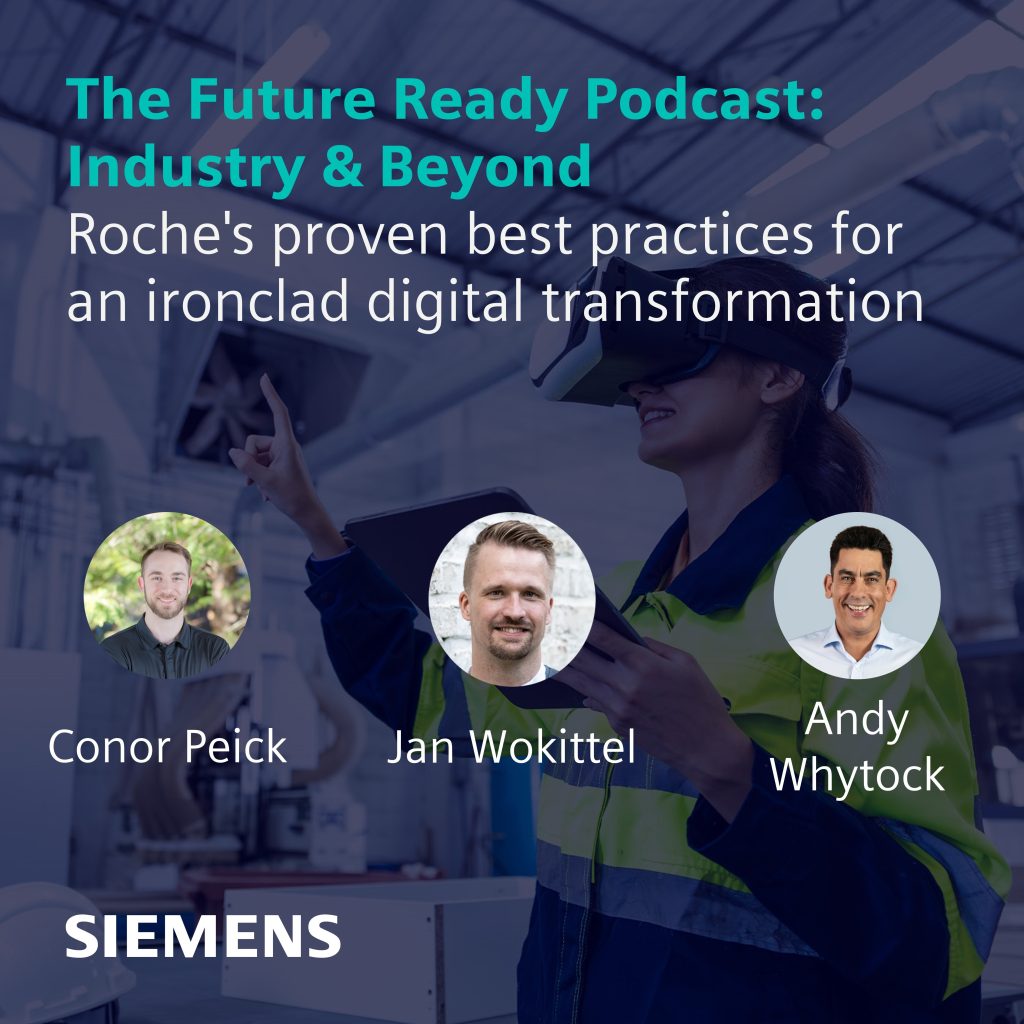
Roche’s proven best practices for an ironclad digital transformation – transcript
Conor Peick: Hello, and welcome to the Future Ready Podcast. My name is Conor Peick. And today I’ll be moderating our discussion on how to get buy-in for digital transformation in the pharmaceutical industry.
Joining me to dive into this topic, we have Andy Whytock, who is the head of Market Strategy and Thought Leadership for the Life Sciences Business segment at Siemens Digital Industry Software. Also joining us is Jan Wokittel, director of Smart Manufacturing at Roche.
Jan, Andy, welcome to the show.
Conor Peick: [So, on] some of the challenges [that] may be involved in [digital transformation]. Andy, I wonder what you see, in your experience, where organizations most often get stuck? When they try and do some of these connections, or connect engineering and operations, or they try and maybe adopt sort of an industrial metaverse approach?
Yeah. Where do they get stuck? [And] how do they get unstuck, basically?
Andy Whytock: It’s around steering that ship in the same direction. So, your strategic direction, that sort of tone from the top, as you sometimes call it. That you’ve got somebody with the ***** to stand up and say, “we are investing in this, and this is where we’re going and we believe that this will create value in the future.”
You can’t embark on these journeys, if you want to make a real transformational change, by doing your proof of concept (POC) of a digital twin on a specific process. It’s a starting point, but it’s got to be added up somehow and it’s a lot better and a lot easier to do that when you know that the management and that the board, at that level, are behind this idea.
And I think that we’re seeing more and more of this in pharmaceutical industry in the last two to three years. Perhaps [there is] a lot around [how] AI is driving a little bit the perceived need to transform even faster. I’m not saying that they shouldn’t. But what I’m saying is that management attention is better now. And that’s an important thing to do.
The other thing I think is this … and then you can go [on to] the other end, is this cultural change. [It] is the change management of people, of the way they’re doing things. And whether that’s around:
- The way that jobs are being changed,
- The way that processes are going to be done,
- The types of jobs or the types of tasks that are being done.
Why is it, and how is it that [the] technology is going to help me to do that?
If you’re successful, then more people want to bring more things. If you’re imposing something on someone without necessarily people understanding or feeling the benefits, then they won’t continue.
Now, you can only tell people so much, you can’t get them to feel it, you can’t get them to understand it until that real impact has been felt, then they’re on board.
So, you can’t just do it because management is saying; you can’t just do it because you believe in it. You’ve got to really see it and then you can build that momentum to do things.
I think I’m talking relatively abstractly here, but I think that it’s that thing. So, change management from the bottom, getting everyone on board, building that momentum, but also having the overview that this will actually help us to get to a better place.
I don’t know, how did you (Jan) make success?
Jan Wokittel: I would like to add a third party to this discussion because you just ask for, “okay, where do organizations, whether it’s engineering or operations, might get stuck into?” I would like to add the strategic level.
Because why is this so? When you don’t have these commonly aligned [visions] of where you want to go to … nothing will happen. What does it mean? You have a very strategic direction, where you want to go to, and what needs to be done until then.
You have [engineers], and they are somehow by nature responsible to develop something. Of course, they would rely on what they know and where they can guarantee that this will work. And then you have the operations team afterwards. And they … somehow need to deal with what they get.
So, what I have discovered is that when you create [digital maturity] for your site, there are some … cool methodologies out there [to do] this. Where you then … align everyone on that. We say, “okay, this is where we want to go to.”
I think this is crucial because otherwise maybe the engineers will pitch something, introduce something, but it’s not very well covered by the strategic vision? Or maybe the operators will have a lot of concerns [with] how to deal with it afterwards?
So for our capex (capital expenditures) projects, one of the things which [was] very crucial was, “okay, create these very well explained level of digital maturity we want to have,” and then getting the agreement and the approval, the buy-in of the engineers, the operators, and the strategic guys, in brackets: the management, “okay, this is where we want to go to,” right?
Because [there are the] ones [that] needs to pay for that. And the other [ones that need] to deploy this. And the other ones [that need] to maintain it. So, having the agreement and the buy-in of [all] these three, I think this is essential.
Andy Whytock: So, how did you get the buy-in? Everyone’s always asking this question. What was your secret to getting the buy-in? Or did you not get the buy-in? You had to force them to do it.
All laughing.
Jan Wokittel: So, I think I’m a good sales guy.
Andy Whytock: That’s our job! Yeah, our job at Siemens!
All laugh saying, “that’s our job.”
Jan Wokittel: Yeah, I think at the end, I think a good thing was just [to] help the engineers to create a very well-explained business problem. [And] to support the management, the strategy guys, with a good business case. And from there, then also involve operators, “how this will make their life easier.”
Andy Whytock: That’s a nice one though. Articulate the business problem in the right way with the view of how that will impact the person who has the problem.
Jan Wokittel: Exactly, and the people have different problems. So, the strategic level has the problem: “can we deliver in time, quality and budget?” The engineers have the problem: “can we deploy what’s there?” And also, [future] technologies, right? “Can we create [that] future readiness?”
So, … bringing these people together and [helping] them to speak the language of the other side, I think this is the secret ingredient.
Andy Whytock: I think if you over [complicate] it, or you get into too much detail on it.
I mean. I did a thing, we were doing a thing on calibration, calibration of our equipment, … this is a problem. It takes a lot of time for people to calibrate their equipment. But articulating that into “how do I solve that with technology?”
And I’m going off in a slightly different thing, but it’s a good example of a relatively simple thing that we all know costs time and effort.
But [asking] “how do I articulate how technology can help me to do that (calibration) through a guided work instruction was the answer.” But, you know, it’s articulating something: … what was the benefit?
“You don’t need to do calibration anymore, dear operator. You know, you can just get straight on with your job. You don’t have to do that. Or you can press a button and it’s done. End of story and recorded and blah, blah, blah.”
So, I like it. Articulating that problem and making it resonate with the people who have that problem without even sometimes realizing it.
Jan Wokittel: Yes, yes, yes.
Conor Peick: Explaining it in their terms, and their reality as well.
Andy Whytock: Sometimes you don’t realize you have a problem, right? Because you don’t realize that you’re being inefficient and that there’s a better way.
Jan Wokittel: I found myself most of the time in situations where I see things which are quite cool from a technology point of view. But I need to rewrite and … work with the colleagues [to] make it more appealing to another stakeholder group—to explain this a bit more. Right?
And I think the success comes from that. If you collaborate so that the other party can understand your language. Right? Most of the technologies, and it doesn’t matter how fancy they are, don’t address, like you said (and I like this), the problem of the other stakeholder group, right?
Because on technology, we can talk about technology, right? But the business problem is another thing. And they can be completely different, whether it’s a presentation, credit applications, right? On the same problem, but for totally different stakeholder groups.
Conor Peick: Yeah.
Andy Whytock: I have a nice example of this, a simplified example. Today in this podcast, we’re obviously talking a lot about manufacturing and manufacturing operations. But a lot of the work we’re doing in Siemens is, as well, around the enabling [of] research and development scientists to be better at managing data. And believe it or not, there’s some resistance to do that:
“Why do I need to record all of these data points for people who are further downstream? I know what I’m doing. I’m building my process or my experiment and I’m recording that on a clipboard with data, you know, with a pen and so on and so forth. That’s my job. I’m a scientist. I science. I don’t manufacture, right?”
And so, that sort of [articulation of], “I’m giving you an electronic tool to help you to record all of your experimental data easier.”
“That’s not easier than a piece of pen and paper. It’s much easier for me to…”
So, you have to go back to [articulating] the problem. “Yes, we need that data because then we can use that further down the line to make … and a better understanding when we’re looking at process improvement and blah, blah, blah, blah.”
And I think it’s a really simple mindset change. But it comes back again to articulating and talking about how you can have an impact a little bit later. But people focus on their own problems and sometimes don’t want to see that bigger picture.
Jan Wokittel: Yeah, and maybe another good practical example for that. I had [a] very interesting discussions with our engineers, especially [those] also coming from the automation section. [It was about] why it’s so crucial that they create these open data interfaces from the automation systems itself.
And they said, “okay, why should I do this? Because I can guarantee that I have a robust pipeline and the automation will work.”
“Okay, I understand their point of view.” But then I came up with the need from our AI engineers [as they] invest more than 60 percent of [their] time in data acquisition. Why? Because they’re not so easily available from the automation itself.
But the automation colleagues [haven’t] been aware that we have more and more AI data engineers in place. And they [are] bring in more [digital transformation] and AI driven use cases in a shorter period of time. So, it’s quite necessary for them [to be] able to collect the data coming from the source systems.
To learn more about digital transformations, click here.
But these two parties need to be aware of each other so that they understand: “what is the business problem from the other [side], right?” So, the business problem from automation is more like [guarantees] that it will work. And AI engineers: “I want to deploy here my AI-driven and digital use cases in [an] even shorter period of time, bringing external vendors … whatever it is.”
But everything relies on each other, if you want to be successful on a strategic dimension.
Conor Peick: Yeah. So, [as] we’re looking ahead and thinking more about how companies can adopt these technologies. Then of course we’ve been talking a lot about, sort of, managing the changes within the organization as well.
So, looking ahead, what do you think scalable success actually looks like for pharmaceutical companies as they attack these problems?
Is there a sort of standardization that needs to take place or sharing of lessons learned? I don’t know, Jan, what do you think about that?
Jan Wokittel: So, for me, success is the ability to deal with a heterogeneous digital landscape. Because I need to be able to scale the use cases across my network. So, this is where the big business value comes from. It’s not so successful if you just have one use case, at one side and just one line, right? When you have multiple lines across the globe.
And for that, of course, being able to scale something, you need some kind [of] standardizations. And it’s still challenging figuring out how [much] standardization is needed, because you also need to maintain the standard. Also, a standard can evolve, right?
What I try to standardize … first, [is] always having a [common] understanding of the problem. And formulating a good problem statement is not so easy as it sounds. So, this is where we start first.
Secondly, We want to have an adaptive, agnostic and flexible system landscape because also the technology, the vendors, they are changing continuously. And maybe in the future there’s a more innovative solution. And then I want to use this, right? I want to have [that] kind of flexibility and don’t want to have like vendor lock-ins or whatever it is, right?
And third, I want to standardize how we measure and quantify business value, because I don’t want to have this death by POC. And this is also something I figured out, being able to quantify business value is very important, right? Because, the argument, “it’s a new technology,” it’s not a good one, right?
Andy Whytock: Let me jump on that because I think that—I was just thinking of how I would answer this question.
Because we’re talking about [pharmaceuticals] and we should be thinking about a patient. And we talk about business value. And of course, solving a patient’s problems is not really a business value, it’s a patient value, it’s a health value. That’s why we’re in this business. That’s the reason that Roche is trying to make factories more efficient.
And when we talk about how [we] measure success, whatever technology it might be, we need to get, and pharmaceutical companies want to get (and need to get because they will get commercial benefit), but they want to get medicines to patients faster, safer.
It takes 10 years to bring a medicine to market. If you can shorten that time and those people, especially with rarer diseases or more specialty type drugs, if you can get those to patients more affordably and more quickly, then you’re winning something.
Now technology helps companies like Roche and many others to do that. What we’re talking about is the adoption of [technology] to create the business value as Jan says. But let’s not lose sight of the fact that the reason we’re doing this is … a commercial benefit, but also, it’s actually [helping] a patient.
And that’s the uniqueness of why the industry, the pharmaceutical and life sciences industry is really driving some of these technologies, because it can make a [human] impact. And I think that’s the fantastic thing about what we do. [It] is to be able to do that.
We [talked] about this 10 years [to get a medication to market]. If we can get the process to bring a medicine to market down to five years, then that’s already a great thing. Technology can do that. It’s not just the metaverse. It’s not just a data hub that will do that. There’s also a need for the regulations to change. We still expect our drugs to be safe and efficient, but there are ways in which we can really squeeze certain parts.
And what we’ve been talking about today, what Jan was saying, it took him three to four years to build the plant and he’s really happy with that. Well, it should take three to four months, perhaps, if we can use technology in the right way.
Jan Wokittel: So, in the past it took us like 10 years, right?
Andy Whytock: So, we’re coming down, but that’s for me is the thing. And the technology is enabling us to be faster. Not maybe three months, [it] is a little bit of an exaggeration because you actually do physically have to build something. But you get the point, right?
It’s making things faster because there’s a real benefit at the end of it for patients as much as for the companies that are able to meet those requirements.
Conor Peick: Yeah. So, I think that’s such a great sort of lead into my last question for today.
As we sort of wrap up, I just would love to know if we were to fast forward one year, maybe then five years and 10 years into the future (the time it takes to put a drug out to market, as Andy just mentioned).
But what would you hope is normal practice in your industry for planning and running factories? And what do you think leaders should start doing now to get there? Andy, maybe you can start and then we’ll close off with Jan.
Andy Whytock: I think I already articulated that in the last answer to a certain extent.
I believe that there are two or three things, two or three key areas in which that a company can do to look at improving things. And it’s speed. It’s all about speed. How can we be faster to find the medicine, to find the process, to find how to make the medicine, how quickly can we build that plant?
If we can accelerate all of these different aspects, then that’s what I’d like to see. So, although today we say it takes an average [of] 10 years and it costs on average $5 to $6 billion dollars to bring a new medicine to market.
Why is it costing us so much? We need to be and we can be, thanks to tools, bringing those down by half, if not more. And that’s billions of dollars and lots of days, lots of speed. And that can then result in hopefully millions of lives and better lives for millions of people.
So, for me, it’s around squeezing that down, getting the speed and getting things more affordable as well. So that [is the view for me.]
Today we talk about how there is inefficiency both in R&D (research and development) and in manufacturing. We can bring a lot more, using technology.
But not just Siemens, right? By working together, by identifying these [technologies], by working with governments and regulators and so on and so forth.
And I think that one of those aspects to this, and we haven’t really talked about that surprisingly enough, is being able to use artificial intelligence. To use it.
And that really comes back, and this is perhaps the next podcast, we can talk about artificial intelligence.
But that really comes back to the point around **** in, **** out. If you don’t have the right data, then you can’t start to do things faster. You can’t build that plant faster. You can’t make that process faster. So, get the data right. And that would [probably be] the short answer to your question. Get the data right and then you can do things much more quickly.
Jan Wokittel: For me, when you ask, “what would I expect for the future, or what could I recommend to leaders?”
I do not want to find myself anymore in meetings in which I have to explain to a supplier, a vendor, or partner why I need open data interfaces, open data exchange. Or why it’s so crucial being able to consume and forward data. Because these kind of discussions are blocking everything. And it’s still ongoing also in 2026, right? This would be my vision.
And points of getting there based on my experiences would be: “have this clear vision.” And what does it mean? Like what kind of capabilities are needed based on your business problems? What kind of capabilities do you want to have in your future manufacturing?
Break it down. So, what’s now missing, from a technology perspective, to get those kind of capabilities. Because now it’s getting very concrete. Also, for the different stakeholder groups, whether it’s the engineers, operators, and then you need to be [very] concrete. They cannot deal with just visions, right?
And third, identify fields of application to start small and scale from there. And find a small team where you can start a very well described project with a clear scope where you can apply and then go from there. Otherwise, you would try to boil the ocean, and this won’t work.
Conor Peick: Yeah, there’s this, it’s a theme that’s beginning to emerge it is the idea of big ambitions. Dream big. Start small. You know, make sure that your initial application is bounded.
But anyways, guys, thank you so much for your time today. It’s been a real pleasure talking with you both today.
Andy Whytock: Thank you, Connor.
Jan Wokittel: Thank you, very much.
Conor Peick: All right, everyone, that’s all the time we have for today.
A big thank you to Jan Wokittel and Andy Whytock for joining me and sharing their perspectives on digital transformation and how companies can manage the challenges and secure buy-in as well from various stakeholders throughout an organization.
And of course, thank you all for tuning in and listening. We really appreciate you being a part of the Future Ready Podcast. And we do hope to catch you next time.
To learn from another industry’s digital transformations, listen to the podcast: Energy sectors’ digitalization is a must in an AI world.
About the voices:

Jan Wokittel, Director of Smart Manufacturing at Roche.
Jan Wokittel is a director of Smart Manufacturing at Roche. He is responsible for the digitization technologies used in greenfield pharmaceutical and medical device production facilities. For over seven years, he has helped Roche plan and implement large scale capital expenditure projects.

Andy Whytock, Head of Market Strategy and Thought Leadership of Life Sciences at Siemens.
Andy Whytock is the Head of Market Strategy and Thought Leadership of Life Sciences at Siemens. Andy is responsible for driving digital transformation initiatives and thought leadership activities in the pharmaceutical and life sciences sector and specializes in helping life sciences manufacturers embrace digital transformation, adopt cutting-edge technologies and evolve into fully connected, data-driven and sustainable enterprises.

Conor Peick, Marketing Professional for the Thought Leadership team at Siemens Digital Industries Software
Conor is a Marketing Professional creating forward-looking content for the Thought Leadership team at Siemens Digital Industries Software. Conor collaborates with industry experts and executives to produce impactful content exploring the challenges companies face and the technologies that can provide solutions.