From site to simulation: Optimizing earthwork resources through data-driven modeling

Anna-Maria Mehringer Max Bögl
Optimizing earthwork is the subject at the Plant Simulation Realize Club 2026, Anna-Maria Mehringer from Max Bögl will present an innovative approach to construction optimization that bridges the gap between real-world site operations and digital simulation.
Introduction: Bringing construction to life through simulation
Construction projects face an age-old challenge: how to optimize resource allocation when dealing with complex, interdependent processes across large-scale sites. Traditional planning methods rely on historical data and expert intuition, leaving significant room for inefficiency. Max Bögl, in collaboration with OTH Regensburg, tackled this problem head-on by developing a comprehensive discrete-event simulation model for earthwork construction. The result is a powerful methodology that transforms site data into actionable optimization strategies—proving that when construction meets simulation, performance improves dramatically.
About the presenter

Anna-Maria Mehringer studied Civil Engineering at OTH Regensburg, specializing in Digital Construction for her Master’s degree. For her thesis, she expanded an existing simulation model focusing on a single construction process by modelling the entire process chain in greater detail. Since April 2025, she has been working on the government-funded KIREL research project, investigating how synthetic data generated through simulation can be used to train machine learning models and optimise construction logistics. She holds a joint position at Max Bögl and OTH Regensburg, acting as a link between the two organisations to ensure scientific developments remain closely aligned with practical industry needs.
About the company
Max Bögl is a family-owned construction and technology company with a strong focus on innovation and infrastructure development. With over 7,500 qualified employees at 40 locations worldwide and annual revenue of over 3 billion euros, Max Bögl is one of the largest companies in the German construction industry.
The challenge: Optimizing earthwork and complex construction processes
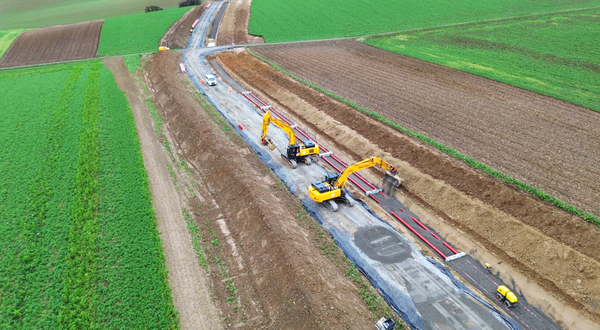
Construction projects face a fundamental challenge: how to optimize resource allocation when dealing with complex, interdependent processes across large-scale sites. Energy transmission line construction using the open-cut method exemplifies this complexity. The process requires precise coordination of eight distinct earthwork phases—from topsoil removal through final site restoration—with multiple teams, equipment, and material flows operating simultaneously. The potential for bottlenecks, delays, and resource misallocation is substantial. Traditional planning methods rely on historical data and expert intuition, leaving significant room for inefficiency and missed optimization opportunities.
The solution: From site to simulation
Mehringer’s presentation explains the journey from a real construction site to a flexible, data-driven simulation model for open-cut energy transmission projects. The construction process was systematically analyzed and translated into modular processes, parametric trench models, logistics parameters, and an overall simulation. Rather than relying on generic assumptions, the model was developed in close cooperation with several specialist departments: construction sites (for real-world process logic), geology (for soil models), estimating (for effort values), and research (for advanced modeling techniques). This interdisciplinary approach created a practical model that can be quickly adapted to similar projects without requiring complete rebuilding.
Modular architecture: Breaking complexity into components
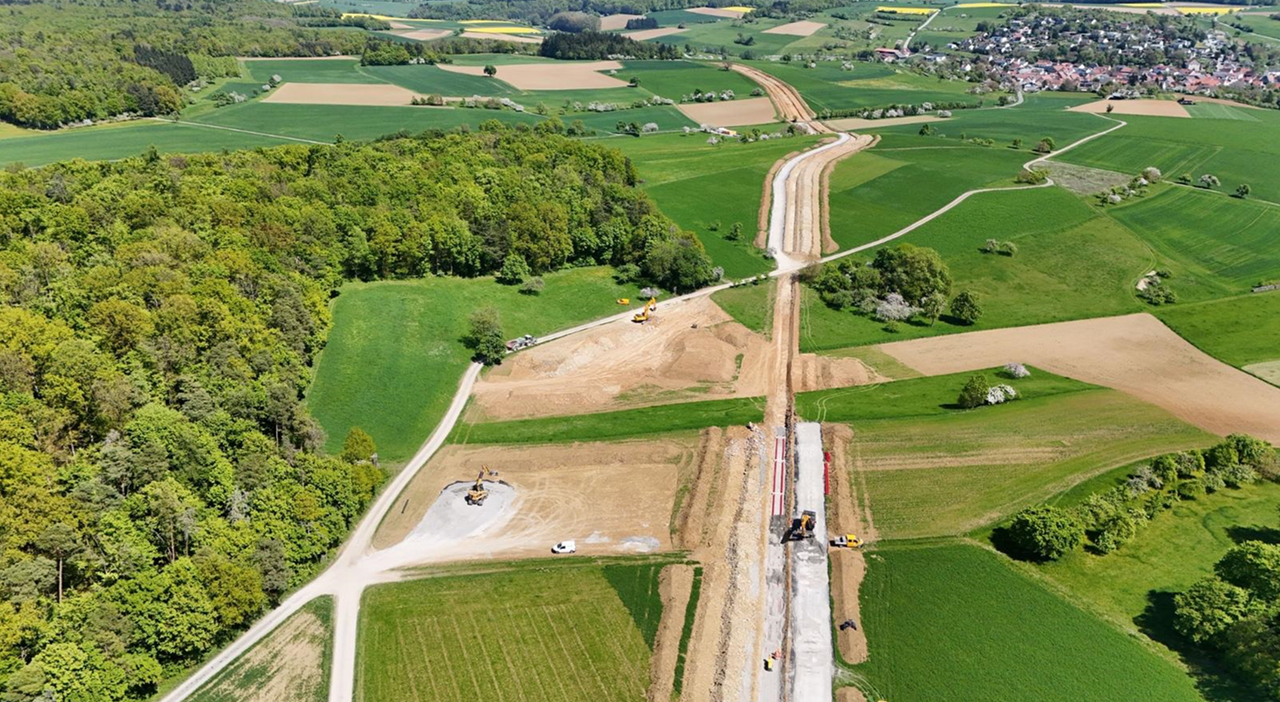
The simulation employs a bottom-up principle that breaks the eight-phase construction process into manageable, independently validated modules. Each phase—topsoil removal, trench excavation, pipe bedding installation, pipe laying, first and second protective layers, backfilling, and topsoil replacement—is simulated separately. A parametric base model forms the foundation, with individual modular process simulations feeding into a simplified overall process simulation. This approach allows each phase to be validated independently while revealing how all phases interact when executed sequentially. The modular structure ensures that changes to one phase don’t require rebuilding the entire model, and bottlenecks in specific phases can be identified and addressed without affecting the overall architecture.
Data-driven modeling: Three pillars of accuracy
Accurate simulation requires accurate input data from three integrated sources. First, effort values developed through cooperation with estimating engineers capture the specific work requirements for each phase. Second, soil models created with the Geology Department ensure that variations in soil type are reflected in simulated process durations and equipment performance. Third, process logic derived directly from construction sites themselves captures real-world timing, sequencing decisions, and resource management strategies. This ground-truth data ensures the simulation reflects how construction actually happens, not how textbooks say it should happen. The integration of these three data streams creates a model grounded in practical reality rather than theoretical assumptions.
Parametric flexibility: Adapting to site conditions
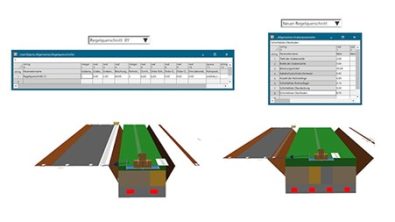
One of the model’s key innovations is its use of parametric trench cross-sections that automatically adjust the 3D geometry based on entered parameters. Rather than manually creating individual models for each site condition, engineers can define standard cross-sections and allow the system to adapt automatically. This approach enables three critical advantages: ability to define reusable standard cross-sections across multiple projects, automatic adjustment of 3D models as parameters change, and flexibility to enter new custom cross-sections as site conditions vary. This parametric approach dramatically reduces modeling time while increasing flexibility and accuracy—when soil depth changes or material specifications shift, the visualization updates instantly.
The pacing vehicle concept: Logistics at the core
At the heart of the simulation is the pacing vehicle concept—the excavator that moves along the trench route, setting the pace for all downstream activities. Supporting this primary equipment are transport vehicles that deliver fresh materials and remove excavated soil. The simulation captures this through configurable logistics parameters: number of transport vehicles, frequency of visits, loading capacity, and distance to temporary storage. By making these parameters adjustable, the simulation enables what-if analysis before implementation: What happens if we add another truck? What if we move the temporary storage site closer? What if we increase truck capacity? Each adjustment can be tested virtually, revealing its impact on project duration, resource utilization, and cost.
Four optimization opportunities
The simulation enables optimization of transport vehicles by determining the cost-effective balance between logistics capacity and project duration—revealing whether 5, 12, or 15 trucks is optimal for your specific project. It identifies opportunities to reduce construction schedules by revealing inefficiencies and bottlenecks. It enables elimination of waiting times where equipment sits idle or material deliveries are poorly coordinated. And it supports sustainability optimization by recording kilometers driven for each transport vehicle, allowing project managers to make data-driven decisions about material positioning, delivery consolidation, and fleet sizing that reduce environmental impact.
Practical impact: Resource optimization across multiple dimensions
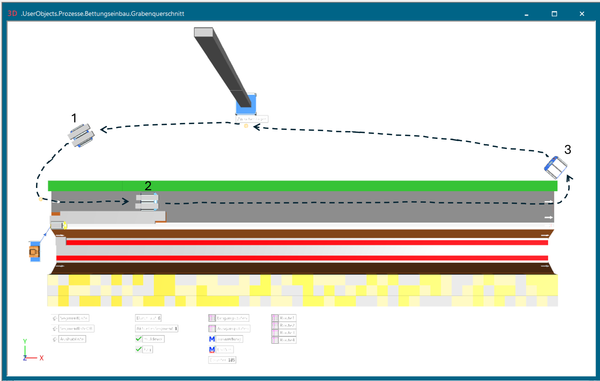
The simulation creates a comprehensive framework for balancing resource use, costs, and adherence to deadlines. This is not theoretical optimization—it’s practical decision support. Project managers can test different scenarios and understand trade-offs: adding one transport vehicle might reduce project duration by 3 days while increasing total kilometers driven by 8%, allowing informed decisions based on specific project constraints and priorities. The model supports optimization of not just individual parameters, but the entire project execution strategy.
Why this matters: Digital transformation in construction
Mehringer’s work exemplifies the digital transformation of the construction industry. For decades, optimizing earthwork relied primarily on experience and historical data. Today, sophisticated simulation models are capturing real-world complexity and enabling data-driven decision-making. The lessons from this construction application extend far beyond the industry: the bottom-up modular approach, parametric modeling techniques, and multi-disciplinary collaboration are best practices for any simulation project in manufacturing, logistics, or supply chain management.
Conclusion: From data to decisions
The journey from site to simulation is ultimately a journey from data to decisions. Anna-Maria Mehringer’s presentation demonstrates how sophisticated modeling can transform raw construction site data into clear, actionable insights. By breaking down complex processes into modular simulations, grounding those simulations in real-world data from multiple specialist departments, and focusing optimization on practical business objectives, her team has created a powerful tool for construction excellence that proves applicable across industries.
For construction companies seeking competitive advantage, for simulation professionals looking to expand their impact beyond traditional domains, and for anyone interested in how digital transformation is reshaping infrastructure development, this presentation offers both inspiration and practical methodology.
Event details
The Plant Simulation Realize Club 2026 will feature Anna-Maria Mehringer’s complete presentation on October 12, 2026 in Munich at the Infinity Hotel Munich.
Learn how real-world construction challenges are solved through data-driven simulation.
Join the conversation
Interested in learning more about discrete event simulation and connecting with peers and experts? Join the Plant Simulation Realize Club 2026 and be part of the discussion.
- Plant Simulation Realize Club 2026: Join discrete event peers and experts at the Plant Simulation Realize Club 2026
- Tecnomatix Plant Simulation Discussion Group: LinkedIn Plant Simulation – Siemens Digital Industries Software Tecnomatix Plant Simulation Discussion Group
- Plant Simulation Realize Club | October 12, 2026: Plant Simulation Realize Club: Munich, Germany