From 22 Days to 60 Seconds: How Max Bögl Cut Idle Time and Costs with Plant Simulation
Large-scale infrastructure projects are defined by complexity, but also by uncertainty. Coordinating heavy machinery across hundreds of kilometers, while dealing with variable soil conditions, weather, and tight deadlines, makes reliable planning extremely challenging. For Max Bögl, one of Germany’s leading construction companies, this challenge is at the heart of delivering two of the country’s most strategic energy transition projects: SuedLink and SuedOstLink.
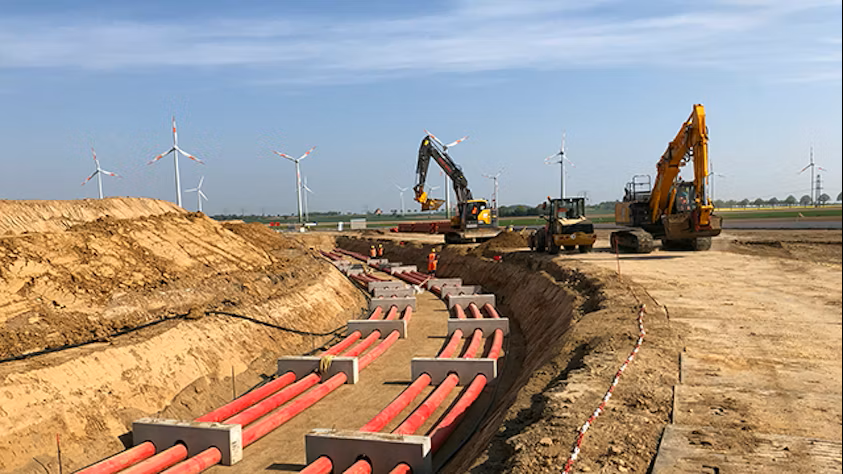
By leveraging Plant Simulation from Siemens Digital Industries Software (Tecnomatix® portfolio), Max Bögl has fundamentally transformed construction logistics planning, reducing weeks of real-world operations into simulations that run in under a minute.
Using Plant Simulation, we have now expanded the base trench model and tested it on additional sites, where it has worked very well too.
Anna-Maria Mehringer, Civil Engineer, Max Bögl
The Challenge: Planning a Moving Construction Site
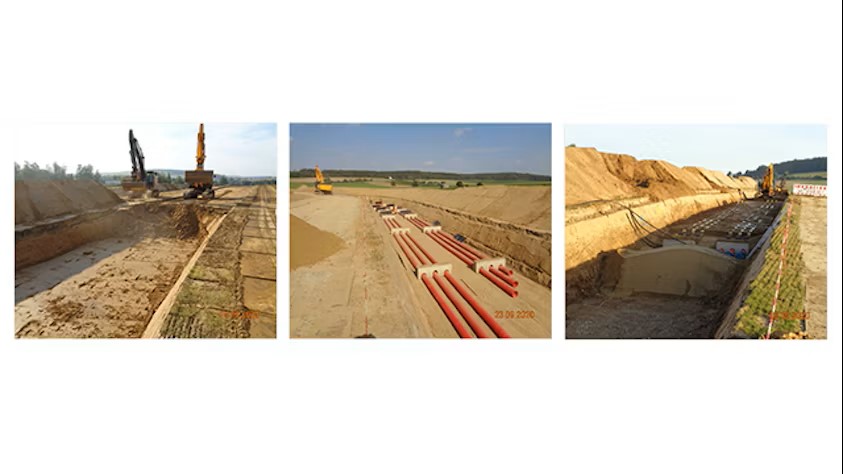
SuedLink and SuedOstLink are underground high-voltage direct current (HVDC) transmission corridors stretching across several hundred kilometers. Their purpose is critical: transporting renewable energy generated in northern Germany to industrial and population centers in the south.
From a construction perspective, the challenges are enormous:
- Deep trench excavation (2.3 to 4 meters depending on soil)
- Highly variable soil conditions, ranging from sand to rock and compacted clay
- Tight coupling between excavators and transport vehicles
- Long transport distances to intermediate storage or final disposal sites
- Changing access roads, weather, and workforce availability
A key bottleneck is the interaction between excavators and transport vehicles.
Too many trucks increase costs and idle time. Too few slow the excavation progress. Traditional planning methods relied heavily on experience and estimates,often revealing problems only after work had begun.
Why Plant Simulation for Construction Logistics Planning?
Max Bögl already had experience using Plant Simulation in precast production. The breakthrough idea was to transfer this proven simulation approach to a far more dynamic and complex environment: a construction site that continuously moves along a corridor.
The first feasibility model, developed as part of a master’s thesis, focused on topsoil removal and trench excavation for SuedLink. It immediately showed that simulation could deliver reliable decision support, even at an early stage.
The civil engineering team then expanded this work into a comprehensive, parametric model capable of representing real-world conditions in detail.
From Soil Models to Parametric Simulations
One of the most powerful advancements came from close collaboration with Max Bögl’s geology department. Using existing soil models, the team embedded local geological conditions directly into Plant Simulation.
The result:
- Each construction segment could be simulated with site-specific soil behavior
- Excavator productivity adjusted automatically based on soil type
- Transport volumes, cycle times and queues reflected actual conditions
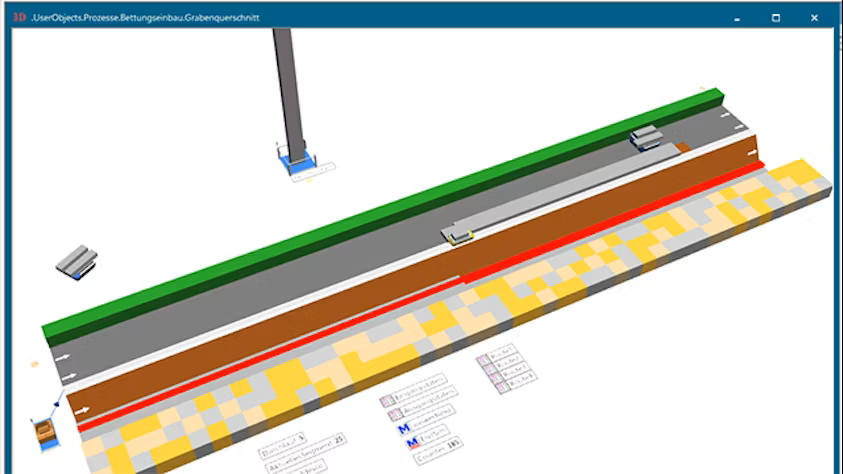
In the simulation:
- The excavator sets the pace and moves along a defined segment
- Part of the excavated material is stockpiled for reuse
- Remaining material is transported by tractor-trailer combinations or high-performance tractor units
- Logistics parameters can be changed instantly to test alternatives
This parametric approach made the model reusable and scalable across multiple sites.
Results That Change Decision-Making
The performance difference between reality and simulation is striking:
- 22 working days of construction simulated in under one minute
- Over 10,000× faster than real-world execution
- ~20% reduction in transport equipment idle time
- ~7% reduction in total costs
- Clear visibility into excavator and truck utilization
Instead of waiting weeks to see if assumptions were correct, planners can now test dozens of variants in minutes, before the first machine ever starts.
Using Plant Simulation models, it’s very easy and fast to bring those elements into better alignment.
Anna-Maria Mehringer, Civil Engineer, Max Bögl
Empowering Site Managers, Not Just Analysts
A critical goal for Max Bögl is simplicity. The team is continuously refining the models so that site managers can use them directly, without needing deep simulation expertise.
The visual 3D representation in Plant Simulation plays a key role:
- Makes processes easy to understand and validate
- Supports discussions across disciplines
- Turns scattered expert knowledge into a shared, transparent model
This means better communication, faster decisions and fewer surprises on site.
From Segments to System-Level Planning
So far, simulations have focused on individual construction segments. The next step is even more ambitious: modelling entire project sections end-to-end.
By systematically representing:
- Typical open-cut installation processes
- Dependencies between activities
- Bottlenecks and constraints
Max Bögl is building a reusable digital foundation for future infrastructure projects. Variants that once required extensive manual analysis can now be evaluated in parallel—supporting rapid responses to changing conditions during execution.
A New Standard for Infrastructure Planning
What sets this work apart is not just speed or cost reduction, but the ability to simulate a moving construction site over many kilometers—a scenario rarely addressed in traditional simulation use cases.
Plant Simulation has become more than a planning tool:
- It preserves organizational know-how
- It improves transparency across teams
- It enables fact-based, data-driven decisions under uncertainty
As Germany accelerates its energy transition, infrastructure projects like SuedLink and SuedOstLink will only increase in scale and complexity. Max Bögl’s approach demonstrates how digital simulation complements engineering expertise, turning experience into measurable, repeatable advantage.
Plant Simulation is helping Max Bögl not only improve construction planning efficiency but also redefine how complex infrastructure projects are executed.


![Orchestrating the AI Factory of tomorrow: a workflow for speed and future-readiness [VIDEO]](https://blogs.sw.siemens.com/wp-content/uploads/sites/7/2026/04/digital-thread-ai-factories-395x201.png)
