What’s new in Simcenter STAR-CCM+ 2602?
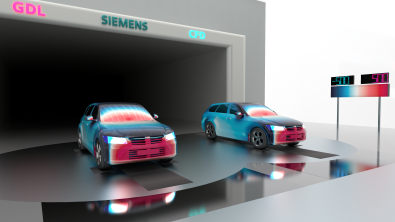
Deliver instant predictions with AI. Accelerate multiphase CFD with GPUs. Boost performance across CPU–GPU resources. Speed-up vehicle wading simulations with SPH solver. Plus, many more.
AI‑powered Geometric Deep Learning (GDL) in Simcenter STAR‑CCM+ 2602 enables instant predictions to evaluate design variants in real time and accelerate early‑stage decision‑making. This release also brings GPU‑native support for Volume Of Fluid (VOF) and Mixture Multiphase (MMP) solvers, along with improved multi‑GPU scaling that significantly reduces turnaround time across multiphase and large‑scale CFD workloads. New GPU flexibility, including AMD support on Windows and smarter CPU/GPU co‑utilization, helps extract full value from engineers’ hardware, regardless of operating environment. Foundational accuracy improvements, such as enhanced prism‑layer meshing and fully conservative implicit mixing planes, strengthen numerical robustness and confidence in results. Application‑specific advances, from vehicle wading with SPH to more efficient transient automotive aerodynamics, further reduce engineering cycle time. Together, these upgrades allow to simulate more designs, with higher fidelity, on more hardware configurations, ultimately enabling faster, more confident engineering decisions.
Learn how to use Support Center
New enhancements in Simcenter STAR-CCM+ are designed to:

Model the complexity
Faster convergence, increased accuracy and robustness with Enhanced Quality Prisms

Complex geometries often force prism layers to retract, especially near concave and convex corners, thereby degrading near‑wall mesh quality and slowing convergence. CFD engineers frequently face “hanging node” transitions that complicate boundary layer continuity and make it harder to achieve robust turbulence resolution at the wall.
In Simcenter STAR‑CCM+ 2602, activate the Enhanced Quality Prism layer mesher to generate thicker, better‑behaved layers and preserve layer integrity in problematic corners. This will reduce prism retraction and eliminate hanging‑node topologies at layer transitions, which stabilizes residuals and accelerates solver convergence. This improvement translates to cleaner boundary‑layer representation and more trustworthy wall‑shear, heat‑transfer, and separation predictions. Across aerospace and automotive use cases, gain robustness on challenging surfaces and cut the number of restarts required to reach targets. The net effect is a smoother residual drop and earlier asymptotic behavior, which shortens the path to engineering decisions. Ultimately, achieve faster convergence with increased accuracy and robustness.
Full conservation at implicit mixing planes with improved solver stability
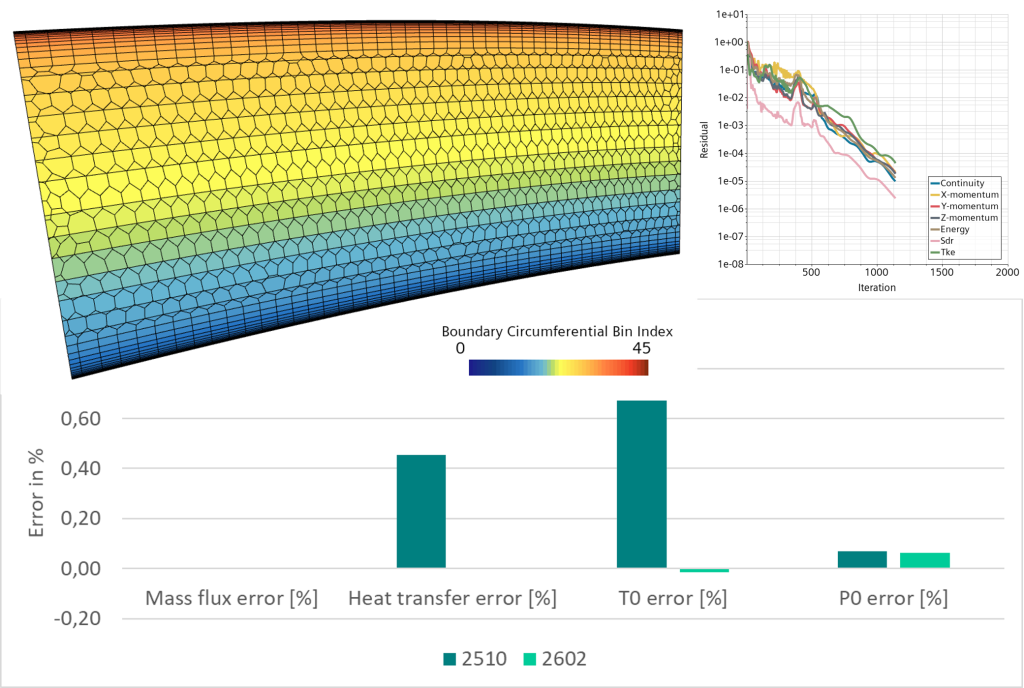
When rotors and stators couple through implicit mixing planes with poor conformality, energy conservation suffers and total pressure/temperature errors creep into turbomachinery predictions. Those inaccuracies can mask true stage performance and compromise design choices. In multi-stage configurations, these errors compound, undermining the confidence engineers require to optimize compressors and turbine designs.
With Simcenter STAR-CCM+ 2602, apply an enhanced boundary value update strategy together with imprint binning at the mixing plane to enforce conservation more faithfully. Stabilize the solver across mesh types and lower the error on total pressure and total temperature by an order of magnitude, while maintaining full compatibility with existing simulation workflows. The result is more reliable predictions, robust solver convergence, and the precision needed when simulation informs critical design decisions. No workflow changes required – just better physics and better answers.
Explore the possibilities
Instant external aerodynamics predictions
Early design stages require fast solutions to quickly assess multiple variants and guide key decisions. Having rapid insight at this phase enables broader exploration and quicker alignment on optimal concepts.
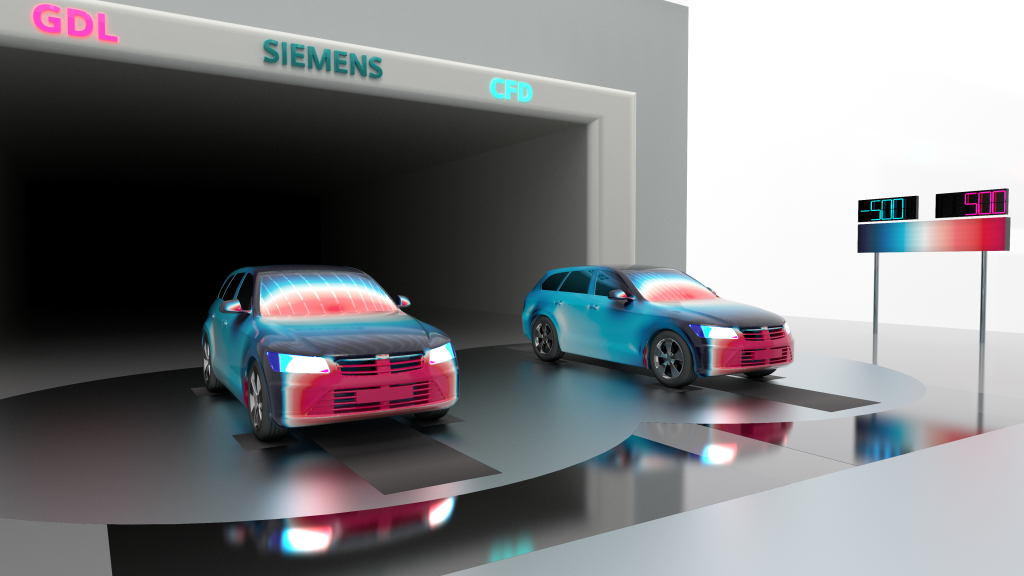
With Simcenter STAR‑CCM+ 2602, Geometric Deep Learning (GDL) capabilities are integrated directly into Simcenter STAR-CCM+ Design Manager, removing friction between simulation and prediction. Train predictive models that evaluate performance in minutes, using only a minimal set of simulations or leveraging existing CFD datasets. Working directly within the familiar Design Manager environment avoid external data transfers and keep iteration fluid and intuitive. Dual‑prediction by comparing side by side CFD results and AI inference give confidence to explore the design space. As GDL predictions replace hours‑long CFD loops, focus high‑fidelity simulations only on the most promising concepts. This approach compresses early design phases while preserving accuracy where it matters most. The result is rapid external aerodynamics predictions that enable decision‑grade design iteration at a glance.
Leverage existing simulation results
Engineers often sit on years of high‑value simulation results from previous projects, yet these datasets remain underused when it comes to accelerating new AI‑driven workflows like the abovementioned GDL. Re‑running simulations solely to generate training data slows adoption of predictive methods and duplicates past effort.
With Simcenter STAR‑CCM+ 2602, import existing simulation results directly into Design Manager to reuse them as training data for Geometric Deep Learning (GDL) models. Leverage proven datasets, whether from legacy projects or single standalone runs, without changing your established CFD practices. Using Design Manager’s automated workflows, generate consistent post‑processing across imported results, ensuring data quality and comparability. Compare multiple simulation files side by side in a unified environment, making trends and sensitivities easier to identify. This capability extends the value of historical CFD investments while accelerating surrogate‑model creation. As a result, build predictive GDL models faster, with less manual effort and fewer new simulations. Ultimately, exploit existing results to scale AI‑driven design exploration with confidence.
Go faster
Get faster results for multiphase applications
Volume Of Fluid (VOF) and Mixture Multiphase (MMP) cases, especially those involving free surfaces or phase change, previously had long run times, offering less opportunities for users to make design changes.
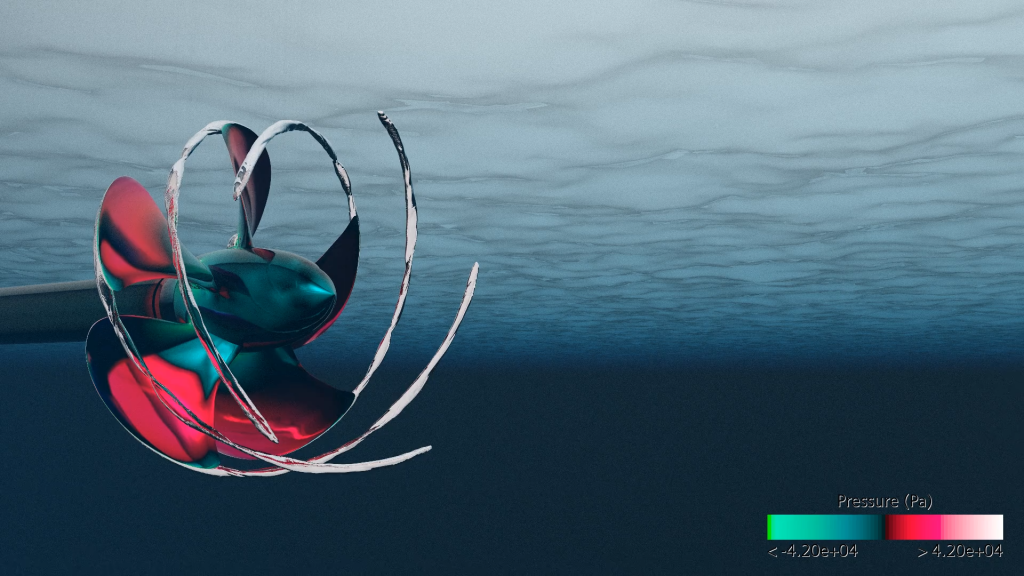
With Simcenter STAR-CCM+ 2602, multiphase simulations can now be executed on GPUs using GPU-native VOF and MMP solvers, representing a major step forward in multiphase simulation acceleration. This capability includes support for phase change and surface tension models, broadening the set of industrial scenarios which can be covered on GPU. It also integrates acceleration techniques such as implicit multi-step and supports multiple regime through MMP-LSI (Large Scale Interface).
Because the same solver is used for both CPU and GPU executions, the same results are guaranteed, provided that the solutions are well converged on each hardware type. In terms of performance, a single GPU matches the throughput of approximately 250 CPU cores for a tank‑sloshing case for example, while consuming only 19% of the energy required for the CPU run.
This GPU‑based acceleration delivers substantial benefits for multiphase applications in sectors such as automotive, marine, and process engineering, where free‑surface behavior and interphase interaction are critical. The improved throughput enables broader design‑space exploration, increased design confidence, and more effective risk management.
Up to 20% enhanced multi-GPU performance
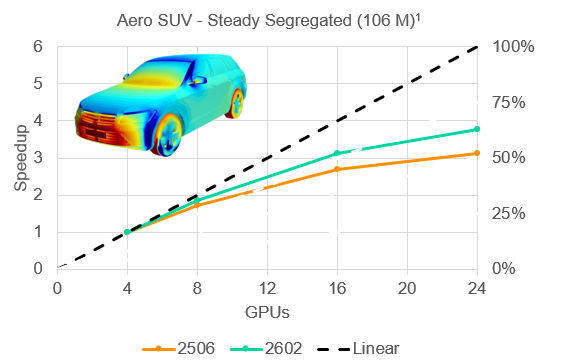
While GPU acceleration significantly speeds up CFD simulations, a common challenge arises when scaling to multiple GPUs: the computational overhead of data transfer and communication between devices can hinder efficiency. This often limits the practical benefit of adding more GPUs, as the speedup doesn’t always scale linearly. This bottleneck can prevent users from fully leveraging their multi-GPU hardware investments for larger, more complex simulations.
With Simcenter STAR-CCM+ 2602, leverage enhanced multi-GPU scalability. This improvement offers more proportional increase in simulation speed as additional GPUs are added, enabling greater parallelization. This delivers a noticeable increase in throughput for large and complex CFD models. Achieve faster turnaround times by effectively utilizing multiple GPUs on a single workstation or on multi-node servers. This enhanced scalability maximizes the value of multi-GPU hardware, allows extensive design exploration and accelerates the entire simulation workflow up to 20% at higher GPU counts.
Maximize flexibility to leverage GPU-enabled CFD acceleration
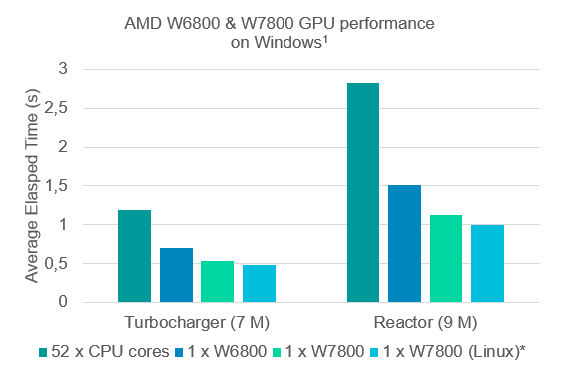
Many Windows workstations come with powerful AMD GPUs that, until now, couldn’t be used for CFD workloads in earlier Simcenter STAR-CCM+ versions. This limitation often forced engineers to move jobs to other machines or operating systems, complicating IT planning and slowing down local execution. This meant existing hardware investments were underutilized, creating a significant barrier to efficient workflow.
With Simcenter STAR‑CCM+ 2602, full AMD GPU acceleration on Windows removes this limitation. This pivotal development unlocks these devices for production simulations: run complex cases with competitive performance directly on preferred workstations. This advancement bridges the software gap and enables the full potential of AMD hardware. Broaden deployment choices and simplify IT planning across operating systems. Streamline license allocation and keep analysts productive in their preferred environment. Make more of installed hardware viable: maximize flexibility and budget efficiency by leveraging AMD GPU resources for accelerated CFD with Simcenter STAR-CCM+ 2602.
Make more out of your CPU and GPU resources
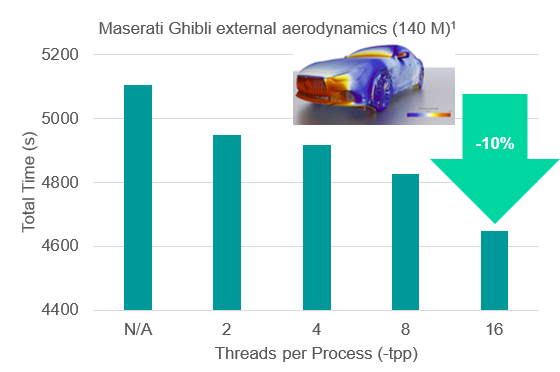
In high-performance computing, especially on GPU nodes, a key challenge arises because certain simulation tasks, like surface wrapping or post-processing, remain inherently CPU-bound. This often leads to underutilized CPU resources, as a fixed CPU-to-GPU ratio can leave significant CPU power idle during GPU-intensive phases. This inefficiency slows down overall simulation turnaround and wastes valuable computing capacity.
With Simcenter STAR-CCM+ 2602, dynamically engage available CPU cores for multi-threaded tasks, even while GPUs are heavily engaged, with adaptive utilization of CPUs on GPU nodes. This ensures that CPU-bound portions of a simulation no longer cause delays or leave valuable CPU resources idle, optimizing the entire workflow. Leverage a more holistic and efficient use of the entire computing node. Experience significant speed-ups and potential computational cost reductions for simulations involving complex pre-processing or specific physics like sliding mesh. Accelerate your path to innovation with this harmonious approach, ensuring that every component, both CPU and GPU, contributes optimally to the overall simulation effort.
Faster turnaround time for vehicle wading applications
Traditional vehicle wading analyses involve time‑consuming, complex workflows to set up water interaction, tire–road contact, and suspension response. Achieving local resolution where it matters adds further overhead.
With Simcenter STAR‑CCM+ 2602, tackle vehicle wading using the SPH solver, refine particles around the vehicle to increase local accuracy, and resolve dynamic motion including suspension and tire‑road contact. Analyze backplate mechanical stresses and predict wetting, bringing structural and hydrodynamic considerations together. This streamlined approach reduces overall turnaround while improving fidelity where forces and splashes peak. The simplified setup lowers the barrier to routine wading assessments across variants and trims. The payoff is faster turnaround time for vehicle wading applications.
These are just a few highlights in Simcenter STAR-CCM+ 2602. These features will enable you to design better products faster than ever, turning today’s engineering complexity into a competitive advantage.
Share your experience with Simcenter STAR-CCM+ to help peers make informed decisions.

What to read next:


Comments
Leave a Reply
You must be logged in to post a comment.
Hey, I was trying to gather extra funds for a weekend getaway in Canada and didn’t want to waste money blindly. I lost several small bets on slots elsewhere and almost stopped, but then I noticed dark wolf app https://darkwolfcasino.org/app/ and decided to try playing through the app for convenience. I went with Starburst first, had a rough start, then increased my stake carefully and finally hit a chain of solid wins. The flexibility of the app made it easy to manage my budget, and that win helped my trip fund. I’d recommend giving it a careful try if you play smart.