When lightweighting is not enough: an engineer’s search for a better structural design

Every engineer is familiar with lightweighting and knows the satisfaction of a good optimization result.
You define the design space. You apply the constraints. You ask the model to remove material where it is not needed, and when the part becomes lighter while still meeting the structural requirements, it feels like progress.
For automotive structures, that way of thinking has served engineers well. A lighter component can support efficiency targets, reduce material usage and help teams move toward more refined designs. For a long time, that made mass reduction the natural objective.
But I started to wonder whether that objective was still enough.
The challenge came from a simple observation.
A structure is not made from absract “mass”, but from real materials, and those materials come with different costs and different carbon dioxide emissions depending on how they are produced and sourced. If the optimizer only focuses on mass, it may find the lightest design, but is that still the better design when cost and CO2 emissions are part of the decision?
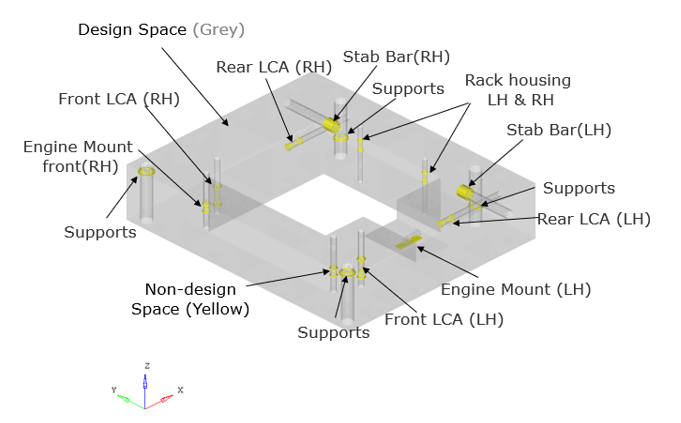
That question led to a study on an automotive engine cradle using steel and aluminum. The goal was not only to optimize the shape, but to better understand how material choice, material sourcing, cost constraints and CO2 pricing could influence the result.
At first, the problem seemed straightforward. One objective was to minimize structural mass while keeping the design within a cost constraint. Another was to minimize total CO2 emissions while still meeting structural and cost constraints. The study then compared recycled and unrecycled material sourcing for steel and aluminum, along with different CO2 pricing levels.
What made the study interesting was not that the results were dramatic. It was that they were not quite what a traditional lightweighting mindset might expect.
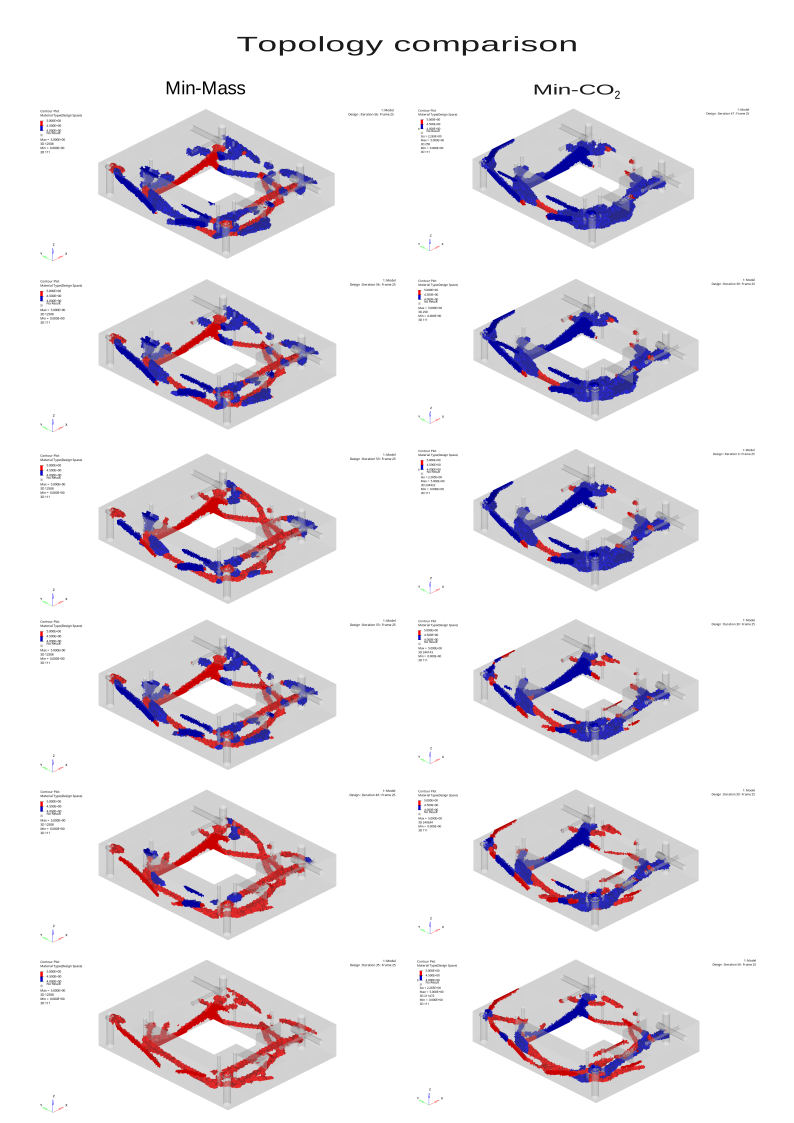
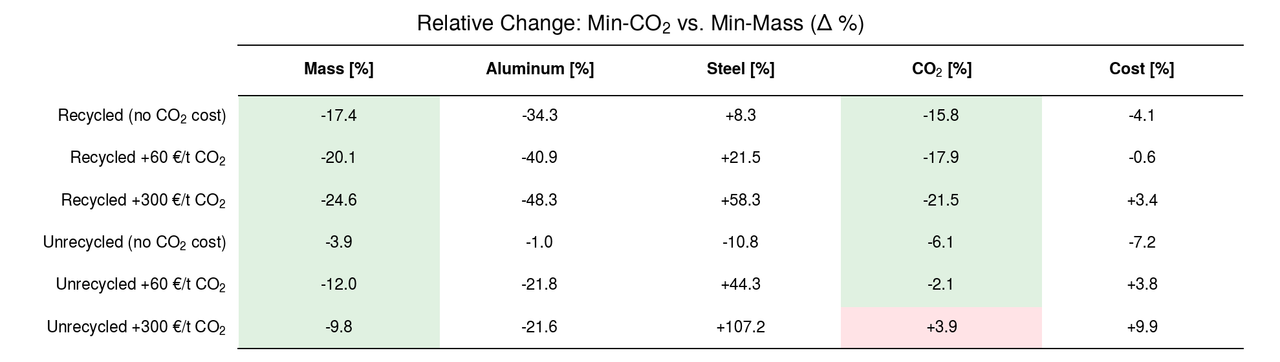
When minimizing mass, adding CO2 pricing shifted the optimized designs toward steel instead of aluminum. That was worth pausing over. Steel is obviously heavier, yet once cost and CO2 pricing were included, the optimizer moved in that direction. In those scenarios, mass increased by up to 12 percent.
That does not mean lightweighting suddenly became unimportant. It means lightweighting was only part of the answer.
The recycled-material scenarios added another layer.
When the objective was to minimize CO2 emissions, recycled-material designs were lighter and lower in emissions than unrecycled-material designs. That was an encouraging result because it showed that reducing emissions does not automatically have to mean accepting a heavier structure. Under the right material sourcing conditions, the design could move in a better direction for both mass and CO2 emissions.
The unrecycled-material scenarios were more constrained. When minimizing CO2 emissions with unrecycled materials, the optimization favored steel, reducing emissions by 2 to 6 percent and mass by 4 to 12 percent. But at the highest unrecycled CO2 pricing level, both objectives became infeasible. That result was a useful reminder that optimization does not only find better answers, it also reveals when the problem, as defined, may not have a feasible answer.
The shape of the part matters.
The mass matters, but the assumptions behind the optimization matter just as much. Material sourcing, CO2 pricing and cost constraints can change the design direction before an engineer ever reviews the final geometry and this creates a more challenging engineering question.
Instead of asking only, “How light can this structure be?” the better question becomes, “What design best balances structural performance, mass, cost and CO2 emissions under realistic material assumptions?”
That question is harder to answer because it requires more than a simple mass-minimization setup. The optimization needs to handle multiple materials, structural constraints, cost constraints and CO2-related parameters together. It needs to show not only the final design, but also how different assumptions change what is feasible.
That is why this study used Simcenter™ OptiStruct® software to provide us with a way to investigate multi-material topology optimization while accounting for mass, cost and CO2 emissions in the same workflow. For an automotive structure such as an engine cradle, that makes it possible to explore trade-offs earlier, before the design direction is locked in.
The lesson is clear: lightweighting remains important, but it is no longer enough on its own. When cost and CO2 emissions are included in the optimization problem, engineers can uncover design directions that may not be visible from mass reduction alone.
If you want to see the full methodology, scenarios and results behind the study, read the white paper.