E-Motor Vibration Synthesis for efficient high-fidelity eNoise evaluation – What’s new in Simcenter 3D Acoustics 2512
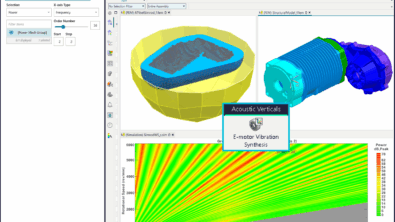
Simcenter 3D Acoustics 2512 and Simcenter E-Machine Design team up to introduce a new e-motor NVH analysis tool.
Electrification is booming, and with it, customer demands for ever quieter and more comfortable products are increasing! This creates a significant challenge: how do we design electric motors that are both high-performing and incredibly quiet?
That’s why addressing Noise, Vibration, and Harshness (NVH) right at the source has become non-negotiable for electric motor design, including their sophisticated power electronics and control systems. It’s now a critical KPI for electric motor design, especially in automotive and industrial applications. We need faster, more accurate NVH predictions to avoid costly fixes, reduce prototype testing, and get our innovations to market quicker (and quieter).
Simcenter 3D Acoustics 2512 and Simcenter E-Machine Design 2512 introduce a new e-motor NVH analysis tool: E-Motor Vibration Synthesis (EMVS). This dedicated “current to noise” process combines a customized workflow and efficient EMAG and NVH Reduced Order Models (ROMs) to deliver rapid and e-motor specific NVH insights. It’s perfect for both NVH novices and specialists alike!
Simcenter 3D Acoustics advanced capabilities for e-motor NVH prediction
Over the past decades, Siemens has developed advanced and highly efficient workflows for in-depth NVH analysis of electric powertrains. The workflow shown below considers each step in the noise and vibration generation process. From currents that induce electro-magnetic fields over their application and onto the surfaces of the different motor components, to the highly efficient resolution of multi-rpm coupled vibro-acoustic Finite Element (FE) models.
The workflow includes force-mapping strategies specifically tailored to e-motor loads, state-of-the-art FE solvers optimized for powertrain NVH prediction performance, and provides control over each step in the simulation process, as well as in-depth NVH-specific post-processing. As such, Siemens enables NVH specialists to gain a full understanding of how the noise and vibrations are generated and to use this knowledge to implement efficient and effective mitigation measures.

While this process offers all the insight an NVH specialist needs during the later stages of detailed e-motor development, it comes at a cost both in terms of required NVH simulation expertise and throughput time. Moreover, since the operating conditions of the electric machine are the starting point of the entire workflow, performing iterations during early design stages where the desired motor operating points constantly change becomes very time-consuming.
In their 2512 release, Simcenter 3D Acoustics and Simcenter E-Machine Design bring a new complementary “current-to-noise” EMVS workflow for fast e-motor NVH assessment in both early and later stages of the development. By combining the computational efficiency and accuracy of EMAG and NVH ROMs, key e-motor NVH characteristics can be predicted in a matter of minutes with the same accuracy as the detailed process above. Moreover, by offering guided workflows for creating these high-fidelity ROMs, the full strength and depth of Siemens’ e-motor NVH solutions is now unlocked for non-NVH simulation experts. The different steps in this new workflow are shown below.
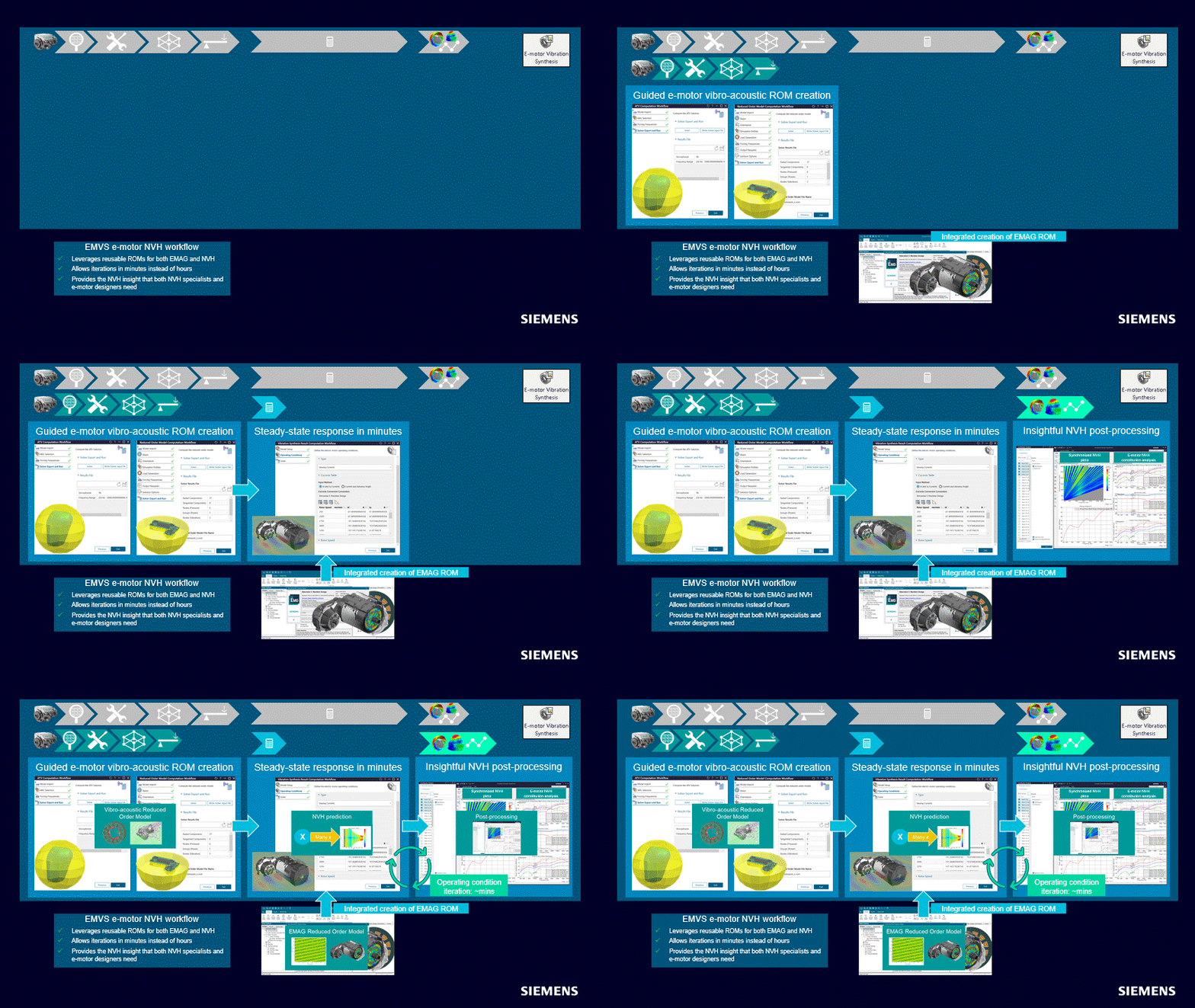
EMVS workflow step 1: EMAG ROM creation
To enable early and efficient NVH assessments with the EMVS process, engineers can now generate a single electromagnetic ROM for a specific design and reduce the overall amount of data transfer and data generation time. This process is shown below and more information can be found here
EMVS workflow step 2: Vibro-acoustic ROM creation
A next step in this novel e-motor NVH process uses the new Simcenter 3D Acoustics EMVS application which enables you to easily set up the structural dynamic and vibro-acoustic ROMs that unlock the enhanced computational efficiency of the EMVS workflow.
The easy-to-use step-by-step guided workflow helps the user to create these models in a robust way and leverages all of Siemens’ decades-long best practices and technologies for powertrain NVH prediction. The overall workflow is illustrated below.
EMVS workflow step 3: Fast solution and in-depth post-processing
Once the structural-dynamic or vibro-acoustic ROMs are available, they can be combined with the EMAG ROMs generated in step 1, to predict the acoustic pressure, acoustic noise or structural vibrations generated by the operational loads of the electric motor.
In Simcenter 3D 2512, the user can now obtain these responses in a highly efficient way, in a matter of minutes instead of hours. All while using the same complex physics and level of fidelity as a full NVH model of the assembled powertrain. Moreover, both ROMs are independent of the actual operating conditions, so the analysis of another load condition only requires the repetition of this final step.
The ability to not just calculate approximate vibro-acoustic performance indicators like Equivalent Radiated Power (ERP) or powertrain surface velocities, but also detailed acoustic pressure and power fields in any microphone point or mesh is a truly unique capability for this type of analyses.
To gain thorough insight into how the topology of the electric motor contributes to its NVH performance, the Simcenter 3D 2512 E-Motor Vibration Synthesis Acoustics Vertical introduces dedicated e-motor NVH post-processing features such as:
- Structural-dynamic and vibro-acoustic ROM sensitivity visualization to show how strongly different spatial harmonic airgap excitations are amplified by the e-motor structure to generate noise and vibration responses.
- Synchronized waterfall and mechanical order-cut plots enable you to analyze the overall noise signature at different operating speeds and quantify the powertrain noise performance.
- Once the dominant mechanical orders have been identified, the advanced contribution analysis tools enable you to break down individual order cut responses into contributions from the different airgap force spatial harmonic components and give insight into whether the actual NVH response is caused by high excitation levels, a high sensitivity of the e-motor structure to this component or a combination of both.
This functionality provides critical insight into the most effective NVH mitigation strategies (changes in the e-motor design, changes in the mechanical design of the structure or a combination of both).
These capabilities are shown in the movie below
Conclusions
For both NVH novices and vibro-acoustic experts alike who want to efficiently and accurately analyze the NVH behavior of their electric motor designs, the new “E-Motor Vibration Synthesis” capability offers an easy to use end-to-end “current to noise” workflow integrated inside the Simcenter 3D Acoustics Verticals and Simcenter E-Machine Design products.
Engineers often face the challenge of performing NVH analysis quickly and accurately, especially when dealing with complex E-motor multi-attribute balancing.
The EMVS workflow greatly improves NVH process efficiency, offering an easy-to-use step by step workflow for creating e-motor reduced order models and delivering NVH results up to 100 times faster with full FEM accuracy and realistic loads. This enhancement enables quick iterations on different e-motor operating conditions and gives specific e-motor related insights into the NVH response through dedicated post-processing features.